Vehicle telematics collects real-time location, diagnostics, and driver behavior data to improve fleet management. It enhances operational decision-making by providing detailed insights into vehicle health, driving patterns, and utilization. Proper filtering and device selection are critical to maximizing data accuracy and achieving operational benefits.
Vehicle telematics is defined as the integrated system that collects, transmits, and analyzes real-time data from vehicles by combining GPS tracking, onboard diagnostics, and wireless communication. GPS provides location, but telematics goes further by interpreting that location alongside vehicle diagnostics and driver behavior data. Platforms like Verizon Connect and Motorq have built entire product lines on this distinction. With global IoT connections projected to reach 31 billion units by 2030, telematics is no longer optional for competitive fleet operations. It is the data infrastructure that separates reactive fleet management from proactive control.
What is vehicle telematics and what data does it collect?
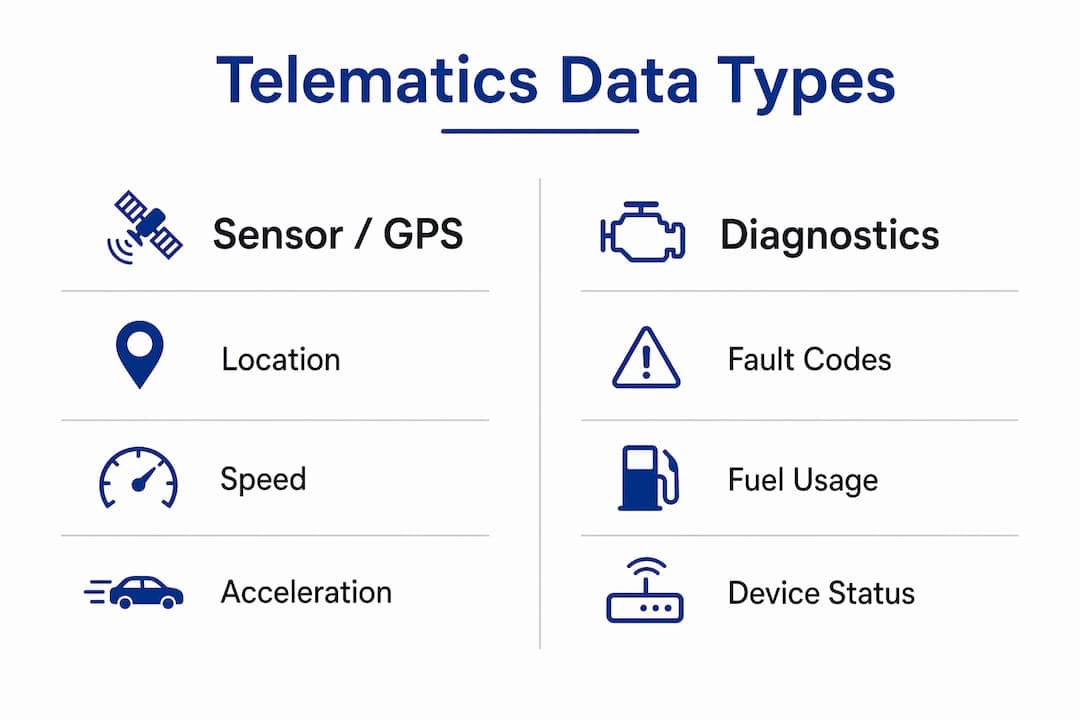
Vehicle telematics collects data across three distinct categories, and knowing the difference between them determines how much value you actually extract. Telematics data falls into sensor/GPS data, device status updates, and in-vehicle diagnostics. Each category has a different collection frequency, complexity level, and operational value.
Sensor and GPS data captures location, speed, heading, and acceleration in near real time. This is the most accessible data type and forms the foundation of vehicle tracking and telematics systems.
Device status data covers connectivity health and heartbeat signals from the telematics unit itself. These updates typically transmit every two hours and confirm the device is functioning correctly.
In-vehicle diagnostics pulls from the OBD-II port or the CAN bus. OBD-II provides standardized fault codes and fuel usage data. CAN bus data goes deeper into manufacturer-specific systems but requires per-vehicle configuration.
Data Category
Source
Update Frequency
Example Data Points
Sensor / GPS
GPS receiver
Continuous
Location, speed, acceleration
Device status
Telematics unit
Every ~2 hours
Connectivity, heartbeat signals
OBD-II diagnostics
OBD-II port
Event-triggered
Fault codes, fuel consumption
CAN bus diagnostics
Vehicle network
Event-triggered
Manufacturer-specific parameters
The gap between OBD-II and CAN bus data is where most fleet managers underestimate complexity. CAN bus data is advanced and requires per-vehicle configuration. Many fleet managers attempt to read manufacturer-specific parameters through a standard OBD-II connection and get nothing useful in return. Understanding this distinction before you select a telematics device saves significant time and budget.
Pro Tip:Match your data category goals to your device selection before purchasing. If you only need location and basic diagnostics, a standard OBD-II device works well. If you need deep engine data, confirm CAN bus compatibility for each vehicle make and model in your fleet.
How does vehicle telematics work in practice?
The telematics process follows a clear sequence from vehicle to dashboard, and each step introduces potential data quality issues worth understanding.
Data capture. A Telematics Control Unit (TCU) installed in the vehicle collects signals from the GPS receiver, the OBD-II port, and onboard sensors. The TCU acts as the central nervous system of the vehicle's data output.
Data transmission. The TCU sends data packets over a cellular network using lightweight protocols like MQTT. MQTT is designed for low-bandwidth environments, which makes it well-suited to moving vehicles with variable signal strength.
Cloud reception. A cloud platform receives the raw data stream. At this stage, the data is unfiltered and includes noise from GPS signal jumps, brief stops, and connectivity gaps.
Filtering and validation.Filtering telematics data is critical to avoid errors from GPS signal jumps or false idle detection. Without filtering, a vehicle parked in a parking garage can generate dozens of false movement events.
Interpretation and reporting. The validated data feeds into dashboards, alerts, and scoring engines. Fleet managers see trips, events, and vehicle health summaries rather than raw data packets.
The filtering step is where many telematics deployments fail quietly. A system that skips proper validation will report inflated mileage, phantom trips, and incorrect idle times. Those errors compound into bad maintenance schedules and inaccurate driver scores.
Pro Tip:When evaluating a telematics platform, ask specifically how it handles GPS signal anomalies and idle detection thresholds. A vendor that cannot explain their filtering logic is likely passing raw data directly to your dashboard.
What are the operational benefits of vehicle telematics for fleet management?
Telematics delivers measurable operational improvements across four core areas: driver behavior, fuel costs, maintenance, and fleet utilization. Each benefit connects directly to cost reduction or risk reduction.
Driver behavior monitoring
Driver behavior scoring can be configured to weight events differently, aligning with fleet priorities. Harsh braking, rapid acceleration, and excessive idling each receive separate weights in a scoring model. A delivery fleet focused on fuel economy will weight idling heavily. A passenger transport fleet will weight harsh braking more. This customization means telematics scoring is not a one-size-fits-all metric. You define what safe and efficient driving looks like for your specific operation.
Fuel cost reduction
Federal fleet guidance emphasizes telematics to log aggressive driving and idling as direct levers for reducing fuel costs and engine wear. Idle time is a particularly high-value target. A vehicle idling for one hour burns fuel with zero productive output. Telematics makes idle time visible, attributable to a specific driver and vehicle, and trackable over time. Fleet managers who act on idle data consistently reduce fuel spend without changing routes or vehicles.
Maintenance optimization
OBD-II fault codes give maintenance teams advance warning before a breakdown occurs. A check-engine code logged on monday morning means a scheduled repair on tuesday rather than a roadside breakdown on wednesday. Predictive maintenance reduces both repair costs and vehicle downtime. For rental fleets, unplanned downtime directly reduces revenue-generating availability.
Fleet utilization and routing
Real-time telematics data gives dispatchers an accurate picture of where every vehicle is and how it is being used. Underutilized vehicles become visible. Routing inefficiencies show up in trip data. Fleet managers can right-size their fleets based on actual utilization patterns rather than assumptions.
OEM telematics vs. aftermarket devices: what fleet managers need to know
The hardware you choose determines the quality and depth of data your telematics system produces. The market has shifted significantly toward OEM-integrated telematics, and that shift has real implications for fleet managers managing mixed-brand fleets.
OEM-integrated telematics reduce total cost of ownership and improve data accuracy compared to aftermarket devices. OEM solutions are factory-installed, which eliminates installation labor, reduces hardware failure risk, and provides access to deeper vehicle data streams. Aftermarket devices plug into the OBD-II port and work across brands, but they are limited to standardized data outputs.
Hardware Type
Installation
Data Depth
Cost
Best For
Aftermarket OBD-II device
Plug-in, any vehicle
Standard OBD-II data
Low upfront
Mixed-brand fleets, quick deployment
Hardwired aftermarket device
Professional install
GPS + OBD-II + some CAN
Medium
Fleets needing tamper resistance
OEM-integrated telematics
Factory-installed
Full OEM data access
Higher TCO upfront, lower ongoing
New vehicle purchases, single-brand fleets
The challenge for most fleet managers is that real-world fleets contain multiple vehicle brands and model years. A Ford Transit, a Ram ProMaster, and a Mercedes Sprinter each have different OEM telematics architectures. Platforms like Motorq address this by normalizing data across manufacturers, but multi-brand data normalization requires platforms that convert raw data into prioritized alerts rather than dumping raw feeds into a dashboard.
For rental fleet operators specifically, the types of vehicle tracking systems available range from basic GPS loggers to fully integrated OEM telematics. Matching the hardware tier to your operational needs prevents both overspending and data gaps. If your priority is location tracking and basic trip logging, an aftermarket OBD-II device is sufficient. If you need engine health monitoring and driver scoring at scale, OEM integration or a normalized data platform is the right investment.
Key Takeaways
Vehicle telematics combines GPS, OBD-II diagnostics, and wireless data transmission to give fleet managers real-time visibility into vehicle performance, driver behavior, and maintenance needs.
Point
Details
Telematics goes beyond GPS
It adds diagnostics, driver scoring, and communication to location data.
Three data categories matter
GPS/sensor, device status, and OBD-II/CAN bus each serve different operational purposes.
Filtering determines data quality
Without proper validation, GPS jumps and false idles corrupt trip and performance reports.
OEM telematics reduces total cost
Factory-installed systems improve accuracy and eliminate aftermarket installation overhead.
Driver scoring is configurable
Weight harsh braking, acceleration, and idling differently to match your fleet's priorities.
The 42-Point Car Rental Operations Checklist
The exact checks profitable rental operators run every week — free, straight to your inbox.
Fleet readiness & handover
Bookings & no-show prevention
Pricing & revenue reviews
Contracts & compliance
Payments & invoicing
Maintenance & fleet health
One email with the checklist. No spam, unsubscribe anytime.
The data you collect is only as good as what you do with it
Fleet managers often ask me which telematics platform is best. My honest answer is that the platform matters less than how you define what you want to measure before you deploy anything.
The most common mistake I see is collecting everything and acting on nothing. A fleet running 50 vehicles can generate thousands of data events per day. Without a clear framework for what constitutes an alert worth acting on, that data becomes noise. The fleets that get the most from telematics start with two or three specific operational problems, configure their scoring and alerts around those problems, and expand from there.
The shift toward OEM telematics is real and worth paying attention to. But I would caution against assuming OEM data is automatically better for your use case. OEM systems give you depth on a single brand. If your fleet spans multiple manufacturers, you will still need a normalization layer to make that data comparable across vehicles. Motorq and similar platforms exist precisely for this reason.
The other thing worth saying directly: driver behavior monitoring is the highest-return telematics application for most rental and logistics fleets. Fuel savings from reduced idling and smoother driving compound quickly. The technology is mature, the data is reliable, and the ROI is measurable within a single quarter. Start there before you invest in complex CAN bus integrations.
— Dizzy
How Nomora connects telematics data to fleet operations
Telematics generates the data. What you do with it operationally determines the return on that investment.
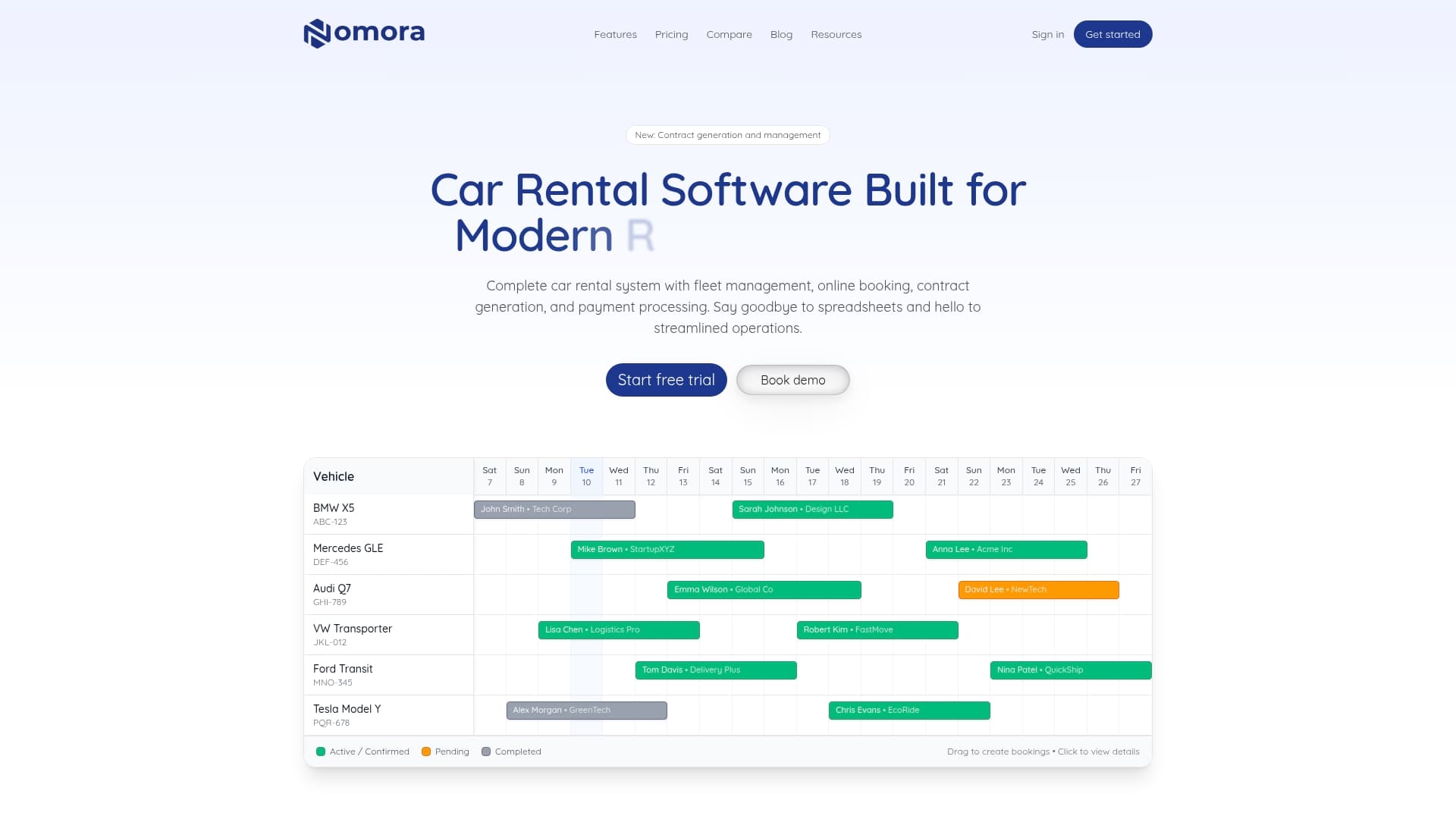
Nomora is a cloud-based fleet management platform built for rental businesses and corporate fleet operators. It integrates GPS tracking data directly into reservation management, contract generation, and fleet availability reporting. Fleet managers get a single view of vehicle location, utilization, and booking status without switching between systems. Nomora's rental fleet use cases cover independent operators, franchise networks, and corporate fleets, with onboarding completed in 24–48 hours. For teams also managing payment workflows, Nomora's automated payment tools connect financial data to fleet activity in one platform.
FAQ
What is the vehicle telematics definition in simple terms?
Vehicle telematics is the system that collects GPS location, vehicle diagnostics, and driver behavior data from a vehicle and transmits it to a cloud platform for analysis. It combines communication technology with onboard sensors to give fleet managers real-time operational visibility.
How does vehicle telematics differ from basic GPS tracking?
GPS tracking records location only. Vehicle telematics adds OBD-II diagnostics, driver behavior scoring, and two-way data communication, making it a full operational intelligence system rather than a simple location logger.
What types of vehicle telematics data are most useful for fleet managers?
The three most operationally useful data types are GPS/sensor data for location and speed, OBD-II diagnostics for fault codes and fuel usage, and driver behavior events like harsh braking and idling. Each type supports a different management decision.
Are OEM telematics systems better than aftermarket devices?
OEM-integrated telematics provide deeper data access and lower ongoing maintenance costs, but they work best in single-brand fleets. Aftermarket OBD-II devices offer broader compatibility across mixed-brand fleets at a lower upfront cost.
How do telematics solutions help reduce fleet operating costs?
Telematics reduces costs by identifying idle time, flagging aggressive driving that increases fuel consumption and wear, and providing early fault code warnings that prevent costly breakdowns. Federal fleet guidance specifically cites telematics as a proven tool for reducing fuel spend and engine wear.