What Is the Vehicle Allocation Process, Step by Step?
Running a dependable vehicle allocation process comes down to a repeatable sequence, not a one-time setup. Most operators who get this right follow a version of this checklist daily, then run a deeper pass weekly.
- Capture unit-level data. Every vehicle needs a VIN or unit ID linked to class, mileage, location, and any active reservation.
- Refresh the demand forecast. Pull updated bookings, lead-time trends, and local events before assigning anything new.
- Pre-position vehicles. Move stock toward high-demand pools before the rush, not during it.
- Apply assignment window rules. Decide how far in advance a reservation locks to a specific unit versus staying flexible.
- Run the scheduled batch optimization. Let the system re-solve the network assignment on a fixed cadence.
- Coordinate maintenance and cleaning queues. A vehicle isn't available just because it's not booked.
- Flag and resolve exceptions. Breakdowns, no-shows, and last-minute cancellations need a fast reroute path.
Pro Tip: Prioritize specialty or low-count rental groups (exotic cars, cargo vans, ADA-equipped vehicles) in your allocation rules first. A single misallocated unit in a pool of three costs far more, proportionally, than one in a pool of forty.
Set escalation triggers before you need them: a days-of-supply drop below your comfort threshold in any class, or a utilization dip that persists more than a day, should page someone automatically.
Which Demand Signals Should Drive Vehicle Allocation Decisions?
Allocation only gets smarter when the inputs feeding it get sharper. The data that actually moves the needle falls into a short list, but each item needs to be segmented correctly or it produces noise instead of signal.
- Historical bookings by class and location, not blended fleet-wide averages.
- Lead-time distribution, since a 60-day advance booking behaves nothing like a walk-up rental.
- Event and seasonality calendars, covering conventions, holidays, and local demand spikes.
- Maintenance forecasts, so a vehicle scheduled for service tomorrow doesn't get promised to a customer today.
Segmentation matters most at the intersection of rental class and pool location, because that's exactly where repositioning costs get created or avoided. A luxury SUV forecast lumped in with the economy fleet average will consistently mislead your allocation logic.
Watch four metrics as your core dashboard: fleet utilization (time-based and unit-based), RevPAC, days-of-supply by class, and forecast accuracy. On that last point, the gap between a mediocre model and a strong one is larger than most operators assume. The RentOptima framework, which combines LSTM forecasting with optimization, achieved an R² of 0.93 on branch-level demand and materially improved alignment between forecast and actual fleet distribution. That kind of accuracy translates directly into fewer emergency repositions later in the week.

Online vs. Batch Allocation: Which Mode Fits Your Situation?
Every mature vehicle distribution system runs two allocation modes side by side, and confusing them is one of the most common operational mistakes. Online (real-time) assignment happens at the point of sale, when a counter agent or booking engine needs a fast yes-or-no answer. It relies on quick heuristics: greedy rules, priority tiers, or simple availability checks. Batch optimization runs on a schedule, often overnight or several times a week, and re-solves the assignment problem across the whole network to squeeze out inefficiencies that real-time logic can't see.
The distinction between these two modes isn't academic. Industry practice consistently treats them as complementary decision layers that must be reconciled, not competing systems.
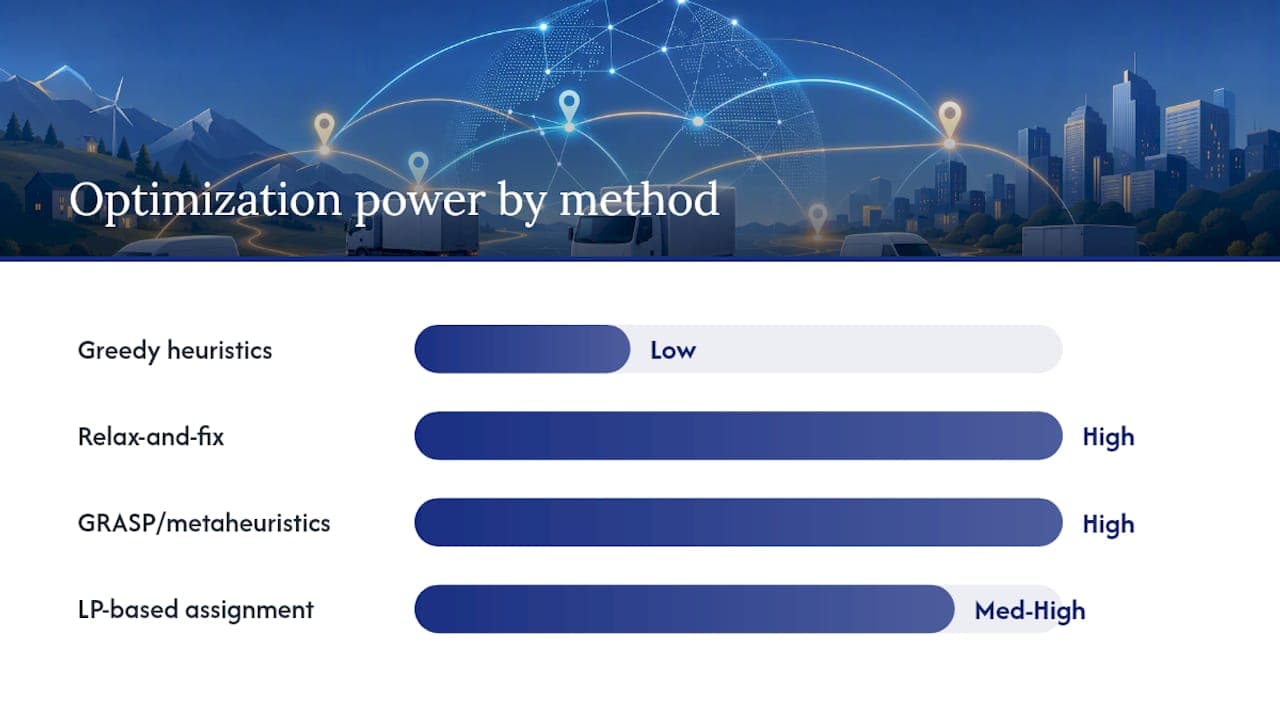
| Approach | Best for | Speed | Optimization power |
|---|
| Greedy/priority heuristics | Counter-level online decisions | Seconds | Low |
| Relax-and-fix | Batch reoptimization of reservation assignments | Minutes to hours | High |
| GRASP/metaheuristics | Network-wide fleet scheduling, special-vehicle pools | Hours | High |
| LP-based assignment | Mid-size fleets with clear cost structures | Minutes | Medium to high |
Batch runs work best when scheduled ahead of known demand shifts, weekly at minimum, daily for high-turnover fleets. Force a manual override only when an exception (a breakdown, a VIP account, a compliance hold) falls outside what any algorithm should decide alone. Joint pricing-and-capacity models add another layer of upside: research on integrated matheuristics shows that solving capacity and pricing together, rather than sequentially, produces measurably higher profit on real-sized fleets.
How Do You Reduce Empty Vehicle Repositions?
Deadheading, moving a vehicle with no paying customer aboard, is the quiet cost center in almost every rental operation. It rarely shows up as a single alarming number; it shows up as fuel, labor, and wear spread across dozens of small transfers nobody flagged as a problem.
- Segment pools tightly so vehicles rebalance within a lane instead of crossing the whole network.
- Pre-position by lane ahead of forecasted demand rather than reacting after a shortage appears.
- Use targeted upgrades or downgrades to absorb a shortfall without triggering a physical transfer.
- Batch transfers into convoys when multiple units need to move the same direction.
- Incentivize one-way returns at locations already running short.
The scale of the opportunity here is well documented. The same relax-and-fix study cited earlier found its heuristic cut empty repositions enough to deliver an average 33% improvement over baseline scheduling, concentrated in special-vehicle fleets where pool sizes were small and each misallocation was expensive. That context matters. Gains of that size are most realistic when you're managing constrained pools, not a thousand-unit economy fleet where averaging effects already smooth out much of the waste.
Run the math on your own numbers: avoiding just one unnecessary transfer per week, per vehicle, across a 50-unit pool adds up to 2,600 avoided trips a year. Multiply that by fuel, driver time, and wear, and the case for tighter allocation logic writes itself.
What Systems and Integrations Support Automated Allocation?
A dependable transportation resource allocation setup depends on the data foundation underneath it as much as the algorithm on top. Before evaluating any software, confirm the system can support these basics.
- Canonical vehicle master: one VIN or unit ID per asset, with class, mileage, and feature attributes attached.
- Live status and tracking: telematics feeding real fleet position and condition, not last week's spreadsheet.
- Reservation linkage: every booking tied to a specific unit or, at minimum, a specific pool and class.
- Conflict-free booking logic: a system that physically prevents double-booking the same VIN.
- Pricing engine integration: so allocation and rate decisions inform each other instead of running in silos.
On the integration side, GPS and telematics feeds, payment gateways, and cleaning or maintenance queue systems all need to talk to the same operations cockpit, ideally a single dashboard rather than five disconnected tabs.
This is where a platform like Nomora fits the checklist directly. Nomora combines real-time fleet visibility with the conflict-free booking logic that prevents double-assignment, and its onboarding process typically runs 24 to 48 hours, short enough that a pilot pool can go live in the same week you decide to test it. That mirrors the industry precedent set by Europcar's Opticar system, which pairs forecasting, simulation, and optimization to plan fleet capacity up to six months out.
Pro Tip: Don't try to automate the whole fleet on day one. Start with one or two pools and a single rental group, then let the daily batch run prove itself before you scale.
Which KPIs Show Whether Your Allocation Process Is Working?
A short, well-chosen KPI set tells you more than a dashboard crowded with metrics nobody checks. Track fleet utilization by both time and unit count, RevPAC and RevPACD for revenue efficiency, and days-of-supply by class and pool to catch shortages before they become lost sales.
- Fleet utilization (time-based and unit-based) to catch idle inventory.
- DOS by class and pool to spot an impending shortage days before it hits.
- Empty repositions per period as your direct cost signal.
- Forecast accuracy (RMSE/R²) to know whether your inputs are trustworthy.
- Upgrade rate and lost-sales rate as customer-impact indicators.
Set alert thresholds tied to action, not just observation: if economy-class DOS drops below two days at any pool, trigger a price adjustment and a pre-positioning transfer automatically rather than waiting for a manager to notice. A weekly review rhythm, ten minutes, same time, same dashboard, catches drift before it compounds into a quarter of lost utilization.
How Should You Roll Out a New Allocation Process?
Rolling out a new vehicle assignment process works best as a staged pilot rather than a fleet-wide flip.
- Days 0 to 14: discovery and baseline. Document current utilization, DOS, and reposition frequency before changing anything.
- Days 15 to 45: pilot one or two pools. Get the canonical data model, telematics feed, and first automated batch run working end-to-end.
- Days 46 to 90: scale and stabilize. Expand to additional pools once the pilot's KPIs beat baseline.
- Months 3 to 6: optimization loop. Refine forecast models and batch cadence based on real results.
Milestones worth tracking along the way include a completed telematics integration, an established KPI baseline, and finished SOP training for staff. Build exception handling into the plan from day one, breakdowns and cancellations will happen during rollout, and coordination with maintenance and cleaning teams determines whether those exceptions stay minor or cascade.
What Legal and Compliance Rules Affect Vehicle Allocation?
Allocation decisions carry compliance weight that pure logistics thinking tends to overlook. Assigning the wrong vehicle to the wrong booking isn't just an operational miss; it can create a licensing or regulatory problem depending on the vehicle class and the renter's credentials.
Commercial vehicles above certain weight thresholds may require renters to hold specific license endorsements, and your allocation rules need to check that before confirming an assignment, not after the keys change hands. Specialty categories, box trucks, passenger vans over a certain seating capacity, and vehicles equipped for accessibility, often carry their own state-level rules governing who can rent them and under what insurance terms.
Driver-facing regulations matter too. Corporate fleet managers assigning vehicles to employees need allocation logic that respects hours-of-service limits where applicable, and rental operators need age and license-history checks baked into the assignment window, not treated as a separate manual step that someone might skip during a busy weekend.
Data handling adds another layer. Because allocation systems store renter information alongside vehicle assignment history, that data falls under general consumer privacy expectations, and platforms handling it should carry clear security and compliance practices. None of this makes allocation a legal minefield, but it does mean your assignment rules should include a compliance check as a hard gate, not an afterthought bolted on after the vehicle's already been handed over.
How Do You Keep Allocation Data Accurate Over Time?
An allocation process is only as good as the data feeding it, and data quality tends to decay quietly unless someone owns it. The most common failure isn't a bad algorithm; it's a VIN that never got updated after a vehicle moved pools, or a maintenance flag that stayed active a week after the repair finished.
Build a feedback loop around three checkpoints. First, reconcile the vehicle master against physical fleet counts on a fixed schedule, weekly for smaller fleets, more often for larger ones. Second, compare each batch optimization's assigned outcome against what actually happened, did the vehicle show up where the algorithm expected? Discrepancies here usually point to a data gap, not a model flaw. Third, feed real outcomes back into your forecasting inputs so the model that mispredicted demand for a location gets corrected rather than repeating the same error next month.
Assign clear ownership for each data field. Fleet coordinators typically own vehicle status and location; revenue managers own forecast inputs; operations owns exception logs. Without an owner, stale data lingers because no one notices it's their job to fix.
Treat every allocation error as a diagnostic signal rather than a one-off mistake to smooth over. A pattern of misallocations concentrated in one pool or one vehicle class usually reveals a forecasting blind spot or a data field nobody's been maintaining, and fixing that root cause prevents the same error from recurring across dozens of future bookings.
What Challenges Come With Scaling Allocation Across Regions?
Extending a working allocation process from one region to several introduces problems that don't show up in a single-market pilot. Regional demand patterns diverge: a class that's slow-moving in one metro area might be your highest-margin unit somewhere else, and applying one forecasting model across all regions flattens signals that matter.
Fleet mix compounds the challenge. A company expanding from standard sedans into specialty categories, cargo vans, luxury vehicles, EVs with charging logistics, needs allocation rules that account for fundamentally different constraints per class. An EV's range and charging schedule affects assignment windows in a way a gas sedan's fuel level never does.
Organizational structure matters as much as the software. Multi-region operators need to decide whether allocation decisions stay centralized or get delegated to regional managers with local override authority. The fleet-planning literature on hierarchical decision structures backs a middle path: strategic fleet sizing and pool segmentation work best set centrally, while tactical day-to-day assignment benefits from regional flexibility within those guardrails.
Practical scaling advice: expand one region at a time, reuse the pilot's data model and KPI baseline rather than rebuilding it, and resist the urge to customize allocation rules per region before you've confirmed the core logic works consistently. A platform that scales its integrations, telematics, payment processing, cleaning queues, without requiring a rebuild per market makes multi-region rollout considerably less painful.
An Editorial Take on Building a Real Allocation System
The conventional advice on vehicle allocation treats it like a scheduling puzzle: match car to customer, done. That framing misses what the academic research actually demonstrates, which is that allocation is a profit lever, not just a logistics chore. The relax-and-fix results showing 33% improvement, and the matheuristic work showing joint pricing-capacity decisions beat sequential ones, both point to the same conclusion: operators leave money on the table by treating forecasting, pricing, and assignment as separate departments instead of one integrated decision.
Where most guides overstate things is implying every fleet needs GRASP-level metaheuristics from day one. It doesn't. A fifty-unit economy fleet with steady demand gets most of its value from clean data and a disciplined batch cadence.
What deserves priority isn't the algorithm. It's building the canonical data foundation first. Every optimization method in the literature assumes accurate, unit-level data. Skip that step and even GRASP produces confident, wrong answers.
Get Your Vehicle Allocation Process Running on Nomora
Nomora replaces the spreadsheet-and-phone-call version of vehicle allocation with a system built specifically for the checklist covered above: a canonical vehicle master, real-time fleet visibility, and conflict-free booking logic that prevents the double-assignments driving your repositioning costs up in the first place.
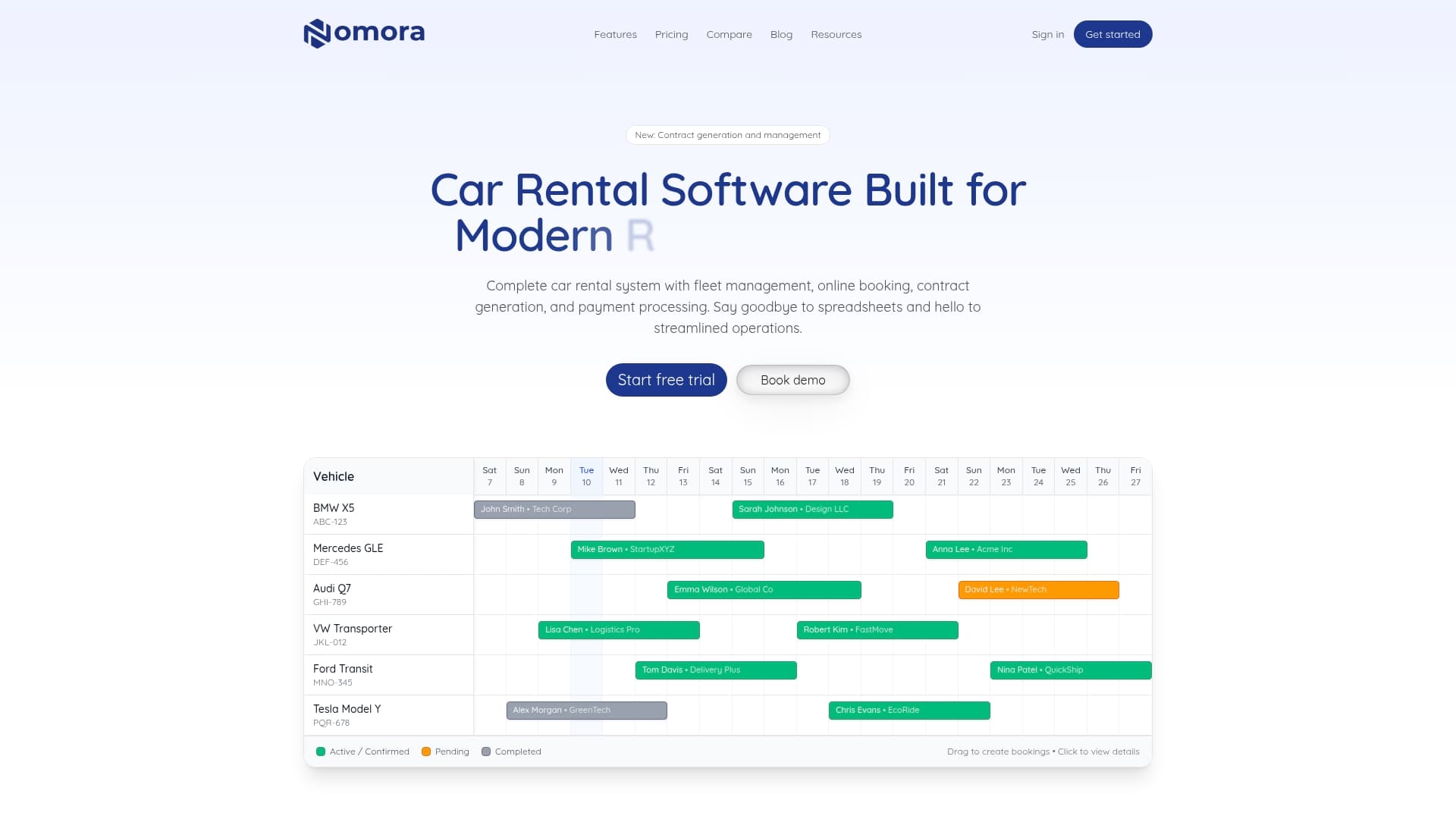
Unlike building this in-house or stitching together generic scheduling tools, Nomora comes preconfigured for rental operations, reservations, fleet status, and payments live in one system, with onboarding that typically takes 24 to 48 hours rather than months of custom integration work. That matters if you're trying to pilot a new allocation approach on one or two pools without disrupting the rest of your operation.
Whether you're running a small independent fleet or coordinating vehicles across multiple corporate locations, Nomora's use cases by business type show how the platform adapts to different fleet sizes and rental models. If you're ready to see how automated, forecast-driven allocation would look on your own fleet, explore Nomora's car rental software and start a trial to test it against your current process.
Frequently Asked Questions About Vehicle Allocation
What is the difference between vehicle allocation and fleet management?
Fleet management covers the entire lifecycle of vehicles, acquisition, maintenance, and disposal, while the vehicle allocation process specifically handles assigning individual units to reservations, routes, or locations. Allocation is one operational layer inside the broader fleet management strategies a rental company runs.
How often should batch optimization run?
Most rental operations benefit from at least a daily batch run, with higher-turnover fleets or multi-pool networks running it several times a day. The right cadence depends on how quickly your reservation mix and fleet status change.
Can small rental companies benefit from optimal vehicle allocation without expensive software?
Yes, though the ceiling is lower. A disciplined manual checklist with clean unit-level data captures much of the value, but the 33% improvement documented in relax-and-fix research required systematic optimization that manual scheduling can't replicate at scale.
What causes most empty repositions in a vehicle distribution system?
Empty repositions typically stem from demand imbalances between pools that weren't forecasted early enough, forcing reactive transfers instead of planned pre-positioning. Poor class-location segmentation in forecasting is the most common root cause.
Does the vehicle allocation process differ for corporate fleets versus rental companies?
The core mechanics, matching available units to demand while minimizing empty movement, stay the same, but corporate fleet managers often weigh employee scheduling and internal policy compliance more heavily than revenue-per-unit metrics that drive rental company decisions.
Sources
Recommended