Fleet rightsizing aligns vehicle capability and count to real demand, lowering total operating cost while preserving the service levels renters expect. The practice, as DOE's AFDC guidance frames it, means matching each vehicle's task, drive cycle, and payload to actual work rather than historical habit. Done well, it cuts cost per available vehicle hour without leaving branches short when demand spikes. At Nomora, we build the dashboards that make this kind of decision possible in real time.
TL;DR:
- Proper rightsizing involves matching vehicle types, quantity, and utilization to actual demand, preventing service erosion or excessive idle costs.
- Data collection over at least one seasonal cycle is crucial, focusing on utilization, drive patterns, maintenance, and reservation metrics for informed decision-making.
- Fleet decisions should consider fungibility, location transfer costs, and strategic importance, with vehicle reallocation prioritized over outright retirement.
- Modeling fleet size and repositioning simultaneously using rolling forecasts and scenario analysis yields better coverage of demand variances and transfer inefficiencies.
- Integrating real-time telematics, reservation data, and automation systems streamlines rightsizing projects, reducing manual effort and accelerating iteration.
Table of Contents
What fleet rightsizing means for rental operations
Rightsizing is not the same as downsizing. Downsizing cuts vehicles to hit a budget target; rightsizing matches fleet composition to demand patterns, which sometimes means adding vehicles in one segment while retiring them in another. The distinction matters because a fleet cut purely for cost reasons can quietly erode service levels and push renters toward competitors.
AFDC's guidance centers the practice on evaluating each vehicle's task, drive cycle, mileage, payload, fuel economy, and operational importance before deciding whether to reassign, replace, or eliminate it. That evaluation touches four aspects of a fleet:
- Quantity: how many vehicles exist in each class and location.
- Functionality: whether vehicle type and features match the jobs they're used for.
- Accessibility: whether vehicles are available where and when renters need them.
- Utilization: how intensively each unit is actually used relative to its capacity.
The trade-off is real. Shed too aggressively and you risk unmet demand during peak periods; hold too much idle capacity and carrying costs quietly erode margin on every unit that sits unused.
Build the data foundation before you touch the fleet
Rightsizing decisions are only as good as the data behind them. Before changing fleet composition, collect a baseline across every branch for at least one full seasonal cycle, typically 60 to 90 days at minimum, longer if your business has pronounced seasonal swings.
The metrics that matter most:
- Utilization rate by branch and vehicle class, measured as rented days over available days.
- Drive cycle and mileage patterns, which reveal whether vehicles are matched to their actual use.
- Payload and vehicle class fit against the reservations they fulfill.
- Downtime from maintenance, cleaning, and repositioning.
- Maintenance cost trend per vehicle and per class.
- Reservation patterns, including lead time, one-way requests, and cancellation rates.
Telematics systems supply drive cycle and mileage data; your reservation system supplies booking patterns and utilization; maintenance logs supply cost and downtime trends; periodic branch audits catch what the systems miss, like a vehicle sitting unrented because of a key fob issue nobody logged.
A simple schema makes the analysis tractable:
| Field | Source | Update frequency |
|---|
| Vehicle ID and class | Reservation system | Real time |
| Utilization rate | Reservation system | Daily |
| Mileage and drive cycle | Telematics | Daily |
| Maintenance cost | Maintenance logs | Per event |
| Branch location | Fleet records | Static |
A decision framework: fungibility, location, criticality
Once the data is in hand, triage each vehicle against three questions. Fungibility asks whether a vehicle can be pooled across customer segments or whether its specialization locks it into one role; a standard sedan is highly fungible, a wheelchair-accessible van is not. Location asks how transfer costs between branches compare to the cost of holding redundant capacity at each one, since one-way rental imbalances routinely leave some branches long and others short. Criticality asks whether a low-utilization vehicle still serves a mission-critical function, such as the only van capable of handling a recurring corporate contract.
- Rank vehicles by utilization first, then re-rank by contribution margin.
- Flag any vehicle whose low utilization masks high strategic value.
- Map transfer costs between branch pairs before deciding to relocate rather than retire.
A simple impact-by-frequency matrix, plotting how often a vehicle type is requested against the cost impact of not having one available, gives managers a reusable way to prioritize which units get attention first.
Pro Tip: Run the fungibility and criticality checks separately. A vehicle can fail both, one, or neither, and conflating them leads to retiring units that are rare but essential.
Modeling fleet size and repositioning together
Treating fleet size and vehicle repositioning as separate problems is a common mistake. A peer-reviewed study on vehicle size and transfer policy models them jointly using constrained optimization, because time-dependent demand across multi-branch networks creates supply imbalances that a fixed fleet count alone cannot absorb. Solve fleet size without accounting for repositioning, and you'll undercount the vehicles needed to cover transfer lag.
Fleet size and transfer policy should be determined simultaneously, not sequentially, because each one changes the optimal value of the other.
For most rental operators, full joint optimization is overkill. A lighter approach works:
- Run rolling-horizon simulations instead of a single-point forecast.
- Test multiple demand scenarios, not just the average case.
- Feed in resale value, transfer cost, utilization targets, and downtime penalties as explicit inputs.
- Re-run the model quarterly as new data arrives.
A 2021 optimization study on fleet size and mix found that incorporating resale value into the model changed the optimal replacement timing meaningfully, since ownership costs and demand volatility interact in ways a static spreadsheet misses. Our demand forecasting guide walks through the rolling-forecast approach in more detail.
Replacement timing beyond age and mileage
Age and mileage are easy to track but incomplete signals. Geotab's fleet replacement guidance recommends layering several factors before retiring a vehicle:
- Maintenance cost trend over the trailing 12 months, not just the current repair bill.
- Downtime frequency, since a vehicle out of service often costs more than its repairs.
- Safety record and any recall history.
- Fuel economy relative to newer vehicles in the same class.
- Resale market conditions at the time of disposal.
- Sustainability or regulatory targets your fleet needs to hit.
Replace vehicles in phases rather than all at once. A phased approach smooths capital spending and avoids the cash flow strain of replacing an entire class in a single quarter. For make-or-buy decisions, weigh short-term rental or leasing against outright purchase when demand for a vehicle class is seasonal or uncertain; locking capital into low-utilization assets undercuts the rightsizing goal before it starts.
Electrification changes what availability means
Adding electric vehicles to a rental fleet shifts availability from a pure vehicle-count question to a charging and turnaround question. A smaller EV fleet can still fail commercially if charger capacity or state-of-charge timing delays pickups, even when the vehicle count on paper looks sufficient.
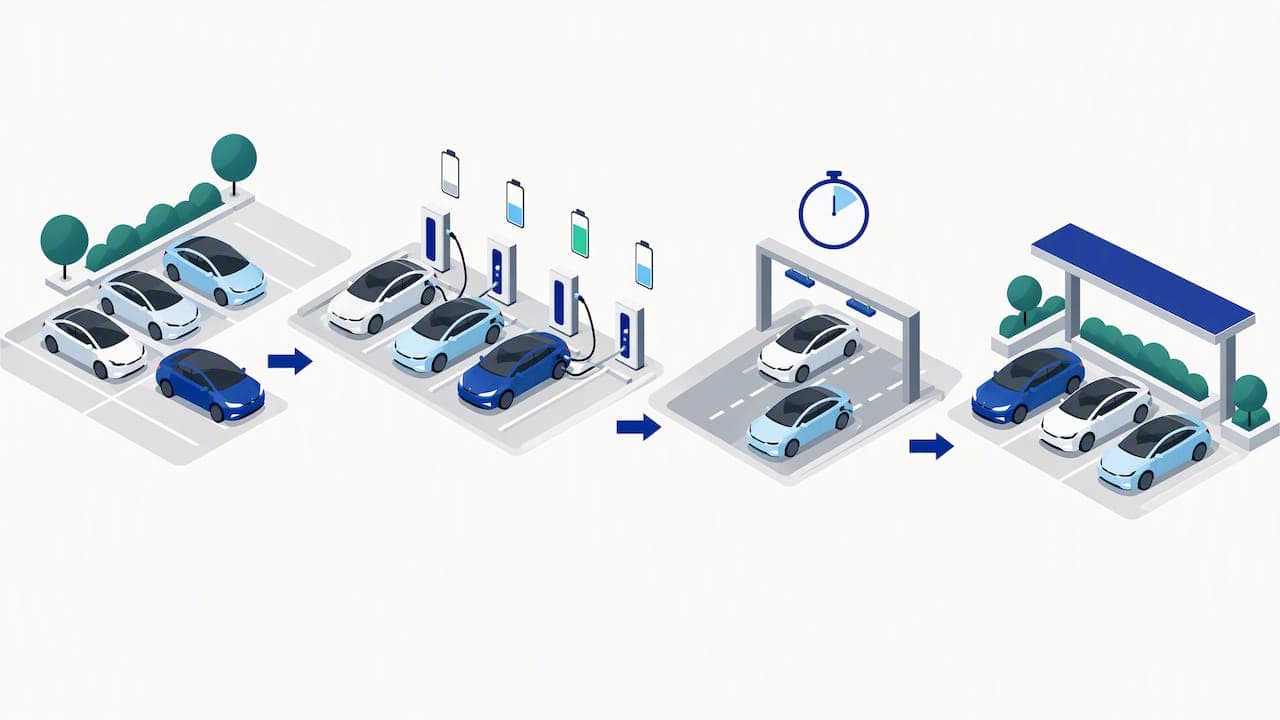
NREL's EVI-Rental tool models charging demand, dispatch timing, customer wait times, charger utilization, and lifecycle costs for EV rental fleets. Its airport case study validated these simulations against real operating conditions and showed that integrated microgrid and storage systems can reduce lifecycle energy costs, in high-intensity environments like airport rental counters.
Practical steps for operators adding EVs:
- Set staging state-of-charge policies so vehicles are ready, not fully charged, at the moment of peak demand.
- Schedule depot charging around overnight and off-peak windows.
- Pilot a mixed charger fleet, Level 2 and DC fast, before committing to one infrastructure type.
For context on vehicle selection itself, FrenzyCars' roundup of electric company cars covers current cost-to-own considerations relevant to fleet buyers.
Your implementation roadmap: audit, model, pilot, rollout
A rightsizing project moves through four phases, each with its own owner and deliverable.
- Baseline audit (30 to 90 days). Operations and maintenance teams compile the data schema above across every branch. Deliverable: a utilization and cost report by vehicle class and location.
- Modeling and scenario testing. Finance and fleet management jointly run rolling-horizon scenarios, testing transfer costs and resale assumptions against the baseline.
- Small pilots (30 to 60 days). Choose two or three branches to test a transfer policy or a reduced-fleet scenario before scaling. Track utilization, downtime, and unmet demand weekly.
- Phased rollout and monitoring. Expand the pilot's winning approach gradually, reviewing KPIs monthly for the first quarter and quarterly afterward.
Stakeholders from operations, reservations, maintenance, and finance should each sign off before a phase advances. Success metrics to track throughout: utilization rate by class, cost per available vehicle hour, unmet demand incidents, and transfer cost as a share of total fleet cost. Our step-by-step fleet optimization checklist lays out templates for each phase.
Pro Tip: Keep pilots small enough that a wrong call costs you a branch quarter, not a fleet year.
What rightsizing projects actually teach you
The surprises are predictable once you've seen them: one-way rental imbalances pile vehicles at airport branches while downtown locations run short, and transfer costs always land higher than the first estimate. What consistently works is starting small, measuring total cost rather than vehicle count alone, and keeping finance and operations in the same room from day one. One pilot we've seen cut idle vehicle days at two branches within a single quarter just by reassigning transfer routes.
— Dizzy
How Nomora supports a rightsizing program
The workflow we described above, utilization tracking, telematics data, reservation pattern analysis, needs a system that connects all of it in one place rather than three spreadsheets that never sync. 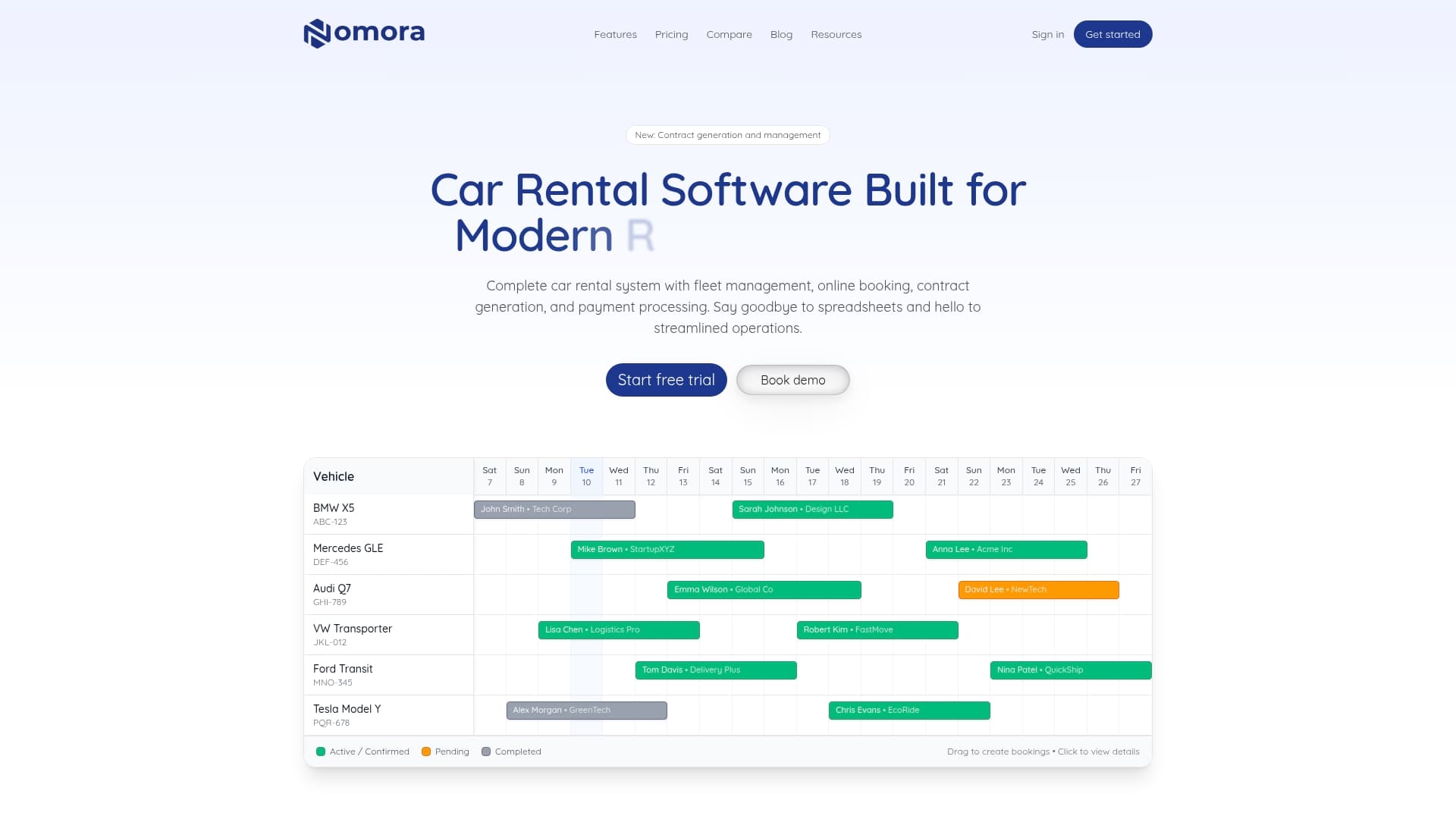
We built Nomora around that gap. Our platform gives fleet managers real-time utilization dashboards, direct telematics integration for drive cycle and mileage data, and conflict-free booking tools that make branch-level reservation patterns visible without manual reconciliation. Onboarding is designed to be fast, enabling a rightsizing pilot to start collecting clean data quickly instead of waiting weeks for a new system to settle in.
What this means in practice for a pilot:
- Less time spent manually compiling utilization reports across branches.
- Clearer visibility into which vehicles and locations drive transfer costs.
- Faster iteration between data collection and scenario testing.
If you manage a mid-sized or growing fleet, our Fleet plan is built for this kind of ongoing monitoring. Current prices are listed on our pricing page. Review our use cases by business type to see how the platform fits your fleet size, or explore the full feature set before requesting a demo.
FAQ
What does fleet mean on a rental car?
In a rental business, "fleet" refers to the full inventory of vehicles a company owns or leases for renting out, organized by class, location, and availability. Fleet size and composition directly determine how much demand a branch can serve at any given time.
What is the best car rental fleet management system?
The right system depends on fleet size and feature needs, but the strongest options integrate reservations, telematics, and maintenance tracking in one platform rather than separate tools. Nomora offers this integration across its Starter, Business, Fleet, and Enterprise plans, with pricing scaled to fleet size.
Should you avoid buying a fleet vehicle?
Not necessarily, but DOE's AFDC guidance recommends considering alternatives like short-term rentals, motor pools, or vehicle sharing for low-utilization needs instead of defaulting to ownership. The decision should weigh utilization forecasts and transfer costs against purchase and holding costs.
How many vehicles does it take to be considered a fleet?
There's no fixed threshold; a fleet is generally defined by common management and purpose rather than a specific vehicle count. Rightsizing principles apply whether the operation runs a handful of vehicles or several thousand, since the core question, matching capability to demand, scales either way.
Sources
Recommended
Ready to streamline your car rental business?
Book 30 minutes with the founder. We set up everything in this guide on your own vehicles, and migrate you out of Excel for free.