1. Why a loyalty program pays off for rental operators
A loyalty program works because retaining an existing renter costs less than acquiring a new one, and repeat renters tend to generate more revenue over time through additional bookings and fewer price-sensitive comparisons. The operators who see the clearest return are those with naturally repeat-heavy segments: corporate accounts, frequent business travelers, and specialty or luxury fleets where relationships matter more than one-off transactions.
Before committing fleet-wide, weigh the basic cost-vs-benefit variables:
- Reward liability: outstanding points or credits represent a real financial obligation that needs monthly reconciliation.
- Redemption rates: unredeemed rewards reduce actual cost but also reduce perceived value, so balance generosity against breakage.
- Retention lift: the percentage increase in repeat bookings attributable to the program, measured against a control group.
A clearly explained, firm-initiated service recovery, such as a downgrade paired with compensation, increased the likelihood of a repeat booking by several percentage points in an analysis of 81,672 airport rentals, which suggests loyalty mechanics tied to real service moments can outperform generic point schemes. A small pilot lets you quantify these effects locally before expanding.
2. Choosing a program model: points, tiers, credits, or corporate accounts
The right model depends on your average ticket size, rental frequency, and how much operational complexity your team can absorb in launch.
- Points-per-dollar: straightforward and familiar to renters, works well for leisure fleets with moderate repeat frequency.
- Tiered status: rewards your highest-frequency renters with perks like waived fees or priority vehicles, suited to operators with a clear top segment worth retaining.
- Prepaid credits or corporate lines: fits business accounts that rent repeatedly under a master agreement, simplifying billing and loyalty into one ledger.
- Partner rewards: co-branded perks with hotels or airlines add perceived value but require coordination overhead that smaller operators may not have the staff to manage.
Smaller independent fleets with tight margins generally do better starting with prepaid credits or a simple points system rather than multi-tier status programs, which demand more rules, more communication, and more customer service training. Larger fleets with distinct customer segments can justify tiers once the basic program proves out.
Pro Tip: Keep your redemption rules to one sentence a renter could repeat back to you; if your own staff needs a reference sheet, the program is too complicated for launch.
3. How to implement a loyalty program without disrupting operations
A phased rollout keeps the pilot manageable and gives you clean data to evaluate before expanding.
- Map required integrations: your booking engine or reservations system, CRM, payment processor, email or SMS tool, kiosk or point-of-sale system, and accounting software all need to share customer and transaction data without manual re-entry.
- Build the data model: assign each customer a unique ID, create a points or credits ledger with timestamped earn and redemption entries, define redemption rules in writing, set a retention and deletion policy, and keep an audit trail for every consent and transaction.
- Prepare your team: write simple staff scripts for enrolling renters and explaining rewards, train front-line staff before launch, and draft customer-facing communications that match what staff will say.
- Design the pilot: select a control group of similar renters who won't see the program, pick a sample size large enough to detect a meaningful difference, and choose a measurement window, typically 30, 90, and 365 days, to track short- and long-term effects.
- Set go or no-go criteria: decide in advance what retention lift or redemption behavior justifies scaling versus revising the model.
Favor event-driven updates (a completed rental or a signed contract triggering a ledger entry) over periodic batch syncs, since batch processes tend to introduce reconciliation errors that are harder to trace later.
4. Data privacy and consent requirements for loyalty marketing
Rental contracts collect sensitive information in a context renters expect to stay private, not to feed a marketing database. The FTC's notice on misuse of information collected in confidential contexts states that using such data for secondary purposes like marketing requires separate affirmative express consent, and that terms buried inside a privacy policy do not satisfy that standard. A related FTC order against General Motors required affirmative express consent before certain vehicle and driver data could be used for secondary purposes, underscoring how seriously regulators treat this in the vehicle rental space.
Practical steps for your program:
- Present a standalone opt-in: a dedicated checkbox or form for loyalty marketing, separate from the rental agreement itself.
- Record consent properly: capture the consent text, timestamp, method, and the specific purpose agreed to, stored alongside the customer record.
- Keep consent granular and reversible: a renter who opts into loyalty emails shouldn't be automatically opted into unrelated marketing, and opting out should take one step.
5. Measuring results: the KPIs that tell you if it's working
Track a small set of metrics consistently rather than a long dashboard nobody reviews weekly.
- Repeat-booking rate at 30, 90, and 365 days, compared against your control group.
- Incremental revenue per customer, isolating what the program adds beyond baseline spend.
- Redemption rate, since very low redemption suggests the rewards aren't valued, and very high redemption affects your liability forecasting.
- Cost per earned point, tying the ledger back to actual dollars spent on rewards.
- Net promoter score, as a simple pulse check on whether renters would recommend you.
Report these on a monthly cadence during the pilot, and extend to quarterly once the program stabilizes.
6. Common pitfalls and how service recovery can rebuild loyalty
Most loyalty program failures trace back to a handful of avoidable mistakes:
- Overly complex rules that staff can't explain and renters don't trust.
- Underfunded reward liability, where points accumulate faster than the budget anticipated.
- Clunky redemption experiences that make renters work harder to use rewards than to earn them.
- Hidden conditions, like blackout dates or fine-print exclusions, that erode goodwill the program was meant to build.
Service failures themselves can become loyalty-building moments when handled transparently. The Cornell thesis on vehicle downgrades found that a clearly explained, firm-initiated downgrade paired with a compensating gesture increased repeat-booking probability by roughly 6 to 7 percentage points compared to no explanation at all.
Pro Tip: Train staff to explain a service issue before the renter notices it, since a proactive explanation plus a small gesture tends to land better than a reactive apology after a complaint.
A platform that already centralizes reservations, customer data, payments, and contracts shortens the distance between deciding to run a pilot and actually launching one. Some platforms bring reservations, customer records, payment processing, automated contract generation, and fleet and GPS data into a single system, which means loyalty-relevant events like a completed rental or a signed contract already exist in one place rather than scattered across spreadsheets.
When evaluating any vendor for loyalty integration, ask about:
- API or webhook access for real-time event triggers.
- Whether the system supports a points ledger or exposes hooks for one.
- Reporting exports for the KPIs you'll track during your pilot.
- Security and compliance practices, including data retention and deletion controls.
Our guide to choosing car rental software walks through these evaluation criteria in more depth.
8. Comparison of major car rental loyalty programs and their unique benefits
Large national and international rental brands run consumer-facing loyalty programs built around points, membership tiers, and partner airline or hotel rewards, each designed to reward frequent personal and business travelers with faster pickup, free rental days, or upgrades. These programs differ mainly in how fast points accumulate, how status tiers unlock perks, and how deeply they integrate with airline and hotel partners.
For an independent or regional operator, the relevant comparison isn't which national program to join, since you're not competing on that scale, but which program structure to borrow from. A points-per-dollar model mirrors the accessibility of entry-level consumer programs and works well when your renters are price-conscious and infrequent. A tiered status model mirrors the structure used by programs that reward their top travelers, and it fits operators with a distinct high-frequency segment, such as corporate accounts or contractors renting trucks regularly.
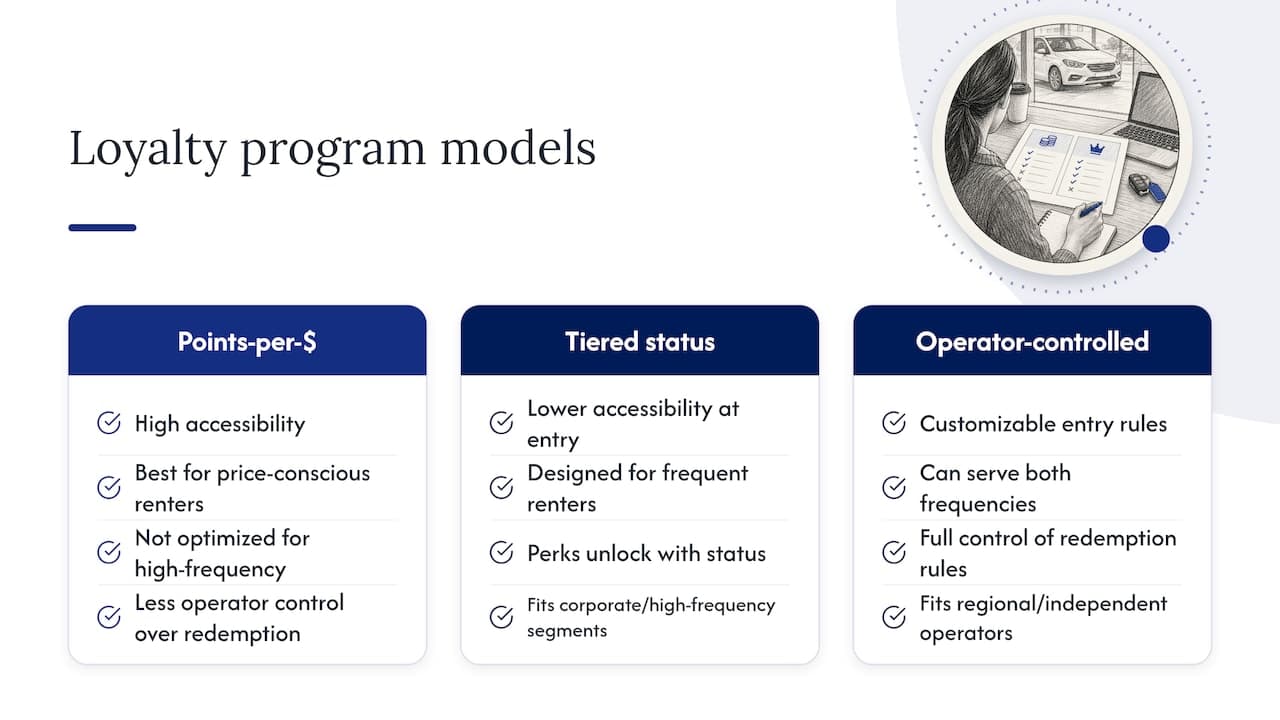
The unique benefit of building your own program, rather than trying to replicate a national brand's scale, is control: you set the redemption rules, fund the liability at a level your margins support, and tie rewards to the specific behaviors that matter to your business, like advance bookings or longer rental terms. A smaller, well-run program with predictable redemption tends to build more trust with regular renters than an imitation of a larger brand's complexity.
9. Customer segmentation strategies to tailor loyalty offers effectively
Segmenting renters before designing rewards prevents the common mistake of building one program that fits no one well. Start with frequency: renters who book once a year need a different incentive than those who book monthly.
- Corporate and business accounts: typically value predictable pricing and account-level credits more than points, since the renter and the payer are often different people.
- Leisure frequent renters: respond well to points redeemable for free days or upgrades, especially around seasonal travel.
- Specialty or luxury fleet renters: often value recognition and service perks, like priority vehicle selection, over discounts.
- One-time or infrequent renters: rarely justify full loyalty enrollment but may respond to a simple referral incentive instead.
Segmentation data should come from your existing reservation and customer records rather than a separate survey, since behavior (how often someone books, what vehicle class they choose, whether they're billing a company) is more reliable than self-reported preference. Once segments are defined, tailor the reward type and communication cadence to each rather than running one blanket offer across your entire customer base.
10. How loyalty programs affect acquisition and word-of-mouth advocacy
A well-run loyalty program influences more than repeat bookings. Renters who feel recognized and fairly treated are more likely to recommend a rental business to colleagues or mention it in a review, which matters more for independent operators than for national chains with large advertising budgets. Corporate accounts in particular tend to consolidate their rental spending with operators who offer predictable account-level benefits, which can turn one corporate relationship into a steady stream of individual bookings from employees.
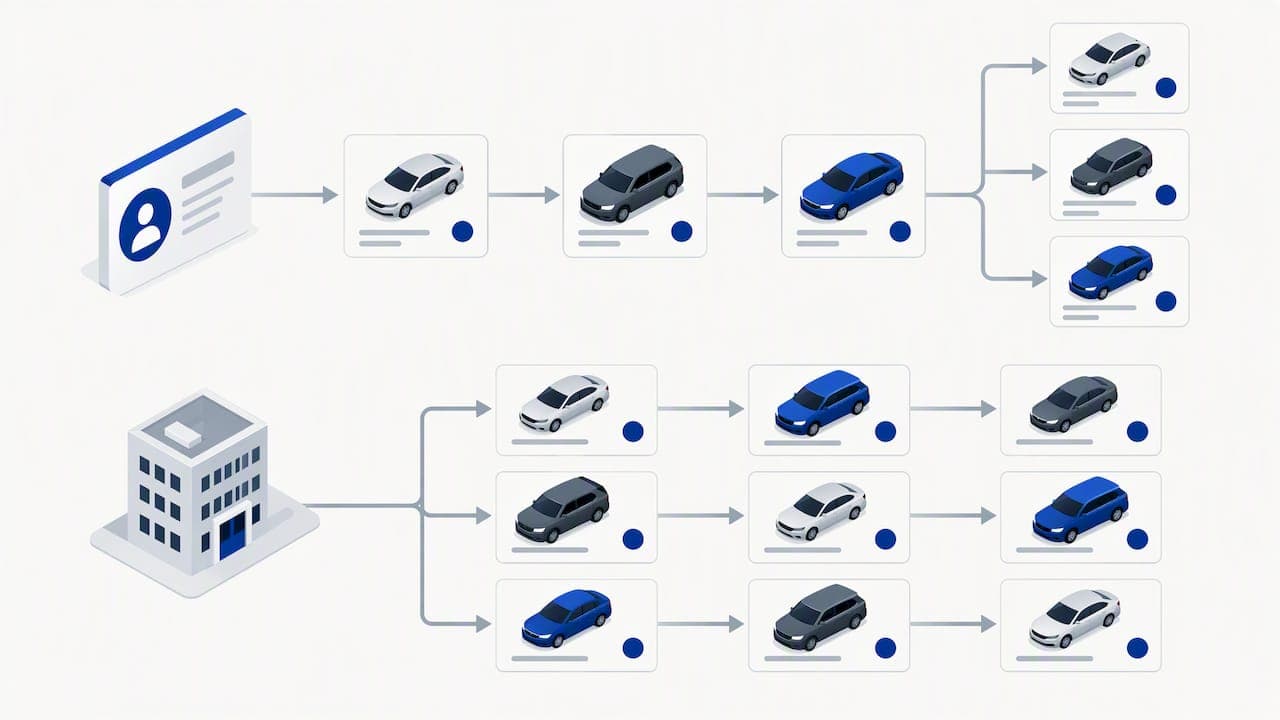
The acquisition effect is indirect but real: a loyalty program rarely attracts new customers on its own, but the service consistency and recognition it encourages often shows up in referrals and repeat corporate contracts. This is part of why transparent service recovery matters so much, since a renter who experiences a handled problem and a fair resolution often becomes a more vocal advocate than one who never had an issue at all. Treating loyalty as a retention and advocacy tool, rather than purely an acquisition channel, sets realistic expectations for what the program should deliver.
11. A 90-day starter plan worth following
If you're starting from nothing, keep it simple. Pick one model, either points or a corporate-credit line, and spend the first 90 days on four tasks: mapping your customer and transaction data, setting up a standalone consent opt-in, writing a one-paragraph staff script, and defining your pilot metrics in advance. Measure early, adjust quickly, and resist building tier structures until the basic version proves itself.
— Dizzy
12. Starting a loyalty pilot with Nomora
Running a pilot is faster when reservations, customer records, payments, and contracts already live in one place instead of across spreadsheets and disconnected tools. That's the gap our platform closes: Nomora brings those pieces together so the data your loyalty pilot needs, completed rentals, renter history, payment records, is already structured and ready to use rather than something you have to assemble first.
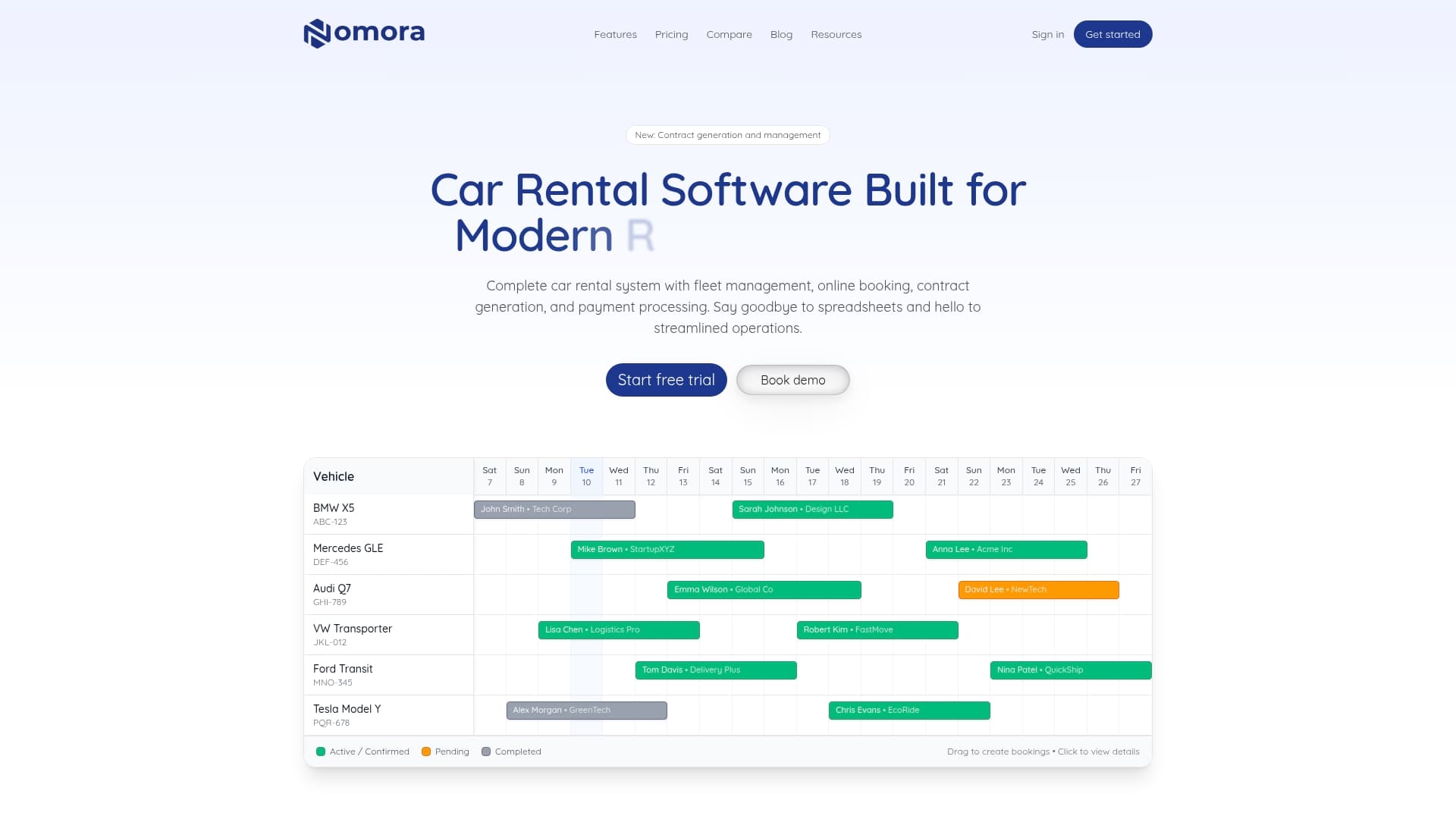
If you're mapping out a pilot, start by reviewing our car rental software overview to see which integrations are available, then check pricing plans to match a plan to your fleet size. From there, requesting a demo is the fastest way to see how reservation and customer data would flow into your specific loyalty design.
FAQ
What is a loyalty program for a car rental business?
A loyalty program for a rental operation is a structured system, often points, tiered status, or prepaid credits, that rewards renters for repeat bookings and ties those rewards to your reservation and customer data. The goal is to increase repeat-booking rate and lifetime revenue rather than just offer one-time discounts.
Do we need customer consent to use rental data for loyalty marketing?
Yes. Guidance from the FTC states that using information collected in a confidential context, like a rental contract, for marketing requires separate affirmative express consent, not terms buried in a privacy policy. A standalone opt-in with a recorded timestamp and purpose is the safer, compliant approach.
Which loyalty model works best for a small independent fleet?
A simple points-per-dollar or prepaid credit model tends to work best for smaller fleets because it's easy for staff to explain and easy for renters to understand. Tiered status programs add value for larger fleets with a distinct high-frequency segment but require more operational complexity to run well.
How long should a loyalty program pilot run before deciding to scale?
A pilot measured across 30, 90, and 365-day windows against a control group gives enough data to evaluate both short-term engagement and longer-term retention lift. Deciding to scale before completing at least one full measurement window risks committing to a reward structure that hasn't been properly tested.
Can handling a service failure well actually improve loyalty?
Yes. An analysis of 81,672 airport rentals found that a clearly explained, firm-initiated downgrade paired with compensation increased the likelihood of a repeat booking by a meaningful margin compared to no explanation. Transparent communication paired with a fair remedy can turn a service issue into a reason a renter comes back.
Sources
Recommended