TL;DR:
- Vehicle allocation is a strategic process that assigns specific vehicles to routes or tasks to maximize efficiency. Proper allocation reduces costs, improves customer satisfaction, and prevents booking conflicts, especially when automated systems are used for larger fleets. Monitoring demand signals and planning allocations in advance are essential for maintaining service reliability and operational effectiveness.
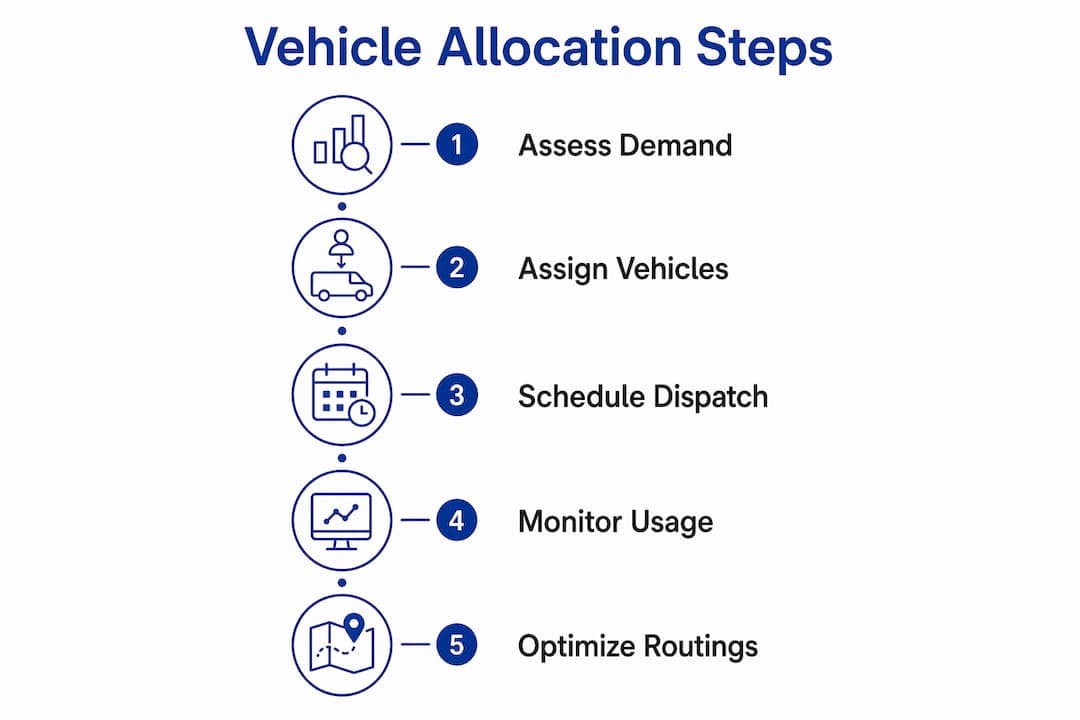
Vehicle allocation is defined as the strategic process of assigning specific vehicles to designated routes, tasks, or customers to maximize fleet utilization and minimize operating costs. The industry term most commonly used in logistics and fleet management is "fleet allocation," though rental operators often use "vehicle assignment" interchangeably. Getting this process right separates profitable rental businesses from ones that bleed money through idle assets and mismatched deployments. This guide gives you a clear framework for understanding vehicle allocation meaning, identifying where your current process breaks down, and applying proven methods to fix it.
What is the definition of vehicle allocation in fleet operations?
Vehicle allocation is the binding commitment of a specific asset to a specific order or job. This is distinct from a reservation, which is provisional and can be cancelled without consequence. Conflating the two leads directly to double-booking and customer disputes. Every rental manager who has scrambled to find a replacement vehicle on a busy Saturday morning has experienced this distinction the hard way.

The vehicle distribution definition goes further than simply deciding which car goes where. It encompasses matching vehicle type, capacity, and condition to the exact requirements of each job. A cargo van sent on a passenger shuttle run wastes fuel and frustrates customers. A compact car assigned to a heavy equipment delivery fails the job entirely. Proper vehicle assignment process thinking starts with the job requirement and works backward to the asset.
Fleet allocation also operates within a time dimension. Measuring fleet capacity in vehicle-hours rather than vehicle counts gives a far more accurate picture of true availability. A fleet of 45 vans corresponds to 360 van-hours per 8-hour shift. That number tells you what you can actually promise customers, not just how many keys are on the board.
How does vehicle allocation improve operational efficiency in rental businesses?
Matching vehicle capabilities to job requirements is the single most direct way to cut operating costs. A data-driven allocation strategy that aligns vehicle type to task requirements can reduce operational costs by up to 30%. That reduction comes from preventing misuse, reducing wear on the wrong vehicle class, and eliminating the fuel waste that comes from oversized or underpowered deployments.
Operational efficiency gains show up in three specific areas:
- Reduced vehicle wear: Assigning a heavy-duty vehicle to a light task accelerates depreciation without adding value. Matching load to capacity extends vehicle life and lowers maintenance frequency.
- Faster service delivery: When the right vehicle is pre-assigned to the right route, drivers spend less time repositioning. Customers receive their vehicle on time, and your team avoids reactive scrambling.
- Higher utilization rates: Vehicles sitting idle cost money. A well-structured fleet optimization strategy keeps assets moving and earning rather than depreciating in a parking lot.
- Lower fuel costs: Route-matched vehicles consume fuel at expected rates. Mismatched deployments inflate fuel spend unpredictably.
- Fewer customer complaints: Service reliability is the direct output of consistent allocation. When customers receive the right vehicle at the right time, satisfaction scores improve without any additional investment.
Pro Tip: Track utilization by vehicle class, not just overall fleet utilization. A fleet with 90% overall utilization can still have an entire vehicle class sitting at 40% while another is overbooked. Class-level data reveals the real allocation gaps.
What are common challenges in vehicle allocation and how can they be identified?
The fleet allocation problem rarely announces itself until a customer is already waiting. The good news is that data signals appear well before service failures do. Up to 80% of pending allocation issues can be identified 2–3 days before customers experience a failure by monitoring four key signals: location, time of day, weather, and usage loops.
Here is how each signal works in practice:
- Location: Vehicles clustering in one geographic zone while demand spikes in another is a distribution mismatch. Monitor vehicle positions against demand maps daily, not weekly.
- Time of day: Allocation gaps often follow predictable patterns. If your compact cars are always unavailable between 8:00 AM and 10:00 AM on weekdays, that is a scheduling pattern, not a coincidence.
- Weather: Adverse weather increases demand for specific vehicle types, particularly AWD and 4x4 units. Fleets that do not pre-position these vehicles before weather events face last-minute shortfalls.
- Usage loops: Vehicles returning late from one job delay the next allocation. A single late return can cascade into three or four missed commitments if the schedule has no buffer.
Proactive monitoring of these signals turns allocation from a reactive scramble into a planned operation. Fleet managers who review these four data points each morning catch problems while they are still fixable. Those who wait for customer calls are always one step behind.
How does technology and data-driven software enhance vehicle allocation?
Real-time tracking software enables vehicle reallocation based on live demand changes, preventing idle vehicles and long wait times. This is the core difference between static scheduling and dynamic allocation. Static schedules are built once and break under pressure. Dynamic allocation adjusts continuously as conditions change.
The table below shows how manual dispatching compares to automated allocation across key operational dimensions:
| Dimension | Manual dispatching | Automated allocation |
|---|
| Fleet size limit | Reliable up to 20 vehicles | Scales to any fleet size |
| Response to demand changes | Delayed, dependent on dispatcher availability | Immediate, rule-based redeployment |
| Double-booking risk | High without strict manual checks | Low with conflict-detection logic |
| Maintenance integration | Typically separate from dispatch | Unified with vehicle status data |
| Reporting accuracy | Dependent on manual data entry | Automated and real-time |
Manual dispatching becomes unreliable beyond 20 vehicles due to cognitive overload. Operational risk increases exponentially with fleet size under manual management. This is not a criticism of dispatchers. It is a structural limitation of human working memory when tracking dozens of moving assets simultaneously.
Nomora addresses this directly by integrating GPS tracking, real-time booking status, and fleet availability into a single cloud-based dashboard. Fleet managers see every vehicle's status without switching between systems or calling drivers for updates.
Pro Tip: Integrate maintenance schedules into your allocation software so vehicles due for service are automatically flagged as unavailable. Allocating a vehicle that breaks down mid-job costs far more than the revenue from that booking.
What are best practices for effective vehicle allocation?
Effective vehicle allocation requires both planning discipline and clear operational communication. The following practices apply whether you manage 10 vehicles or 100.
- Separate allocation from reservation in your workflow. Reservation holds a vehicle tentatively. Allocation commits it. Never treat a reservation as a guarantee of availability without completing the allocation step. This single distinction prevents double-booking and the customer disputes that follow.
- Keep at least one reserve vehicle per shift. Dynamic redeployment during high-demand periods reduces wait times without adding vehicles. A reserve unit in active standby costs far less than sourcing a last-minute replacement from outside your fleet.
- Use demand maps to pre-position vehicles. Analyze where bookings originate by time and location. Pre-position vehicle types in zones before demand peaks rather than repositioning reactively after it arrives.
- Document route maps and staging layouts before large jobs. Pre-event plans that include detailed vehicle allocation, route maps, and contingency protocols significantly reduce real-time dispatch errors. This applies equally to corporate fleet deployments and event transportation.
- Match vehicle type to job complexity, not just capacity. A job requiring multiple stops in a dense urban area calls for a different vehicle than a single long-haul delivery. Factor maneuverability, parking requirements, and driver familiarity into the assignment decision.
- Review allocation data weekly, not monthly. Weekly reviews catch emerging patterns before they become entrenched problems. Monthly reviews only confirm what already went wrong.
Rental managers who apply these practices consistently report fewer last-minute conflicts and higher customer retention. The cost-saving impact of disciplined allocation compounds over time as vehicle wear decreases and utilization rates climb.
Key Takeaways
Effective vehicle allocation is the foundation of profitable fleet management. It requires matching assets to jobs by type and capacity, monitoring demand signals proactively, and using automated tools once fleet size exceeds 20 vehicles.
| Point | Details |
|---|
| Allocation vs. reservation | Allocation is a binding commitment; reservation is provisional. Conflating them causes double-booking. |
| Capacity in vehicle-hours | Measure fleet availability in vehicle-hours, not vehicle counts, for accurate service promises. |
| Early problem detection | Monitor location, time, weather, and usage loops to catch allocation failures 2–3 days early. |
| Automation threshold | Manual dispatching breaks down beyond 20 vehicles. Automated systems are necessary at scale. |
| Reserve vehicle discipline | Keep at least one reserve unit per shift to handle demand surges without last-minute sourcing. |
Why most rental businesses get vehicle allocation wrong
I have worked with fleet managers who could recite their vehicle count from memory but had no idea what their actual available vehicle-hours were on any given day. That gap is where allocation failures live. The number of vehicles in your fleet is almost irrelevant. What matters is how many of those vehicles are available, matched to the right job type, and positioned where demand will hit.
The other mistake I see repeatedly is treating allocation as a dispatch function rather than a planning function. Dispatch is real-time. Allocation should happen the night before, or ideally two to three days out. By the time a customer is standing at your counter, it is too late to allocate well. You are just reacting.
The rental businesses that get this right share one habit: they review demand data before they review their vehicle list. They ask "what will customers need tomorrow?" before they ask "what do we have available?" That sequence change is small in practice and enormous in outcome. Pairing that mindset with a platform like Nomora, which surfaces real-time fleet status and booking conflicts automatically, removes the guesswork entirely.
— Dizzy
How Nomora supports smarter vehicle allocation
Rental businesses that move from spreadsheets to a purpose-built platform see the difference immediately. Nomora acts as the central nervous system of your fleet operation, connecting reservations, vehicle status, GPS tracking, and customer data in one place.
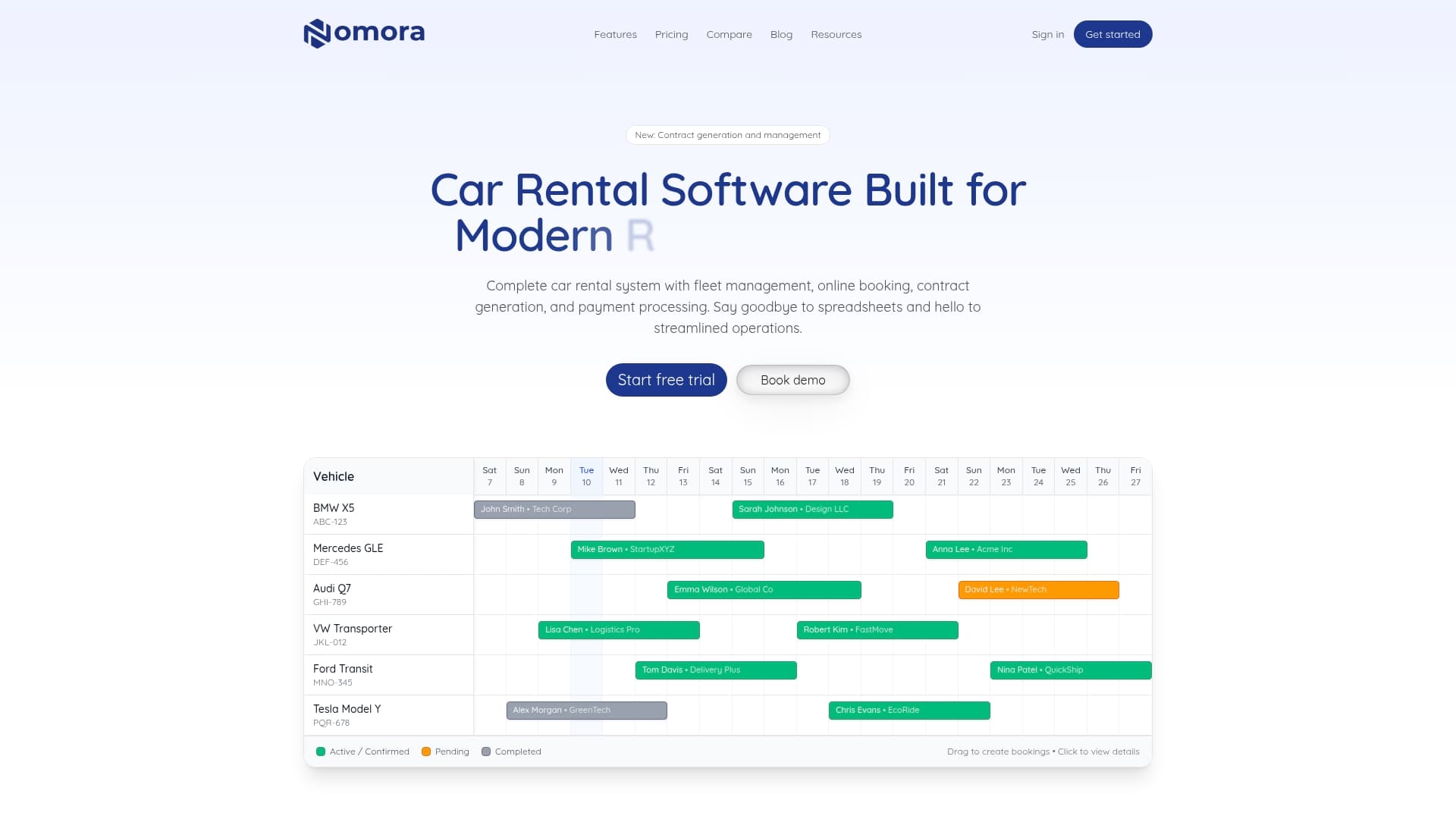
Nomora's fleet management use cases cover independent operators, franchise networks, and corporate fleet managers. The platform flags booking conflicts before they become customer problems, integrates with GPS systems for real-time vehicle positioning, and generates contracts and payment records automatically. Setup takes 24–48 hours, and the system scales as your fleet grows. If you manage more than 20 vehicles and still rely on manual dispatch, the operational risk is real and the fix is straightforward.
FAQ
What is the definition of vehicle allocation?
Vehicle allocation is the binding assignment of a specific vehicle to a specific job, route, or customer. It differs from a reservation in that it is a firm operational commitment, not a provisional hold.
What is vehicle allocation for events?
Vehicle allocation for events means pre-assigning specific vehicles to defined routes, staging areas, and time slots before the event begins. Pre-planned allocation with documented route maps and contingency protocols reduces real-time dispatch errors significantly.
How does fleet allocation differ from fleet management?
Fleet management covers the full lifecycle of vehicles including maintenance, compliance, and procurement. Fleet allocation is one function within fleet management, focused specifically on assigning available vehicles to active jobs or bookings.
When does manual vehicle allocation become a problem?
Manual dispatching becomes unreliable beyond 20 vehicles due to cognitive overload. At that scale, automated allocation software is necessary to prevent booking conflicts and maintain service reliability.
How do you measure fleet capacity for allocation purposes?
Fleet capacity is most accurately measured in vehicle-hours rather than vehicle counts. A fleet of 45 vans operating an 8-hour shift has 360 van-hours of capacity, which gives a precise picture of what can actually be promised to customers.
Recommended
Ready to streamline your car rental business?
Book 30 minutes with the founder. We set up everything in this guide on your own vehicles, and migrate you out of Excel for free.