TL;DR:
- Vehicle tracking systems employ various technologies such as GPS, GSM, satellite, RFID, and telematics to provide fleet location and operational data. Choosing the appropriate system depends on coverage areas, installation security, data quality, and specific operational needs, with hybrid and satellite options suited for remote zones. Effective fleet management requires understanding data accuracy, offline buffering, and platform flexibility to optimize vehicle visibility and maintenance workflows.
Vehicle tracking systems are defined as integrated hardware and software solutions that combine GPS units, telematics devices, and data platforms to provide location data and operational insights for fleet management. The industry recognizes several distinct categories, including passive, active, hybrid, GPS-based, GSM, satellite, and RFID systems. Each type serves different operational needs, from real-time dispatch to remote-area logistics. This guide breaks down the top types of vehicle tracking systems so you can match the right technology to your fleet's specific requirements and stop guessing which solution fits.
1. Types of vehicle tracking systems: passive, active, and hybrid
Vehicle tracking systems combine GPS hardware with software platforms to deliver location data and operational insights. The most fundamental classification separates systems by how they transmit that data: passively, actively, or through a hybrid of both.

Passive tracking systems record location and trip data onboard the device and upload it later, typically when the vehicle returns to a base or connects to Wi-Fi. They cost less and work without a cellular subscription, but the trade-off is latency. You get route history, not live visibility.
Active tracking systems transmit data in real time over cellular networks. Dispatchers can see vehicle positions live, reroute drivers instantly, and respond to incidents as they happen. This is the standard for most commercial fleet operations today.
Hybrid tracking systems combine both modes. When cellular coverage is available, data transmits live. When a vehicle enters a dead zone, the device buffers data locally and backfills the record once connectivity returns. This matters more than most fleet managers realize. Active systems in dead zones must define local buffering and backfill methods to avoid real-time data gaps. A hybrid system handles this automatically.
Pro Tip: If your fleet operates in areas with inconsistent cellular coverage, choose a hybrid system with confirmed offline buffering. Ask vendors specifically how many hours of data the device stores locally and how backfill is handled.
2. Hardwired GPS trackers
Hardwired GPS trackers connect directly to a vehicle's electrical system. They draw power continuously, which means they can report location without battery constraints. Hardwired trackers report location every 10–30 seconds while moving, with slower update intervals when stopped.
This update frequency makes hardwired units the best choice for fleets that need precise, near-real-time monitoring. Delivery companies, emergency services, and rental operators with high-value vehicles all benefit from this level of detail. The installation requires a technician, which adds upfront cost, but the result is a tamper-resistant device that drivers cannot easily unplug.
For large fleets, hardwired units also support ignition detection, which triggers reporting automatically when a vehicle starts. This eliminates wasted pings during idle periods and keeps data clean.
3. OBD-II plug-in trackers
OBD-II plug-in devices insert directly into a vehicle's onboard diagnostic port, which is standard on most vehicles manufactured after 1996. Setup takes under two minutes and requires no technician. That simplicity makes OBD-II trackers popular with small fleets and businesses testing GPS tracking before committing to a full hardwired rollout.
The real advantage is data depth. OBD-II and CAN-bus interfaces allow combining GPS location with engine diagnostics and performance data, including fuel use, fault codes, speed events, and more. You get location and vehicle health in one device.
The limitation is security. An OBD-II device can be unplugged in seconds. For fleets where driver accountability or theft prevention is a priority, this form factor carries risk.
Pro Tip: Before deploying OBD-II trackers fleet-wide, verify which specific vehicle parameters your vendor actually pulls from the port. Not all platforms expose the same data fields, and gaps in fuel or odometer reporting will affect your maintenance scheduling.
4. Battery-powered and portable trackers
Battery-powered trackers attach magnetically or with adhesive to any surface, making them ideal for assets that move between vehicles or are not permanently assigned. Trailers, equipment, and rental assets without fixed power sources are common use cases.
The trade-off is update frequency. Battery-powered trackers have longer update intervals than hardwired units because frequent pings drain the battery quickly. Most use motion-based logic: the device wakes up when movement is detected and sleeps when stationary. This conserves power but creates gaps in stationary reporting.
For fleet managers tracking high-value movable assets, battery-powered trackers fill a gap that hardwired systems cannot. They are not a replacement for primary vehicle tracking, but they are an effective complement.
5. GPS-based tracking systems
GPS-based tracking is the standard positioning technology across nearly all fleet tracking solutions. A GPS receiver in the device calculates position from satellite signals, then transmits that location via a separate communication channel, typically cellular. The GPS component handles location. The cellular network handles delivery.
Fleet GPS data consists of timestamped location messages generated by OBD-linked units, and sampling frequency directly affects KPI accuracy and route adherence analysis. A system pinging every 30 seconds produces a far more accurate route reconstruction than one pinging every five minutes. This distinction matters when you are calculating ETA accuracy, mileage reimbursement, or geofence compliance.
GPS accuracy is generally within 3–5 meters under open sky. Urban canyons and dense foliage can degrade this, but modern devices compensate with accelerometer data and map-matching algorithms.
6. GSM and cellular network tracking
GSM tracking uses cellular networks to transmit location data from the GPS device to a cloud platform. Most active tracking systems on the market today are GPS plus GSM systems. The GPS chip determines position. The GSM modem sends it.
Coverage is the key variable. GSM tracking works well in urban and suburban environments where cellular infrastructure is dense. Rural routes, mountain corridors, and international borders can create coverage gaps. For fleets operating primarily within well-covered regions, GSM-based systems are cost-effective and widely supported.
Data plans for GSM trackers are typically low-cost because location pings are small data packets. A fleet of 50 vehicles rarely exceeds a few gigabytes of tracker data per month.
7. Satellite tracking systems
Satellite tracking systems bypass cellular networks entirely. They transmit data directly to orbiting satellites, providing coverage in locations where no cell tower exists. Satellite networks like Iridium and Globalstar enable continuous tracking in mining, long-haul trucking, and maritime sectors.
The cost premium is significant. Satellite data plans run higher than cellular, and the hardware costs more. Update intervals are also typically longer, often every few minutes rather than every 30 seconds. For most urban or suburban fleets, satellite tracking is unnecessary.
Where it earns its cost is in remote operations. A mining fleet in Nevada's high desert, a logging operation in the Pacific Northwest, or a long-haul carrier crossing stretches of rural highway without cell coverage all require satellite tracking to maintain any visibility at all.
8. RFID-based tracking systems
RFID tracking uses radio frequency identification tags attached to vehicles or assets, read by fixed or handheld scanners at specific checkpoints. It is a short-range technology, typically effective within a few meters of a reader. RFID does not provide continuous GPS-based location. Instead, it confirms presence at a defined point.
Common applications include yard management at distribution centers, vehicle check-in and check-out at rental depots, and access control at secure facilities. When a vehicle passes an RFID reader at a gate, the system logs the timestamp and vehicle ID automatically.
RFID works best as a complement to GPS tracking, not a replacement. It adds precision at fixed locations where GPS accuracy alone is insufficient, such as confirming which bay a vehicle entered in a large parking structure.
9. Advanced telematics systems
Telematics is defined as the combination of GPS location data with vehicle diagnostics transmitted via OBD-II or CAN-bus interfaces. It is not simply GPS tracking. Telematics encompasses GPS location and vehicle diagnostics, not just simple position reporting.
A full telematics system captures speed, harsh braking, rapid acceleration, fuel consumption, engine fault codes, odometer readings, and idle time. Fleet managers use this data for driver behavior scoring, predictive maintenance alerts, and insurance reporting. The operational value extends well beyond knowing where a vehicle is.
Platforms like Geotab and Mix Telematics bundle hardware and software together. Wialon operates as a device-agnostic platform, meaning it works with hardware from multiple manufacturers. Telematics platforms differ in hardware bundling, and that distinction affects integration flexibility and long-term vendor lock-in risk. Choosing a platform that supports your existing hardware saves significant replacement costs.
For fleet managers evaluating telematics data quality, the critical questions are: what parameters does the vendor actually expose, how frequently is data sampled, and how does the system handle offline periods?
10. How to choose the right system for your fleet
Selecting the right tracking solution comes down to four variables: update frequency needs, installation constraints, geographic coverage, and software platform capabilities.
| Tracking type | Best for | Coverage | Update frequency | Cost level |
|---|
| Passive GPS | Route history, low-cost fleets | Any | Post-trip | Low |
| Active GPS/GSM | Real-time dispatch, urban fleets | Cellular areas | 10–30 seconds | Medium |
| Hybrid | Mixed-coverage routes | Cellular + buffered | Real-time with backfill | Medium |
| Satellite | Remote operations, mining, maritime | Global | 1–5 minutes | High |
| OBD-II plug-in | Small fleets, diagnostics | Cellular areas | 10–60 seconds | Low to medium |
| Hardwired GPS | High-value vehicles, tamper resistance | Cellular areas | 10–30 seconds | Medium |
| RFID | Yard management, depot check-in | Short range only | On-demand at reader | Low |
Start with your geography. If your routes stay within cellular coverage, an active GPS/GSM system covers most needs. If drivers cross dead zones regularly, move to a hybrid system with confirmed buffering. If any vehicles operate in genuinely remote areas, satellite tracking is not optional. It is the only solution that works.
Match installation type to your security requirements. High-value vehicles warrant hardwired units. Small or rotating fleets can start with OBD-II plug-ins. Add RFID at fixed facilities where checkpoint precision matters.
Finally, evaluate the software platform independently from the hardware. The right fleet management platform should support analytics, maintenance scheduling, and integration with your existing operations tools.
Key takeaways
The most effective vehicle tracking strategy combines the right hardware type with a software platform that turns raw location and diagnostic data into decisions.
| Point | Details |
|---|
| Match system to coverage needs | Use GSM for urban fleets, hybrid for mixed routes, and satellite for remote operations. |
| Hardwired beats plug-in for security | Hardwired units update every 10–30 seconds and resist tampering better than OBD-II devices. |
| Telematics goes beyond location | Full telematics captures fuel use, fault codes, and driver behavior, not just GPS position. |
| Hybrid systems handle dead zones | Hybrid trackers buffer data locally and backfill when connectivity returns, preventing gaps. |
| Platform choice affects flexibility | Device-agnostic platforms like Wialon avoid hardware lock-in; bundled platforms like Geotab offer tighter integration. |
What most fleet managers get wrong about tracking systems
The biggest mistake I see is treating vehicle tracking as a location problem when it is actually a data quality problem. Operators spend weeks comparing GPS hardware specs, then deploy a platform that samples data every five minutes and wonders why their route compliance reports look wrong.
The second issue is ignoring dead zones until they cause a problem. I have seen fleets run active-only systems through mountain corridors and lose hours of trip data with no recovery path. Hybrid systems with local buffering solve this, but you have to ask vendors the right questions before you sign a contract. Ask how many hours the device stores locally. Ask how backfill is triggered. If the vendor cannot answer both questions precisely, that is a signal.
The third overlooked factor is OBD-II data validation. Not every platform pulls the same parameters from the diagnostic port. One vendor's "fuel monitoring" might mean tank level. Another's might mean consumption rate per trip. These are not the same metric. Before you build maintenance workflows around telematics data, verify exactly what your platform is capturing and at what frequency. The probe data accuracy question is one most fleet managers never ask until a KPI report produces results that do not match reality.
The trend toward IoT-integrated and hybrid solutions is real and worth following. But the fundamentals still matter more than the technology label on the box.
— Dizzy
How Nomora connects tracking data to fleet operations
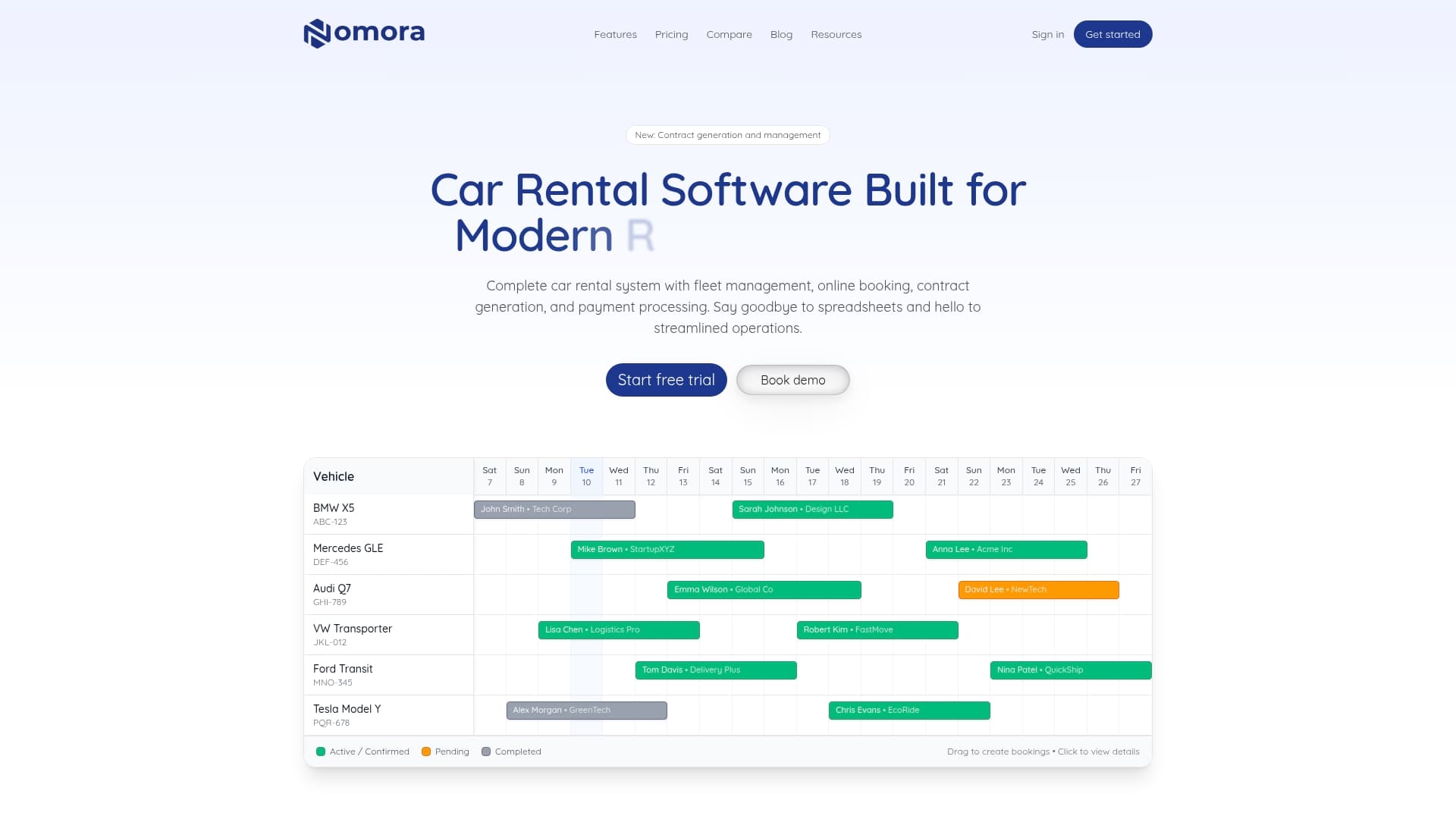
Nomora is a cloud-based fleet management platform built to turn tracking data into operational results. It integrates with GPS tracking hardware to give rental and commercial fleet operators real-time visibility, automated reservation management, and conflict-free scheduling in one place. Whether you run a small independent rental operation or a multi-location corporate fleet, Nomora connects the dots between vehicle location, availability, and customer bookings. Explore the fleet management use cases to see how Nomora supports different business types, from daily rentals to long-term corporate programs, and find the configuration that fits your operation.
FAQ
What are the main types of vehicle tracking systems?
The main types are passive, active, and hybrid systems, classified by data transmission mode. They are further divided by technology: GPS, GSM, satellite, RFID, and OBD-II telematics.
What is the difference between GPS tracking and telematics?
GPS tracking provides vehicle location. Telematics combines GPS location with vehicle diagnostic data from OBD-II or CAN-bus interfaces, adding fuel use, fault codes, and driver behavior to the data stream.
Which tracking system works in areas without cell coverage?
Satellite tracking systems using networks like Iridium or Globalstar provide continuous coverage in remote areas without cellular infrastructure. Hybrid systems buffer data locally and transmit when coverage resumes.
How often do hardwired GPS trackers update location?
Hardwired trackers report location every 10–30 seconds while a vehicle is moving, with longer intervals when stationary, depending on device configuration and platform settings.
What should fleet managers ask vendors before buying a tracking system?
Ask how the device handles cellular dead zones, what specific OBD-II parameters the platform exposes, how frequently data is sampled, and whether the platform is device-agnostic or locked to proprietary hardware.
Recommended