Centralize every incoming notice in one system, link it to a vehicle and driver record within 24 to 72 hours, apply a written recharge or appeal policy, and automate deadline alerts so nothing slips through. If your fleet has no single owner for incoming tickets today, assign one this week, or turn on automated import for your highest-volume notice channel first.
TL;DR:
- Automating traffic fine management reduces missed deadlines by integrating all notices into one system within 24 hours, with automated alerts and centralized data.
- Driver identification should be completed within 72 hours using telematics, reservation logs, and official records to prevent delays and inaccuracies.
- Implementing a clear decision framework for paying, recharging, or contesting fines avoids stalls and ensures approval thresholds are consistently applied.
- Automating data collection and reconciliation minimizes manual efforts, lowers disputes, and enhances audit readiness across multiple jurisdictions.
- Piloting automation on high-volume notice channels first helps measure effectiveness and avoid risks associated with full-scale rollout without clear policies.
Table of Contents
Why traffic fine management is labor-intensive for fleets
Fines arrive through mail, municipal portals, third-party collection agencies, and toll authorities, each with its own format, so someone has to normalize the data before anyone can act on it. Matching a citation to a driver is rarely automatic: it depends on reservation records, telematics logs, motor vehicle records, and sometimes photo evidence that has to be pulled and reviewed by hand. Multi-jurisdiction fleets face a patchwork of deadlines, since NHTSA's state-by-state enforcement surveys confirm that automated enforcement rules and program presence vary widely by state, so a single national policy cannot be assumed. On top of that, finance and compliance teams need clean audit trails for every fine, recharge, and payment.
The friction shows up in a few recurring places:
- Notices come from multiple channels in different formats, requiring manual normalization before processing.
- Driver attribution depends on cross-referencing reservations, telematics, and MVRs, plus collecting proof when records conflict.
- Deadlines differ by jurisdiction, so tracking them manually invites missed windows.
- Every step needs a retrievable audit trail for finance, insurance, and legal review.
The hidden costs and compliance risks of manual fine handling
Manual handling costs more than the fine itself. Staff time spent identifying the driver, drafting a recharge notice, and filing paperwork adds up ticket by ticket, and late fees compound quickly when a notice sits in an inbox past its due date.
Appeal windows are often just 20 to 30 days, according to California Courts' self-help guidance on traffic ticket appeals, which also notes that appeals are procedural and require specific filings, not simply a restatement of the facts. Miss that window and the right to contest the fine is typically gone.
Manual processes also raise compliance exposure in a few specific ways:
- Missed appeal deadlines forfeit the right to contest a citation, regardless of its merits.
- Incorrect driver identification can trigger disputes, recharge pushback, or inaccurate records tied to the wrong employee.
- Incomplete documentation weakens a fleet's position if repeated violations affect insurance underwriting or safety ratings.
Managing traffic fines in 5 practical steps
A working fine-management process does not need to be complicated. It needs five clear steps, each with an owner and a timeline.
- Central intake. Route every notice, whether by mail, portal, or third-party agency, into one inbox or system within 24 hours of receipt. Capture the plate number, violation date and time, jurisdiction, amount, and due date at intake, and use automated import where a channel supports it.
- Driver identification. Cross-reference the violation timestamp against reservation records and telematics data to identify who had the vehicle. When records conflict, pull motor vehicle record checks or request driver confirmation, and treat GPS timestamp plus reservation log as your primary evidence pair.
- Decision framework. Decide whether to pay, recharge the driver, or contest the fine based on written policy thresholds, such as fine amount, driver history, and likelihood of a successful appeal. Set an approval level for anything above a set dollar threshold so decisions do not stall waiting on a manager.
- Appeal workflow. When contesting, assemble the citation, driver statement, and any supporting evidence immediately, since statutory windows are frequently 20 to 30 days as California Courts explains. Loop in counsel for high-value fines or cases involving license sanctions rather than a straightforward civil fine.
- Reconciliation and retention. Post the payment or recharge to the correct accounting entry, issue a recharge notice to the driver where policy allows it, and retain the full file, citation, evidence, correspondence, and resolution, for audit purposes.
Pro Tip: Set a 72-hour internal SLA for driver identification. Anything that takes longer usually means your telematics and reservation data are not talking to each other.
What to look for in a fine-management workflow or system
Whether you build this process manually or adopt software, the same criteria decide whether it holds up at scale; for example, understanding and applying USDOT Number Placement Rules for Fleet Managers helps ensure compliance and supports accurate vehicle identity checks. A workflow needs to parse incoming notices automatically, map license plates to drivers without manual lookup, send deadline alerts before a window closes, and keep an audit log that finance and legal can pull without asking the ops team to reconstruct history.
Integration matters as much as the core features:
-
GPS and telematics data to confirm which vehicle, and often which driver, was on the road at the time of the violation.
-
Reservation or rental management systems to cross-check bookings against citation timestamps.
-
HR and MVR databases to confirm driver identity and license status.
-
Payment gateways to reconcile fine payments and driver recharges in one place.
Operationally, look for role-based access so only authorized staff can approve recharges or appeals, clear exception handling for cases where GPS data is missing or a vehicle was swapped mid-rental, and defined evidence requirements so every dispute has a consistent paper trail. Because these workflows store license plates, driver names, and sometimes license numbers, data privacy and security controls, encryption, access limits, retention schedules, deserve the same scrutiny you would apply to payroll data. A driver license verification playbook covers the documentation side of this in more detail.
Automating fine management: what automation saves and how to introduce it
Automation earns its keep in four specific places: it cuts missed deadlines, reduces the manual search time spent matching a citation to a driver, lowers recharge disputes by producing a clear evidence trail, and eliminates duplicate data entry across systems.
The integration map for a fleet is fairly consistent regardless of size:
- GPS and telematics feeds for vehicle location and timestamp confirmation.
- Reservation systems to identify who booked the vehicle during the violation window.
- MVR databases to confirm license status and driver history.
- Payment processors to handle both the fine payment and any driver recharge.
Start small. Pick your single highest-volume notice channel, whether that is one municipality or one toll authority, and pilot automated intake there first. Track time-to-resolve and late-fee rate as your two core metrics before expanding to other channels.
Pro Tip: Never fully automate exception handling. Cases involving vehicle swaps, shared bookings, or missing GPS data still need a human to review the evidence before a recharge notice goes out.
The most common pitfalls are automating edge cases without oversight, storing driver PII without proper access controls, and rolling out automation with no defined exception workflow for the cases that do not fit the standard pattern. A closer look at telematics and timestamp correlation is useful groundwork before this step.
Vendor-agnostic operational checklist and Nomora-sourced templates
A few standardized templates make the five-step process repeatable across a team, regardless of which system runs it.
- Intake fields: plate number, violation date and time, jurisdiction, amount, due date, and source channel, captured the same way for every notice.
- Driver evidence checklist: reservation confirmation, telematics timestamp, MVR status, and a signed driver acknowledgment, retained for at least the length of the appeal window plus one full billing cycle.
- Recharge notice essentials: citation reference, amount, due date, and a line referencing the policy authorizing the recharge, matched against the reconciliation entry in accounting.
- Shortening driver-ID time: pairing telematics timestamps against reservation logs typically resolves most cases in hours rather than days, leaving manual effort concentrated on the exceptions where GPS was off or the vehicle changed hands mid-rental.
Fleets managing data security around these records may find practical data-handling controls a useful companion reference.
Why pilot-first adoption beats chasing features
Fleets often shop for fine-management features before they have written down their own rules for who pays, who gets recharged, and when counsel gets involved. Codify that policy first. A small pilot, one channel, thirty days, tracked against time-to-resolve and late-fee rate, tells you more than a feature comparison ever will. Whatever system you choose, treat driver PII with the same governance you apply to payroll records, not as an afterthought.
— Dizzy
Where to verify these procedures and policies
For state-level enforcement rules, NHTSA's automated enforcement survey and its system analysis of automated speed enforcement are the primary references, alongside the FHWA speed safety camera program guide for program design standards. For appeal procedures, consult your state court's self-help resources directly.
How Nomora fits into your fine-management process
Most of the friction in this guide traces back to one problem: reservation data, vehicle records, and driver history live in separate places, so matching a citation to a driver takes longer than it should. Nomora keeps reservations, fleet records, and GPS tracking in one cloud-based system, so the driver identification step in your workflow pulls from data that is already connected rather than data you have to chase down across spreadsheets and separate logins. Onboarding is designed to be quick, and plans include access to core features with no hidden fees, enabling fleets to centralize data efficiently. Nomora is not a fine-payment or appeals service, but it removes the manual cross-referencing that eats the most staff time in steps one and two of the process above.
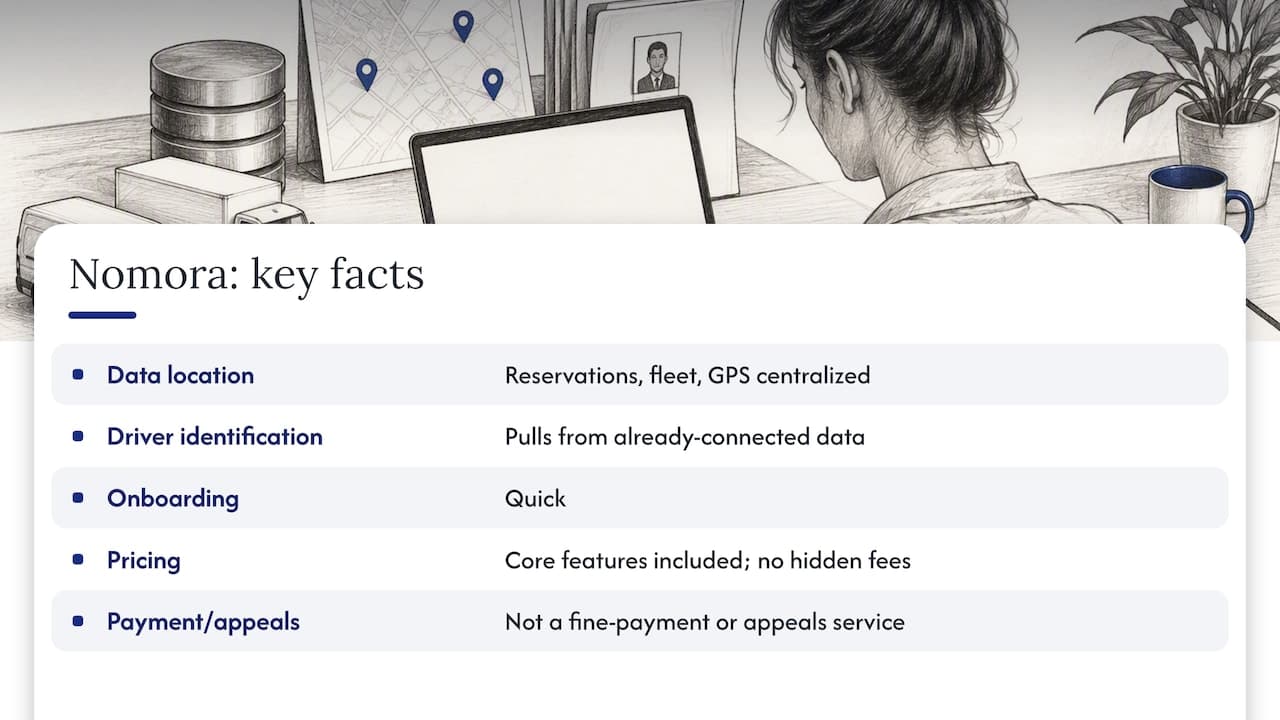
If your team is still matching citations to drivers by hand, see how Nomora's rental management platform centralizes reservation and fleet data, or check current plans on the pricing page to find the right fit for your fleet size.
Sources
FAQ
How do I file a traffic fine complaint?
Most jurisdictions require you to file a complaint or dispute directly with the issuing court or agency named on the citation, following the process listed on the notice itself. State court self-help resources, such as California Courts' appeal guidance, outline required forms and filing windows, which are typically 20 to 30 days from the citation or judgment date.
How can I check my traffic fines?
Check the issuing agency's or court's online portal using the citation number or license plate listed on the notice you received. For fleets managing many vehicles, centralizing intake into one system makes it far easier to track outstanding fines across jurisdictions rather than checking each portal separately.
How long do I have to appeal a traffic ticket?
Appeal windows are frequently 20 to 30 days from the citation or judgment date, though the exact window depends on the issuing jurisdiction, according to California Courts' self-help guide. Treat this window as a hard deadline and assemble evidence, driver statements, and telematics data as soon as a notice arrives rather than waiting.
Who is responsible for paying a fine when a rental or fleet vehicle is involved?
Responsibility typically depends on internal fleet policy: some companies pay the fine and recharge the driver, while others require the driver to handle it directly once identified. A written recharge policy with clear approval thresholds keeps this decision consistent and reduces disputes.
Does automating fine management reduce compliance risk?
Automating intake and driver identification reduces the chance of missed deadlines and incomplete records, both common sources of compliance exposure. It does not remove the need for human review on exceptions, such as vehicle swaps or missing GPS data, where judgment calls still matter.
Recommended
Ready to streamline your car rental business?
Book 30 minutes with the founder. We set up everything in this guide on your own vehicles, and migrate you out of Excel for free.