At-a-glance retention chart by document type
A retention schedule only earns its place on a manager's desk if it can be scanned in under a minute. The table below covers the record categories every rental business generates, with a recommended holding period, the legal minimum where one exists, and the condition that should extend it.
| Document type | Recommended retention | Legal minimum (if any) | When to extend |
|---|
| Rental agreements and signed contracts | Until dispute resolution, plus 3 to 6 years | None specific, but supports tax filings | Active claim, chargeback, or litigation hold |
| Invoices, receipts, payment records | 3 years | 3 years for tax return support | Underreporting risk, extend to 6 years |
| Vehicle inspection reports and condition photos | Until claim period expires, minimum 3 years | Varies by state | High dispute risk or total loss claim |
| Damage claims, insurance correspondence, police reports | Until resolution plus 3 to 6 years | Governed by state statute of limitations | Ongoing litigation or insurer appeal |
| Vehicle title, depreciation, and disposal records | Through the limitation period for the disposal tax year | Tied to IRS rental property recordkeeping guidance | Capital gains dispute or IRS inquiry |
| Payroll and employment tax records | Several years | Retained per IRS employment tax rules | State labor law may require longer retention |
| Telematics, GPS, and mileage logs | As long as operationally necessary | None federal; state privacy rules may apply | Active dispute involving vehicle location or usage |
"Retain until resolved" means the clock does not start until a claim, dispute, or audit formally closes. "Retain until the audit period ends" means counting forward from the date a tax return was filed, not from the transaction date. A single-location operator with low claim volume can lean toward the shorter end of each range. A multi-state fleet with frequent disputes, high-value vehicles, or corporate clients carrying indemnification clauses should default to the longer end and document the reasoning in the retention policy itself.
Statutory baselines: IRS, federal transport rules, and state examples
Retention decisions start with the legal floor, not the ceiling. Three sources set that floor for most U.S. rental operators, and understanding how they interact prevents both under-retention and unnecessary hoarding.
The IRS retention guidance is the most universally applicable rule for any business filing federal returns. It sets a baseline of 3 years from the date a return was filed for records supporting income, deductions, and credits. Employment tax records carry their own 4 year minimum, separate from the general income tax rule, which matters for any rental company running payroll for counter staff, drivers, or maintenance crews.
Federal transportation rules add a second layer for companies involved in interstate commerce or vehicle-for-hire activity. 49 CFR Part 379 establishes preservation periods for transportation-related records and lists specific categories in its appendix, including contracts, dispatch sheets, and vehicle load documentation, with varying retention windows. The rule does not stop a company from keeping records longer to satisfy other obligations, and in practice most rental businesses should treat the federal minimum as a floor rather than a target.
State statutes fill in the rental-specific gaps that federal rules leave open. Virginia Code §46.2-108 is a useful model because it spells out recordkeeping obligations specific to businesses renting motor vehicles without drivers, covering the kind of rental agreement and identification data that federal tax and transportation rules do not directly address. Every state sets its own version of these requirements, so an operator running fleets across multiple states should check the equivalent statute in each one rather than assuming Virginia's language transfers directly.
When these authorities overlap, the longest applicable period wins by default. A few practical rules help sort out conflicts:
- Start with the IRS baseline for anything tied to a tax return, then check whether federal transportation rules or state statutes require a shorter or longer specific period for that same document.
- Treat any active audit, subpoena, or litigation hold as an automatic override that suspends normal disposal schedules for the affected records, regardless of what the baseline period says.
- Document which authority drove each retention decision in the policy itself, so a manager reviewing the schedule in three years understands why a category was set the way it was.
- When state and federal minimums genuinely conflict, or when a rental business operates across state lines with materially different statutes, consult counsel rather than guessing at the safer interpretation.
Getting this layered structure right at the policy level saves far more time than resolving it record by record later.
What to keep and for how long, by record type
Legal minimums tell you the floor. Business risk tells you how much higher than that floor to build. The categories below combine both, since a rental company that only meets the legal minimum on damage claims or contracts is often the one caught without evidence when a dispute surfaces years later.
Rental agreements and signed contracts carry the most direct exposure of any document a rental business holds. They establish the terms of liability, deposit handling, and damage responsibility for every transaction, so the safest approach is to keep them until any related dispute resolves, then add 3 to 6 years on top as a buffer against late-filed claims or chargebacks. A signed agreement tied to a total-loss incident should stay in the file far longer than one tied to an uneventful weekend rental, even though both start on the same clock.
Invoices, receipts, and payment records align closely with the IRS support requirements for anything backing a tax return. The 3 year default covers most routine transactions, but any category of revenue where underreporting risk is plausible, such as cash payments or high-value corporate accounts, should shift to the 6 year window automatically rather than waiting for an audit notice to trigger the change.
Inspection reports and vehicle condition photos are cheap to store and expensive to be missing. Keep them at minimum until the relevant claim period expires, which in most states runs a few years past the rental date, but extend photo evidence specifically whenever a vehicle has any history of prior damage disputes, since photographic proof tends to be the deciding factor in insurer and small-claims disagreements.
Damage claims, insurance correspondence, and any police reports generated during a rental period should stay on file until the claim formally closes and the applicable statute of limitations passes, plus a cushion of a few years beyond that. Insurers sometimes reopen claims after settlement, and having the full correspondence trail available prevents a routine reopening from becoming a scramble.
Vehicle ownership, title, and depreciation records need to survive through the tax limitation period tied to the year the vehicle was disposed of, not the year it was purchased. This mirrors the IRS guidance on rental property recordkeeping, which ties retention of asset records to the disposal year specifically because depreciation and capital gains calculations depend on the full ownership history being available if the IRS questions that year's return.
Payroll and HR records follow the employment tax minimum of 4 years, but personnel files often carry separate state labor law requirements that run longer, particularly for wage disputes or workers' compensation claims. Check state rules directly rather than assuming the federal minimum covers everything in the HR file.
Telematics, GPS, and mileage logs deserve the most conservative approach of any category on this list, for a different reason than the others. These records generate large volumes of location and usage data tied to individual renters, which makes them a privacy liability the longer they sit unused. The practical rule is to keep them only as long as they serve an active purpose, such as resolving a mileage dispute or supporting a damage claim, then remove them. Related guidance on GDPR compliance for car rentals and on employee tracking laws from Moto Watchdog covers the privacy side of this decision in more depth.
- Rental agreements: retain until dispute resolution plus 3 to 6 years.
- Payment records: retain 3 years, extending to 6 years for underreporting risk.
- Telematics data: retain only as long as operationally necessary, and document the purpose for each retained record.
Retention only matters if the records survive in a form that is searchable, intact, and defensible in a dispute. That means treating storage as a security decision, not just an archiving one.
Digital formats should favor long-term stability over convenience. PDF/A is the standard choice for archived contracts and correspondence because it locks formatting and prevents the kind of silent corruption that can happen with editable file types over a multi-year retention window. Where records carry particular evidentiary weight, such as signed contracts or damage documentation, adding a hash or checksum at the time of storage creates a way to prove the file has not been altered since it was filed.
Access controls matter as much as the format. Encryption at rest and in transit protects records from external breach, but role-based access is what prevents internal misuse, limiting who can view, edit, or delete a given record class to the people whose job actually requires it. Audit logs that capture every access and deletion event turn the storage system itself into a piece of evidence, which becomes valuable if a dispute ever raises the question of whether a record was altered or removed improperly. A guide on rental software audit logs covers what a reasonable audit trail should capture.
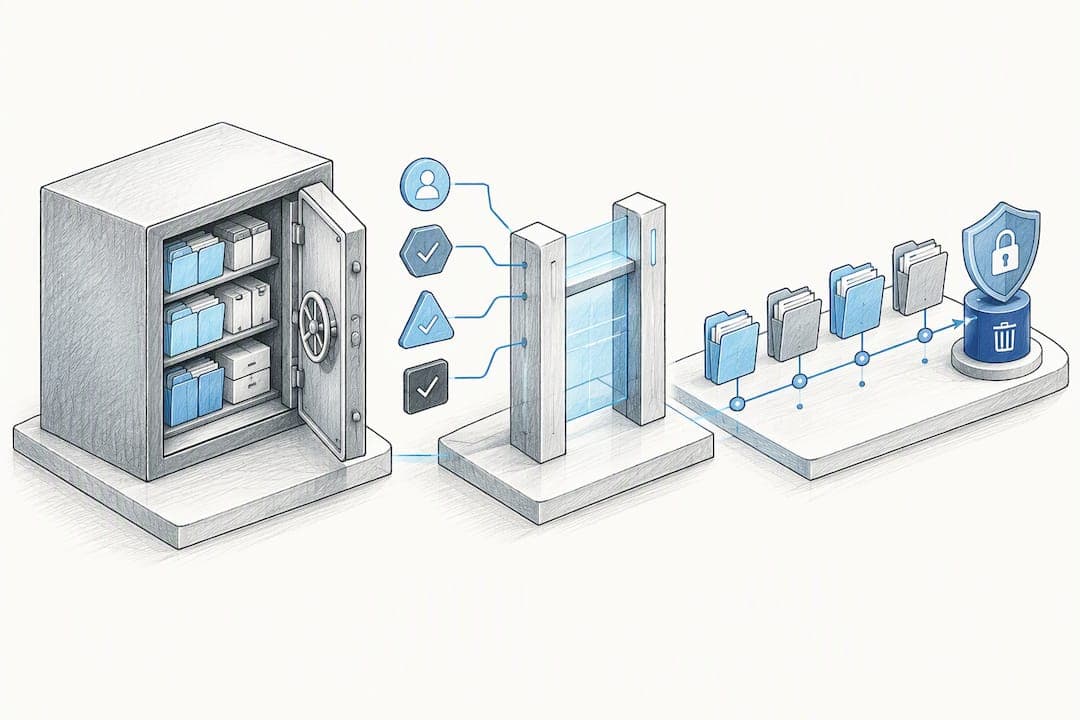
Backups need their own retention discipline. Multiple copies, kept offsite or in a separate cloud region from the primary storage, protect against both technical failure and site-level incidents. Backup retention should mirror the policy set for the live records rather than running on its own separate schedule, since a record that has been properly deleted from the primary system but lingers in an old backup for years defeats the purpose of the deletion.
Some documents still need a physical original on file regardless of how thorough the digital archive is. Vehicle titles and certain insurer forms fall into this category, and those originals should be stored in a locked, fire-rated location with limited key or badge access, separate from day-to-day paperwork.
- Use stable, long-term formats like PDF/A for anything retained past 3 years.
- Apply role-based access and audit logging to every record system, not just the ones holding financial data.
- Keep backup retention aligned with live-record retention so deleted files do not persist indefinitely in older backups.
Pro Tip: Store deletion logs separately from the records they describe, since a deletion log that gets destroyed along with the record it documents is useless in a dispute.
Building, mapping, and automating a retention policy
A retention schedule that lives only in a spreadsheet tends to decay within a year, since nobody updates it once the person who built it moves on to other priorities. Turning the schedule into an actual policy with assigned ownership is what keeps it functional.
- Draft a retention policy document that defines its scope, inventories every record category the business generates, sets a retention period and legal basis for each one, and spells out disposal methods and who is responsible for each step.
- Map where each record category actually lives across accounting software, CRM, fleet management systems, and telematics platforms, since duplication across systems is where retention policies quietly fail.
- Assign an owner for each record class, whether that is the finance lead for tax documents or the fleet manager for inspection reports, and set a review date so the assignment does not go stale.
- Automate archiving and deletion wherever the underlying system supports it, and build a separate exception workflow that can place a legal hold on specific records without disrupting the rest of the schedule.
- Run periodic audits that confirm deletions actually happened on schedule, and keep a deletion report as proof that the policy is being followed rather than just written down.
The mapping step is usually where operators discover the real risk. A signed contract might exist as a PDF in the rental software, an attachment in an old customer service email, and a printed copy in a filing cabinet, all with different retention clocks running because nobody set them consistently.
Practical guidance on organizing fleet records by purpose can help managers sort out which copy is authoritative before setting the schedule.
Pro Tip: Set retention review dates to coincide with your annual tax filing, so the same conversation that covers this year's deductions also covers whether last year's disposal schedule actually ran.
Destroying records safely and keeping proof
Retention policies fail as often at the disposal end as at the storage end. Keeping a record for exactly the right number of years does no good if the eventual destruction cannot be proven or if it exposes sensitive data during the process.
Physical records containing financial, personal, or vehicle identification data should go through cross-cut shredding or a certified destruction vendor, and for any batch of sensitive documents, a certificate of destruction from that vendor becomes part of the compliance file. Digital records require a different standard entirely. Deleting a file or emptying a recycle bin does not remove the underlying data from storage media, which is why cryptographic erasure or a full-disk wipe is the defensible standard for anything containing personally identifiable information or telematics data.
Every destruction event should be logged with the document type, the date, the method used, who authorized and carried it out, and the evidence produced, whether that is a shred certificate or a system-generated erasure log. This log is what turns "we deleted it" into something an auditor or a court will accept.
- Use certified shredding or destruction vendors for sensitive physical records and keep the resulting certificate.
- Apply cryptographic erasure or full-disk wipes for digital records containing PII, never a simple file deletion.
- Log every destruction event with date, method, responsible party, and supporting evidence.
- Treat recycle-bin deletion or informal disposal as insufficient for any record tied to a customer or a regulatory requirement.
How rental software can automate retention and disposal
Manually tracking retention dates across dozens of record categories and multiple storage systems is where most policies break down in practice, not because the rules are unclear but because enforcing them by hand does not scale past a handful of vehicles.
A rental management platform can close that gap by attaching retention rules directly to the events that generate records. Nomora, as one example of this kind of system, ties contract generation, payment processing, and fleet data into a single cloud platform, which means a retention schedule can be enforced at the point where a record is created rather than reconstructed later from scattered files.
- Event-based archiving that timestamps a contract, invoice, or inspection report the moment it is generated, so retention counts from an accurate date rather than a guess.
- Scheduled deletion rules that can be applied by record category, removing the need to manually track hundreds of individual expiration dates.
- Role-based access and audit logs that record who viewed, edited, or deleted a record, supporting the kind of proof-of-deletion requirement covered earlier.
- Automated contract generation and payment records that reduce the number of scattered copies a single rental produces across email, spreadsheets, and paper files.
The onboarding process can reduce setup time, which matters for a compliance conversation because it means a retention policy built into the system does not sit unused for months while implementation drags on.
Security and access controls built with GDPR-minded settings in mind, combined with cloud accessibility, mean a retention policy enforced in the software applies consistently regardless of which staff member or location is handling a given rental. For an operator managing this manually across spreadsheets, that consistency is often the hardest part to achieve on its own.
Recommended baseline policy and where to stay flexible
The biggest mistake rental operators make with retention is treating it as an all-or-nothing decision: either keep everything forever out of caution, or keep the bare legal minimum and hope nothing surfaces later. Neither approach reflects how disputes and audits actually unfold. A purpose-bound policy, where each record category has its own retention period tied to why that record exists, protects the business without turning storage into a liability of its own.
A workable baseline for most small to midsize rental operators looks like this: 3 years for routine invoices and payment records, extending to 6 years for any account with underreporting risk, contracts and damage claims held until resolution plus a 3 to 6 year cushion, asset and title records held through the disposal tax year's limitation period, and telematics data purged as soon as its operational purpose ends. Review this schedule annually, not because the underlying law changes often, but because business risk does. A rental company that starts serving corporate fleet clients or expands into a new state should revisit its schedule immediately rather than waiting for the next scheduled review. When a dispute, audit, or multi-state conflict arises that the baseline does not clearly cover, that is the moment to bring in counsel rather than guess.
— Dizzy
Nomora: how it supports your retention policy
Building a retention schedule is only half the work. Enforcing it consistently across every rental, every vehicle, and every staff member is the part that spreadsheets and shared drives tend to lose over time.
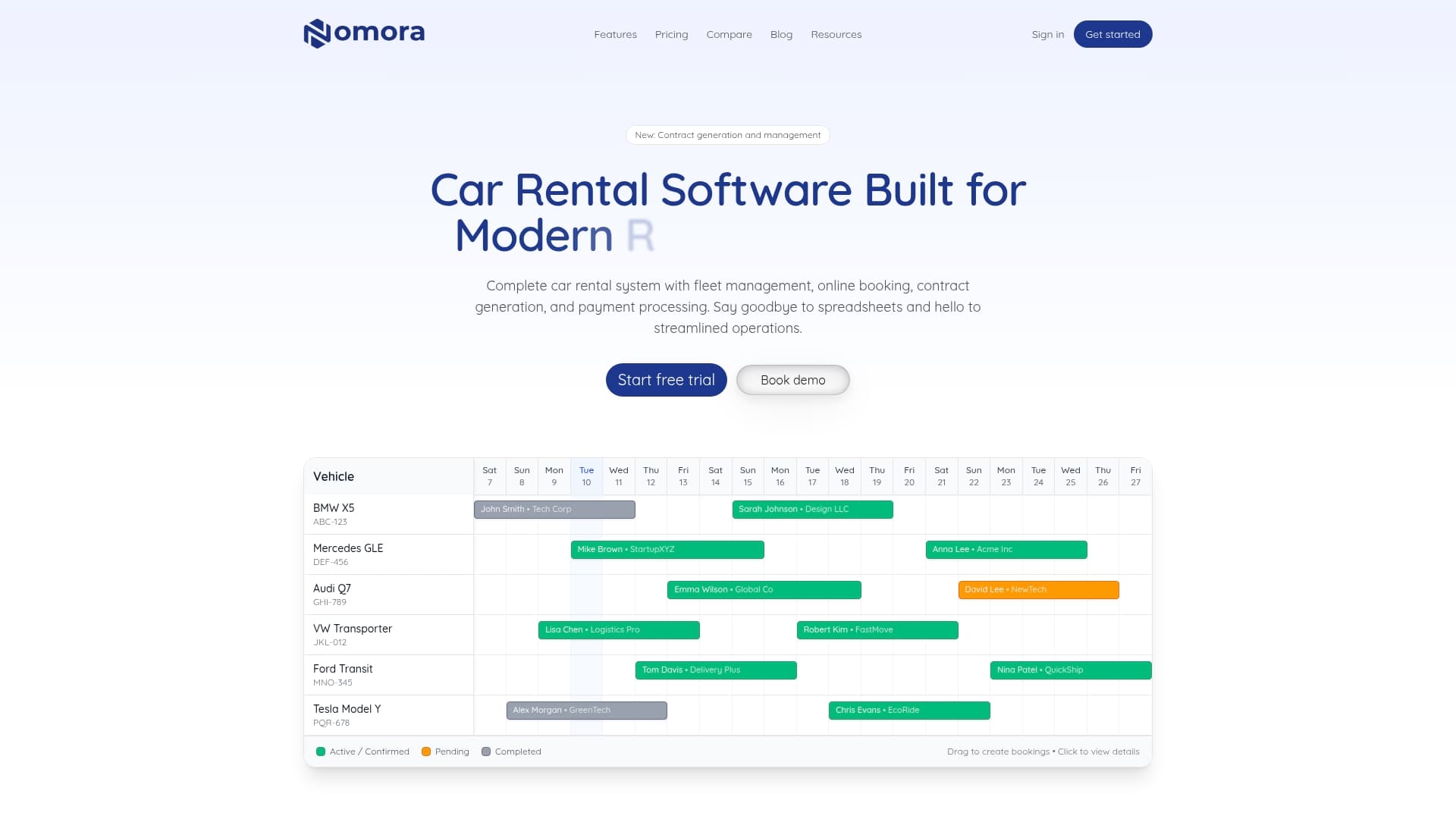
Nomora replaces that manual tracking with a cloud-based system where contract generation, payments, fleet data, and GPS tracking all live in one place, so the retention rules covered in this guide can be attached to records automatically instead of maintained by hand. Real-time data visibility and conflict-free booking tools mean a manager can see exactly what records exist for a given vehicle or rental without hunting across multiple systems, and role-based access keeps sensitive documents restricted to the people who need them.
For an operator ready to move off spreadsheets, Nomora's plans scale with fleet size. The Starter plan runs €45 per month, while the Business plan is priced at €2.80 per month per vehicle and the Fleet plan at €2.20 per month per vehicle, with an Enterprise option available for larger operations. Every plan includes full feature access with no hidden fees, and onboarding typically takes 24 to 48 hours.
Review the pricing page to compare plans against your fleet size, or explore how the platform fits your specific business type before requesting a demo.
Sources
Start with the IRS recordkeeping guidance for tax retention baselines and 49 CFR Part 379 for federal transportation preservation rules. Virginia Code §46.2-108 offers a concrete state-level example of rental-specific obligations. For implementation guidance on privacy and telematics data, see Nomora's posts on GDPR in fleet management and securing customer data.
FAQ
What is the longest you can keep a rental car on record?
There is no fixed cap on how long a rental business can retain records related to a specific rental car. The practical limit is set by the retention category involved: tax-supporting documents typically follow the IRS 3 to 6 year window, while title and disposal records extend through the tax limitation period for the year the vehicle was sold or retired.
How many years does rental history typically need to be kept?
Most routine rental agreements and payment records should be retained for at least 3 years to satisfy IRS support requirements, extending to 6 years where underreporting risk exists. Contracts tied to unresolved damage claims or disputes should be kept until resolution, plus an additional 3 to 6 year cushion.
How long do rental companies typically keep records?
Retention practices vary by company and record type, but most rental businesses align routine financial records with the IRS 3 year guideline and keep contracts or claims-related documents until any dispute resolves. Specific retention periods for any individual rental company are not publicly listed, so the schedules above reflect general legal and operational baselines rather than any one operator's internal policy.
Can I put a high number of miles on a rental car?
Mileage limits for a specific rental are set by the rental agreement itself, not by any general legal standard, so the allowed mileage varies by company and rental type. Mileage logs and telematics data tied to a rental should be retained only as long as needed to resolve any dispute over usage, then removed to limit unnecessary data exposure.
Recommended