TL;DR:
- Most car rental failures stem from operational inefficiencies, not bad ideas or poor service. Standardizing processes and measuring KPIs lay the foundation for effective automation and fleet optimization. Relying on technology without first stabilizing operations often leads to amplified problems and reduced ROI.
Most car rental businesses don't fail because of bad ideas or poor customer service. They stall because manual processes quietly eat into margins, inconsistent workflows create costly errors, and fleets sit underutilized while fixed costs keep climbing. If you've hit a growth ceiling and can't figure out why, the answer is almost always operational. This guide gives you a practical, step-by-step roadmap to break through that ceiling, covering how to benchmark your current state, automate core workflows, optimize fleet utilization, and measure the ROI of every improvement you make along the way.
Table of Contents
Key Takeaways
| Point | Details |
|---|
| Standardize operations | Document processes and KPIs first to enable reliable, measurable scaling. |
| Automate with purpose | Target bottlenecks and enforce consistency with workflow software to reduce errors. |
| Maximize fleet utilization | Monitor utilization rates, optimize pricing, and reduce downtime for higher profits. |
| Measure and refine ROI | Benchmark performance before and after implementing new tools for tangible results. |
| Avoid 'tool-first' traps | Never invest in technology before your workflows and baseline data are solid. |
Assess your current state and set a foundation
With a clear understanding of why most rental businesses stall, it's crucial to dig into your own operation and analyze where you stand before adding new technology or expanding. Scaling on top of broken or inconsistent processes doesn't fix problems; it amplifies them.
The foundation of any successful scaling effort is standardization. Before you automate anything, you need to define exactly how your business operates at every stage: reservation intake, vehicle check-out, damage inspection, return processing, invoicing, and maintenance scheduling. If two employees handle the same task differently, your data is unreliable, your customer experience is inconsistent, and any software you layer on top will inherit those inconsistencies.
Once processes are documented, establish your key performance indicators (KPIs). These are the numbers that tell you whether your business is healthy. For a car rental operation, the most critical KPIs include:
- Utilization rate: The percentage of your fleet rented on any given day or period
- Turnaround time: How quickly a vehicle moves from return to ready-for-rent status
- Average booking lead time: How far in advance customers book
- Revenue per available vehicle day (RevPAD): A metric combining price and utilization
- Cost per mile for maintenance: A direct indicator of fleet health and spend efficiency
- Ancillary revenue per rental: Income from add-ons like insurance, GPS, or child seats
The fleet reporting benchmarks you establish now become the baseline against which all future improvements are measured. According to industry guidance, a practical scale plan for SMEs is to first standardize operations and define KPIs, then implement automation, then expand pricing and ancillary revenue, and finally validate ROI with baseline measurements across cost categories including fuel, maintenance, labor, utilization, and risk.
Sample baseline KPI table:
| KPI | Your current value | Industry target |
|---|
| Fleet utilization rate | ? % | 70–80% |
| Turnaround time (hours) | ? hrs | Under 2 hrs |
| Average booking lead time | ? days | 3–7 days |
| Maintenance cost per mile | $ ? | Track and reduce quarterly |
| Ancillary revenue per rental | $ ? | 15–25% of base rental rate |
| Revenue per available vehicle day | $ ? | Set based on your market |
Use these fleet management best practices to align your internal metrics with what the industry recognizes as healthy benchmarks. Reviewing your utilization benchmarks against external standards gives you an honest picture of where you stand.
Pro Tip: Standardize your processes in writing before you scale. A new hire or a new software system should be able to follow your procedures without needing to ask a manager for every edge case. Consistency now prevents very expensive rework later.
Automate core workflows and enforce consistency
Once you have a clear baseline and core processes defined, the next step is to strategically automate daily operations and ensure those workflows are consistent across your business.
Automation in the car rental context means using software, APIs (application programming interfaces), and AI-driven tools to replace tasks that currently require manual intervention. These include confirming bookings, sending payment reminders, updating fleet availability in real time, generating rental contracts, and notifying customers at each stage of their experience. AI and workflow automation can target both back-office and customer-facing steps, including chat support, automated workflow triggers via APIs, predictive maintenance alerts, and demand forecasting for better revenue planning.
The risk many operators fall into is automating the wrong things first. Start with your biggest time sinks and highest error-rate processes. If your team spends two hours per day manually checking availability and confirming bookings by phone or email, that's where automation delivers the fastest return.
Step-by-step approach to automating your operations:
- Map every workflow: Write out each step in your key processes, from initial inquiry through to final billing and vehicle return.
- Identify failure points: Mark the steps where errors occur most often, where staff spend the most time, or where customer complaints originate.
- Document the policy: Before automating, confirm the correct, standardized version of each workflow in writing.
- Choose the right automation tier: Not every task needs AI. Simple tasks like booking confirmations and invoice generation need basic workflow software. Demand forecasting and predictive maintenance benefit from more advanced tools.
- Implement and train staff: Roll out changes one process at a time, train your team thoroughly, and collect feedback before moving to the next workflow.
The comparison between manual and automated operations is significant in both time and accuracy:
| Workflow | Manual process | Automated process |
|---|
| Booking confirmation | 10–20 minutes per booking | Under 60 seconds |
| Fleet availability update | Manual, prone to double bookings | Real-time, conflict-free |
| Contract generation | 15–30 minutes, error-prone | Instant, templated |
| Payment collection | Follow-up calls, delays | Automatic billing, instant notification |
| Maintenance scheduling | Reactive, often forgotten | Triggered by mileage or calendar |
"To avoid scaling failures, ensure organizational consistency and that workflows do not depend on individuals remembering steps; enforce standardized workflows via software or workflow management systems." (Source: What breaks first when scaling fast)
Think of your rental management software as the central nervous system of your operation. Every part of the business sends and receives signals through it. If that system is fragmented or manual, messages get lost, decisions slow down, and the whole operation becomes reactive instead of proactive. Reviewing the software vs spreadsheets ROI makes the financial case for this transition very concrete.
Also consider the role of a predictive maintenance guide in reducing unplanned vehicle downtime, which is one of the most direct ways to improve utilization without adding a single vehicle to your fleet.
Pro Tip: Start with automation that addresses your biggest time sinks or failure points. Trying to automate everything at once leads to poor implementation and confused staff. Pick one workflow, get it right, then move to the next.
Optimize fleet utilization and dynamic pricing
With automation in place, it's time to make the most of your fleet and inventory by focusing on what drives the bottom line: utilizing assets and adjusting pricing for real market conditions.
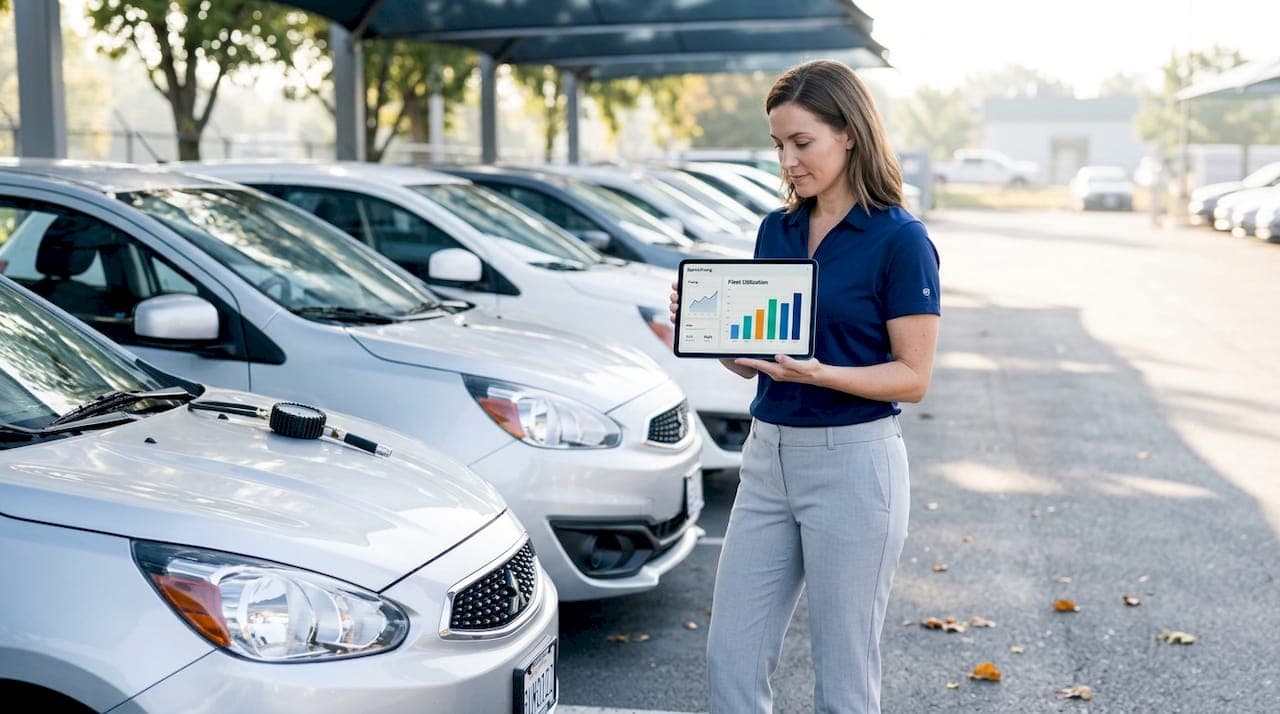
Fleet utilization is the single most powerful lever in a car rental business. Every vehicle sitting idle is revenue that cannot be recovered. Fleet utilization benchmarks show that average daily utilization clusters around 70 to 79%, with peaks reaching 90 to 95% in high season and a maintenance and cleaning band accounting for 5 to 10% of offline time. Your target should be to push consistently toward the upper end of that 70 to 80% range while managing your maintenance windows efficiently.
Proven ways to boost fleet utilization:
- Dynamic dispatch: Match vehicle availability to incoming demand in real time, prioritizing high-demand categories and locations
- Demand forecasting: Use historical booking data and seasonal trends to anticipate periods of high and low demand, adjusting inventory positioning accordingly
- Fast turnaround protocols: Streamline the cleaning, inspection, and check-in process so vehicles spend less time offline between rentals
- Maintenance downtime control: Use preventive scheduling rather than reactive repairs to keep vehicles available during peak periods
- Multi-channel distribution: List inventory across booking channels to maximize exposure and fill low-demand periods
Pricing strategy is equally important. The key rental scaling mechanics for profitability include higher utilization, dynamic or segmented pricing, and monetizing high-margin add-ons rather than focusing only on cutting costs. Segmented pricing means adjusting your rates based on location, season, vehicle category, booking lead time, and inventory levels. A vehicle available during a holiday weekend in a high-demand location should never be priced the same as the same vehicle available on a Tuesday in January.
| Strategy | Expected profit impact |
|---|
| Increase utilization from 65% to 78% | 10–18% revenue increase |
| Add dynamic pricing by season and demand | 8–15% rate improvement |
| Monetize ancillaries (insurance, GPS, upgrades) | 15–25% boost to rental revenue |
| Reduce turnaround time by 30 minutes | Up to 5% more available rental days annually |
Use your fleet reporting strategies to monitor these numbers in real time, not just in monthly reports. Combine that visibility with solid rental pricing strategies and apply inventory optimization tips to align your fleet composition with actual demand patterns.
Benchmark, measure ROI, and refine as you grow
Once you've launched automation and optimization strategies, ongoing measurement and refinement are essential to ensure your scaling efforts pay off and keep delivering results.
The baseline KPIs you recorded before implementation now become your most valuable tool. Compare current performance against those numbers at regular intervals: monthly during the first quarter post-implementation, then quarterly thereafter. Fleet management software ROI is typically justified by measurable reductions in fuel costs, maintenance spend, labor hours, and risk-related losses, all of which require that initial baseline to quantify accurately.
Typical fleet scaling ROI timeline:
| Phase | Timeframe | What to measure |
|---|
| Go-live | Weeks 1–4 | Adoption rate, time savings per task, error reduction |
| Early results | Months 2–4 | Utilization change, labor hours saved, booking volume |
| Breakeven | Months 6–10 | Cost savings vs. software investment |
| First-year value | Months 10–14 | Full ROI across all cost categories |
Industry data suggests that the average time to achieve ROI from fleet management software is approximately 10.31 months, compared to a benchmark average of 14.66 months for leading solutions. Knowing this gives you a realistic expectation and helps you benchmark your own timeline.
Steps to regularly assess and refine your scaling program:
- Pull monthly performance reports across all core KPIs and compare against your baseline and your targets.
- Identify underperforming areas and determine whether the cause is a process issue, a training gap, or a configuration problem with your software.
- Gather staff feedback on workflow pain points that data alone may not reveal.
- Adjust pricing and fleet positioning based on seasonal demand data and booking trends.
- Review your ROI case study frameworks quarterly and update your cost-benefit calculations with actual figures.
Use your measurement cadence to identify not just what isn't working, but what's working better than expected. Allocate more resources toward high-performing strategies and scale back or restructure those that aren't delivering. The strategies for higher ROI available to rental operators grow more effective the longer you maintain rigorous measurement habits.
Pro Tip: Build a feedback loop by reviewing your tech stack and workflows every quarter. Markets shift, demand patterns change, and software capabilities expand. A quarterly review keeps your operation aligned with current realities rather than last year's assumptions.
Having outlined how to implement and measure effective scaling, it's worth pausing for a frank look at the biggest mistake rental businesses make on this journey: relying on software before operations are stable.
Many operators see a slick platform demo, purchase a subscription, and expect the technology to sort out their operational chaos. It doesn't work that way. Software enforces and accelerates whatever processes you already have. If your processes are inconsistent or poorly defined, automation will just make those problems happen faster and at greater scale.
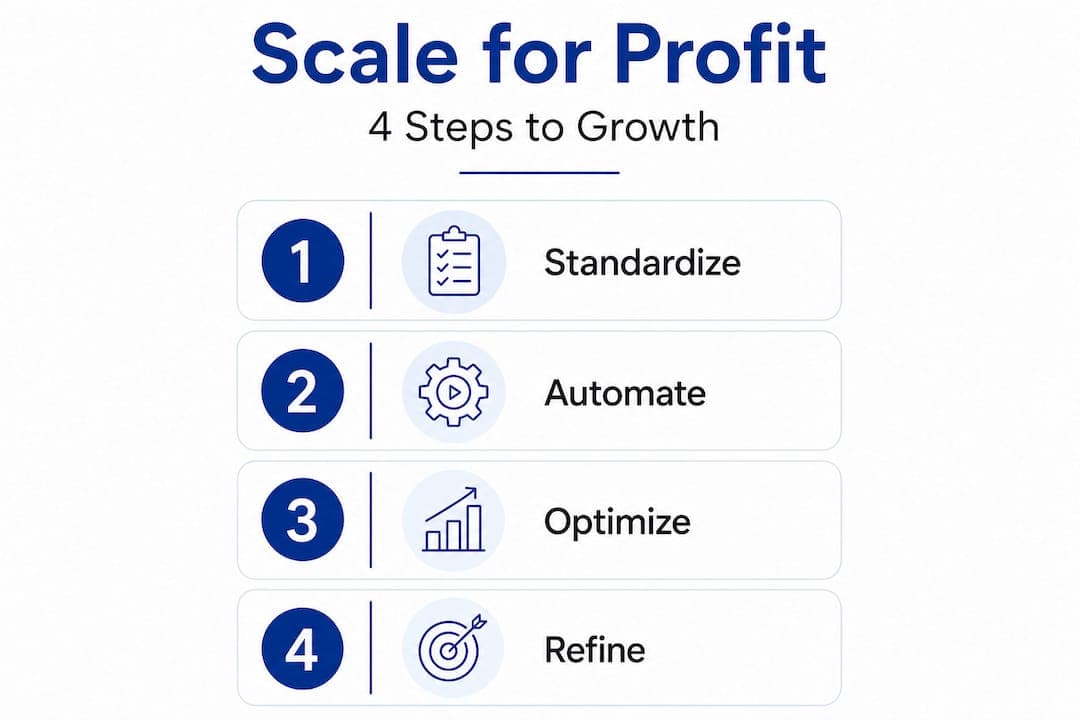
The most successful scaling stories we observe share a common trait: disciplined process work came first. These businesses invested time in mapping their workflows, training their teams, and measuring their baselines before spending a dollar on new technology. When they did implement software, the transition was smooth, adoption was high, and ROI was measurable. The practical scale plan for SMEs confirms this sequence: standardize first, automate second, expand third, and validate ROI throughout.
This is a contrarian position in an industry that loves to talk about technology. But the uncomfortable truth is that technology is only as good as the people and processes behind it. The businesses that see benchmarked ROI results are the ones that did the foundational work first.
Our advice: make every technology purchase contingent on a specific, measurable problem you are trying to solve. Define the metric you expect to improve, set a target, and hold the tool accountable for delivering it. If a piece of software can't demonstrate its value against your baseline within a reasonable timeframe, that's critical data, not a reason to keep paying.
Process discipline is not glamorous. But it is the most reliable path to sustainable, profitable growth in this industry.
Take the next step toward smarter scaling
If you're ready to put these strategies into action and avoid the most common scaling mistakes, here's how our platform can help.
Nomora is built specifically for car rental businesses that want to move beyond spreadsheets and manual coordination. The platform acts as the central operational hub, connecting reservations, fleet management, payments, contracts, and customer data in one place.
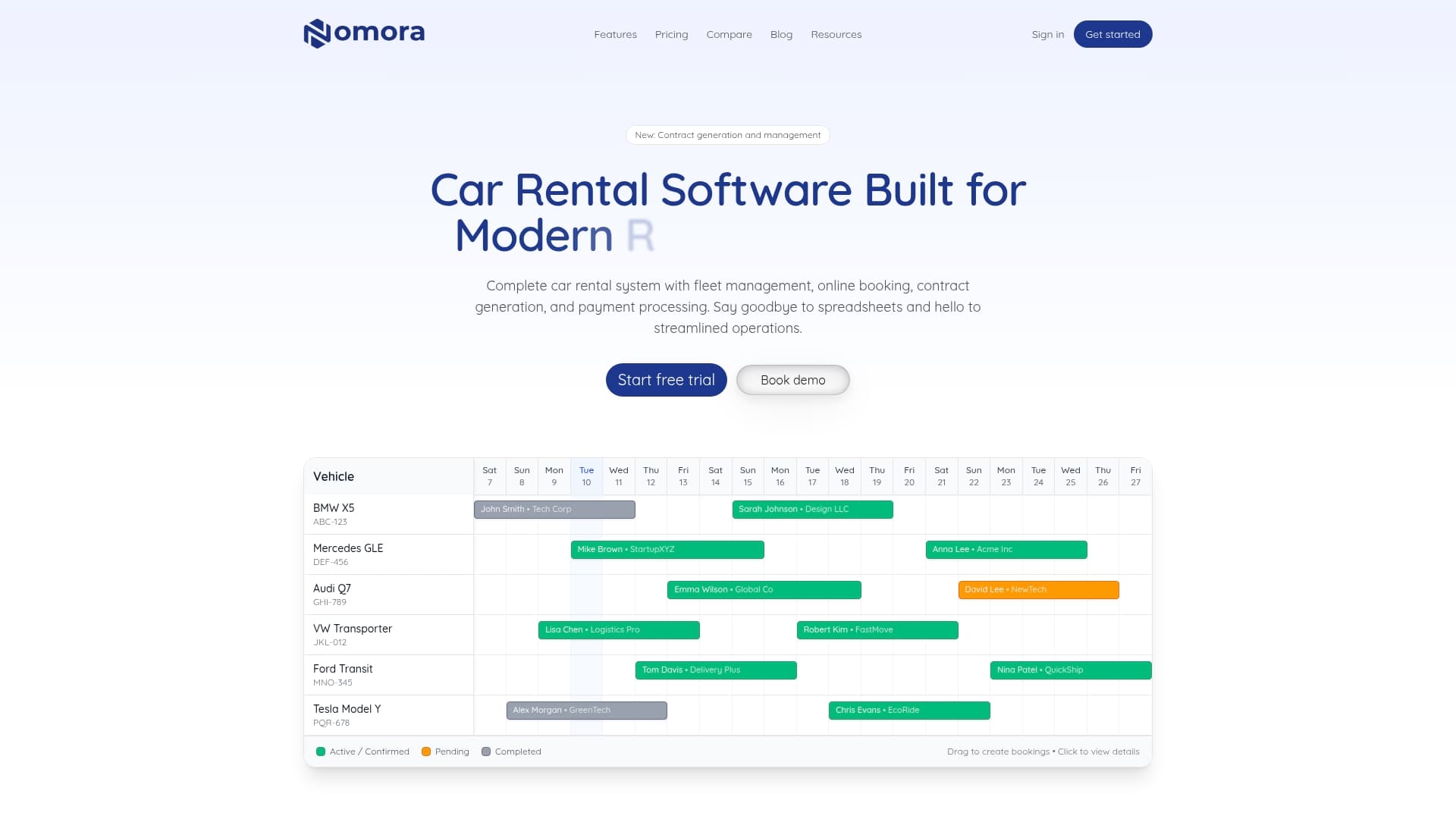
From preventing double bookings to automating payment collection and generating contracts instantly, Nomora handles the repetitive work so your team can focus on growth. Whether you run a small independent operation or manage a larger fleet network, the car rental software use cases available through Nomora are designed to support every stage of scaling. Explore modern fleet management software that gives you real-time visibility, conflict-free bookings, and the data you need to make smarter decisions every day.
Frequently asked questions
What is the most important metric when scaling a car rental business?
Utilization rate is the critical metric, because it directly connects fleet capacity to revenue generation. Average daily utilization clusters around 70 to 79% for well-run operations, making it the clearest indicator of operational efficiency.
How does automation increase profit margins in rental businesses?
Automation reduces manual workload, cuts errors, speeds up vehicle turnaround, and creates consistent pricing and upsell opportunities across every booking. AI and workflow automation targets both back-office and customer-facing processes, compounding the efficiency gains over time.
How long does it usually take to see ROI from rental fleet management software?
Based on industry data, the average time to achieve ROI is approximately 10.31 months, compared to a benchmark average of 14.66 months, so operators should plan for a 10 to 14 month payback window.
What is the biggest mistake businesses make when trying to scale?
The most common error is purchasing software before standardizing workflows, which means the technology enforces broken processes rather than fixing them. A practical scale plan always puts process standardization and KPI definition ahead of any automation investment.
What's a quick win for boosting car rental profits?
Monetizing high-margin add-ons such as insurance, GPS units, and vehicle upgrades delivers faster profit growth than cutting operational costs alone. Key rental scaling mechanics confirm that ancillary revenue is one of the most direct levers available to rental operators at any scale.
Recommended