Key Takeaways
| Point | Details |
|---|
| Set your criteria | Define integration must-haves like API flexibility, compliance, and data accuracy before choosing solutions. |
| Automate finance and fleet | Payment and accounting integrations cut manual work and sync financials instantly for error-free operations. |
| Track and optimize in real-time | GPS and telematics integrations let you monitor vehicles, prevent theft, and make data-driven maintenance and usage decisions. |
| Expand bookings and profits | Channel and pricing integrations increase revenue and fleet utilization by linking you to new markets and automating price updates. |
| Integration strategy matters | Mapping workflows and tackling edge cases turns tools into competitive advantages and prevents implementation pitfalls. |
Integration criteria: What matters for fleet success
With the benefits of integration clear, the next step is knowing exactly what to evaluate before committing to any solution. Not all integrations are built the same, and choosing the wrong one can create more friction than it solves.
The foundation of any reliable integration is API flexibility. A REST API with webhook support allows your rental management software to send and receive data in real time, rather than relying on slow batch syncs that leave gaps in your records. Before signing with any vendor, confirm they support REST APIs and webhooks, and ask about their data sync frequency. Hourly syncs may work for small fleets, but larger operations often need near-instant updates to avoid booking conflicts and inventory errors.
Regional compliance is another factor that many operators underestimate. In the United States, Electronic Logging Device (ELD) mandates apply to certain commercial vehicles, and your GPS or telematics provider must be compliant. In Europe, GDPR governs how customer data is collected and stored. Choosing a vendor that ignores these requirements exposes you to legal risk.
Security standards matter just as much. Payment integrations should meet PCI DSS compliance (the industry standard for credit card data security), while data handling across the platform should align with GDPR where applicable.
When evaluating integration partners, use this checklist:
- REST API and webhook support for real-time sync
- Data accuracy guarantees and error handling protocols
- Regional compliance certifications (ELD, GDPR, PCI DSS)
- Vendor support quality: response times, onboarding help
- Scalability: can the integration grow with your fleet?
- Hardware agnosticism for GPS and telematics devices
For payment and GPS specifically, the integration system guide recommends prioritizing REST APIs and webhooks for seamless sync, starting with Stripe for payments and Wialon or Geotab for GPS depending on your region. Aligning these choices with your fleet management criteria from the start will save you significant rework later.
Pro Tip: Before signing any integration contract, request a sandbox environment. Testing data flows before going live catches sync errors that would otherwise show up as double bookings or missing payments.
Payment and accounting integrations: Automate revenue and reconciliation
Once your evaluation criteria are set, payment and accounting integrations become the financial backbone of your operation. These tools eliminate manual invoice creation, reduce entry errors, and give you a real-time picture of cash flow.
Stripe and PayPal are the two most widely used payment processors in the car rental space. Stripe charges 2.9% plus $0.30 per transaction and is fully PCI-compliant, handling card data security so you don't have to. PayPal offers similar coverage with a slightly different fee structure and broader international reach. Both integrate cleanly with most rental management platforms via API.
On the accounting side, QuickBooks and Xero are the dominant choices. QuickBooks syncs invoices and payments automatically, complete with line items and tax mapping, eliminating double-entry entirely. Xero offers similar functionality with stronger multi-currency support, which is useful for businesses serving international travelers. The instant sync of invoices with customer details and line items means your books are always up to date without manual intervention.
Here is a quick comparison of the top options:
| Tool | Type | Key Feature | Best For |
|---|
| Stripe | Payment processor | PCI-compliant, 2.9% + $0.30 | Most rental operations |
| PayPal | Payment processor | International reach, buyer protection | Cross-border rentals |
| QuickBooks | Accounting | Auto invoice sync, tax mapping | US-based businesses |
| Xero | Accounting | Multi-currency, real-time reporting | International fleets |
Edge cases are worth planning for. Chargebacks and payment disputes are a reality in rental businesses. Stripe's built-in dispute management tools, combined with your rental contract data, give you a clear paper trail. For regional tax mapping, confirm that your accounting integration can handle state-by-state tax rules if you operate across multiple locations.
Key benefits of payment and accounting integrations:
- Automated invoice generation at reservation completion
- Real-time payment capture and reconciliation
- Tax mapping across jurisdictions
- Chargeback documentation and dispute support
- Elimination of manual double-entry between systems
Pro Tip: Set up automated payment reminders within your rental platform before invoices are due. Combined with QuickBooks sync, this reduces late payments and keeps your receivables clean without extra admin work.
GPS and telematics integrations: Real-time tracking and fleet control
Beyond finance, GPS and telematics keep your fleet visible and protected at all times. These integrations move fleet oversight from reactive to proactive, giving you data on vehicle location, condition, and behavior in real time.
Wialon and Geotab are the two leading platforms for car rental telematics. Wialon costs $5 to $10 per vehicle per month and supports over 2,500 device types, making it a flexible choice for fleets of any size. Geotab runs $15 to $25 per vehicle per month and uses OBD-II plug-in devices with 10-second location updates, ideal for fleets that need high-frequency data and deep diagnostics.

Here is how the two platforms compare:
| Feature | Wialon | Geotab |
|---|
| Monthly cost | $5-$10/vehicle | $15-$25/vehicle |
| Device compatibility | 2,500+ device types | OBD-II focused |
| Update frequency | Varies by device | 10-second intervals |
| Best for | Mixed hardware fleets | Standardized fleets |
Geofencing is one of the most practical features these integrations offer. You can define geographic boundaries for each vehicle and receive instant alerts when a car leaves an authorized zone. Combined with odometer sync and fuel monitoring, you gain a complete picture of how each vehicle is being used.
"Telematics APIs like RentalMatics integrate with Renteon, Wheelsys, and Thermeon for real-time monitoring, damage detection, and theft prevention."
Real-time tracking also supports damage detection at pickup and return, creating timestamped records that hold up in disputes. For US operators, ELD compliance is a non-negotiable requirement for applicable vehicle classes, and both Wialon and Geotab meet those standards.
Cloud-based telematics solutions offer a critical advantage over hardware-locked systems: you avoid vendor lock-in and can scale your fleet without replacing infrastructure. If you manage a booking rental workflow across multiple locations, cloud connectivity means every branch sees the same fleet data simultaneously.
Booking, channel, and pricing integrations: Expand reach and maximize profits
With fleet and finance optimized, booking and pricing integrations unlock your next phase of growth. These tools connect your inventory to more customers and ensure your rates always reflect current demand.
Online travel agencies (OTAs) like Booking.com give you access to millions of travelers who would never find your business through direct search. Top car rental integrations include booking channels and OTAs like Booking.com, as well as system integrations with HQ Rental, Bluebird, Nomora, and Thermeon. These connections allow your inventory and pricing to update automatically across all platforms, eliminating the risk of overbooking.
Comparison of booking and pricing integration options:
| Platform | Type | Primary Benefit |
|---|
| Booking.com | OTA channel | Massive traveler reach |
| HQ Rental | System integration | Fleet and rate sync |
| Bluebird | Channel management | Multi-channel distribution |
| Nomora | All-in-one platform | Unified operations |
Pricing engines add another layer of intelligence. Demand forecasting tools analyze booking patterns, local events, and seasonal trends to recommend rate adjustments automatically. Pricing optimization integration has generated millions in revenue for rental companies by aligning fleet availability with pricing strategy, automating price transfers, and achieving ROI in under one year.
Key features to look for in pricing integrations:
- Automated rate updates across all channels
- Demand forecasting based on historical and real-time data
- Minimum and maximum rate guardrails
- Competitor rate monitoring
- Integration with your existing rental pricing strategies
For operators looking to go deeper, a dedicated pricing optimization guide covers advanced yield management techniques specific to car rental. The broader opportunity here is real: travelers who book car rental online expect consistent pricing across platforms, and channel integrations make that consistency effortless.
Pro Tip: Start with one OTA integration before expanding to multiple channels. Master the inventory sync and rate management process on a single platform, then scale outward. Rushing to list on five channels at once without proper sync can create booking conflicts that damage your reputation.
Most car rental owners approach integrations as a shopping list: pick a GPS tool, add a payment processor, connect an OTA. That mindset leads to disconnected systems that create new problems instead of solving old ones.
The operators who see the biggest gains treat integration as a workflow design exercise first. Before adding any tool, they map how data moves from reservation to return, identify where manual steps slow things down, and then select integrations that eliminate those exact friction points. The tools follow the workflow, not the other way around.
Scaling also demands a cloud-first mindset. GPS and integration data reduce theft and mileage disputes while unifying operations to boost fleet utilization and profitability. But those gains only hold if your architecture can handle growth. Hardware-dependent setups break when you open a new location or add 50 vehicles. Cloud-based SaaS integrations scale without infrastructure investment.
Post-integration edge cases are where most businesses lose ground: chargebacks that lack documentation, tax rules that weren't mapped, offline GPS gaps during connectivity loss. Planning for these scenarios before they happen is what separates a resilient operation from one that's constantly firefighting. Explore fleet profitability insights to understand how the most profitable rental businesses build their processes around their integrations from day one.
Ready to optimize your rental business? Explore top solutions
Nomora is built to handle exactly the integration stack described in this guide, from automated payments to GPS tracking, OTA booking channels, and dynamic pricing, all within a single cloud-based platform. Whether you are running a small independent fleet or a multi-location operation, Nomora connects the tools you need without the patchwork setup.
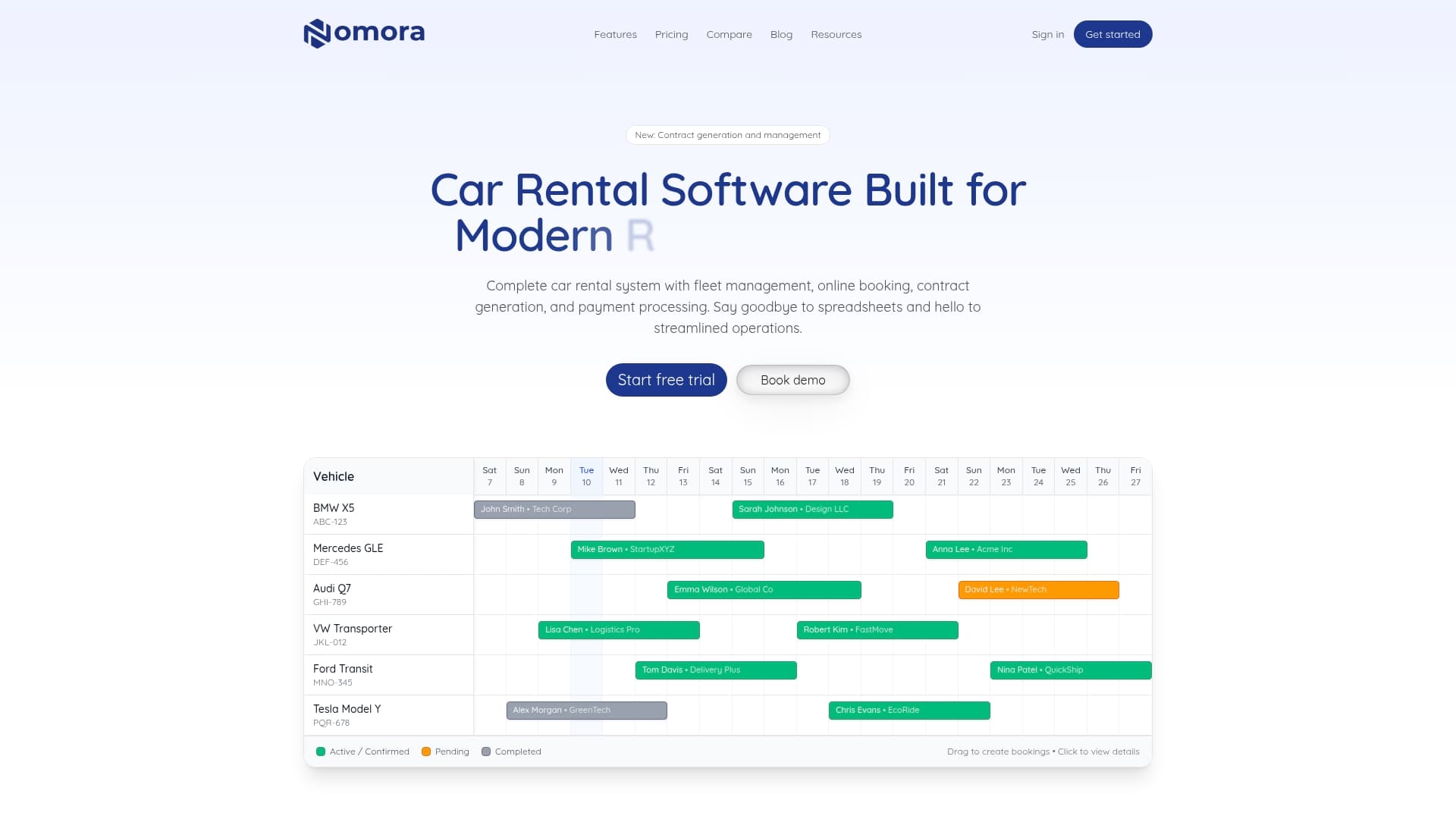
Explore car rental software use cases to see how Nomora fits your specific operation. You can also dive into automated rental payments to streamline your financial workflows, or learn how the platform helps you prevent double bookings across every channel. Implementation takes 24 to 48 hours, and Nomora's onboarding team guides you through every integration step.
Frequently asked questions
What is the most cost-effective GPS integration for a small fleet?
Wialon offers GPS tracking at $5 to $10 per vehicle per month and supports over 2,500 device types, making it a practical and affordable choice for small fleets with mixed hardware.
How do integrations impact revenue for car rental businesses?
Integrations increase revenue by 20-35% through automation and expanded booking channel reach, while reducing manual data entry by up to 90%.
What's the fastest way to automate payment reconciliation?
Connecting Stripe or PayPal with QuickBooks enables instant invoice and payment sync, eliminating manual entry and reducing reconciliation errors significantly.
How do pricing integrations improve fleet profitability?
Pricing optimization tools automate rate updates and use demand forecasting to align fleet availability with market pricing, with documented ROI achieved in under one year.
Are integrations with booking channels complicated to set up?
Most modern car rental platforms support direct OTA integrations like Booking.com, with vendor-guided onboarding and scalable API options that simplify setup considerably.
Recommended