What a Useful Audit Log Records
An audit log earns its name only when it captures the full lifecycle of the events that touch your fleet, not just the ones that are easy to log. Rental operations generate several distinct categories worth tracking separately:
- Reservation and booking lifecycle events, from creation through modification to cancellation
- Contract edits, including amendments and digital signature events
- Payments, refunds, and failed charge attempts
- GPS events and geofence entries or exits
- Vehicle status changes (available, in service, out for repair)
- User role and permission changes
- Data exports and API calls
- Authentication events, including failed logins
Each entry in that log needs specific fields to be useful later. At minimum: the actor's ID, email, and role; a timestamp in UTC down to the millisecond; the action name; the resource type and ID it touched; a before/after diff; the source (was this a UI click, an API call, or a background job); and metadata like IP address, device, app version, and GPS coordinates where relevant. An optional reason field matters more than it sounds. A production-grade schema should answer who acted, what they did, what changed, what it changed on, when, and from where, every time.
The diff and source fields are what separate a real audit log from a glorified activity feed. Knowing that a return date changed matters less than knowing it moved from June 3 to June 10, that a branch manager made the edit through the admin panel rather than the customer app, and that the edit happened at 11:47 p.m. from an unrecognized IP address.
Why Audit Logs Matter for Compliance, Disputes, and Theft Recovery
A clean audit trail turns a multi-day compliance review into an afternoon of query results. Auditors and insurers ask predictable questions: who approved this discount, when was this vehicle marked stolen, why does this contract show two different mileage figures. A rental system with searchable, field-level history answers those requests in minutes instead of forcing someone to reconstruct events from memory or scattered spreadsheets.
The stakes show up clearly in a few recurring scenarios:
- Insurer claims often hinge on exact timestamps: when a GPS geofence exit occurred relative to a reported theft, or when a damage note was added to a contract.
- Customer disputes over billing usually come down to a single question: did the customer authorize this charge, or did staff apply it without consent?
- Internal investigations into scope creep or fraud depend on seeing every edit to a rate or discount field, not just the final number.
Weak logging costs you exactly when you need it most. Unverifiable edits, missing diffs, and slow queries turn a routine audit into a liability, and governance guidance for fleet operators increasingly recommends logging read events too, since exposure of sensitive location data can carry consequences similar to unauthorized edits. Raw, unchained logs are also not enough on their own. A proper fleet audit trail links records chronologically so investigators can reconstruct a sequence of events rather than piece together isolated log lines.
Technical Design: The Minimum Audit Log Schema
If you're evaluating a platform or specifying requirements to your IT team, the schema doesn't need to be complicated. It needs to be complete. A workable audit_events table includes:
- tenant_id: isolates your data from every other rental company on a shared platform
- actor_id / actor_email: who performed the action, tied to a real user record
- action: a fixed vocabulary string like
booking.updated or payment.refunded
- resource_type / resource_id: what the action touched and its unique identifier
- changes: a JSON field storing the before and after state
- metadata: IP address, device, app version, GPS coordinates, and session details
- source: whether the action came from the UI, an API call, or a background job
- created_at: the timestamp, stored in UTC with millisecond precision
Query patterns matter as much as the fields themselves. Four lookups cover most audit needs: a full account timeline, a single actor's history, an event-type filter, and an affected-entity lookup. An index on tenant_id and created_at descending is the one that carries the most query weight, and it's worth confirming your platform has it before you need it during a live audit.
Append-only enforcement is a design choice, not a policy statement. That means a separate writer role, revoked UPDATE and DELETE permissions on the audit table, row-level security enforcing tenant isolation, and partitioning that separates hot recent data from cold archives.
Pro Tip: Set a retention baseline of at least 12 months for every record type, and extend it further for anything touching PCI, SOC 2, or contractual dispute windows. Legal hold should be able to override your default retention on a per-case basis, not force a blanket policy change.
Access Controls, Alerts, and Export Workflows
Good logs sitting unused are worse than useless, they're a false sense of security. Role-based access needs to be explicit: full administrative access to a small group, read-only access to support staff and branch managers who need to investigate disputes, and session controls backed by SSO and multi-factor authentication for anyone touching the audit interface. Vendor documentation for fleet platforms commonly restricts audit log access to account admins by default, which is the right instinct even if it occasionally slows down a support ticket.
A read API or SIEM export matters more than passive log collection ever will. Enterprise buyers increasingly ask about export access before they finalize pricing, because a log you can't query on demand is a log you can't actually use.
A few alert rules catch most of the trouble worth catching:
- Booking or rate edits made outside normal business hours
- Cost variances above a set dollar threshold on a single transaction
- Mass export events, especially of customer payment data
- Repeated failed login attempts on privileged accounts
Route flagged events to a manager's inbox or a shared channel, not a log file nobody checks. When you do need to pull records for a legal case, export the relevant tenant-scoped data, tag it under legal hold so it's excluded from routine deletion, and keep a record of who requested the export and why.
Pro Tip: If your platform supports it, run a quarterly test export of a random booking's full history. If anything is missing, you want to find out during a drill, not during a subpoena.
What Good Audit Entries Actually Look Like
Reading a real audit entry makes the abstract schema click. A booking edit should show something like: return date changed from June 3 to June 10, actor "j.martinez@fleetco.com" (branch manager), submitted from a mobile device at IP 98.42.x.x, timestamp 2026-03-11T23:47:02Z.

A payment reversal record needs the original charge ID, whether the reversal was triggered by a person or an automated system rule, a reason code, and confirmation the event was captured in the export log. A GPS geofence exit tied to a theft claim should show the exact exit timestamp linked to any subsequent status changes, like the vehicle being marked stolen or a police report number being attached to the record. A contract amendment should show field-level diffs, not a vague "contract updated" note, along with a hash of the specific contract version being referenced.
These examples matter because work order history that preserves old values, new values, actor identity, and a reason field is what actually holds up when someone questions a change months later.
Admin Checklist: What to Ask Your Vendor or IT Team
Before you sign a contract or finalize an internal build, run through this list:
- Can you export tenant-scoped logs on demand, without a support ticket?
- Is the audit table genuinely append-only, with UPDATE and DELETE permissions revoked?
- Who has the ability to delete or archive log records, and is that access itself logged?
- What retention periods are available, and can they be set per record type?
- Is there a read API or a direct SIEM export option?
- Which metadata fields get captured automatically: IP, device, app version, GPS?
- Are before/after diffs stored in a searchable format, or just as free text?
- How are role changes and other privileged actions logged, and who reviews them?
- Do common queries (actor history, entity lookup) return results fast enough to use during a live call with an auditor?
If a vendor can't answer most of these clearly, that's your answer about whether the platform is audit-ready.
Catching Trouble Before It Becomes a Problem
Audit logs are only half the job if nobody's watching them. The other half is automated alerting that flags unusual patterns without requiring a human to scroll through thousands of entries looking for something out of place.
The most useful alert rules target behavior that's statistically rare and operationally risky at the same time. A booking edit at 2:00 a.m. isn't automatically fraud, but it's rare enough to deserve a second look. A single user exporting the full customer database in one session is a pattern almost no legitimate workflow produces. A spike in failed login attempts against an admin account, or a sudden run of large refunds processed by one employee in a short window, both fit the same category: technically possible in normal operations, but rare enough that a human should confirm intent.
Set thresholds that reflect your actual volume rather than generic defaults. A ten-vehicle operation and a five-hundred-vehicle franchise network have very different baselines for what counts as a "burst" of activity. Route alerts to a specific person or shared channel with enough context to act, not just a raw log line. The best-configured systems tie anomaly detection directly to the same audit table used for compliance reporting, so a flagged event and its full history are one click apart instead of living in separate tools. That single connection point is often the difference between catching a problem in hours versus discovering it during next year's audit.
Where to Start and What Can Wait
If you're building this out from scratch, sequence matters. Turn on logging for bookings, payments, role changes, and exports first. Those four categories answer the overwhelming majority of audit and dispute requests you'll actually face. GPS and other high-volume telemetry can come next, paired with partitioning or sampling so storage costs don't spiral before the data proves its value.
Write down your retention policy, your legal hold process, and who owns exports, in plain language your whole team can follow. Then run an internal audit tabletop exercise once a year. Pick a fake incident and see how fast your team can actually pull the records.
— Dizzy
How Nomora Handles Bookings, Contracts, and Fleet Records
Nomora replaces the spreadsheet-and-sticky-note approach to rental operations with one system that tracks reservations, contracts, payments, and fleet status in a single place, which is exactly the foundation an audit trail needs to work.
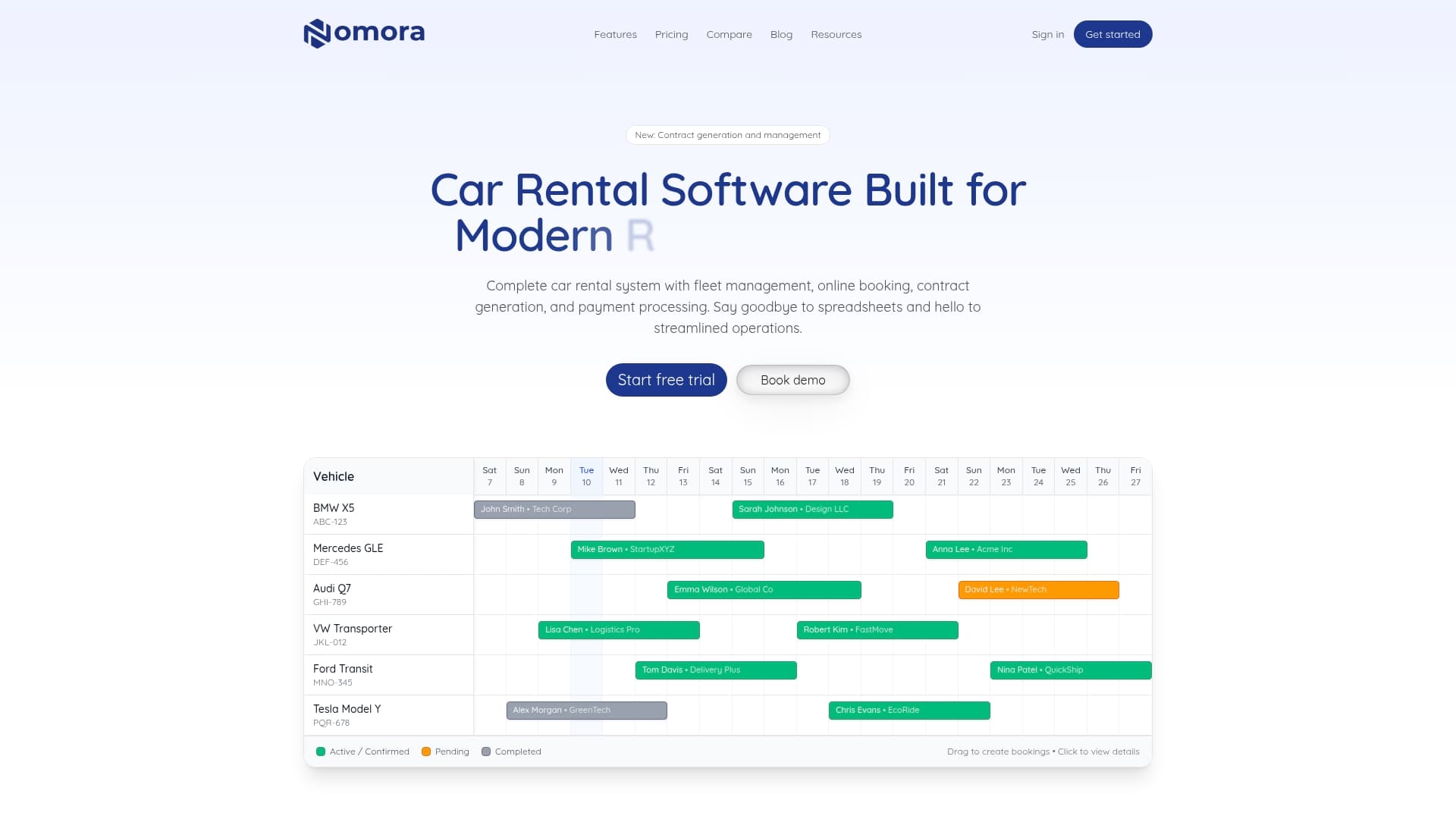
Because Nomora already handles reservations, fleet management, contracts, and payments in one integrated system, the events that matter for an audit, a booking edit, a contract amendment, a payment reversal, aren't scattered across disconnected tools. That's the practical advantage over managing rentals through spreadsheets and separate point solutions: one system means one place to look when an auditor or insurer asks a question.
Nomora's plans start at $45 per month for the Starter tier, with per-vehicle pricing on the Business and Fleet plans as your operation scales. Onboarding typically takes 24 to 48 hours. If you want to see how the platform fits your specific operation, explore Nomora's use cases by business type or check current plan details on the pricing page to find the right starting point for your fleet.
Sources
FAQ
What Should a Rental Software Audit Log Actually Record?
It should capture every booking, contract, payment, GPS, and user action event with the actor's identity, timestamp, before/after values, and the source of the change, whether that's the UI, an API call, or a background job.
How Long Should Rental Companies Retain Audit Logs?
A minimum of 12 months is a reasonable baseline, with longer retention recommended for anything touching payment card data, contractual disputes, or specific regulatory frameworks like SOC 2.
Full administrative access should stay limited to a small group, while support staff and branch managers typically need read-only access; vendor platforms commonly restrict audit visibility to account admins by default.
Does Nomora Provide Audit Trail Capabilities?
Nomora tracks reservations, contracts, payments, and fleet data within one integrated system, giving managers a single, consistent record source instead of fragmented logs across separate tools.
Why Do Insurers and Auditors Ask for Log Diffs Instead of Final Values?
A final value alone can't prove what changed, who changed it, or when, while a before-and-after diff tied to a timestamp and actor identity gives auditors and insurers something they can actually verify.
Recommended