Cards on file, when tokenized and properly authorized, give rental operators the fastest and most reliable way to collect deposits and post-rental charges. The setup works when three things are in place: a tokenized card vault instead of stored numbers, a signed authorization that spells out what can be charged and when, and a payment gateway that correctly separates customer-initiated transactions from merchant-initiated follow-ons. Get those three right, and you cut collection delays, reduce lost fees on tolls and damage, and speed up every checkout.
TL;DR:
- Using tokenized cards for post-rental charges and recurring billing reduces delays, speeds up checkouts, and minimizes fee losses when properly implemented.
- Authorization and PCI compliance rely on storing tokens instead of raw card data, with clear customer consent linked directly to rental contracts.
- The most effective workflow combines a hold at pickup with token vaults for subsequent charges, supplemented by signed paper authorizations for high-value rentals.
- Most small operators can implement a secure card-on-file system within a week by choosing a compatible gateway, connecting it to reservation systems, and testing all transaction paths.
- Integrated platforms like Nomora simplify deployment by combining tokenized payment processing, deposit automation, and contract management into a single system.
Table of Contents
How Card-On-File Workflows Operate in Rental Businesses
A card-on-file (COF) system works in two phases. First, the customer enters or swipes their card at booking or check-in. That's a customer-initiated transaction (CIT), and it's the moment the gateway captures the card and issues a token, a scrambled reference number that stands in for the actual card data. From that point forward, your system uses the token, not the card, for anything that follows.
Three flows cover most rental scenarios:
- Pre-auth hold for a deposit. The token places a temporary hold on funds at pickup, released automatically if there's no damage.
- Delayed damage charge. Days after return, staff use the token to bill for a scratched bumper or a missing accessory. This is a merchant-initiated transaction (MIT), since the customer isn't present to approve it live.
- Scheduled monthly billing. For long-term or corporate rentals, the token triggers a recurring charge on the same date every cycle, no manual entry required.
Only the first touchpoint needs the customer physically present. Everything after that runs on the CIT to MIT pattern that card networks built specifically for delayed charges, reauthorizations, and no-show fees.
Security and Compliance Essentials: Tokenization, PCI, and Consent
Ask any payment gateway one question before you sign a contract: "Do you store card data, or do you store tokens?" If the answer isn't an immediate, confident "tokens," keep looking. Tokenization means your rental system never touches the raw 16-digit number, which keeps your business largely out of scope for the heaviest PCI DSS requirements.
Three habits keep you compliant:
- Never store card numbers in spreadsheets, CRM notes, or paper files. Push that scope entirely to the gateway.
- Confirm your gateway holds current PCI attestations and can explain its breach response process in plain language.
- Record consent properly. That means a signed digital authorization stating exactly what can be charged (deposit, damage, late fees), over what timeframe, and how the customer can reach you with questions.
Pro Tip: Attach the signed authorization directly to the rental contract in your system, not in a separate file. When a dispute lands, you want the charge and the consent sitting side by side.
Common COF Methods and When to Use Them
Not every rental scenario calls for the same payment mechanism. Matching the method to the situation is what separates smooth operations from constant billing headaches.
- Token vaults work best for post-rental incidental charges, tolls, fuel shortfalls, cleaning fees, and for any recurring billing arrangement. The token sits dormant until you need it, with no expiration tied to a single transaction.
- Pre-authorizations (holds) fit security deposits well. The hold reserves funds without moving money, and most holds expire automatically within 5 to 7 days if not captured, so you need a process to release or convert them before that window closes.
- Recurring payments suit monthly equipment leases and corporate fleet accounts. Build in retry logic (typically two or three attempts over a few days) and automatic notifications to both your team and the customer when a charge fails.
- Signed paper authorization still has a place for high-value rentals or corporate accounts where a wet signature satisfies internal audit requirements, even if the actual charge runs through the same tokenized workflow.
The right combination usually blends at least two of these: a hold at pickup, a token vault for anything that surfaces afterward.
Implementation Checklist: Step-By-Step for a Secure Card-On-File Rollout
Rolling out COF doesn't require a six-month IT project. Most small and mid-size operators can be live within a week if they follow a defined sequence instead of improvising.
- Choose a gateway that supports tokenization and both CIT and MIT flows, then request API credentials for your developer or integration partner.
- Connect the gateway to your reservation or contract system. A dedicated rental management platform with built-in payment integration skips a separate build step entirely.
- Add explicit authorization language to your rental contract and capture the signed consent at the moment of booking, not after the fact.
- Document your hold-versus-charge policy, including expiry windows and the exact wording of customer notification templates.
- Test every path before going live: a successful hold, a successful charge, a failed charge with retry, an expired card scenario, and a simulated dispute.
Pro Tip: Run your test transactions with a real (small) charge to your own card first. Simulated sandbox environments often miss the quirks of how your specific gateway handles declines.
Operational Best Practices and Handling Edge Cases
The technology handles the transaction. Your team still has to handle the customer relationship around it, and that's where most disputes actually start or get resolved.
- Send an automated notification before and after every charge, with an itemized receipt attached, so nothing feels like a surprise deduction.
- Set retry rules for recurring payments (two attempts over 48 to 72 hours is common), and escalate to manual outreach only after automated retries fail.
- Keep photo documentation and signed condition reports for every rental. When you charge a token for damage weeks later, that evidence is what stands between you and a successful chargeback.
- Build a standing policy for expired cards: automated reminders 30 days before expiration, with a simple, one-click way for customers to update their payment details.
How Nomora Implements Card-On-File Safely
Nomora's platform builds tokenized payment processing and deposit automation directly into its reservation and contract workflow, rather than treating payments as a bolt-on feature. Cards are captured once at booking, tokenized through the integrated gateway, and linked automatically to the signed rental contract, which covers the authorization and audit trail this article outlines.
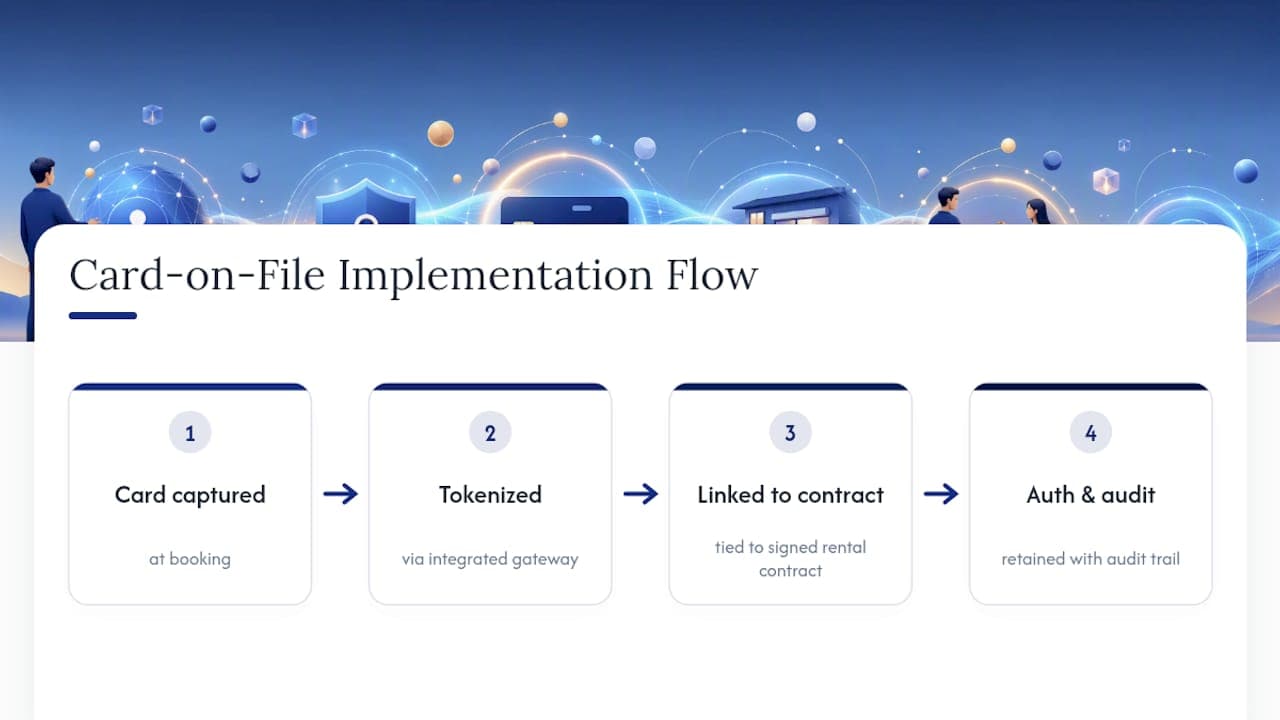
That structure maps cleanly onto the implementation checklist above: one connected system instead of stitching together a separate gateway, a separate contract tool, and a separate CRM. For fleet operators tracking vehicles alongside payments, pairing this with GPS integrations closes the loop between where a vehicle is and what's been authorized against it.
Why Now Is the Right Time to Adopt Card-On-File
Waiting for a perfect rollout costs more than starting small. Begin with tokenized deposit holds, the lowest-risk entry point, then expand into recurring billing once your team has tested the process end to end.
— Dizzy
Get Card-On-File Running Without Building It Yourself
Most operators don't want to stitch together a gateway, a token vault, and a contract system by hand. That's the gap Nomora closes: integrated payment processing with tokenized card storage and automated deposit handling built into the same platform that manages your bookings and fleet.
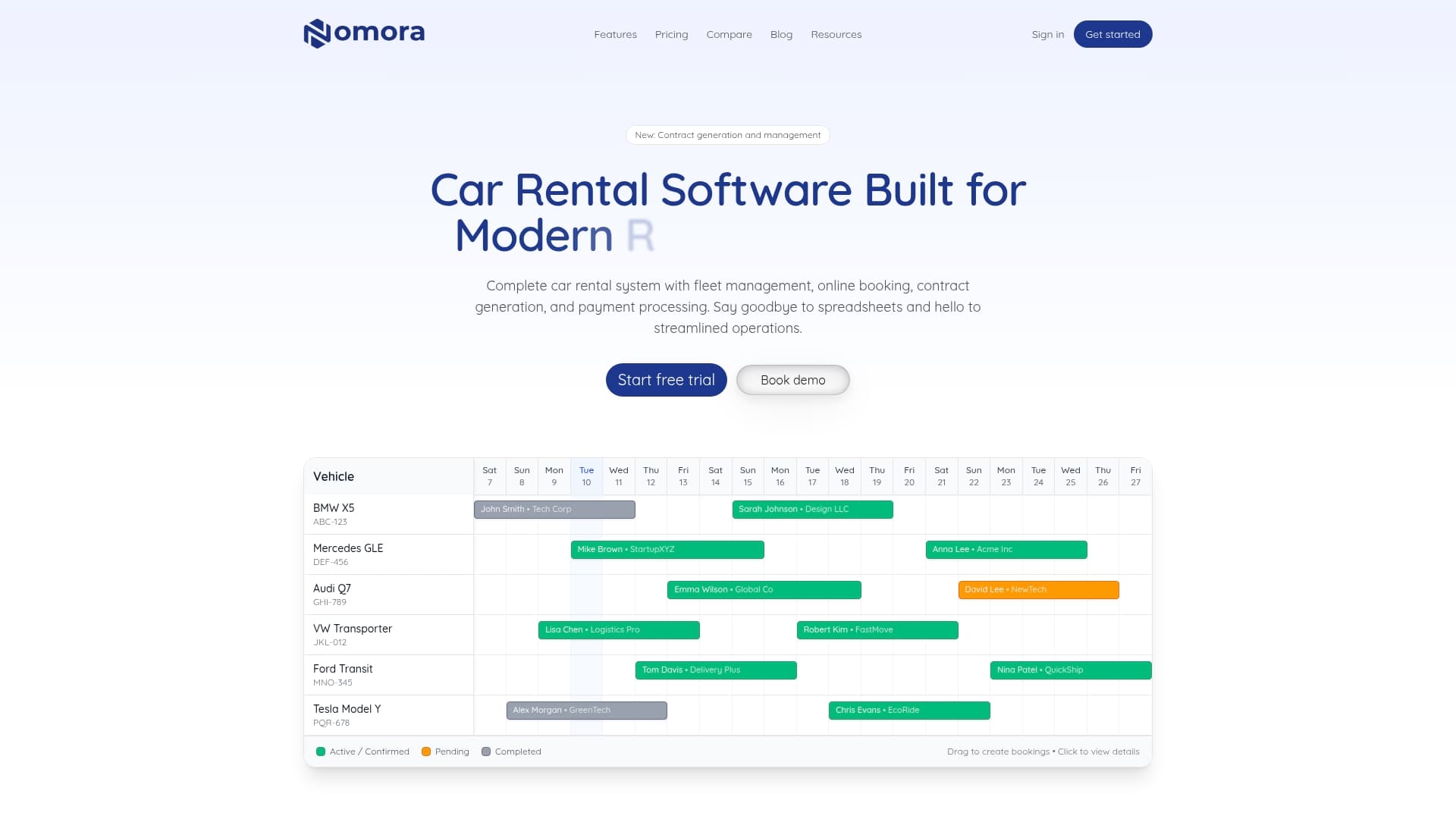
Instead of vetting PCI attestations and API documentation on your own, you get a system where the authorization language, the charge history, and the vehicle record already live together. Nomora's plans, including Starter, Business, and Fleet, come with payment processing built in rather than sold as a separate integration project, and many operators are fully operational within a short time. If you're ready to see how tokenized deposits and automated billing would run inside your own fleet, take a look at the car rental software overview and check current plan details on the pricing page.
Authoritative Sources and Further Reading
FAQ
Is a debit card acceptable for card-on-file rentals?
Most rental operators prefer credit cards because they support holds and reauthorizations more reliably than debit cards, which draw directly from a checking account and can complicate release timing on deposits.
Can a customer use a prepaid card to pay for a rental?
Prepaid cards can work for the initial payment, but they're risky for card-on-file setups because a hold or later damage charge can fail if the balance has already been spent elsewhere.
What's the best payment method for rent or rental payments generally?
A tokenized credit card on file is generally the most reliable option because it supports both the upfront charge and any follow-on charges like damage or late fees without collecting new payment details each time.
What is the difference between a customer-initiated and merchant-initiated transaction?
A customer-initiated transaction (CIT) happens when the customer actively enters or presents their card, while a merchant-initiated transaction (MIT) uses the stored token later, without the customer present, for things like delayed damage charges.
Does Nomora support tokenized card-on-file payments?
Yes, Nomora's integrated payment processing includes tokenized card storage and deposit automation as part of its rental management platform, with current plan pricing listed on its pricing page.
Recommended
Ready to streamline your car rental business?
Book 30 minutes with the founder. We set up everything in this guide on your own vehicles, and migrate you out of Excel for free.