Key Takeaways
| Point | Details |
|---|
| Predictive maintenance saves money | Using telematics and timely service cuts repairs and avoids costly downtime. |
| Automation reduces admin costs | Automating bookings and invoicing frees up staff and slashes overhead. |
| Vendor diversity lowers expenses | Negotiating with several suppliers ensures better prices and less risk. |
| Analytics boost fleet utilization | Leveraging data leads to smarter resource use and greater profitability. |
| Balanced strategy is essential | Sustainable savings come from combining cost control with smart business growth. |
Leverage predictive maintenance and telematics
With operational costs a prime concern, the first and most controllable expense is vehicle maintenance. Most rental operators experience this as a reactive cycle: a vehicle breaks down, it sits off the lot for days, repair bills arrive without warning, and revenue disappears. Breaking that cycle requires a shift from reactive to predictive.
Predictive maintenance uses real-time vehicle data to identify early warning signs of wear, so your team can schedule a repair before a breakdown happens. When combined with telematics (GPS and diagnostic devices installed in each vehicle), the results are measurable. Studies show that predictive maintenance reduces unplanned repairs by 20 to 30 percent and cuts overall maintenance costs by 15 to 25 percent. For a fleet of 30 vehicles, that kind of reduction adds up to real dollars every quarter.
Telematics also give you visibility into driver behavior, idle time, fuel consumption, and engine fault codes before they escalate. The telematics ROI includes 10 to 15 percent savings on fuel and maintenance, 20 to 30 percent fewer breakdowns, and predictive alerts arriving 20 to 45 days before a failure. That kind of lead time turns an emergency into a planned appointment.
Skipping a routine service might save you $150 this week. But a neglected timing belt or coolant issue can easily snowball into a $900 or $1,200 repair, plus three days of rental downtime. The math rarely favors delay.
Here is what a well-structured preventive maintenance program looks like in practice:
- Scheduled inspections triggered by mileage, engine hours, or calendar intervals
- Telematics alerts that notify your team the moment a fault code appears
- Centralized maintenance logs so no service item falls through the cracks
- Downtime tracking to measure how long each vehicle is off the road and why
- Driver feedback loops to flag harsh braking or acceleration patterns before they cause wear
Exploring fleet management strategies and real-world fleet optimization examples can help you build a maintenance program that actually sticks. And for practical maintenance budgeting tips, resources tailored to fleet operators provide a solid starting point.
Pro Tip: Schedule your most critical service intervals (oil changes, brake inspections, tire rotations) using automated reminders inside your fleet management platform. Set alerts for both mileage and time, whichever threshold comes first.
Automate your administrative processes
Once your vehicles are protected with preventive tech, your next area for significant cost-control is office efficiency. Administrative work is invisible to customers, but it consumes a surprising share of your operating budget. Manual booking confirmations, paper contracts, phone-based payment follow-ups, and handwritten maintenance logs all create costs that compound over thousands of transactions.
Research shows that automating admin processes including bookings, invoicing, and maintenance reminders reduces admin time by 20 to 30 percent per booking and can save 530 staff hours or roughly $10,000 annually for a business processing 8,000 bookings per year. That is not a rounding error. That is a part-time salary recovered through software.
The tasks most worth automating, in order of impact, are:
- Online reservations and availability management so customers self-serve without staff involvement
- Digital contract generation and e-signature collection to eliminate printing, scanning, and filing
- Automated payment reminders and invoicing so accounts receivable stops being a manual chase
- Maintenance scheduling alerts that notify technicians and managers without anyone manually tracking due dates
- Customer communication workflows including booking confirmations, return reminders, and feedback requests
Think of your rental management software as the central nervous system of the operation. When it functions well, every other department moves faster and makes fewer errors. When it runs on manual processes, every step becomes a potential bottleneck.

For a closer look at how this works in practice, the guide on how to automate rental bookings covers the mechanics step by step. And if you want to understand the broader financial case, this overview of car rental automation software and profitability is worth your time.
Pro Tip: When you recover staff hours through automation, resist the reflex to reduce headcount immediately. Reassign those hours to customer-facing roles, upselling, or fleet condition checks. That is where the recovered time generates new revenue rather than just cutting costs.
Negotiate and diversify your vendor relationships
Streamlining admin has optimized your workflows. Now, focus turns to reducing the costs tied to suppliers and third-party vendors. Most rental businesses settle into comfortable vendor relationships and stop questioning the pricing. That comfort is expensive.
The most effective operators treat vendor contracts like living documents. They review pricing at least annually, request competitive bids from two or three alternative suppliers, and use that information as negotiating leverage even when they plan to stay with their current vendor. This practice alone can reduce parts and service costs by 10 to 20 percent without changing anything else.
Key actions to take with your vendor strategy:
- Request itemized quotes from at least two competing maintenance providers before renewing any service contract
- Diversify your supplier base so that a single vendor's delay or price increase does not halt your operations
- Negotiate volume discounts if your fleet size justifies it, and revisit those agreements as your fleet grows
- Schedule preventive services at defined intervals, such as oil changes every 500 miles, to maintain both vehicle health and predictable costs
- Track vendor performance metrics such as turnaround time and parts availability so you can make data-backed decisions when renewing or switching
Diversification also protects you from a risk that is easy to overlook: single-vendor dependency. If your one tire supplier runs out of stock or your only body shop books up for two weeks, your vehicles sit idle. A diversified vendor list keeps your operation moving even when one relationship hits a snag.
Strong inventory management techniques connect directly to vendor strategy, because knowing exactly what parts and supplies you have on hand lets you buy smarter and avoid emergency markups. If you are also thinking about adding to your fleet, vendor relationships become even more critical as your maintenance volume scales.
Pro Tip: Set a recurring calendar reminder every six months to review your top three vendor contracts. Even a quick rate check with a competitor gives you negotiating power and keeps your suppliers honest.
Use data analytics for smarter fleet utilization
By shoring up vendor costs, your next lever for savings is maximizing how efficiently every vehicle on your lot is used. A car sitting idle is not a neutral outcome. It is a cost. It depreciates, it requires insurance, and it occupies space that a better-utilized vehicle could fill.
Fleet utilization rate is the single most important metric in your operation. It measures the percentage of your fleet that is actively generating revenue at any given time. Most healthy rental businesses target 75 to 85 percent utilization. Below that, you are carrying excess inventory. Above it, you risk disappointing customers during peak demand.
Data analytics help you understand utilization at a granular level. One documented data-driven fleet system increased utilization by 3 percent, achieved 95 percent demand forecast accuracy, and reduced both transfer costs and idle time. A 3 percent utilization gain sounds small until you calculate it across a 40-vehicle fleet over 12 months.
The key performance indicators (KPIs) worth tracking in your analytics dashboard include:
- Fleet utilization rate by vehicle class, location, and time period
- Average revenue per available car (RevPAC), a direct measure of fleet productivity
- Maintenance downtime percentage, tracking how much of your fleet is unavailable due to service
- Demand forecast accuracy, comparing predicted bookings to actual bookings week over week
- Idle time by vehicle, identifying which specific cars are consistently underperforming
Use this data to make specific decisions: retire underperforming models earlier, shift vehicles between locations based on demand patterns, and adjust pricing dynamically during high-demand windows. Pair your analytics with the frameworks described in rental data analytics and fleet reporting strategies to build a reporting routine that actually influences decisions.
Utilization and cost benchmarks: Case study snapshot
| Metric | Before analytics | After analytics | Improvement |
|---|
| Fleet utilization rate | 72% | 75% | +3 percentage points |
| Demand forecast accuracy | ~70% | 95% | +25 percentage points |
| Unplanned transfer costs | High | Significantly reduced | Measurable decrease |
| Idle vehicle time | High | Substantially reduced | Measurable decrease |
These numbers reflect what structured data use can deliver in a real rental business context.
Summary comparison: Which cost-saving tips have the biggest impact?
With several tactical tips covered, here is a unified view of which actions may drive the greatest savings for your business.
| Strategy | Implementation complexity | Upfront investment | Time to ROI | Long-term impact |
|---|
| Predictive maintenance and telematics | Medium | Moderate | 3 to 6 months | High: 15 to 25% maintenance cost reduction |
| Admin process automation | Low to medium | Low to moderate | 1 to 3 months | High: $10K+ annually for mid-sized fleets |
| Vendor negotiation and diversification | Low | Minimal | Immediate to 3 months | Medium to high: 10 to 20% supply cost reduction |
| Data analytics for fleet utilization | Medium to high | Moderate | 3 to 9 months | High: direct revenue and cost gains |
If you are looking for the fastest win, vendor negotiation delivers results almost immediately and costs nothing beyond your time. Automation follows closely behind, with ROI typically visible within the first quarter. Predictive maintenance and analytics take a bit longer to show full returns but deliver the most sustained impact over time.
For a broader look at how these strategies fit into a profitability plan, the guide on profitability strategies is worth reviewing alongside the annual car maintenance costs breakdown for fleet context.
Why balancing savings and growth is the real game-changer
The comparison table above shows where money is saved, but the big-picture lesson is about more than numbers.
Here is a perspective that does not always make it into cost-cutting conversations: aggressive savings programs, applied without strategic restraint, can quietly erode the things that keep customers coming back. A rental business that defers cleaning services to cut labor, delays fleet refreshes to reduce capital expense, or removes staffed customer support to save on wages might show better numbers for one quarter. Then the reviews turn negative. Repeat bookings decline. Recovery costs more than the savings ever delivered.
The operators who genuinely win over the long run do something different. They treat cost reduction and revenue growth as parallel tracks, not alternative strategies. Research confirms that cost-cutting alone is unsustainable; the strongest results come when savings are paired with pricing improvements, better utilization, and a sharper focus on customer experience.
Automation is a good example of this balance in action. When you automate booking confirmations and payment reminders, your staff stops spending time on repetitive tasks. But the goal is not to eliminate those staff members. It is to free them to handle the high-touch moments where a real person actually makes a difference, resolving a complaint, upselling an upgrade, or turning a frustrated customer into a loyal one. That shift in how human effort is deployed is where automation becomes a growth tool rather than just a cost tool.
Every dollar saved is more powerful when you decide where it goes next. Reinvesting in newer, more fuel-efficient vehicles lowers maintenance costs over time. Reinvesting in a better booking platform reduces future admin burden. Reinvesting in staff training improves customer retention. Paired with the right boosting profitability framework, these compounding effects build a business that is genuinely harder to disrupt.
Cost control without a growth plan is just survival. Cost control with a growth plan is a competitive advantage.
The strategies in this article are most effective when supported by the right technology. Managing predictive maintenance, automating bookings, tracking vendor performance, and running fleet utilization reports all become significantly easier when they run through a single, integrated platform.
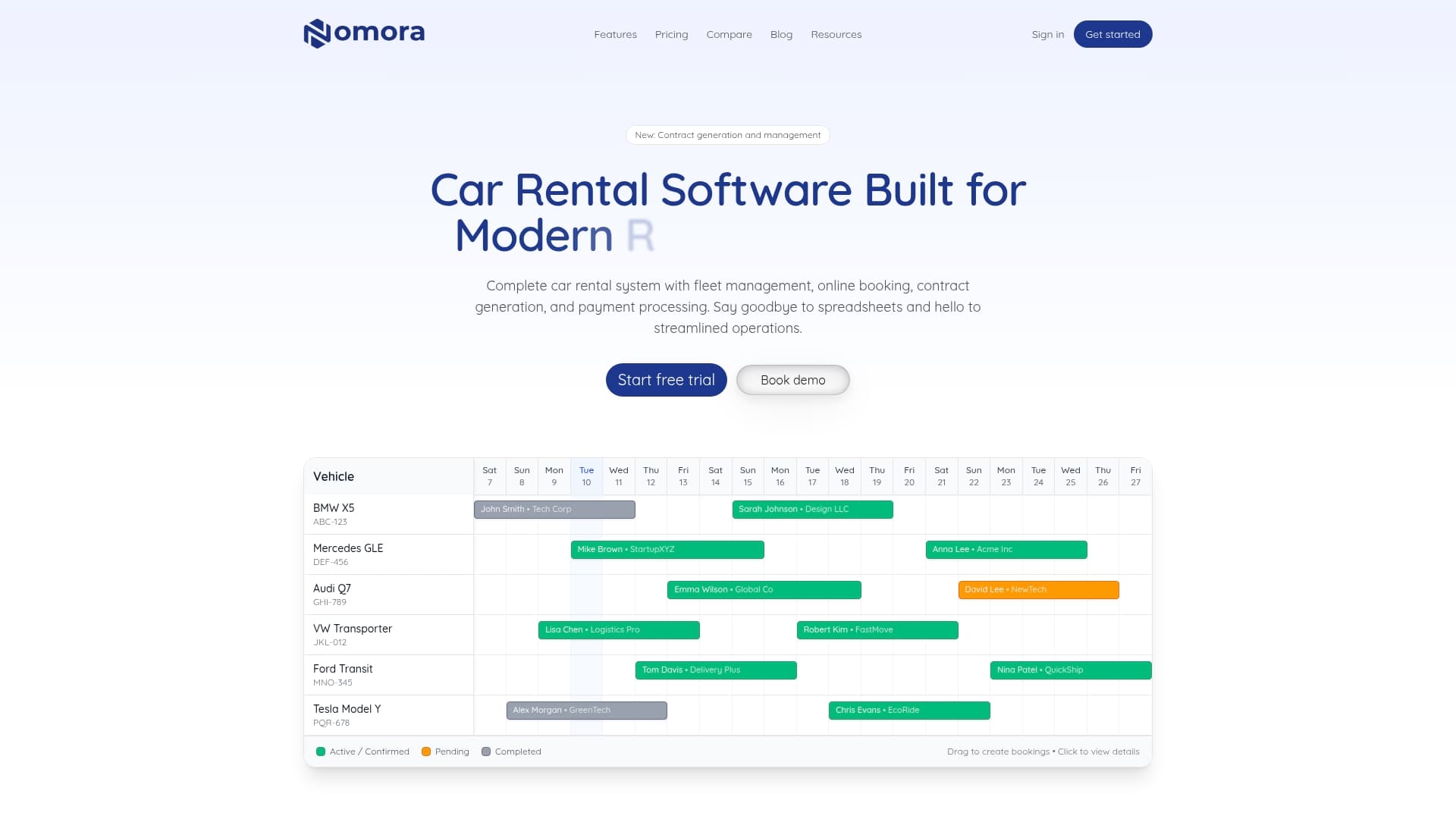
Nomora is built specifically for rental businesses like yours. From car rental software use cases that match your operation's size and structure, to tools for preventing double bookings and enabling automated car rental payments, the platform puts every cost-saving lever within reach. Setup takes 24 to 48 hours, and the operational clarity you gain from day one makes the investment straightforward to justify.
Frequently asked questions
What is predictive maintenance, and how does it cut car rental costs?
Predictive maintenance uses vehicle data to detect early signs of failure and schedule repairs before a breakdown occurs, which reduces unplanned repairs by 20 to 30 percent and cuts maintenance costs by 15 to 25 percent. The result is fewer emergency repairs, less downtime, and a more predictable maintenance budget.
How much can car rental businesses save by automating admin tasks?
Automating admin processes such as bookings and invoicing reduces admin time by 20 to 30 percent per transaction and can save up to $10,000 annually for a business processing 8,000 bookings. The hours recovered can be redirected toward customer service and revenue-generating activities.
Why is negotiating with multiple vendors important for car rental cost control?
Negotiating with multiple vendors keeps pricing competitive and ensures your operation is not vulnerable to a single supplier's delays or price increases. Diversifying your supplier list reduces downtime risk and gives you leverage when renewing contracts.
How does fleet data analytics help save money in car rentals?
Fleet analytics sharpen your demand forecasting and identify which vehicles are sitting idle, allowing you to make smarter scheduling and pricing decisions. A data-driven fleet system can increase utilization by 3 percent and reach 95 percent forecast accuracy, translating directly to lower idle costs and higher revenue.
Can aggressive cost-cutting strategies hurt my car rental business?
Yes. Cost-cutting alone is unsustainable and can undermine service quality, customer loyalty, and long-term brand strength. The most effective approach combines smart cost controls with revenue strategies, technology investment, and a customer experience focus.
Recommended