Seasonal pricing in car rental means setting different rates for different parts of the year, based on demand, fleet availability, competition, booking windows and rental length. Done well, it lets you earn premium rates when vehicles are scarce and fill idle cars when demand dips. This guide gives you a practical framework: which periods move demand, which factors belong in your rate logic, how to adjust prices while a peak is underway, and how to get your fleet ready for it.
TL;DR
- Demand peaks in the U.S. cluster around summer and the Thanksgiving, Christmas and New Year's holidays. Your rate calendar should be built around them, with the lead time to match.
- Base rates on five inputs: customer demand, fleet availability, competition, booking window and rental length.
- Price by vehicle class, not one fleet-wide uplift. SUVs and 7+ seaters sell out first, so they carry the steepest premiums.
- Adjust during the season, not only before it. Watch pace of bookings and utilization weekly, and move rates in small, documented steps.
- Accurate reservation and fleet data is the foundation. Without it, you are guessing at both price and capacity.
Table of Contents
Why seasonal pricing matters for a rental business
A car that sits on your lot earns nothing, and a car rented at an off-peak rate during a sold-out week earns less than it could. Seasonal pricing addresses both problems. In low-demand periods, lower prices can encourage rentals and keep vehicles from sitting idle. In high-demand periods, higher rates protect your margin on the vehicles customers want most.
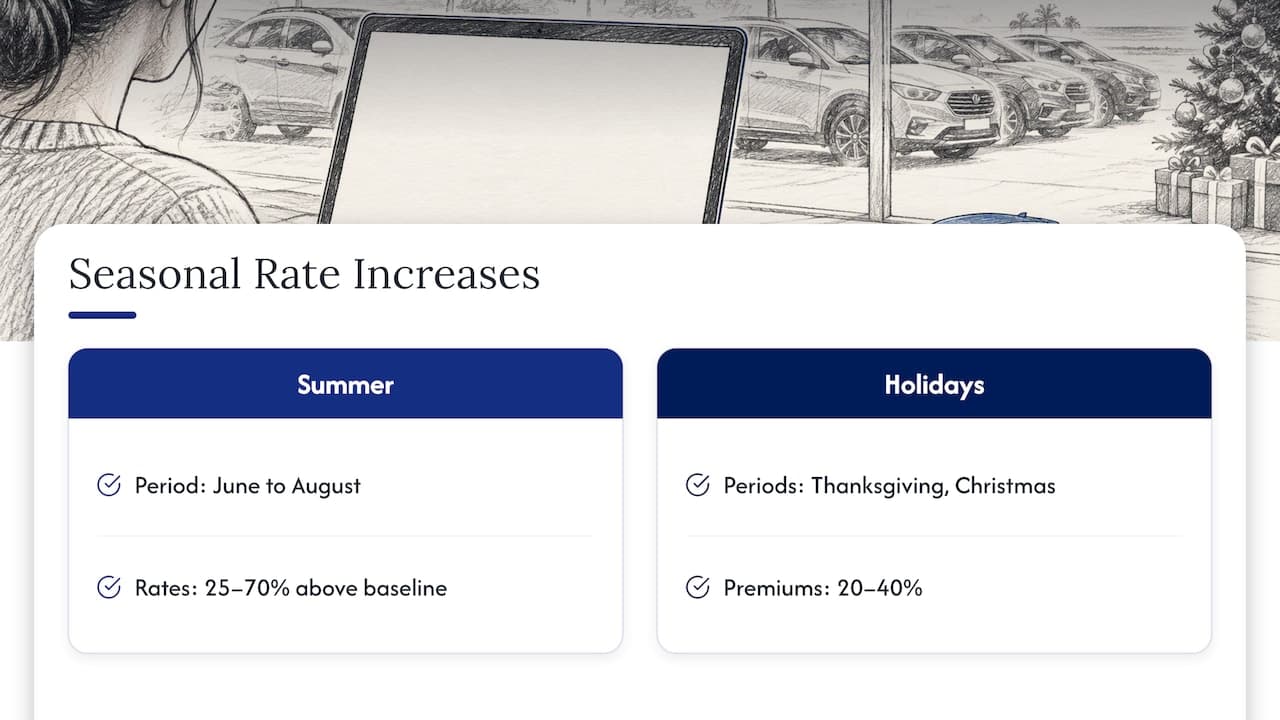
The size of the swing is large. One U.S. guide reports that summer months (June to August) can push rates 25 to 70% above baseline, while holiday periods such as Thanksgiving and Christmas add 20 to 40% premiums. Those are market-wide observations, not a target for your fleet. Your own premiums depend on your location, vehicle mix and competitors. But they show why a flat annual rate card leaves money on the table.
The industry is also moving away from fixed, counter-based pricing. Academic work on intelligent rental platforms describes a shift toward systems that ingest real-time signals such as local events and weather to forecast demand. You do not need a data science team to benefit from that thinking. You need a clear calendar, clean data and a habit of reviewing both.
What drives seasonal demand in the U.S.
Start with the calendar. According to a U.S. rental marketplace's booking guidance, demand spikes occur in summer and around Thanksgiving, Christmas and New Year's Eve, with ski destinations and warm-weather resorts especially popular. The same source notes that larger vehicles such as SUVs and 7+ seaters tend to go first.
That last point matters for pricing. SUVs are the fastest-growing rental segment, and full-size SUVs can exceed $200 per day during peak July weeks. If your fleet includes SUVs, vans or luxury and specialty vehicles, those classes deserve their own seasonal curve rather than a copy of your economy-car pricing.
The demand calendar to build your rates around
| Period | What happens | Pricing implication |
|---|
| Summer (June to August) | Leisure travel peaks; rates market-wide can run well above baseline | Highest base premiums, especially on SUVs and large vehicles |
| Thanksgiving week | Short, intense spike | Premium for the holiday window, tighter minimum rental rules |
| Christmas and New Year's | Long peak with early bookings | Premium that starts building months ahead |
| Spring break | Regional, destination-driven demand | Premium in the destinations you serve |
| Winter in cold-weather regions | Lower leisure demand | Promotional rates, longer-rental discounts to keep cars working |
| Local events and weather shifts | Short, local spikes or dips | Targeted adjustments for specific dates |
Your local market may have peaks that national guides never mention: a college graduation weekend, a festival, a trade show or a sports tournament. Add those to the calendar. They are often the dates where a small operator can price most confidently, because the demand is predictable and nearby competitors may not have adjusted.
How far ahead customers book
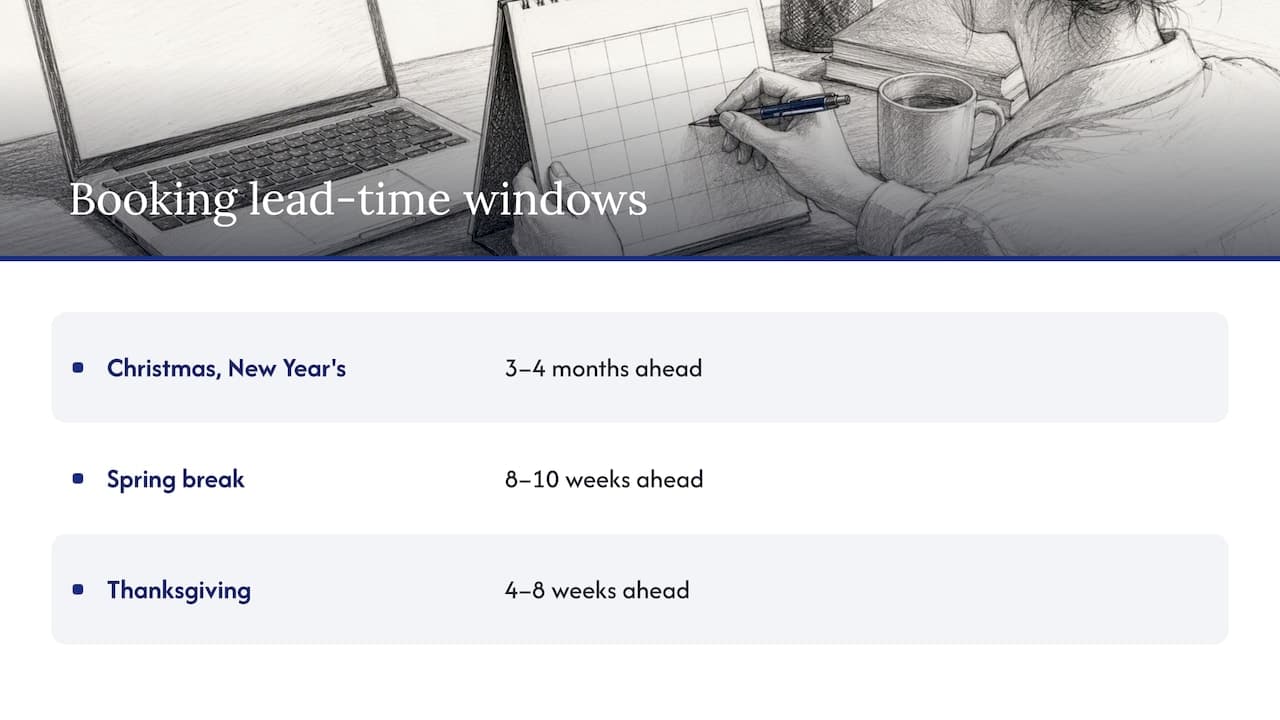
Booking windows tell you when to start raising rates. One U.S. source recommends customers book 4 to 8 weeks ahead for Thanksgiving, 3 to 4 months ahead for Christmas and New Year's, and 8 to 10 weeks ahead for spring break. Read that from your side of the counter: those are the windows in which your inventory starts to fill. If Christmas bookings begin arriving three to four months out, your holiday rate tiers should be live before then, not after the first wave of reservations has locked in at the old price.
Seasonal pricing is not just "add 30% in July." Trade reporting on rental revenue management says rental companies base rates on customer demand, fleet availability, competition, booking windows and rental length. Here is how each one works in practice.
- Customer demand. Look at last year's reservations by week and by vehicle class, then at this year's pace against it. Demand is the reason for the season, so it sets the shape of your rate curve.
- Fleet availability. A rate should reflect how many vehicles of that class are still open on the dates in question. Ten SUVs free for a holiday weekend and two SUVs free are not the same pricing situation.
- Competition. Check what comparable local operators charge for the same class and dates. You do not have to match them, but you should know the gap and have a reason for it, such as newer vehicles, delivery service or a better contract.
- Booking window. Early bookers and last-minute bookers behave differently. In a peak, last-minute rates usually rise as inventory shrinks. In a slow period, a short-notice discount can fill a gap.
- Rental length. Longer rentals reduce turnaround work and fill calendar gaps. Weekly and monthly rates, or minimum-stay rules during peak weekends, let you steer which bookings you accept.
Location also changes the answer. One guide puts airport rentals at roughly 18.4% more than off-airport alternatives. If you operate from several pickup points, a location-based differential belongs in your rate structure alongside the seasonal one.
A step-by-step approach to building a seasonal rate card
- Set a baseline. Choose a normal-season daily rate for each vehicle class. This is the reference point everything else is measured from.
- Define your seasons. Use three to five bands (for example low, shoulder, high and holiday peak) rather than twelve monthly prices. Fewer bands are easier to explain to staff and customers.
- Assign multipliers per class. An SUV may need a larger peak premium than a compact car. Start with the market ranges above as context, then calibrate to your own history.
- Add rules for length and lead time. Define weekly rates, minimum stays for holiday weekends and any early-booking incentive.
- Publish on a schedule. Make the peak rates live before your customers' typical booking window opens, using the lead times above.
- Review on a fixed rhythm. Weekly in peak, monthly otherwise. Write down every change and the reason.
For a deeper look at the methods behind each step, our guides on vehicle rental pricing strategies and dynamic pricing in car rental go further.
Adjusting rates while the peak is happening
A seasonal rate card is a starting position. The real skill is adjusting as bookings come in. Use a small set of signals and respond in small steps.
- Booking pace versus last year. If you are ahead of the same point last year for a given class, raise the rate for the remaining dates. If you are behind, hold the rate and look at promotion, visibility or length-of-stay offers before cutting.
- Remaining inventory by class. Set trigger points. For example, when a class falls below a share of available vehicles for a weekend, move that weekend to the next rate tier. Pick your own thresholds from your history.
- Gap days. Single open days between reservations are hard to sell. A modest discount for a rental that fills the gap often beats leaving the car idle.
- Cancellations. When a booking cancels close to the date, the vehicle returns to inventory. Decide in advance whether you will reprice it at the current, usually higher, rate.
- Competitor movement. If nearby operators sell out, your remaining vehicles are worth more. If they discount, check whether it is a class-specific move before you follow.
Keep adjustments steady rather than dramatic. Customers who see wildly different quotes for the same dates lose confidence, and so do staff. Our article on the risks and customer perception of dynamic pricing covers how to keep changes explainable.
A worked example
Say a mid-size SUV has a baseline of $80 per day. You define a summer band with a premium in line with the market ranges you observed locally, and a holiday band for Thanksgiving week. By mid-spring, bookings for the first July weeks are ahead of last year, so you move those weeks up a tier and add a three-day minimum. In late August, demand softens and several cars sit open midweek, so you offer a weekly rate that fills those days. None of these moves is dramatic. Each is a response to a signal, recorded with a reason, and each can be reviewed after the season.
The numbers here are illustrative, not a recommendation for your market. Your own history by vehicle class is the best input you have.
Getting the fleet ready for peak demand
Price only works if you have the vehicles to deliver. Peak preparation is a capacity question as much as a pricing one.
Plan the fleet early
A fleet-logistics provider reports that deliberately relocating vehicles from low-demand markets to peak-demand markets 6 to 10 weeks before a season can lift utilization by 8 to 15 percentage points and cut empty-mile costs by 12 to 20%. The same source suggests forecasting demand about 10 weeks out and securing carrier capacity 6 to 8 weeks ahead to avoid spot-market premiums of 20 to 40%. These figures come from a company in the vehicle-moving business and describe large multi-market operations, so treat them as a planning guide for timing. A single-location operator can apply the same logic on a smaller scale: decide early which vehicles to add, rotate or keep in service, and book maintenance before the peak, not during it.
Protect turnaround time
Research on rental revenue management notes that accurate forecasting helps a large operator prepare inventory, transfer vehicles between branches and adjust staffing, and that cleaning delays can reduce revenue. For a smaller business, the lesson is simple. In a peak, every hour a vehicle spends waiting for cleaning or inspection is an hour it cannot be rented at a premium rate. Staff the return and prep process for the busiest days, not the average ones.
Plan the slow season too
Scaling for the peak creates a risk in the low season: added vehicles that sit idle. Reduce that risk by keeping the added capacity flexible where possible, and by using the slow months for longer-term rentals, corporate or business accounts, and maintenance work that you postponed during the peak.
Our guide to car rental demand forecasting explains how to build the forecast that feeds both your rates and your capacity plan.
Seasonal pricing mistakes to avoid
- One uplift for the whole fleet. Classes peak differently. Price SUVs, vans and luxury vehicles on their own curves.
- Raising rates after the booking window opens. Customers who book early lock in the old price, and your best inventory goes cheap.
- Ignoring double bookings. Peak weeks expose scheduling errors. A conflict at a premium rate costs you the booking and the customer's trust.
- No record of changes. If you cannot say why a rate moved, you cannot learn from it next year.
- Fixed rules for variable weeks. A local event or a weather change can alter demand quickly. Keep room for manual overrides.
Perspective: pricing is only as good as your operating data
We think of rental software as the central nervous system of the operation. Every pricing decision starts with the same questions: how many vehicles of each class are free on which dates, how fast are bookings arriving, and what has this week looked like in past years? If those answers live in spreadsheets, text messages and memory, the best seasonal strategy in the world will be applied late and unevenly.
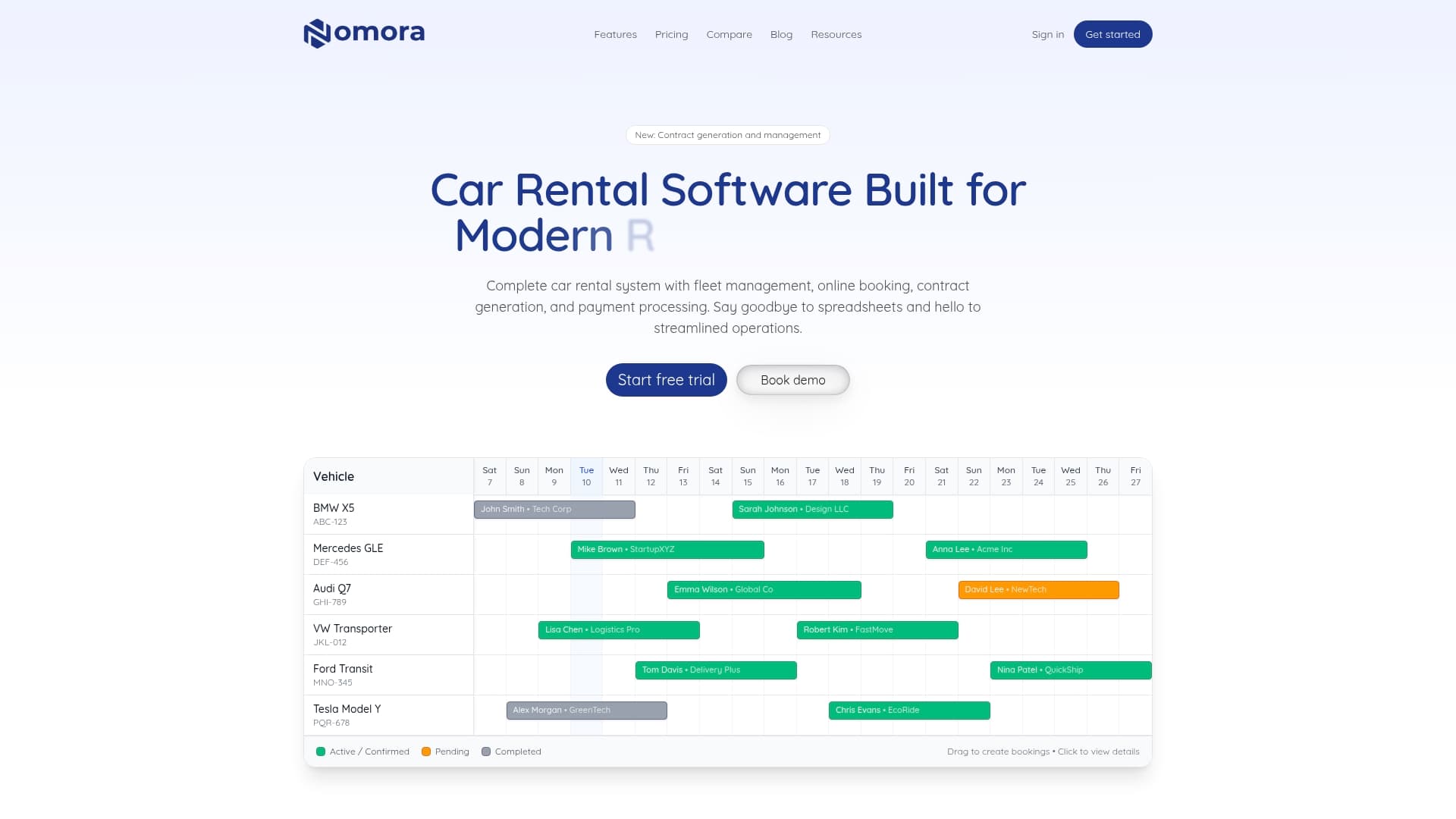
That is why we built Nomora around real-time visibility of reservations and fleet status, with conflict-free booking so a peak-week rush does not create double bookings. When reservations, contracts, payments and customer data sit in one place, you can see utilization by vehicle and date, spot the gap days, and decide on your rate changes with facts in front of you.
We also believe the peak should not require a long project to prepare for. Our onboarding is designed to get you fully operational in 24 to 48 hours, and every plan includes access to all features. For a rental business that wants a clearer view of demand before the next season, that matters more than another price calculator.
Dizzy
How Nomora supports a seasonal pricing routine
Pricing decisions are yours, but they get easier when your operating data is accurate and current. Nomora is a cloud-based rental management platform that brings reservations, fleet management with GPS tracking, automated contracts, payments and customer data into one system, so you can review booking pace and fleet availability without stitching spreadsheets together. See how it works on our car rental software page, or look at fleet management for 50+ vehicles if your fleet is growing into its peak.
Plans are published on our pricing page: Starter is €45 per month, Business is €2.80 per vehicle per month, and Fleet is €2.20 per vehicle per month. Enterprise has no published price, and payment processing is listed without a published price. Every plan includes all features, and our approach is no hidden fees. Corporate fleet managers can also see how the platform fits corporate fleets. For a broader view of margins beyond seasonal rates, read our guide to car rental profitability strategies.
FAQ
When should I raise my rental rates for the holidays?
Before customers typically start booking. One U.S. source suggests customers book 3 to 4 months ahead for Christmas and New Year's and 4 to 8 weeks ahead for Thanksgiving. Publish your holiday rates ahead of those windows, then adjust as your own booking pace shows how demand is developing.
How much higher should peak-season rates be?
There is no single number. Market-wide, one guide reports summer rates 25 to 70% above baseline and holiday premiums of 20 to 40%. Use that as context, then set your own premium by vehicle class using your past utilization, local competition and remaining inventory.
Should every vehicle class follow the same seasonal pattern?
No. SUVs and 7+ seaters tend to sell out first, and full-size SUVs can command far higher daily rates in peak weeks. Economy and compact cars usually move less. Give each class its own multiplier and review them separately.
Can I change prices during the season?
Yes, and you should review them regularly. Compare booking pace with last year, check how many vehicles remain per class, and move rates in small steps. Keep a short note of each change and its reason so you can refine the rate card next year.
Sources
Recommended
Ready to streamline your car rental business?
Book 30 minutes with the founder. We set up everything in this guide on your own vehicles, and migrate you out of Excel for free.