The fastest, lowest-cost way to reduce idle fleet is to measure per-registration utilization and eliminate avoidable return-to-ready days, then use pricing and telematics to turn those days into revenue. Fix inventory decisions last. In that order, most operators find five figures a year hiding in vehicles they already own.
TL;DR:
- Measuring per-registration utilization reveals hidden vehicle idling that class averages conceal, allowing for targeted efficiency improvements.
- Implementing a four-hour turnaround standard and assigning accountability reduces processing time and increases daily vehicle availability.
- Introducing duration-based pricing ladders incentivizes longer rentals, boosting revenue per available day without lowering rates.
- Using telematics for real-time vehicle location and usage data enhances repositioning strategies and minimizes unnecessary idle time and costs.
- Regularly reviewing fleet performance metrics and maintaining systematic controls help sustain reductions in idle fleet and improve environmental and regulatory compliance.
Table of Contents
How Do You Measure and Reduce Idle Fleet Time?
You cannot fix what your reporting hides. Most rental businesses track "fleet utilization" as a class average, which lets three weak vehicles hide behind two strong ones. Fix that first by measuring per-registration — every booking assigned to a specific vehicle, every workshop day logged as unavailable, no averages to hide behind.
Two numbers matter more than any others: earning days per registration (rented days divided by truly available days) and revenue per available day, or RevPAD. "Available days" only counts honestly when you subtract service, detailing, and repair time. A vehicle that sat in the shop for six days last month was never available those six days.
- Track earning days per registration weekly, not monthly.
- Calculate RevPAD per vehicle, not per class.
- Pull data from booking logs, odometer readings, and telematics feeds together.
One avoidable idle day per week, across a 12-car fleet renting at $65 a day, works out to roughly $40,000 a year in lost revenue — money that never shows up on a P&L because it was never earned in the first place.
Operational Fixes You Can Deploy This Week
Turnaround time is the single cheapest capacity increase available to a rental operator, because it costs process discipline rather than capital. Set a hard standard: every returned vehicle gets inspected, cleaned, and relisted within four working hours. Build inspection into the return itself instead of treating it as a separate task that waits for a slow afternoon.
- Assign a turnaround owner for each shift who is accountable for the four-hour clock.
- Sell the afternoon slot instead of defaulting to next-day availability — a car returned Tuesday at 2 p.m. can go back out Tuesday at 5 p.m.
- Schedule servicing as a calendar block, tied to mileage or date, not as a reactive scramble.
- Log every workshop day as unavailable in the system, so utilization numbers stay honest.
Pro Tip: Operators often build in extra buffer time out of caution, holding a returned car overnight "just in case." That instinct quietly costs you a full earning day per turnover. Sell the gap.
Pricing Levers That Turn Idle Days Into Revenue
A duration pricing ladder does something buffer padding never will: it makes longer hires more attractive without cutting your day rate on the bookings you'd get anyway. Weekly renters pay less per day than daily renters, and monthly renters pay less still, but every one of those tiers adds earning days that would otherwise sit empty.
- Build a three-tier ladder — daily, weekly, monthly — with the discount scaling to reward length, not just volume.
- Attach margin-rich extras (insurance upgrades, GPS units, child seats) to longer bookings where the incremental cost is low and the margin is high.
- Target promotions at known off-peak windows rather than running blanket discounts that erode your Friday and Saturday rates.
- Run price changes as small experiments. Adjust one tier, watch RevPAD for two to three weeks, then decide.
Duration-based ladders can shift the booking mix toward longer hires and lift RevPAD while cutting the administrative cost of constant vehicle turnover. The math works because a longer hire at a slightly lower daily rate almost always beats an empty parking spot.
Using Telematics to Find and Move Idle Vehicles
Every rental fleet has a subset of vehicles operators can't see clearly: parked at the wrong location, sitting past a return date, or simply forgotten in a corner of the lot. Industry analysts call this the "ghost fleet," and the root cause is almost always the same. It's not bad vehicles or bad markets. It's a lack of real-time visibility into where cars actually sit.
Telematics fixes that by putting live location and usage data in front of the people making repositioning calls.
- Prioritize moves by immediate return, not by distance or convenience — move the car that fills the highest-value booking first.
- Use low-cost transfer tactics like one-way rental incentives instead of dedicated driver runs whenever the math allows it.
- Treat repositioning as a logistics problem, not a one-off decision. Modeling short-term deployment as a network flow problem measurably cuts the cost of moving vehicles between locations.
Pro Tip: Real-time telemetry doesn't just locate idle cars. It tells you which idle car, moved where, pays for the move fastest.
When to Hold, Transfer, Lease, or Sell a Vehicle
Buying decisions made by gut feeling are how fleets end up with unproductive cars nobody wants to admit are dead weight. Rank every vehicle by RevPAD minus its maintenance cost, then set utilization bands that trigger action instead of debate.
- Below a defined utilization floor (say, 50% of fleet average for two consecutive quarters), that vehicle is a candidate to sell or transfer.
- Above a strong utilization ceiling, that vehicle class is a candidate for expansion, but only after a quarterly review, not a hunch.
- For seasonal peaks, short-term leases add capacity without the long-term carrying cost of a purchase.
- Review the full fleet quarterly, using integrated forecasting data rather than reacting to last week's booking spike.
Systems that combine forecasting, simulation, and optimization let operators plan fleet size months ahead instead of guessing at renewal time.
What to Monitor to Keep Idle Time Low
Fixing idle fleet once is easy. Keeping it fixed requires a routine, because the same slack that crept in the first time will creep back in without a cadence to catch it.
- Check daily: per-registration utilization and any vehicle sitting idle past 24 hours.
- Check weekly: RevPAD trends and exceptions, meaning any vehicle that fell below its utilization band.
- Check quarterly: the full buy, hold, transfer, sell decision across the fleet.
Set alert thresholds so exceptions surface automatically instead of waiting for someone to notice. A platform that ties booking data, telematics, and maintenance schedules into one view removes the manual reconciliation that usually causes these numbers to lag reality by a week or more.
A 30/90/180 Day Roadmap to Cut Idle Time
- Days 1-30: Set up per-registration measurement, enforce a four-hour turnaround standard, adjust buffer settings, and put servicing on the calendar. Owner: operations manager. Metric: earning days per registration, tracked weekly.
- Days 31-90: Roll out telematics where it's missing, launch the duration pricing ladder, and automate maintenance blocks in your booking system. Owner: fleet manager. Metric: RevPAD by vehicle class.
- Days 91-180: Integrate booking, telematics, and maintenance systems fully. Run the first quarterly buy/sell review. Refine repositioning logistics based on three months of data. Owner: general manager. Metric: median idle gap fleet wide.
Environmental and Regulatory Considerations for Idle Fleets
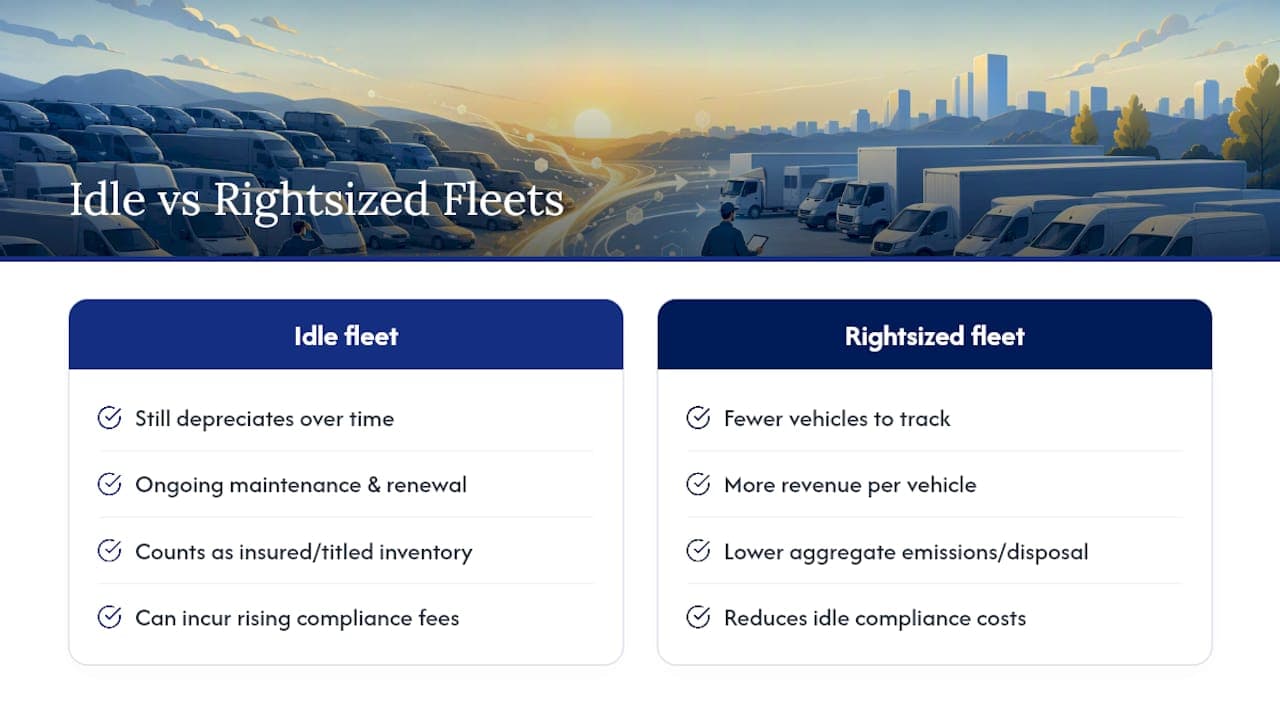
An underutilized fleet carries a cost beyond the balance sheet. Every vehicle you own but rarely rent still depreciates, still needs periodic maintenance and registration renewal, and still occupies insured, titled inventory that a regulator or insurer counts against you whether it earns revenue or not.
Fewer, better-utilized vehicles reduce your fleet's overall environmental footprint in a straightforward way: you're extracting more rental revenue from the same manufacturing and disposal impact per vehicle. Some regions increasingly tie commercial fleet registration fees or emissions compliance costs to vehicle age and class, which means a car you're holding "just in case" can quietly accumulate compliance costs that outpace what it earns. That math tilts even harder against holding idle inventory in jurisdictions with stricter emissions testing cycles for commercial fleets.
Rightsizing your fleet through the utilization bands described earlier does double duty. It cuts idle capital and reduces the aggregate emissions and disposal burden tied to vehicles that spend most of their life parked rather than rented. If your business operates across multiple states or municipalities, registration and inspection requirements can vary, so treat any fleet reduction or transfer plan as an opportunity to also audit compliance obligations for the vehicles you keep. A leaner, better-utilized fleet is easier to keep compliant simply because there's less of it to track.
What I Prioritize First, and Why
Measurement comes before capital every time. A new vehicle purchase feels like progress, but it's often the most expensive way to solve a problem that a four-hour turnaround standard would have solved for free. I'd rather see an operator fix the return-to-ready gap on 12 cars than buy a 13th car to compensate for slack in the other twelve. Utilization gains compound. Capital spending just sits on the balance sheet, depreciating, until the next review.
— Dizzy
How Nomora Helps You Sustain These Gains
Nomora is built to keep the gains above from slipping once the initial push fades. Its per-registration calendar makes utilization tracking automatic rather than a monthly spreadsheet exercise, and its telematics integrations flag idle vehicles the moment they cross your threshold instead of a week later.
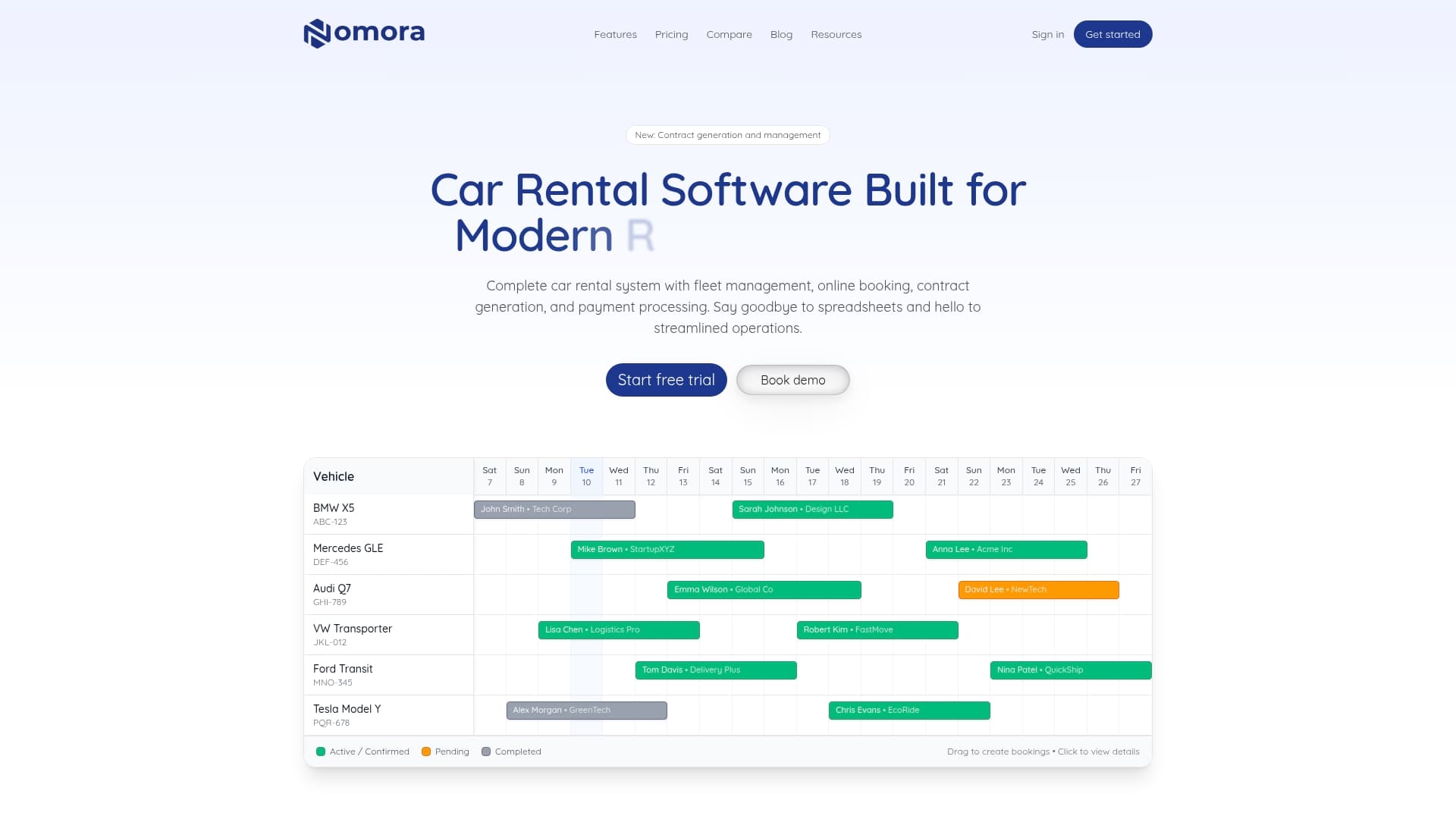
Maintenance scheduling ties directly into vehicle availability, so a service block updates your RevPAD numbers without manual reconciliation, and automated availability rules stop double bookings from creating artificial idle time. Onboarding is designed to be quick, enabling the measurement phase of your 30 day plan to start almost immediately rather than waiting on a lengthy software rollout. If turnaround speed and payment friction are part of your idle time problem, Nomora's automated payment processing cuts counter time on both ends of a rental. See how the platform fits your specific fleet type on the use cases page and start your onboarding this week.
Sources
For deeper detail on the metrics and moves covered here, see Geotab's analysis of idle rental fleets, EquipDash's utilization math, and Nomora's guide to step-by-step fleet optimization.
Recommended
Ready to streamline your car rental business?
Book 30 minutes with the founder. We set up everything in this guide on your own vehicles, and migrate you out of Excel for free.