What Are Rate Codes in Car Rental Management?
A rate code is a product identifier, not a discount. ACRISS defines it as the label that locks in a negotiated contract or specific product structure. A promo code, by contrast, is a temporary marketing modifier that applies a discount and can ride alongside a rate code or exist entirely on its own.
Operators and developers need shared vocabulary here, because confusing the two causes real damage. A rate code determines eligibility, vehicle class, and reporting category. A promo code just knocks a percentage or dollar amount off whatever rate it's attached to.
In CRS and API environments, you'll see these fields repeatedly:
- VendorCode: identifies the rental brand or supplier
- RateCode: the specific product or contract identifier
- PromotionalCode: the temporary discount modifier
- DiscountNumber: often used for corporate or negotiated discount tracking
- VendorLocationRef: ties the rate to a specific rental location
- SIPP/ACRISS codes: the four-character vehicle classification standard that must map correctly between your system and the CRS
Getting these labels straight before you touch a single workflow saves hours of confused troubleshooting later.
Best Practices for Rate Code Naming, Lifecycle, and Governance
Durable rate-code operations depend on structure, not memory. A code with no owner, no expiration date, and no documented eligibility rule becomes a liability the moment the person who created it changes roles or leaves.
Follow a lifecycle rather than treating codes as permanent fixtures:
- Name codes with metadata built in. Include the owner, channel scope, start and end dates, and eligibility criteria directly in the naming convention or attached record.
- Stage before you activate. Move every new code through staging, then run test bookings against it, then activate it for live traffic.
- Set an expiry and an archive step. A code that never expires is a code someone will eventually forget to monitor.
- Automate acceptance tests. Check redemptions, rate parity, and any attached fees or upgrades every time a code goes live, not just at launch.
- Assign clear ownership. Revenue, reservations, and marketing teams all touch rate codes at different points, so define who approves what before conflicts happen.
- Track KPIs on a schedule. Monitor redemption counts, average daily rate (ADR) impact, and parity incidents, drawing on the ADR and rate metrics glossaries operators already use for pricing decisions.
Pro Tip: Run audits that cross-reference every active rate code against its documented expiration date on a regular basis. Codes that outlive their intended promotion window are the single most common source of unexpected discounting.
Regular audits catch the slow leaks. A code built for a two-week corporate event in March that's still live in August isn't a bug most systems will flag on their own.
How Rate Modifiers Work in CRS and API Integrations
Making a rate code bookable across channels is a technical problem as much as an operational one. Travelport's Universal API documents the rate modifier fields, VendorCode, PromotionalCode, DiscountNumber, and VendorLocationRef, that must appear correctly in VehicleSearch, VehicleRules, and VehicleBooking requests for a code to resolve.
Get the vendor code wrong in one field and the whole request can fail validation, often falling back silently to a public rate instead of the restricted one a customer expected. Watch for a few recurring issues:
- CRS platforms often cap the maximum number of rate codes evaluated per search, so test with your real code volume, not a handful of samples.
- Vendor-matching rules require the same vendor identifier across multiple fields; a mismatch commonly triggers a validation error.
- Some providers ignore the PromotionalCode field entirely in certain VehicleRules responses or fail to return the promotional category consistently.
- SIPP/ACRISS vehicle class mapping has to match precisely between your internal categories and what the CRS expects, or eligible customers get shown the wrong car.
Build a pre-booking rules lookup into your workflow, then run an automated test-book against every new or edited code before it goes live.
Rate parity means the price a customer sees for the same vehicle, dates, and location stays consistent across every channel you sell through. Break parity and you don't just lose a booking, you lose the partner or channel's trust in your pricing feed.
Uniqodo's guidance on rate parity recommends unique, single-use codes or partner-bound codes for any closed promotion, rather than a generic code that can be shared or scraped.
Set the rules before you launch, not after:
- Restrict each promotional code to a single channel or a named partner.
- Block stacking so a customer can't combine a promo code with an already-discounted rate code.
- Attach partner attribution to every code so leakage is traceable to its source.
- Monitor public coupon-aggregator sites for codes that were never meant to leave a closed channel.
Parity-monitoring tools like Fornova's mobility intelligence platform correlate competitor pricing with actual fleet availability, which cuts down on false alarms triggered by simple inventory differences rather than genuine parity breaches. A code that leaks to a discount site doesn't just cost you that one booking. It resets what customers expect to pay across every future search.
What to Do When a Rate Code Breaks
Rate-code incidents rarely announce themselves loudly. They show up as a parity alert, a spike in unexpected bookings at an old rate, an API validation error, or a support queue full of confused customers quoting a price your system won't honor.
Triage in this order:
- Contain first. Pause distribution of the affected code and revoke it if it's actively causing bookings at the wrong rate.
- Block further redemptions while you investigate, even if that means temporarily disappointing a few legitimate customers.
- Check the code's validity against its documented expiration and eligibility rules.
- Look for a vendor mapping mismatch or a CRS response that behaves differently than expected, since mismatched vendor codes commonly trigger validation errors that cause silent fallback to public rates.
- Search for duplicate codes that may have been created independently by different teams.
Pro Tip: After any incident, write a short post-mortem the same day. The specific fix matters less than the release gate you add afterward to prevent the same failure mode next quarter.
The checklist above only works if the platform underneath it actually supports the controls. Look for rate-code mapping that ties directly to vehicle classes, distribution guardrails that stop a broken code from reaching every channel at once, API connectors that handle the modifier fields correctly, validation workflows that run before a booking confirms, and reporting dashboards that surface redemption and parity data without a manual export.
Nomora's platform is built around automation and real-time visibility across reservations and fleet, which maps directly onto that list: conflict-free booking logic reduces the chance of a code resolving against the wrong vehicle, and integration options extend to the payment and GPS-tracking systems operators already run. Onboarding typically takes 24 to 48 hours, which matters for a rollout.
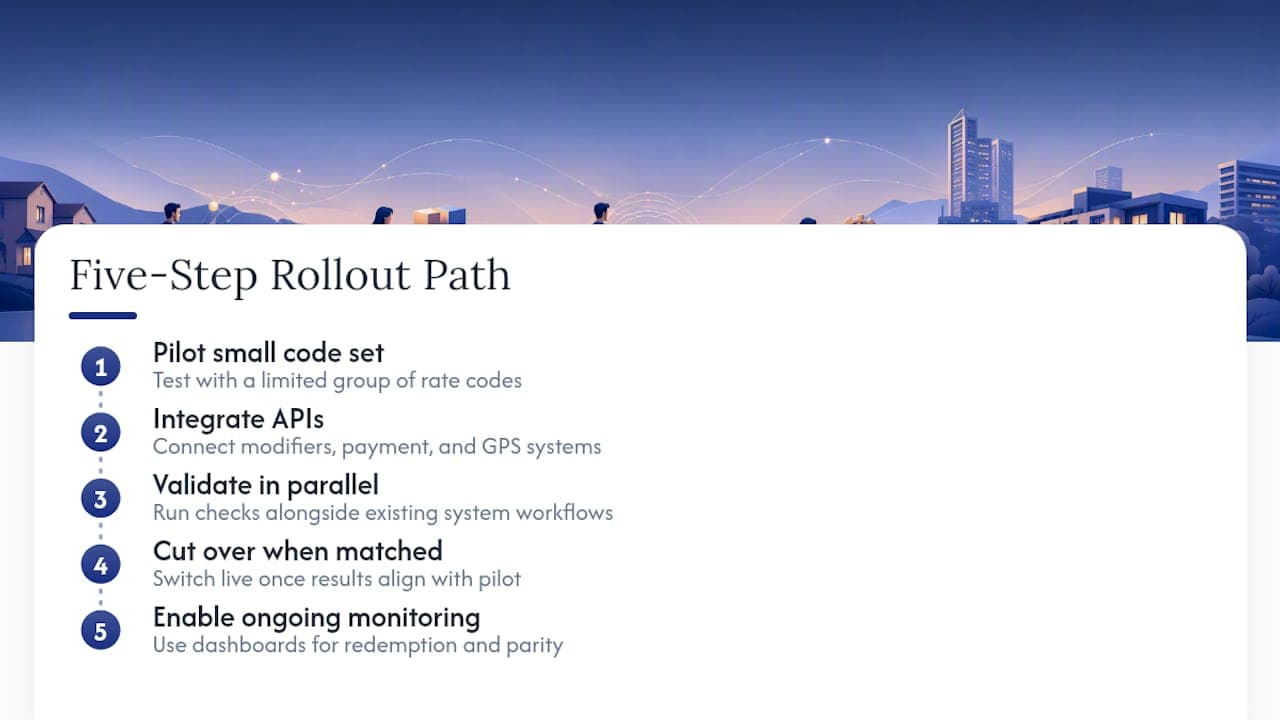
A practical rollout follows five steps: pilot the change with a small code set, integrate the relevant APIs, run validation in parallel with your existing system, cut over once results match, then turn on ongoing monitoring.
How to Add and Edit Rate Codes Without Breaking Live Bookings
Adding a rate code is rarely as simple as typing a new entry into a field. Most rental management systems restrict this function to admin-level users specifically because a badly configured code can cascade into pricing errors across every active reservation tied to it.
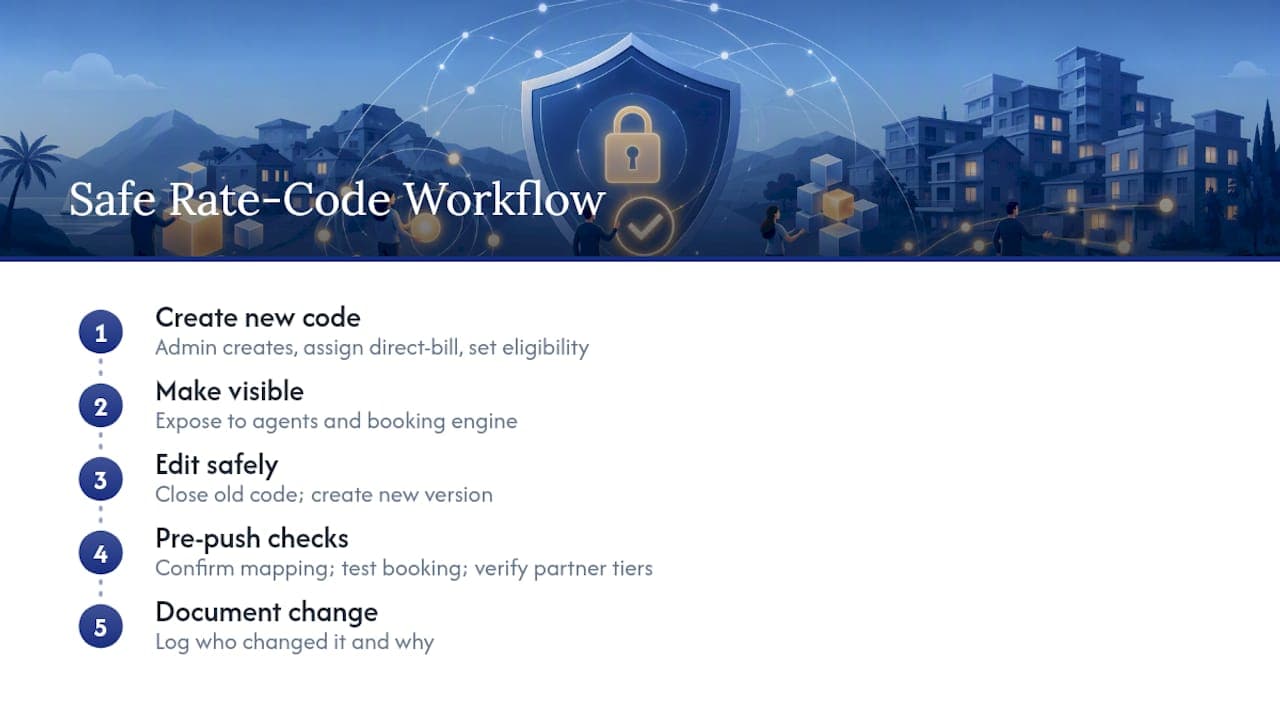
Operator help documentation for rate-code management shows the typical workflow: an administrator creates the code, assigns it a direct-bill identifier if it's tied to a corporate account, sets the eligibility parameters, and only then makes it visible to reservation agents or the booking engine.
Editing an existing code carries more risk than creating a new one. Change the rate value or eligibility window on a code that's already attached to confirmed reservations, and you risk retroactively altering a price a customer already agreed to. The safer pattern is to close the existing code, create a new version with updated terms, and let the old code run out its natural lifecycle against bookings already made.
Before pushing any edit live, three checks matter: confirm the vehicle-class mapping still matches what customers see in search results, run a test booking against the edited code in a staging environment if your platform supports one, and verify the change doesn't accidentally remove a discount tier a specific partner or corporate account still depends on. Document who made the change and why. Six months later, when someone asks why a rate looks different than expected, that record is the only way to answer quickly.
Real-World Patterns in Rate Code Implementation
The operators who avoid rate-code chaos tend to share a few concrete habits rather than a single silver-bullet fix. A regional operator running both corporate direct-bill accounts and retail promotions, for instance, typically separates the two code families entirely, so a marketing team editing a weekend promo code has no ability to touch the corporate discount structure tied to a client's negotiated contract.
Another recurring pattern shows up around seasonal demand. Operators who build rate codes around a fixed calendar, say, a spring-break code that activates and expires on set dates rather than being manually toggled, cut down dramatically on the "forgot to turn it off" problem that keeps a discount live weeks after the promotion should have ended.
The common thread across effective implementations isn't a specific tool. It's the discipline of treating every rate code as a small piece of software with its own lifecycle, rather than a static database entry. Teams that build in automated acceptance tests before any code goes live, the same discipline covered earlier in the lifecycle section, catch the majority of mapping errors before a single customer ever sees a wrong price. Teams that skip that step tend to discover the error from a customer service ticket instead.
Compliance and Regulatory Considerations for Rate Codes
Rate-code adjustments intersect with consumer-protection rules more often than operators expect, particularly around advertised pricing. If a rate code changes the price a customer sees after they've started a booking flow, that shift can trigger deceptive-pricing scrutiny depending on jurisdiction, since regulators generally expect the advertised price and the final charged price to match absent a clearly disclosed reason.
Corporate and government rate codes carry their own documentation requirements. A negotiated corporate contract tied to a direct-bill account typically needs a retained record of the agreed terms, since corporate rental agreement structures often specify audit rights that let the corporate client verify they were charged the contracted rate, not a rate code that drifted from the original agreement.
Tax and surcharge handling adds another layer. A rate code that bundles a discount into the base rate versus one that applies the discount after taxes and fees are calculated can produce materially different totals, and getting that sequence wrong is a common source of billing disputes. Whatever regulatory framework applies in your specific market, the practical safeguard is the same one that protects against operational errors: document the eligibility rule, the discount mechanism, and the calculation order for every code, and keep that record retrievable for as long as your jurisdiction requires transaction records to be held.
The Real Risk Isn't the Discount, It's the Invisible Layer Reading It
AI-driven distribution is quietly becoming the biggest rate-code risk operators aren't watching. Auto Rental News has flagged how AI and agent-based search layers can surface a rate code that looks bookable but isn't compatible with the operator's actual booking logic, creating a mismatch nobody notices until a customer arrives at pickup expecting a price the system never intended to honor.
Validation and parity monitoring aren't optional line items anymore. They're the priority for this quarter, specifically because the layers between your rate feed and the customer are multiplying faster than most operators' QA processes. Run the mapping-and-validation audit now, before an AI-driven channel finds the gap for you.
— Dizzy
A Practical Next Step for Rate-Code Governance
Most of the failure points covered here, mismatched vendor codes, expired promotions still live, parity breaches nobody caught until a partner complained, come down to one thing: a gap between what a rate code says on paper and what actually happens when a customer tries to book it. Closing that gap by hand, across spreadsheets and a half-dozen disconnected systems, is exactly the kind of manual process that lets errors slip through.
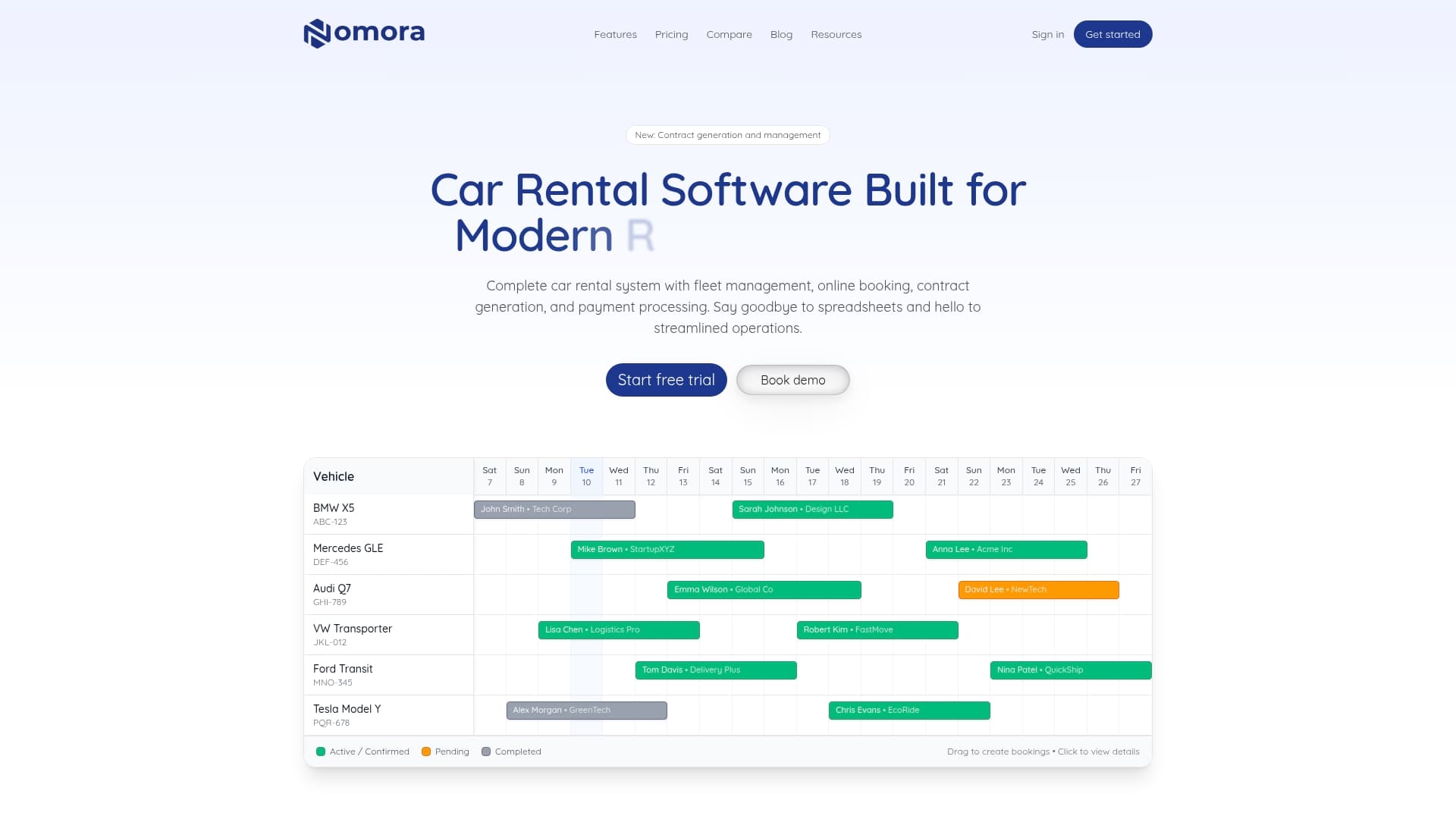
Nomora maps rate codes directly to vehicle classes and distribution channels inside one system, so a code that's edited or expired updates everywhere at once instead of drifting out of sync across your booking engine, your API connectors, and your reservation staff's screens. The platform's integrated fleet and rate management tools pull redemption and parity data into a single dashboard rather than leaving you to piece it together from separate reports.
If you're running an audit of your active rate codes this quarter, a demo is a reasonable next step. Nomora's onboarding typically runs 24 to 48 hours, which is fast enough to run a pilot against a small set of codes before committing to a full cutover. Start by reviewing Nomora's use cases for rental operators to see which parts of your current rate-code workflow map directly onto the platform's validation and reporting tools.
Sources
Recommended