Key Takeaways
| Point | Details |
|---|
| Retention over acquisition | Focusing on keeping customers and upselling extras produces more reliable growth than chasing new clients. |
| Fleet optimization matters | Shifting toward higher-margin vehicles and flexible leasing strategies improves profitability and reduces risk. |
| Digitalization drives efficiency | Implementing digital contracts and AI-powered pricing can significantly boost revenue and reduce costs. |
| Analytics fuel smart growth | Using analytics and automating tasks enables better fleet management and scalable business expansion. |
Focus on retention and ancillary revenue to maximize profits
Now that we've set the stage for what's possible, it's time to look closely at what actually moves the profit needle in today's car rental world. Most operators instinctively focus on acquiring new customers. But the data tells a different story.
Retaining an existing customer costs significantly less than winning a new one. Loyalty programs, consistent service quality, and proactive communication after each rental build the kind of repeat behavior that stabilizes your revenue base. A customer who rents from you three times a year is worth far more than three separate first-time renters, because the cost of serving them drops with each return visit.
Beyond retention, boosting profitability with upselling is one of the most underused levers in the industry. Ancillary revenue, meaning income from add-ons beyond the base rental rate, can add over $6,000 annually per location when upselling is approached systematically. That is not a rounding error. It is a meaningful contribution to your bottom line.
The most profitable ancillary services to prioritize include:
- Collision damage waivers and supplemental liability insurance: High-margin products that customers readily accept when presented clearly
- GPS navigation units: Low cost to provide, high perceived value for travelers unfamiliar with local roads
- Child safety seats: A necessity for families, often forgotten until the last moment
- Prepaid fuel options: Convenient for customers, profitable for operators
- Vehicle upgrades at pickup: Converts available inventory into premium revenue
Statistic to know: The global car rental market is projected to surpass $223 billion by 2030, with the US segment already exceeding $37 billion. In a market this size, even small improvements in revenue per customer create significant competitive advantages.
Pro Tip: Train your front desk staff to present two or three add-ons as a natural part of every check-in conversation, not as a hard sell. Framing extras as helpful options rather than upsells dramatically improves acceptance rates.
Shifting your mindset from "more customers" to "more value per customer" is the foundation of sustainable profitability. Acquisition has its place, but optimization of what you already have is where the real margin lives.
Optimize your fleet mix for higher margins and flexibility
Maximizing revenue per customer works best when you're offering the right vehicles for your market. Not all cars are created equal when it comes to profitability, and the composition of your fleet directly shapes your revenue ceiling.

High-ADR vehicles like SUVs and luxury cars (average daily rate, meaning the price charged per rental day) now represent roughly 35% of competitive fleets, and for good reason. These vehicles generate more revenue per rental day, attract customers willing to pay a premium, and often carry stronger brand associations that support repeat bookings.
Benefits of prioritizing high-ADR vehicles:
- Higher revenue per transaction without increasing fleet size
- Stronger margins even at slightly lower utilization rates
- Greater appeal to business travelers and premium leisure customers
- Opportunities for meaningful vehicle upgrade upsells at pickup
Leasing, rather than purchasing outright, gives you flexibility to adjust your fleet composition as market demand shifts. If SUV demand softens seasonally, a leased fleet is easier to restructure than one built on capital purchases. This approach also reduces long-term depreciation risk and frees up working capital for other investments.
Controlling maintenance costs is equally critical. The target benchmark for vehicle management strategies is keeping maintenance expenses below 50 to 70% of rental revenue. Tracking this metric per vehicle helps you identify underperformers before they drain profitability.
| Vehicle type | Avg. daily rate | Maintenance cost ratio | Margin potential |
|---|
| Economy sedan | Low | Higher % of revenue | Thinner margins |
| Mid-size SUV | Medium-high | Moderate % of revenue | Strong margins |
| Luxury/premium | High | Lower % of revenue | Highest margins |
Pro Tip: Review your fleet composition quarterly. If economy vehicles are sitting idle while SUV requests go unfulfilled, that is a direct signal to rebalance your mix.
A well-calibrated fleet is not the biggest fleet. It is the one best matched to what your customers actually want to rent.
With your vehicle mix dialed in, the next step is using technology to drive operational efficiency and maximize every transaction. Digital transformation in car rental is no longer a future-state ambition. It is a present-day competitive requirement.
The most compelling evidence comes from real-world results. Europcar achieved 7.1% revenue growth using AI-driven pricing, compared to a manual target of just 1.7%. That gap, 7.1% versus 1.7%, is the difference between a business that scales and one that stagnates.
AI for dynamic pricing works by continuously adjusting rates based on demand signals, competitor pricing, local events, and historical booking patterns. Unlike manual rate-setting, which is slow and reactive, AI pricing responds in real time.
Steps to implement dynamic pricing in a mid-sized rental operation:
- Audit your current pricing process and identify where manual adjustments are made
- Select a pricing tool that integrates with your reservation system
- Define your pricing rules: floor rates, ceiling rates, and demand triggers
- Run a pilot on one vehicle category before rolling out fleet-wide
- Review performance weekly and refine rules based on actual booking data
Digital contracts in rentals reduce paperwork, eliminate transcription errors, and cut the time staff spend on administrative tasks. Fewer errors mean fewer disputes. Fewer disputes mean lower operational costs and better customer experiences.
| Pricing approach | Revenue growth | Error rate | Staff time per booking |
|---|
| Manual pricing | ~1.7% growth | Higher | More |
| AI-driven pricing | ~7.1% growth | Lower | Less |
"Digitalization cuts staffing needs, but it requires data maturity to deliver its full potential. The businesses that invest in clean, consistent data first are the ones that extract the most value from AI tools."
The technology investment pays for itself quickly when the alternative is leaving revenue on the table with static rates.
Tap into analytics and automation for scalable decision-making
Technology isn't just about increasing revenue. It's also about making smarter, faster decisions as you scale. Analytics and automation are the two tools that make growth manageable rather than chaotic.
Key analytics to track in your rental operation:
- Fleet utilization rates: What percentage of your vehicles are rented on any given day? Anything below 70% signals either pricing or marketing inefficiencies
- Booking trend analysis: Which days, seasons, and vehicle types drive the most demand? Use this to plan staffing and inventory
- Maintenance cycle tracking: Predictive maintenance scheduling reduces unexpected downtime and costly emergency repairs
- Revenue per available vehicle: A single metric that captures both pricing and utilization performance in one number
Automation handles the repetitive work so your team can focus on higher-value activities. Billing, payment reminders, booking confirmations, maintenance alerts, and reporting can all be automated with the right platform. The result is fewer errors, better asset allocation, and a team that spends less time on administration.
Fleet analytics for car rentals also supports smarter expansion decisions. When you can see clearly which vehicle types are most profitable, which locations generate the best returns, and where demand is trending, you make expansion choices based on evidence rather than instinct.
For teams just starting with analytics, the advice is simple: start with utilization rates and booking trends. These two metrics alone will surface the most actionable insights without requiring advanced data infrastructure. As your data maturity grows, layer in more sophisticated reporting.
Pro Tip: Set a weekly 30-minute review of your core metrics. Consistent review habits, not complex dashboards, are what separate data-driven operators from those who only look at the numbers when something goes wrong.
Automation and analytics together act as the central nervous system of a well-run rental operation. They keep information flowing, decisions grounded, and operations running smoothly even as volume increases.
Why optimizing beats expanding: The hidden key to rental growth
After reviewing the main strategies, it's worth stepping back to challenge what many car rental operators believe about growth. The instinct to expand the fleet is understandable. More vehicles feel like more revenue. But fleet expansion without optimization multiplies your risks just as fast as it multiplies your assets.
Adding vehicles to a business with weak pricing, poor retention, and manual processes does not fix those problems. It amplifies them. Every new car is a new maintenance cost, a new depreciation liability, and a new asset that needs to be priced, tracked, and managed.
The operators who grow most sustainably are the ones who squeeze maximum value from what they already have before they add more. The Europcar example is instructive: a 7.1% revenue gain came not from a bigger fleet, but from smarter pricing. That kind of return is available to any operator willing to invest in the right tools and processes.
Focus on profit-boosting strategies first. Build the systems, sharpen the data, and optimize each asset. Then, when you do expand, you are scaling a machine that works rather than a set of problems that are simply getting larger.
Take your rental business further with the right technology partner
The right strategies make a difference, but even the best ideas need a solid platform to succeed. Nomora is built specifically for rental businesses like yours, combining fleet management, dynamic rate tools, digital contracts, analytics, and automation in one integrated system.
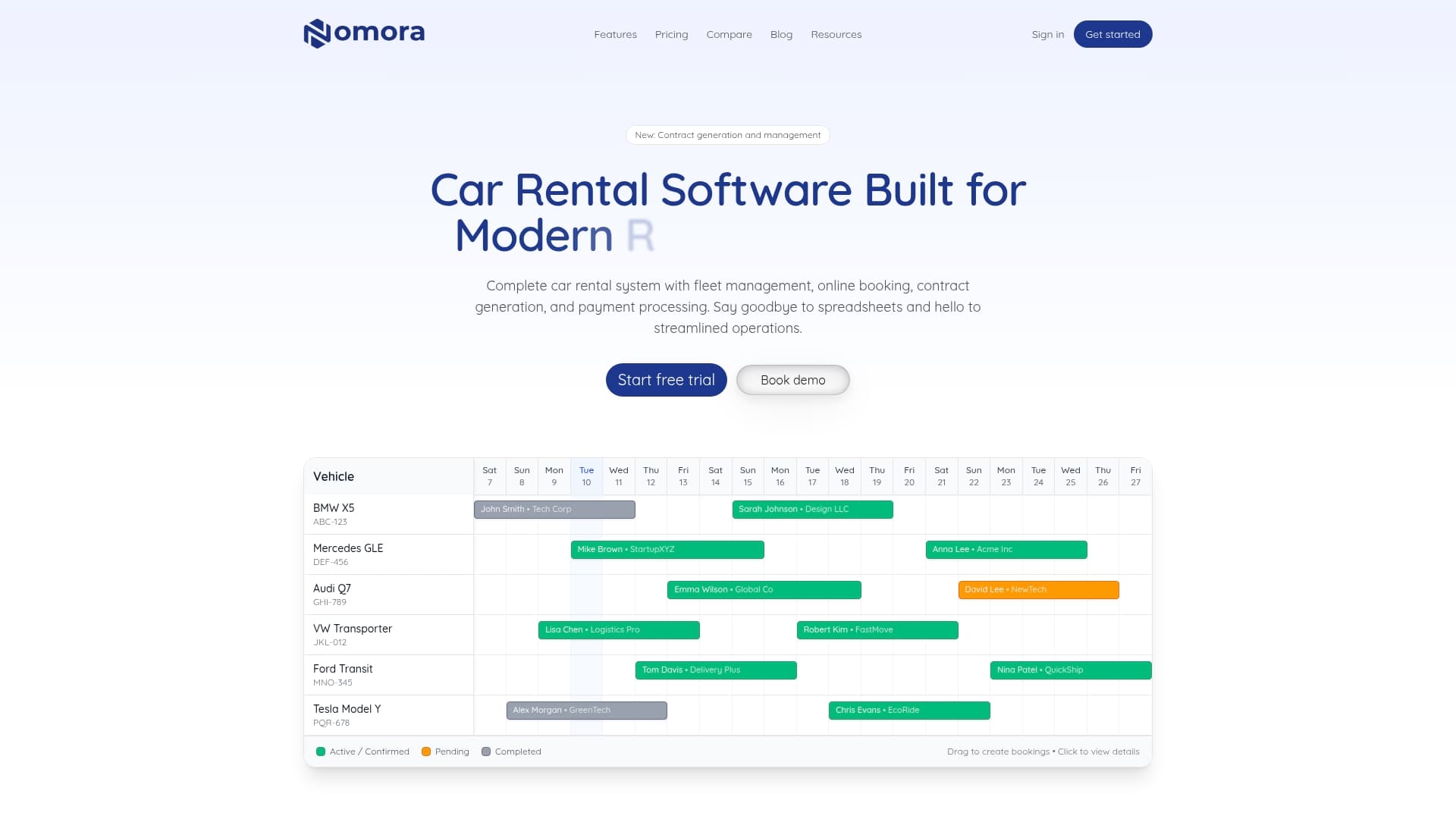
Whether you're a small independent operator or managing a growing multi-location business, Nomora's car rental solutions are designed to put these strategies into practice immediately. Setup takes as little as 24 to 48 hours, and the platform scales with you as your operation grows. Explore Nomora's software use cases to see exactly how operators at every stage are using the platform to drive measurable results.
Frequently asked questions
What is the most profitable way to grow a small car rental business?
Focusing on customer retention and upselling ancillary services delivers stronger profit margins than chasing new customers, because retention costs less than constant acquisition and each returning customer generates more value per interaction.
Digital contracts, analytics platforms, and AI-driven pricing reduce operational errors and administrative overhead, with real-world results showing AI pricing achieving 7.1% revenue growth compared to just 1.7% with manual methods.
Should I expand my fleet or optimize existing vehicles first?
Industry evidence strongly supports optimizing pricing, utilization, and processes before adding vehicles, since expansion without optimization increases costs and complexity without fixing underlying inefficiencies.
What kinds of vehicles bring in the highest margins for rental businesses?
SUVs and luxury vehicles consistently earn higher average daily rates than economy cars, making them more profitable on a per-rental basis even when utilization rates are slightly lower.
Which routine tasks in a rental business are easiest to automate?
Digital bookings, billing, payment reminders, maintenance scheduling, and reporting are among the most straightforward tasks to automate, freeing your team to focus on customer service and strategic decisions.
Recommended