Centralized fleet control unifies vehicle data, maintenance, and compliance into a single real-time system. It improves decision speed, reduces errors, and enhances operational efficiency across multiple locations. However, partial implementation risks fragmenting data and undermining the system's benefits.
Centralized fleet control is defined as the unified management of an entire vehicle fleet through a single platform that consolidates vehicle data, maintenance scheduling, compliance tracking, and administrative tasks in real time. Fleet managers and rental business owners who operate without this kind of system spend hours reconciling data from disconnected spreadsheets, separate maintenance logs, and siloed GPS apps. Platforms like Verizon Connect and Fleetworthy demonstrate what centralized fleet management looks like in practice: one interface, one data source, and one workflow for every vehicle in your fleet. The result is faster decisions, fewer errors, and measurable cost savings across operations.
What is centralized fleet control and how does it work?
Centralized fleet control manages operations from one place through fleet management software and telematics, consolidating vehicle data including maintenance records, compliance status, and administrative tasks into a single system. Think of it as the central nervous system of your operation. Every vehicle feeds data upward, and every decision flows back down through the same channel.
The technology behind this model relies on Telematics Control Units (TCUs), which are onboard devices installed in each vehicle. These units collect data from vehicle diagnostic systems like CAN-bus and OBD-II ports, capturing engine health, fuel consumption, mileage, and fault codes. GPS modules within the same hardware record location, speed, and route data continuously.
Telematics transmits this data to centralized backend servers, where it is processed and made available through secure web dashboards and mobile apps. Fleet managers see every vehicle's status in real time, from a single screen. Alerts fire automatically when a vehicle misses a scheduled service, exceeds a speed threshold, or enters an unauthorized zone.
One critical design requirement that many operators overlook: telematics data pipelines must handle connectivity gaps through local buffering and syncing. If a vehicle loses signal in a rural area, the TCU stores data locally and uploads it once connectivity is restored. Without this architecture, your "real-time" dashboard has blind spots.
Pro Tip:When evaluating fleet control systems, ask vendors specifically how their hardware handles connectivity loss. A system that drops data during outages is not truly centralized. It is selectively centralized, which creates the same gaps you were trying to eliminate.
Key benefits of centralized fleet control for rental and fleet operations
The operational case for centralized fleet control is built on six measurable advantages that compound over time.
Real-time visibility. Every vehicle's location, status, and condition is visible from one screen. This eliminates the phone calls, manual check-ins, and guesswork that slow down dispatch decisions in rental and multi-vehicle operations.
Predictive maintenance scheduling. Centralized systems pull diagnostic data directly from vehicles and trigger service alerts before breakdowns occur. For rental businesses, unplanned downtime means lost revenue on every day a vehicle sits in a shop instead of generating bookings. Nomora's fleet maintenance management capabilities address exactly this cost center.
Automated reporting and reduced paperwork. Compliance reports, mileage logs, and service histories generate automatically from the same data stream. Staff time shifts from data entry to exception handling.
Fuel and route optimization. Centralized dashboards surface inefficient routes and idling patterns across the entire fleet simultaneously. Acting on this data consistently produces fuel savings that scale with fleet size.
Driver behavior monitoring. Scoring systems built into platforms like Verizon Connect track hard braking, rapid acceleration, and speeding. Fleets that act on this data reduce accident rates and insurance premiums.
Compliance and safety management.Fleetworthy's CVM platform synchronizes safety, compliance, tolls, and weigh station data under one system, automatically enrolling vehicles across services and eliminating duplicate records.
Fleet Management and Control Systems have shown the ability to improve operational efficiency at minimal cost through real-time alerts and exception handling. That finding matters because it reframes centralized control not as a luxury for large fleets, but as a cost-effective tool for operations of any size.
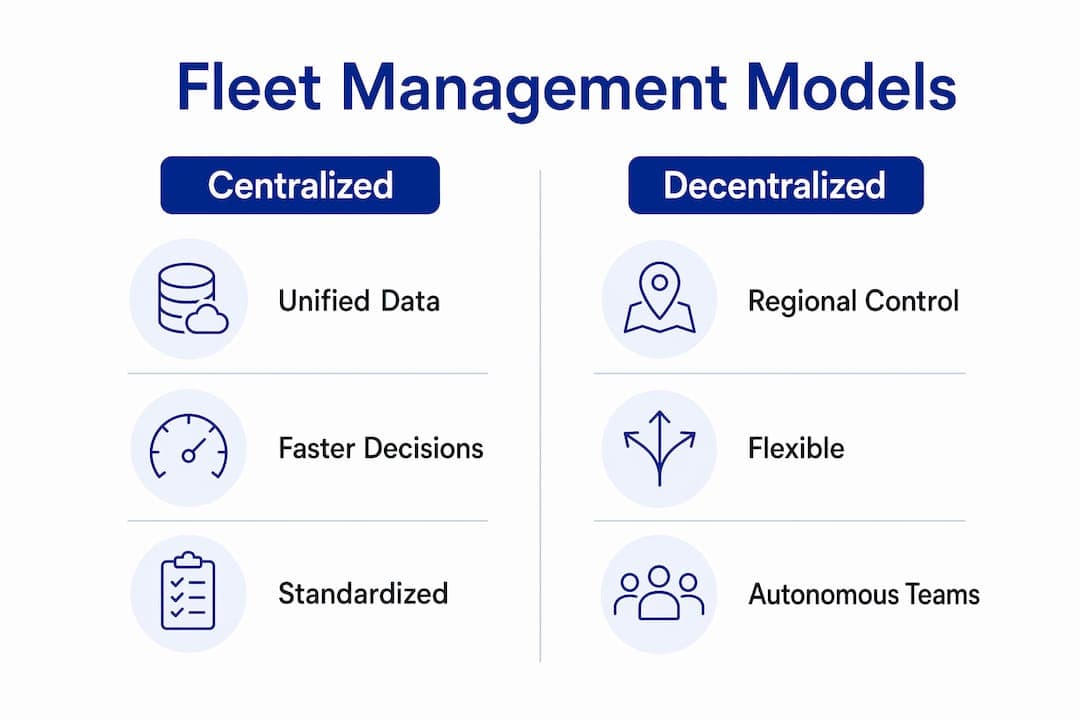
Centralized vs. decentralized fleet management: what fleet managers need to know
The choice between centralized and decentralized fleet management is not purely philosophical. It has direct consequences for data quality, response times, and operational cost.
Feature
Centralized management
Decentralized management
Data source
Single system of record
Multiple regional or departmental systems
Decision speed
Fast, based on unified real-time data
Slower, requires cross-team coordination
Maintenance consistency
Standardized across all vehicles
Varies by location or manager
Compliance tracking
Automated and synchronized
Manual, prone to gaps
Best suited for
Fleets of all sizes with multi-location operations
Highly autonomous regional operations
Risk
Single point of failure if system goes down
Data fragmentation and inconsistent records
Decentralized management suits operations where regional teams need significant autonomy, such as a franchise network where each location handles its own procurement and maintenance independently. The trade-off is data fragmentation. When your regional managers each use different tools or spreadsheets, you lose the ability to make fleet-wide decisions based on accurate, current information.
Centralized management becomes the stronger model as fleet size grows, geography expands, and regulatory requirements increase. Centralized workflow design ensures that every decision-maker acts on the same operational data, producing consistent outcomes across locations. For rental businesses managing vehicles across multiple branches, this consistency directly affects booking accuracy and vehicle availability. Nomora's multi-location fleet management guide covers this operational model in detail.
How to implement centralized fleet control: best practices and pitfalls
Adopting centralized fleet control requires more than purchasing software. The implementation process determines whether you achieve genuine operational centralization or just add another dashboard to your existing fragmentation.
Audit your current data sources. List every system, spreadsheet, and tool currently used to track vehicles, maintenance, bookings, and compliance. This audit reveals where data lives today and what needs to be migrated or connected.
Select a platform that acts as the record of action. Effective centralized fleet control requires that the system be the record of action for maintenance and compliance, not just a viewer of data. If your platform shows you a service is due but the actual work order lives in a separate system, you have not centralized. You have added a layer.
Integrate telematics hardware with your central platform. Match TCU hardware to your platform's API requirements. Confirm that the integration supports real-time tracking and handles data buffering during connectivity loss, as discussed earlier.
Standardize alert workflows. Define which alerts require immediate action, which are logged for review, and who receives each notification. Without this structure, alert fatigue sets in and critical warnings get ignored.
Train staff on the system as the single source of truth. If staff continue updating parallel spreadsheets alongside the new platform, data integrity collapses within weeks. The platform must replace existing tools, not coexist with them.
Partial centralization, where only dashboards are unified but maintenance and compliance functions remain fragmented, leads to delays and inconsistent records. This is the most common implementation failure. Operators invest in a platform, connect their GPS devices, and declare the job done. Six months later, they are still chasing service records across three different systems.
Fleetworthy's CVM prevents this by automatically synchronizing vehicle records across services, reducing administrative errors through consistent data architecture. The principle applies regardless of which platform you choose: centralization becomes control only when the system reliably triggers actions, not just reports on them.
Pro Tip:Start your implementation with one vehicle category or one branch location. Validate that data flows correctly, alerts fire as expected, and staff workflows adapt before rolling out fleet-wide. A phased approach surfaces integration problems when they are still manageable.
Key takeaways
Centralized fleet control delivers measurable operational gains only when the platform functions as the system of record for every vehicle action, not just a reporting layer over fragmented data.
Point
Details
Core definition
Centralized fleet control unifies all vehicle data, maintenance, and compliance into one system.
Technology foundation
TCUs collect diagnostic and GPS data, transmitting it to centralized servers for real-time monitoring.
Primary benefit
Real-time visibility and automated alerts replace manual check-ins and reactive maintenance.
Key implementation risk
Partial centralization leaves maintenance and compliance fragmented, defeating the purpose.
The exact checks profitable rental operators run every week — free, straight to your inbox.
Fleet readiness & handover
Bookings & no-show prevention
Pricing & revenue reviews
Contracts & compliance
Payments & invoicing
Maintenance & fleet health
One email with the checklist. No spam, unsubscribe anytime.
Why most fleet managers underestimate what "centralized" actually means
After working closely with fleet operations across rental businesses and corporate fleets, the pattern I see most often is this: operators confuse a unified dashboard with genuine centralized control. They are not the same thing.
A dashboard shows you what is happening. Centralized control determines what happens next. The distinction matters enormously in practice. Exception management via real-time alerts transforms centralized fleet control from passive monitoring to active operational management. That shift is where the real efficiency gains live.
What I find underappreciated is master data management. Fleet managers increasingly demand simplicity, integration, and operational visibility from centralized systems, yet the underlying data architecture rarely gets the same attention as the interface. Duplicate vehicle records, mismatched service histories, and unsynchronized compliance data are silent killers of operational efficiency. They do not show up on a demo. They show up six months after go-live.
The emerging trend worth watching in 2026 is the connected fleet ecosystem: platforms that integrate GPS telematics, payment processing, booking management, and compliance tracking under one API layer. Fleetworthy's approach of synchronizing safety, tolls, and weigh station data is one version of this. Nomora's integration of reservations, GPS tracking, and payment gateways is another. The direction is clear. Fragmented point solutions are losing ground to platforms that own the full operational workflow.
My advice: before you evaluate any fleet control system, write down every place a vehicle record currently lives in your organization. If the answer is more than one system, you do not have centralized control yet. You have a starting point.
— Dizzy
How Nomora supports centralized fleet control for rental businesses
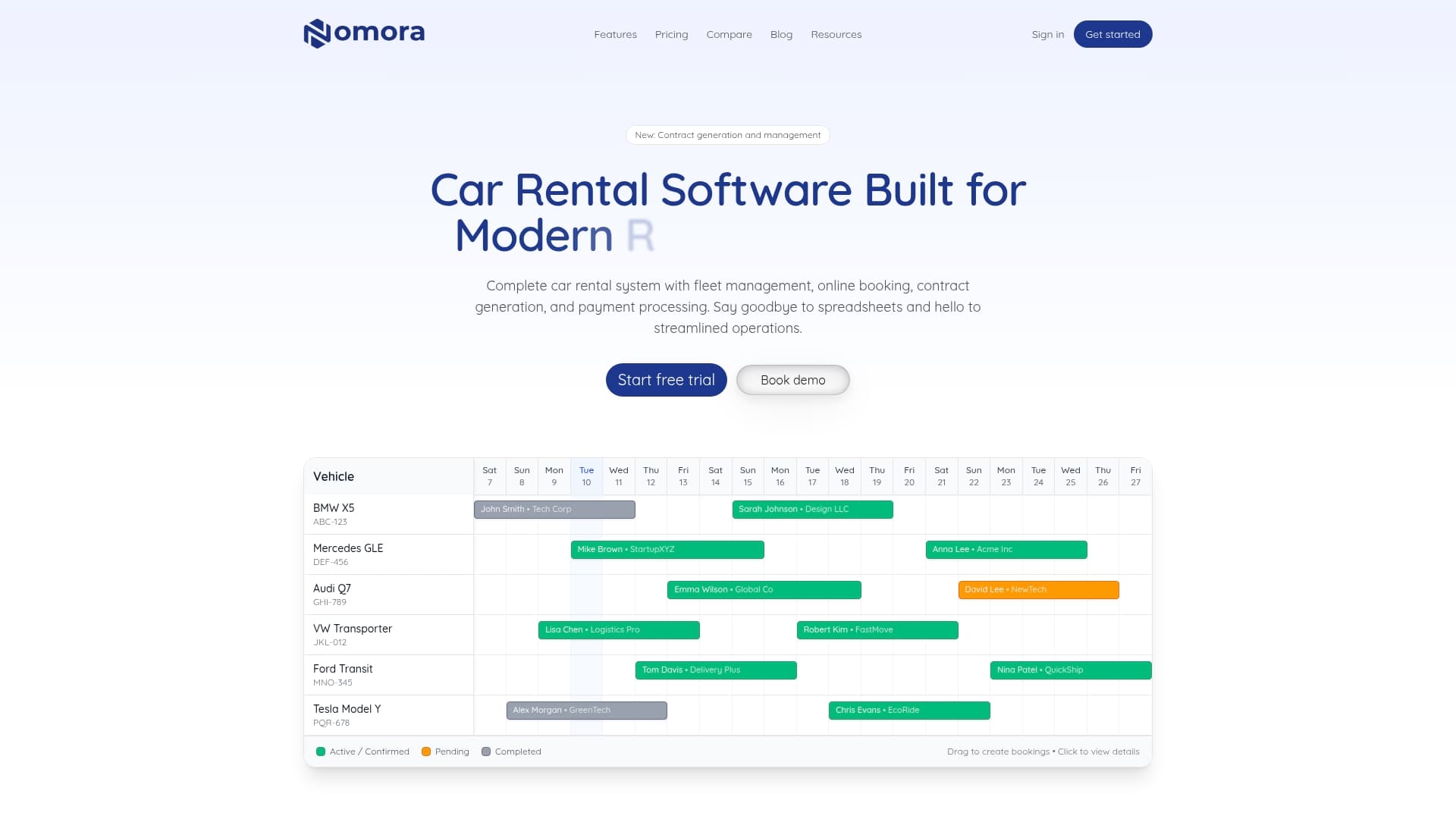
Nomora functions as the central nervous system for rental operations, connecting reservations, fleet tracking, contract generation, payments, and customer data in one cloud-based platform.
For rental businesses managing vehicles across multiple locations, Nomora's fleet management software provides the real-time visibility and maintenance automation that centralized control requires. GPS integration connects directly to the platform, so vehicle location and status update without manual input. Booking conflicts are eliminated through synchronized availability data, and maintenance alerts trigger automatically based on mileage or time intervals. Setup takes 24 to 48 hours, and the platform scales from independent operators to franchise networks. Explore Nomora's use cases to see how businesses like yours have structured centralized fleet operations.
FAQ
What is centralized fleet control?
Centralized fleet control is the management of all vehicles in a fleet through a single platform that consolidates location data, maintenance records, compliance tracking, and operational workflows in real time. It replaces disconnected tools and manual processes with one system of record.
What is a centralized fleet dashboard?
A centralized fleet dashboard is the interface through which fleet managers monitor all vehicle data, alerts, and operational metrics from one screen. It pulls data from telematics devices installed in each vehicle and displays status, location, and service information in real time.
Why centralize fleet operations instead of managing by location?
Centralized fleet operations produce consistent data quality, faster decision-making, and standardized maintenance practices across all vehicles. Decentralized management by location creates fragmented records and inconsistent compliance, which increases operational risk as fleet size grows.
How does telematics enable centralized vehicle tracking?
Telematics Control Units installed in vehicles collect GPS and diagnostic data, then transmit it to centralized servers via secure connections. Fleet managers access this data through web dashboards and mobile apps, enabling real-time monitoring of every vehicle regardless of location.
What is the biggest risk when implementing centralized fleet management?
Partial centralization is the most common failure point. When dashboards are unified but maintenance and compliance functions remain in separate systems, data inconsistencies persist and the operational benefits of centralized control are not realized.