A pool car booking policy is the written set of rules that says who may reserve a shared vehicle, how far ahead, what happens when two people want the same car, and what the driver does at pickup and return. The best policies are short, specific and enforced by the same system that takes the bookings. If you manage a rental company, a specialty fleet or a corporate pool, this guide gives you the sections to write, the numbers real US fleets use, and the places where a policy usually breaks down. Nomora, our cloud-based rental management platform, is built to run reservations, fleet records and contracts in one place, so the rules you write are the rules the booking system applies.
TL;DR
- Cover six areas: eligibility, reservations and changes, priority between requesters, pickup and return, fuel, mileage, cleaning and damage, and records.
- Put numbers in the policy: notice period, cancellation cut-off, grace time for pickup, maximum booking length, and who signs off on longer trips.
- Make the reservation holder accountable for the vehicle while it is checked out, and tie every booking to a named, verified driver.
- Inspections only protect you when the pre-use and post-use checks are recorded against the same vehicle and booking.
- A policy that lives in a PDF and a shared calendar depends on people remembering it; a booking system that blocks conflicts and keeps the log does not.
Table of Contents
What a pool car booking policy is, and what it should cover
A pool vehicle is a shared car assigned for a short period rather than to one person. UCLA's Procedure 320.1 is a good model of scope: it covers shared-use motor pool vehicles assigned hourly, daily, weekly or monthly for official business, and it sets user eligibility, reservation details, cancellation terms, vehicle inspections, damage and incident reporting, and return requirements.
That list is a useful skeleton for any fleet. Whether you rent cars to the public, lend vehicles between departments or run a corporate pool, the same questions come up:
- Who is allowed to book and drive?
- What information must a booking contain, and how far ahead must it be made?
- What happens when demand exceeds supply?
- What does the driver do at pickup and at return?
- Who pays for fuel, fines, cleaning and damage?
- Where are the records, and who can see them?
Write one short section for each. A policy of three to five pages that people read beats a twenty-page manual they skip.
Eligibility: who can reserve and who can drive
Separate two roles that small fleets often blur: the person who books and the person who drives. Public policies treat them differently, and so should yours.
Authorization to book. The City of Minneapolis Vehicle Rental Policy requires an authorized departmental signature for a reservation, and written department-head authorization for overnight use. For a corporate fleet, the equivalent is a named approver per team. For a rental business, it is the account holder or the authorized renter on the contract.
Authorization to drive. Driver checks are where policies are strictest:
You do not need a university's bureaucracy, but you do need a rule on minimum license standing, a rule on who verifies it, and a rule on when it is rechecked. State it plainly: the license is checked before the first booking, and the car is not handed over without a valid license shown at collection.
Responsibility. South Dakota's policy manual makes the reservation holder responsible for the vehicle while it is checked out, even if someone else picks it up or drives it. That one sentence closes a common loophole: a colleague, or a second driver, takes the car and nobody can say who was accountable. If you allow additional drivers, require each to be named on the booking.
Reservations: lead time, required details and changes
The policy should say how bookings are made, what they must contain and how they are changed. Here is what published policies actually specify.
| Rule | Example from a US fleet |
|---|
| Minimum notice | Minneapolis requires 24 hours; Liberty University ordinarily needs at least 24 hours |
| Advance window | ASU allows booking immediately or up to six months ahead; South Dakota offers vehicles for up to two weeks |
| Maximum length | Michigan State Police sets 14 days |
| Late cancellation | UCLA charges a one-day rate when a confirmed reservation is not canceled 48 hours before pickup |
| No-show | ASU automatically cancels if the car is not picked up within 30 minutes; Minneapolis may release it to another user after 30 minutes |
These are examples, not a standard. Pick numbers that fit your demand. A fleet with a few shared cars and steady daily use can live with 24 hours' notice; a luxury or specialty fleet with a handful of high-value vehicles may want longer notice and tighter cancellation terms because one idle car costs more.
What a booking must contain
A booking that lacks information cannot be audited later. The published policies converge on a short list:
- Vehicle or vehicle type, and dates and times (UCLA, Michigan State Police)
- Driver name and contact details (Michigan State Police also requires approximate round-trip mileage and destination)
- Requesting department and funding reference, such as a recharge or purchase-order number (UCLA)
- Purpose, itinerary and estimated mileage (North Carolina Central University)
- Occupants' last names and destination (City of Lewiston)
For a corporate pool, copy the cost-allocation field. It makes charging usage back to departments painless. For a rental company, the equivalent is the renter's details, the rental period and the payment reference.
Changes and late returns
Tell drivers to change the booking, not just the plan. Michigan State Police requires drivers to modify or delete bookings when plans change and to extend the booking or contact affected users if they expect to return late. South Dakota asks that late returns be reported to the travel coordinator as soon as possible. Your policy should name the person or channel for late notice, because the next driver is waiting on that car.
Priority rules when several people want the same car
Every pool eventually has two requests for one vehicle. Decide the tiebreak before it happens.
The most common rule is first-come, first-served. Liberty University uses it, and so does Fermilab, which also assigns vehicles by need, vehicle type, destination, availability and duration. Liberty adds an order of priorities for the motor pool: university needs, order received, available inventory, administration directives and unforeseen repairs. NCCU says reservations are generally first-come, first-served, subject to institutional priorities.
A workable version for a business:
- Confirmed bookings are honored in the order received.
- A vehicle taken out of service for repair or safety reasons overrides any booking, and affected drivers are told at once.
- Named exceptions (an executive trip, a key customer) are decided by one named role, not negotiated between drivers.
- Vehicle type matters more than vehicle identity: if the booked car is unavailable, the driver gets an equivalent, not a refund of nothing.
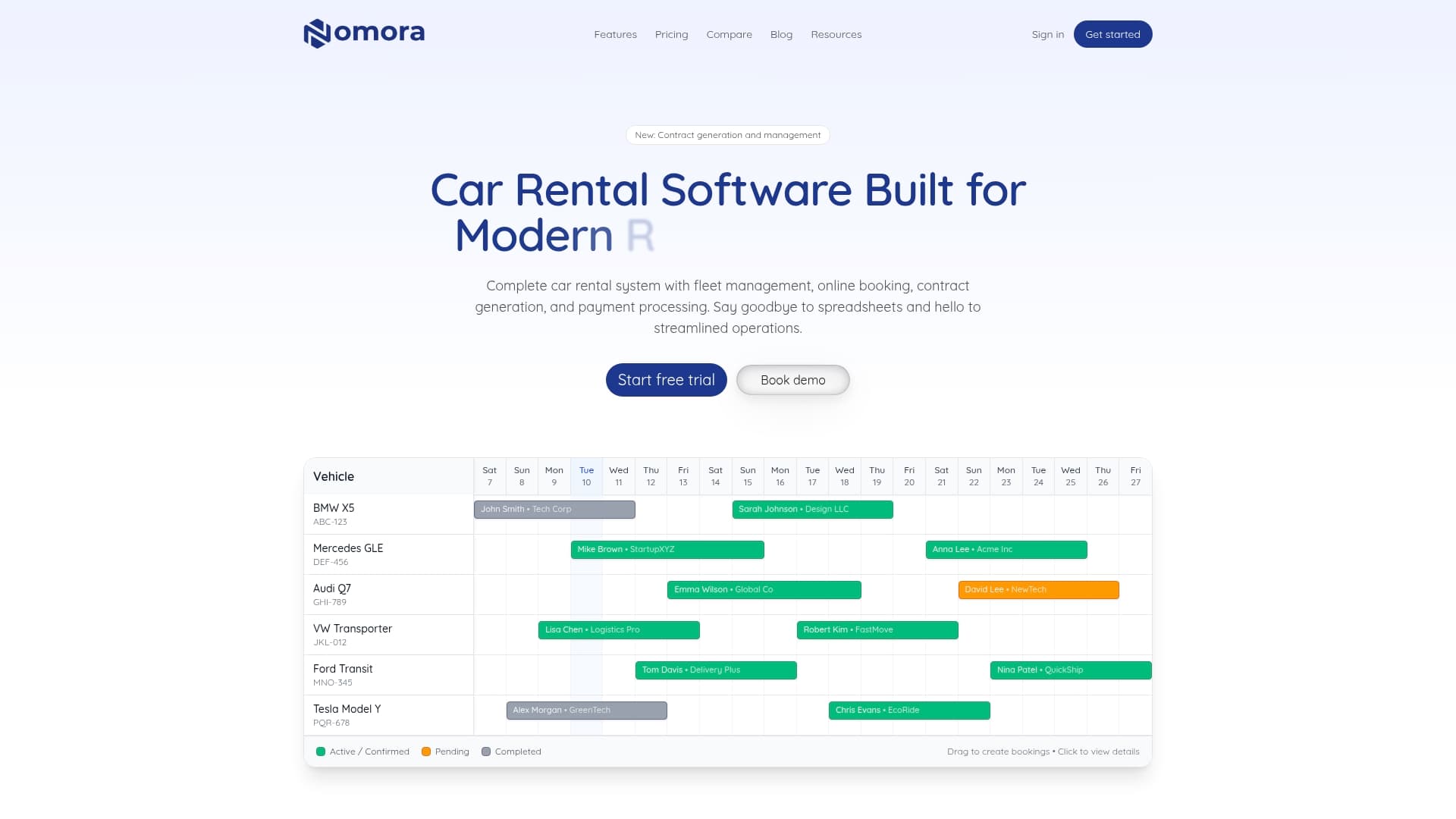
The point of a written rule is that nobody has to argue. The point of a system is that two people cannot hold the same car at the same time in the first place. A shared spreadsheet or Outlook calendar, which some fleets still use, relies on people checking before they write. Nomora's conflict-free booking tools are designed to prevent overlapping reservations on the same vehicle, so the tiebreak rule is needed far less often.
Pickup and return: the handover routine
Most disputes about damage, fuel and mileage start at the handover. The policy should make the routine short and identical every time.
At pickup
A checklist makes the inspection repeatable. Nomora's equipment checklists are part of its check-in and check-out documentation, so the items you want confirmed at handover can be standardized per vehicle rather than rewritten each time.
At return
Minneapolis requires drivers to refuel, remove debris and personal items and return completed forms. Regis University requires a full tank, end mileage recorded, new damage and operational problems documented, trash and belongings removed, and keys returned. UCLA also lists accessories and fuel cards among the items to return at the specified time.
Two details are worth copying. First, Liberty runs joint pre- and post-trip checks covering fuel, fluids, cleanliness and damage, with defects documented by photographs and entered in the fleet database. Photos with timestamps settle most arguments. Second, Lewiston asks drivers to return cars to their normal parking stall, which saves the next driver ten minutes of searching.
Fuel, mileage, cleaning, fines and damage
This is the section drivers actually read when something goes wrong, so keep it concrete.
- Fuel or charging. State the level at return (Regis requires a full tank) and what happens if it is not met. If you run electric vehicles, state the minimum charge in the same sentence.
- Mileage. Record beginning and ending mileage on every trip, as South Dakota requires. Mileage also feeds service schedules.
- Cleaning. South Dakota's list is a model of specificity: remove litter, clean the windshield when supplies and weather permit, wash if needed. A vague "return clean" invites disagreement.
- Fines. Lewiston assigns traffic, parking and toll fines to the driver. Say so, and say that the booking record is how the responsible driver is identified.
- Damage and accidents. Require reporting through one stated channel. Lewiston has drivers report accidents and operational issues to the supervisor and fleet maintenance as applicable.
A clause for liability and insurance belongs in the policy too, but its wording depends on your insurer and your state, so have your insurance broker or attorney review it before you publish.
Records: the part that makes the policy enforceable
Rules without records cannot be applied. Regis keeps a vehicle log with checkout date and time, operator name, start and end mileage and signature, plus a shared online schedule showing availability, authorized operators and key times, and a trained staff inspection after each use before the next one. Regis links that log to accountability: you can identify who had the car and check it is roadworthy before the next booking.
Lewiston adds two operating habits: administrators update the calendar for early returns and mark vehicles unavailable during service. It also recommends tracking usage to spread mileage more evenly across pool vehicles and relocating cars when demand is uneven between sites.
From this, your policy should require that every trip leaves a record of:
- The booked vehicle, driver and time window
- Start and end mileage and fuel level
- Condition at pickup and at return, with photos where possible
- Any incident, fine or late return
- Service status, so a car in the workshop cannot be booked
When a vehicle finally leaves the pool, close out its record with the sale or transfer. Fleets in the New York area that sell a company car in New York should make sure the title and handover paperwork are filed against the vehicle's log, so no booking can reference a car you no longer own.
A policy checklist you can adapt
Use this as the outline for your own document:
- Purpose and scope: which vehicles and which users.
- Eligibility: license standard, who verifies it, how often it is rechecked, training if any.
- Reservations: notice period, maximum length, required booking details, approvals for overnight or long trips.
- Changes and cancellations: cut-off time, late cancellation charge, no-show grace period.
- Priority: first-come rule, out-of-service override, who decides exceptions.
- Pickup: license shown, agreement signed, inspection recorded, start mileage.
- Return: time, fuel or charge level, cleanliness, keys and accessories, end mileage.
- Costs and fines: who pays for what.
- Incidents: who is told, how fast, through which channel.
- Records: what is kept, where, and for how long.
Read each line and ask who checks it and how. A rule nobody can check is a wish. That question leads straight to tooling.
Running the policy with Nomora
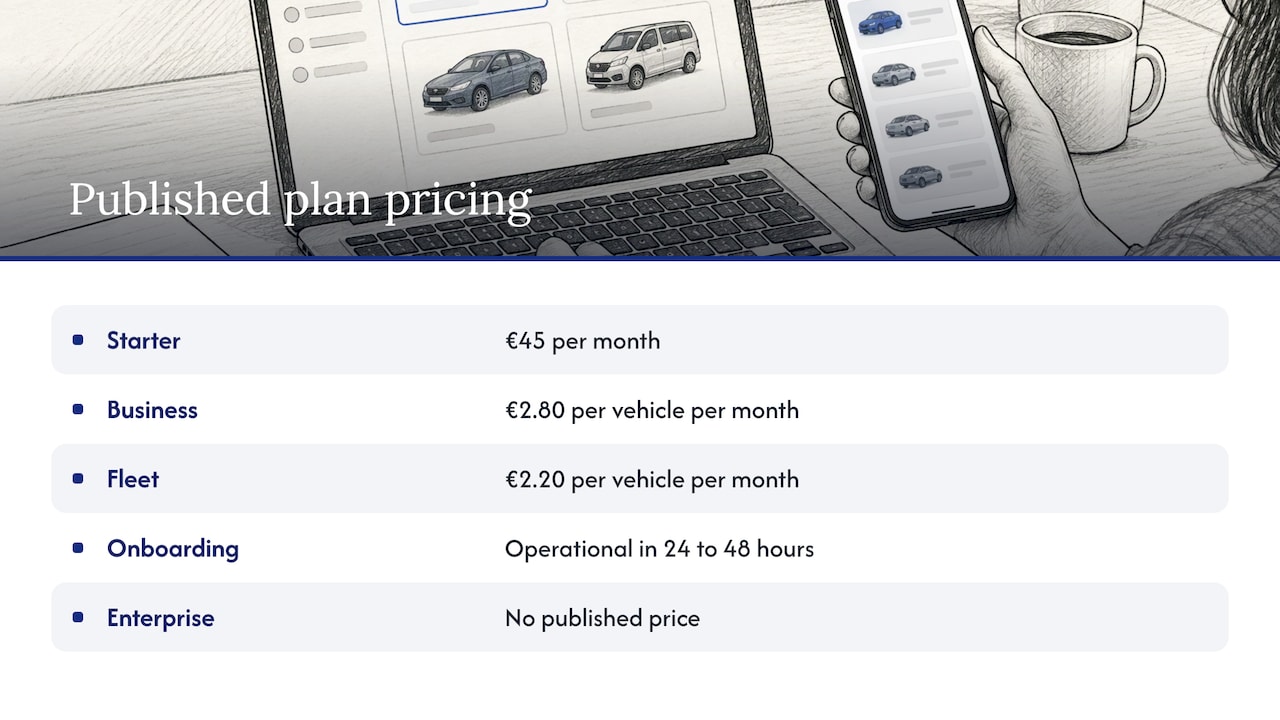
We built Nomora as a cloud-based platform that handles reservations, fleet management including GPS tracking, automated contract generation, integrated payment processing and customer data in one system, replacing spreadsheets and manual steps. For a pool or rental fleet, that means the booking, the vehicle record and the contract sit together, with real-time visibility of reservations and the fleet and conflict-free booking. Onboarding is designed so you are operational in 24 to 48 hours, and every plan includes all features.
Published plans on our pricing page: Starter at €45 per month, Business at €2.80 per vehicle per month, and Fleet at €2.20 per vehicle per month. Enterprise and payment processing have no published price.
If you are turning a policy document into a working process, see the plans and pricing and match the plan to your fleet size.
Our perspective
Most pool car problems we hear described are not policy problems. The policy exists, usually in a PDF. The trouble is that the booking lives in one place, the key log in another, the damage notes in a third, and the mileage in someone's notebook.
We think of rental software as the central nervous system of the operation: it carries the signal from the reservation to the vehicle to the contract to the payment, so each rule you write has something to act on. A notice period means little if the system lets a booking through anyway. A handover checklist means little if the result is not attached to the vehicle and the booking.
That is why Nomora brings reservations, fleet data, contracts, payments and GPS tracking into one platform, with conflict-free booking and real-time visibility. Write the shortest policy that covers your risks, then let one system carry it.
Dizzy
FAQ
How far in advance should a pool car be booked?
Many US fleets set 24 hours as the minimum, as Minneapolis and Liberty University do. Maximum advance windows range widely, from about two weeks in South Dakota to six months at ASU. Choose based on how predictable your demand is.
What should happen if a driver does not show up?
Set a grace period and release the car after it. ASU cancels automatically after 30 minutes, and Minneapolis may give the car to another user after the same interval. State the grace period in the policy and add a late-cancellation charge if no-shows are costly, as UCLA does with a one-day rate.
Who is responsible when someone else drives the booked car?
The reservation holder, under South Dakota's manual. Write the same rule into your policy and require every driver to be named on the booking and to show a valid license at pickup.
What records should a pool car policy require?
At minimum: operator name, checkout and return times, start and end mileage, condition at both ends and any incident. Regis University's vehicle log is a clear example. Keep the records against the vehicle so you can trace any problem to a booking.
Sources
- UCLA Procedure 320.1: Use of University Shared-Use Vehicles
- Vehicle Rental Policy, City of Minneapolis
- Policy and Procedure Manual for Assigned Drivers and Pool Vehicles, State of South Dakota
- Shared Fleet program, Arizona State University
- University Vehicle Use Policy, Wilkes University
- Motor Pool Policy and Procedure, Liberty University
- Procedure: Fleet Management, Motor Pool Operations, Fermilab
- Use of Pool Vehicles, Michigan State Police
- Pool Car Policy, City of Lewiston
- Vehicle Check In/Check Out Policy, Regis University
- RUL 30.05.5 Vehicle Use Rule, North Carolina Central University