A rental company may add a surcharge to eligible credit card payments only when three things line up: the law where the rental outlet sits allows it, the card network's rules are met, and the acquirer (the bank or processor that settles your card payments) has been told in advance. Debit and prepaid cards are off limits. Compliance is therefore less about one percentage and more about a routine you can repeat on every booking, at every counter and on every online checkout. That routine is much easier to keep when reservations, contracts and payments live in one system, which is how we built Nomora.
This guide is for owners of small and mid-sized rental companies, luxury and specialty operators, and corporate fleet managers. It covers the rules you need, a worked example, a rollout checklist, and the mistakes that put a surcharge program at risk.
TL;DR
- A surcharge is allowed on credit cards only. Visa prohibits it on debit and prepaid cards, even if the customer presses "credit" at the terminal.
- Visa's cap is the lower of your merchant discount rate for that card or 3%. Mastercard's brand-level cap is 4%, again limited by your effective rate.
- Notify your acquirer at least 30 days before you start, disclose at the entrance and at the point of sale, and show the surcharge as its own line on every receipt.
- State law sits on top of the card rules. Some states prohibit surcharges and others cap or condition them, so check each rental location separately.
- A cash discount or a convenience fee is a different instrument with different rules. Do not mix them with a surcharge on the same transaction.
Table of Contents
What a surcharge is, and what it is not
Visa defines a surcharge as an extra charge a merchant adds to the customer's bill for using a particular form of payment. In a rental business, that means a line on the rental agreement or invoice, such as "credit card surcharge," that exists only because the renter paid with a credit card.
Three neighboring ideas get confused with it:
- Cash discount. You offer a lower price to people who pay cash, instead of adding a fee for cards. The National Federation of Independent Business explains in its surcharge and cash discount guide that federal law protects cash discounts when they are offered to prospective buyers with clear disclosure.
- Convenience fee. Stripe's guide to card surcharges describes it as a fee for using a nonstandard payment channel, not for using a credit card. A standard payment option must also be available, and the fee should be disclosed before payment. The same guide says a surcharge and a convenience fee cannot be combined on one transaction under Visa and Mastercard rules.
- "Compliance fee." Searchers often ask about this. It is not a recognized category in the card rules. If you add any charge to a rental, name it for what it is and check whether it falls under surcharge, convenience fee or a normal part of the rental price.
The practical point: the label on the agreement does not decide the rules. What the fee is tied to does. A fee that appears only when a credit card is used will be treated as a surcharge, whatever you call it.
The card network rules in plain terms
Card networks write their own rules, and they bind you through your merchant agreement with your acquirer. Breaking them can put your ability to accept cards at risk, even when the state allows a surcharge.
Credit only, never debit or prepaid
Visa's February 2024 U.S. guidance prohibits surcharges on Visa debit and prepaid cards. A customer who runs a debit card as "credit" at the counter does not change its status. This matters for rental desks, where many renters pay with a debit card that has a Visa or Mastercard logo. Your process must separate card type from the way the card was entered. Some states are also adding their own debit-specific bans. Louisiana's Act 751 of 2026 is reported to prohibit debit surcharges for retail businesses from August 1, 2026, another reason to check local law and not rely on the network rule alone.
The cap
For Visa, the cap is the lower of the merchant discount rate for the applicable credit card or 3%. The merchant discount rate is the total percentage you pay your processor to accept that card. For Mastercard, a merchant imposing a brand-level surcharge may charge the lesser of its average effective discount rate for Mastercard credit or the 4% maximum.
So "Is a 3% fee legal?" has no automatic yes. It is legal on a Visa credit card only if your cost for that card is at least 3%, only where your state allows it, and only with the required notices. If your Visa credit cost is 2.4%, the ceiling is 2.4%.
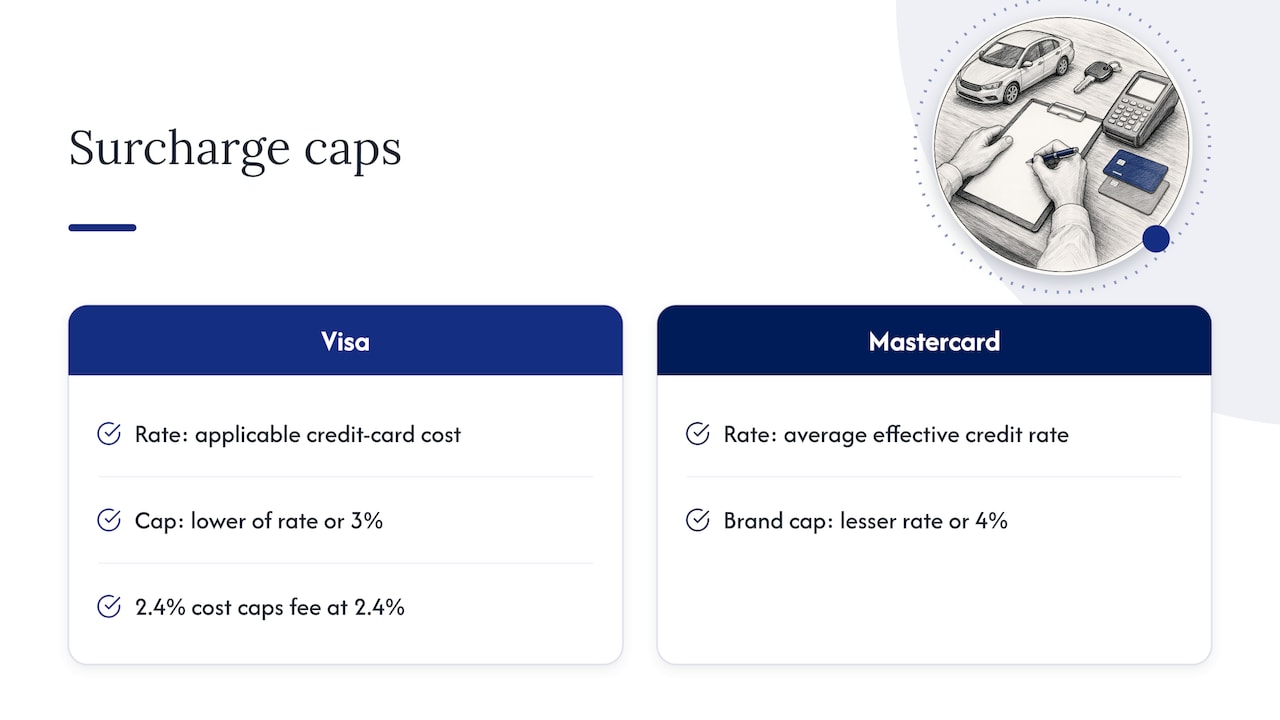
That is why many rental operators set one flat surcharge below their lowest effective rate across card types, then review it when their processing statement changes.
Notice, disclosure and receipts
Visa requires notice to the acquirer at least 30 days before you start, disclosure at the point of entry and at the point of sale or transaction, and a separate surcharge amount on every receipt. Mastercard likewise conditions surcharging on advance notice to both Mastercard and the acquirer no less than thirty days before you begin.
For a rental company, "point of entry" and "point of sale" map onto several places:
- The front door or counter of each branch.
- The online booking flow, before the renter confirms payment.
- Phone reservations, where the agent should state the fee before taking card details.
- The rental agreement and any pre-authorization or invoice emails.
- The receipt, where the surcharge appears as its own line, separate from the rental rate, taxes and add-ons.
State law comes first
Visa says surcharging is allowed in most U.S. states and territories for credit transactions, subject to applicable law, card product and outlet location. That last phrase is the one that matters for multi-location fleets: the rule that applies is the one where the outlet is, not where your head office is or where the renter lives.
A November 2026 state-by-state review reports that Connecticut, Maine, Massachusetts and Texas prohibit credit surcharges, and that Colorado, Minnesota, New Jersey, New York and Oklahoma have caps or specific restrictions. It also notes that Kansas and the District of Columbia have notice requirements and that Texas enforceability has been affected by court rulings, which makes Texas worth a specific legal review. Treat that list as a starting map, not as legal advice. State laws change.
The general counsel of the rental industry's trade association, APRO, makes the same point in a primer on credit card surcharges: determine the surcharge law in each store's jurisdiction and consult your bank or a lawyer, because the rules keep moving. If you operate airport counters, a luxury branch and a downtown office in different states, expect different answers for each.
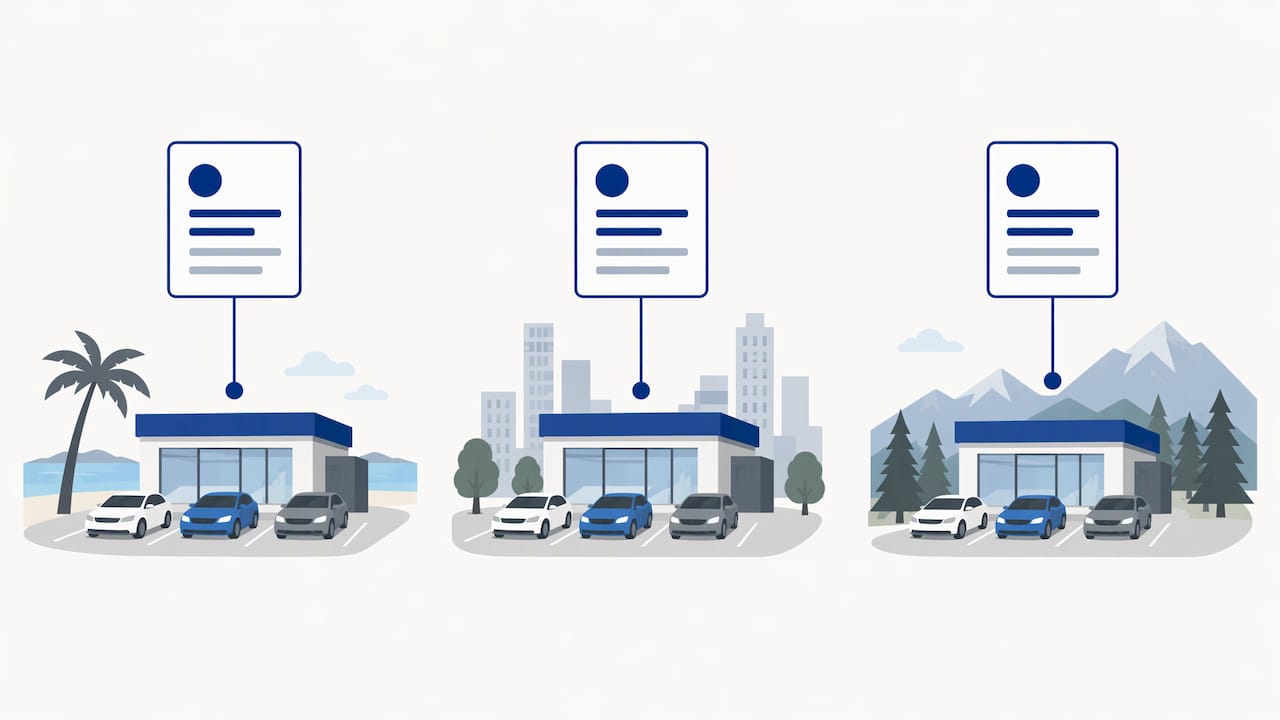
Before you start, ask your bank or a business attorney in each state where you rent vehicles to confirm that a credit surcharge is permitted and whether it has a lower limit than the card networks' caps.
A worked example
A specialty rental company has two locations, one in a state that allows surcharging and one in a state that prohibits it. Its processor statement shows an effective rate of 2.6% on Visa credit and 2.8% on Mastercard credit.
- Cap. Visa's ceiling is the lower of 2.6% or 3%, so 2.6%. Mastercard's is the lower of 2.8% or 4%, so 2.8%.
- Chosen fee. The owner sets one surcharge of 2.5%, safely under both ceilings.
- Locations. The fee is switched on only at the permitted location. The other branch uses a cash discount or no card-based pricing difference at all.
- A $1,200 weekly rental paid by credit card. The surcharge is $30.00. The receipt shows the rental, taxes and add-ons, then "credit card surcharge $30.00" as its own line.
- A renter pays with a debit card. No surcharge, whatever the terminal screen shows.
The figures are illustrative, not a recommendation. Your ceiling depends on your own statement, which is why it needs a review each time your processing rates change.
A rollout checklist for rental operators
Use this order. Skipping the early steps is where most problems start.
- Read your merchant agreement and statement. Find your effective rate for each card brand's credit cards. This sets the cap.
- Confirm state law for each branch. Do it location by location, with your bank or counsel.
- Notify your acquirer, and the networks where required, at least 30 days before launch. Keep a record of the date.
- Decide what the fee is. A surcharge on credit cards only, with one rate that stays under every applicable ceiling.
- Update every customer touchpoint. Signage, website, booking flow, phone script, rental agreement, invoice and receipt.
- Separate credit from debit and prepaid in how you charge. Never rely on the renter's choice at the terminal.
- Train counter and phone staff. They must be able to say what the fee is, why it appears and which cards it does not apply to.
- Review on a schedule. Re-check the rate against your statement and the law each time either changes.
Where surcharge programs go wrong
- Applying it to debit or prepaid cards. This is the most frequent violation and it is never allowed under Visa's rules.
- Charging above your cost. A flat 3% looks tidy, but if your effective rate on a card is lower, the cap is lower.
- Skipping the 30-day notice. Starting on the day you decide is not an option.
- Burying the fee. If the renter first sees it on the final receipt, the disclosure requirement has not been met.
- One policy for all states. A single company-wide setting ignores outlet-level law.
- Stacking fees. A surcharge and a convenience fee on one transaction are not allowed together under the networks' rules, as Stripe's guide explains.
- Missing a rule change. Old policies kept for years drift out of compliance.
Rental payments also have more moving parts than a retail sale: deposits, extensions, tolls, damage charges and add-ons may all be charged separately. Your policy should say clearly which payments carry the surcharge, so that staff apply it the same way every time. Confirm the treatment of each with your acquirer.
Why the system you run rentals on matters
Surcharge compliance fails at the edges: a counter agent who forgets the disclosure, a booking page that shows the fee late, a spreadsheet that holds last year's rate. Each failure comes from the same cause, which is rental data and payment steps living in separate places.
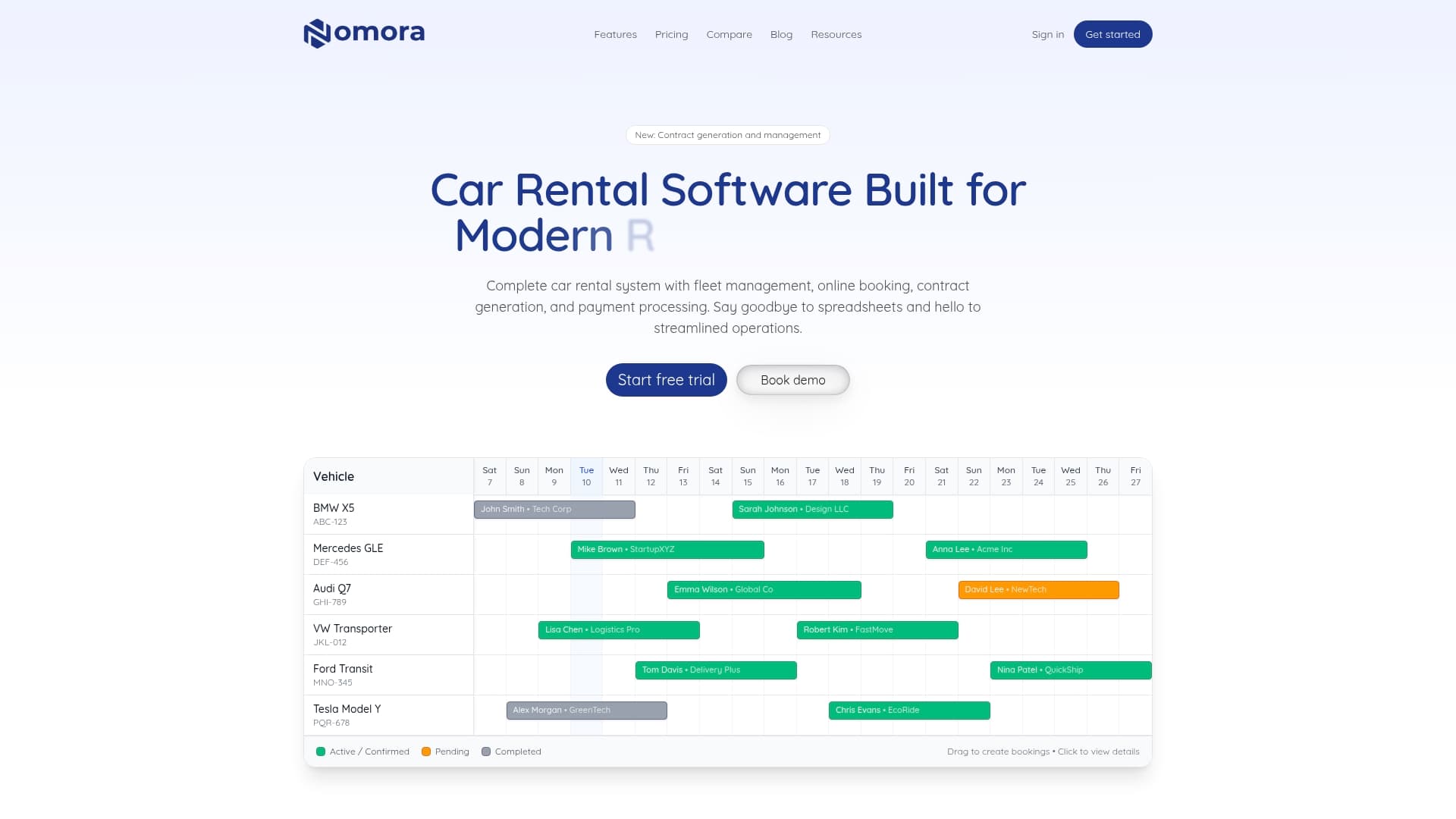
A platform that holds reservations, contracts, customer records and payments together gives you one place to keep your policy consistent. Nomora combines reservations, automated contract generation, integrated payment processing and customer data management in a single cloud system, accessible from any device, so the people at the counter and the people in the back office work from the same records. That is the part of compliance that software can help with: consistency. The legal decision about whether, where and how much to surcharge remains with you, your bank and your attorney.
If you also sell rentals through partners or intermediaries, the question of who is the merchant on the payment matters too. A merchant of record setup determines who carries billing responsibility, and it is worth understanding before you decide where a surcharge would apply.
Nomora for rental operators who want payments under control
Nomora is a cloud-based rental management platform for small and mid-sized rental companies, luxury and specialty vehicle operators and corporate fleet managers. It replaces spreadsheets with one system for reservations, fleet, contracts, payments and customer data, with GPS tracking and payment gateway integrations. Every plan includes all features, and onboarding is designed to have you fully operational in 24 to 48 hours.
Published plans: Starter at 45 EUR per month, Business at 2.80 EUR per month per vehicle, and Fleet at 2.20 EUR per month per vehicle. Enterprise and payment processing carry no published price. See Nomora's plans and pricing to match one to your fleet size.
Our perspective
We talk to rental owners who describe payments as the part of the business that grows quietly and then bites. A surcharge looks like a single setting. In practice it is a policy that touches your booking page, your counter script, your agreement template and your receipts, in every location you run.
Our view is that the safest surcharge program is the one that is easiest to keep identical everywhere. That is why we built Nomora as one cloud platform for reservations, contracts, payments and customer data, instead of a set of tools that each hold a different version of the truth. When the contract and the payment live together, there is one place to look when a renter, a bank or an auditor asks what was disclosed and what was charged.
The legal questions, which states, what rate, which cards, belong with your bank and counsel. The daily discipline is ours to support, and we think rental businesses of every size deserve software that makes it routine.
Dizzy
FAQ
Is it legal to charge a 3% credit card fee?
Sometimes. On Visa credit cards the ceiling is the lower of your merchant discount rate for that card or 3%, and your state must allow surcharging. You also need to notify your acquirer 30 days ahead and disclose the fee to renters. If your cost on a card is below 3%, so is your cap.
Can I surcharge debit cards if the renter selects "credit"?
No. Visa prohibits surcharges on debit and prepaid cards, and a debit card keeps its status when the customer chooses "credit" at the terminal. Some states add their own debit restrictions on top.
What is the difference between a surcharge and a cash discount?
A surcharge is a fee added when the customer pays by credit card. A cash discount is a lower price offered for paying cash. Federal law protects cash discounts that are offered with clear disclosure, according to the NFIB's guide, though state rules can still matter.
Which states do not allow credit card surcharges?
A November 2026 review reports Connecticut, Maine, Massachusetts and Texas as prohibiting them, with Texas affected by court rulings, and several other states setting caps or conditions. Laws change, so confirm each branch location with your bank or an attorney before you start.
Sources
Ready to streamline your car rental business?
Book 30 minutes with the founder. We set up everything in this guide on your own vehicles, and migrate you out of Excel for free.