Key takeaways
| Point | Details |
|---|
| Economy and compact SUVs dominate | Small to medium fleets prioritize these categories for highest utilization and customer demand |
| Utilization benchmarks matter | Average daily rates of 70-79% are standard, with seasonal peaks reaching 90-95% in high demand periods |
| Data-driven management wins | Fleet optimization through demand forecasting and dynamic pricing can boost utilization by up to 25% |
| Fleet diversity scales with size | Medium operators run 1,000+ vehicles across 200+ models while small fleets focus on 20-60 core vehicles |
| Regional demand drives selection | Vehicle preferences vary significantly by geography, requiring tailored fleet composition strategies |
Criteria for selecting your rental fleet vehicles
Your fleet composition determines how effectively you capture revenue opportunities throughout the year. Understanding fleet utilization benchmarks provides essential context: 70-79% average daily utilization represents solid performance, while seasonal peaks can hit 90-95%. Economy cars consistently achieve the highest utilization rates, while luxury vehicles typically underperform.
Vehicle category selection forms your foundation. Economy cars appeal to budget-conscious travelers and business users seeking reliable transportation. Compact SUVs attract families and adventure seekers who need extra cargo space without premium pricing. Sedans serve mid-range customers wanting comfort upgrades, while vans accommodate group travel and special events.
Regional preferences and seasonal demand patterns create complexity in fleet planning. North American markets favor SUVs and trucks, while European customers often prefer smaller, fuel-efficient vehicles. Iceland's rental market demands 4x4 capability for highland routes. Beach destinations see summer spikes, ski resorts peak in winter, and business hubs maintain steadier year-round demand.
Fleet sizing requires balancing peak capacity against off-season efficiency. Purchasing enough vehicles to meet summer demand leaves you with idle inventory during slower months. Smart operators use demand forecasting software to predict booking patterns and right-size their fleets accordingly.
Operational considerations extend beyond purchase price. Maintenance costs, fuel efficiency, insurance premiums, and resale values all impact total cost of ownership. Vehicles with strong reliability records reduce downtime and repair expenses. Popular models command better resale prices when you cycle out older inventory.
Pro Tip: Track utilization by vehicle category monthly to identify which segments consistently outperform. This data reveals where to invest in additional capacity and which vehicle types to phase out during fleet refreshes.
Examples of vehicles commonly found in small to medium car rental fleets
Successful rental operators build their fleets around proven performers that balance customer appeal with operational efficiency. Small to medium fleets typically feature economy cars like the Toyota Corolla Hybrid, Hyundai i20, and Kia Rio. These vehicles deliver excellent fuel economy, low maintenance costs, and broad market appeal. The Corolla Hybrid particularly stands out for its reliability and resale value.
Compact SUVs represent the fastest-growing segment in rental fleets. The Peugeot 2008, Suzuki Vitara, and MG ZS offer the elevated seating position and cargo flexibility customers want without the fuel penalty of larger SUVs. These models hit the sweet spot for pricing, typically renting at 20-30% premiums over economy cars while maintaining strong utilization.

Sedan options like the Peugeot 208 and 308 series serve customers seeking more comfort and features than basic economy cars provide. These mid-range vehicles appeal to business travelers and couples wanting a quieter, smoother ride. The 308 series particularly attracts customers willing to pay modest premiums for additional space and amenities.
Vans fill specialized group travel needs. The Fiat Talento 9-seater exemplifies this category, accommodating large families, wedding parties, and corporate shuttles. While vans represent smaller percentages of total fleet composition, they command premium daily rates and serve markets competitors often neglect.
| Vehicle Category | Popular Models | Typical Fleet Percentage | Key Benefits |
|---|
| Economy Cars | Toyota Corolla Hybrid, Hyundai i20, Kia Rio | 35-45% | Highest utilization, lowest operating costs, broad appeal |
| Compact SUVs | Peugeot 2008, Suzuki Vitara, MG ZS | 25-35% | Strong demand, cargo flexibility, premium pricing |
| Sedans | Peugeot 208, Peugeot 308 | 15-25% | Mid-range pricing, business traveler appeal |
| Vans | Fiat Talento 9-seater | 5-10% | Niche markets, premium rates, group travel |
Fleet diversity scales dramatically with company size. Medium operators like Midway Car Rental operate 4,000+ vehicles spanning 250 makes and models, from Bentley luxury cars to Toyota economy compacts. This breadth allows them to serve every customer segment and capture specialized demand. Meanwhile, Midwestern Wheels grew to 1,170 vehicles in 2024, demonstrating how successful regional operators expand methodically.
Pro Tip: Start with 3-4 proven models in your core categories rather than spreading capital across too many vehicle types. Standardization simplifies maintenance, staff training, and inventory management while you establish baseline utilization patterns. For software for medium fleets that helps track these patterns, integrated management platforms provide real-time visibility into which models perform best. Understanding how software boosts profits through better utilization becomes clearer once you have clean data on vehicle performance.
Comparing fleet sizes and utilization: small versus medium rental companies
Fleet size directly impacts operational complexity and utilization potential. Small operators typically manage 20-60 vehicles concentrated in high-demand categories. This focused approach allows intimate knowledge of each vehicle's condition and booking patterns. A 60-car fleet in Warsaw achieved 82% utilization, demonstrating that smaller operations can match or exceed industry benchmarks through careful management.
Medium-sized companies operate fundamentally different businesses. Midway Car Rental's 4,000+ vehicles and Midwestern Wheels' 1,170 vehicles require sophisticated systems to track maintenance schedules, optimize pricing, and rebalance inventory across locations. Their diverse model mixes serve specialized demands small operators cannot economically address.
| Fleet Characteristic | Small Operators (20-60 vehicles) | Medium Operators (200-4,000+ vehicles) |
|---|
| Vehicle Model Diversity | 5-15 models | 50-250+ models |
| Average Daily Utilization | 70-82% | 70-79% |
| Peak Season Utilization | 85-95% | 90-95% |
| Management Approach | Hands-on, personal oversight | Systems-driven, data analytics |
| Market Coverage | Local/regional focus | Multi-location, diverse segments |
Utilization benchmarks reveal interesting patterns across fleet sizes. Both small and medium operators target 70-79% average daily rates, with peaks reaching 90-95% during high season. Smaller fleets sometimes achieve higher utilization through tighter inventory control and local market knowledge. Larger fleets accept slightly lower averages in exchange for serving broader customer needs and geographic coverage.
Seasonal and regional demand variations affect fleet sizing decisions differently. Small operators often concentrate in single markets, making them vulnerable to local economic shifts but allowing deep expertise in their territory. Medium companies spread risk across multiple locations and customer segments, cushioning against regional downturns but requiring more sophisticated demand forecasting.
The utilization improvement opportunity matters more than absolute fleet size. A 60-car fleet increasing utilization from 70% to 82% gains 12 percentage points of revenue from existing assets. A 1,000-car fleet achieving the same improvement generates proportionally larger absolute gains. Understanding software vs spreadsheets ROI becomes critical as fleet complexity grows, since manual tracking fails to capture optimization opportunities that integrated systems identify automatically.
Scaling from small to medium fleet status requires fundamental operational changes. Manual booking systems and spreadsheet tracking suffice for 30 vehicles but collapse under the weight of 300. Preventive maintenance schedules, dynamic pricing algorithms, and multi-location inventory management demand purpose-built software platforms rather than improvised solutions.
Choosing the right fleet mix and size for your rental business
Data-driven optimization separates profitable operators from struggling competitors. Demand prediction and dynamic pricing can increase utilization by 3-25% by matching vehicle availability to customer willingness to pay. This means implementing systems that analyze historical booking patterns, competitor pricing, and seasonal trends to recommend optimal daily rates for each vehicle category.
Fleet sizing strategy requires honest assessment of your market realities. Size your core fleet to meet 80-85% of annual demand, then use short-term partnerships or strategic overbooking to handle peak periods. Purchasing enough vehicles to cover July 4th weekend leaves expensive assets idle in February. Smart operators accept occasional sold-out situations rather than carrying excess capacity year-round.
The single-fleet pooling versus multi-fleet debate centers on operational efficiency versus customer service. Pooling all vehicles into one shared inventory maximizes utilization by eliminating location-specific shortages. However, customers value consistent vehicle availability at their preferred pickup location. Balancing these competing priorities requires understanding your market's loyalty sensitivity and willingness to accept alternative pickup arrangements.
Focus your investment on economy cars and compact SUVs for maximum return. These categories consistently deliver the highest utilization rates and broadest market appeal. Luxury and specialty vehicles serve niche demands but tie up capital in assets that sit idle more often. A fleet composition of 60-70% economy and compact SUVs, 20-30% mid-range sedans, and 5-10% specialty vehicles typically optimizes both utilization and revenue.
Continuous monitoring and adjustment separate good fleet management from great performance. Track these essential metrics monthly:
- Utilization rate by vehicle category to identify underperforming segments
- Revenue per available vehicle day to measure pricing effectiveness
- Maintenance cost per mile to catch reliability problems early
- Days to rent after return to optimize vehicle turnover
- Seasonal booking patterns to refine capacity planning
Pro Tip: Review your fleet composition quarterly rather than annually. Markets shift faster than yearly planning cycles capture, and early adjustments to vehicle mix prevent extended periods of suboptimal utilization.
"The most successful rental operators treat fleet management as an ongoing optimization process rather than a one-time purchasing decision. They continuously test, measure, and refine their vehicle mix based on real performance data."
Explore software use cases that demonstrate how integrated platforms support these optimization practices. Understanding software pricing helps you evaluate whether technology investments deliver positive ROI through improved utilization and reduced operational friction.
Explore Nomora software solutions for optimized fleet management
Managing a rental fleet efficiently requires more than spreadsheets and manual tracking. Nomora provides specialized software use cases for rental businesses that streamline bookings, automate pricing adjustments, and track utilization across your entire fleet. Small to medium operators gain real-time visibility into which vehicles generate the best returns and where opportunities exist to improve performance.
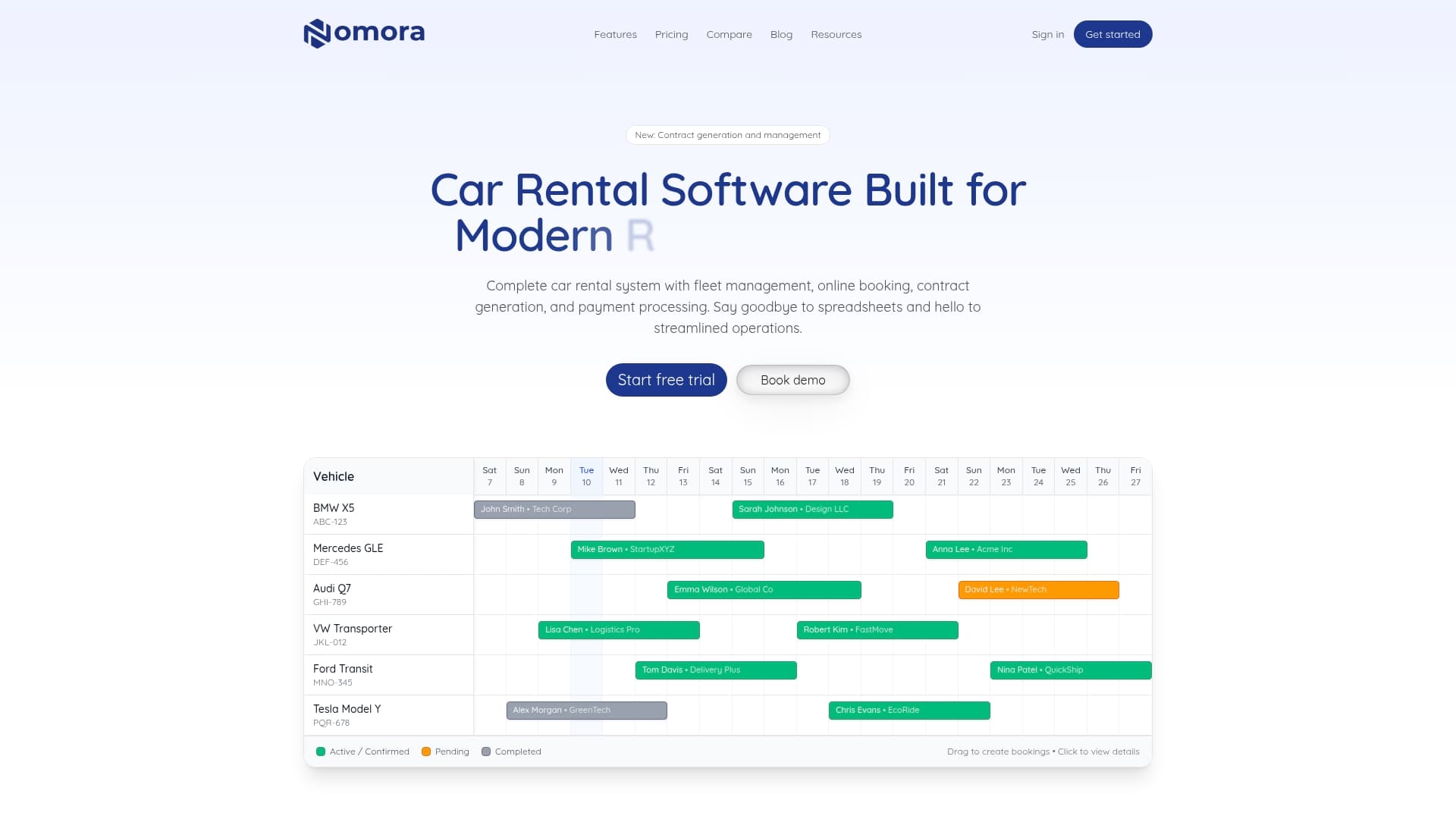
The platform's fleet management software handles reservation conflicts, contract generation, and payment processing in one integrated system. This eliminates the data entry errors and double bookings that plague manual operations. For growing companies, medium fleet rental software scales seamlessly as you add vehicles and locations, maintaining operational efficiency without proportional increases in administrative overhead.
Frequently asked questions
What types of vehicles are best for small car rental fleets?
Economy cars and compact SUVs form the foundation of successful small fleets, with models like the Toyota Corolla Hybrid and Peugeot 2008 delivering optimal utilization rates. These categories balance customer demand, operating costs, and resale values better than specialty or luxury vehicles. Focus 60-70% of your initial fleet on these proven performers before expanding into niche segments.
What is a good utilization target for rental car fleets?
Target 70-85% average daily utilization across your entire fleet, with economy vehicles often achieving the higher end of this range. Seasonal peaks can reach 90-95% during high-demand periods, but maintaining year-round rates above 85% typically indicates insufficient capacity to capture growth opportunities. Track utilization by vehicle category monthly to identify which segments consistently outperform and deserve additional investment.
How can technology improve rental fleet utilization?
AI-driven demand prediction and dynamic pricing increase utilization by 3-25% by automatically adjusting rates based on booking patterns and competitor pricing. Integrated management platforms provide real-time visibility into vehicle availability, maintenance schedules, and revenue performance across your fleet. Forecasting tools prevent both over-capacity during slow periods and missed revenue from under-capacity during peaks, optimizing your fleet size and mix continuously.
How many vehicle models should a medium-sized rental fleet include?
Medium operators typically manage 50-250+ vehicle models to serve diverse customer segments and regional preferences effectively. This diversity allows capturing specialized demand for luxury vehicles, cargo vans, and fuel-efficient compacts that small operators cannot economically address. However, start with proven core models and expand variety gradually based on demonstrated customer demand rather than speculative purchasing.
Should I buy or lease vehicles for my rental fleet?
Buying vehicles outright provides better long-term economics if you plan to operate them for 3-5 years and have capital available. Leasing offers lower upfront costs and easier fleet cycling but typically costs more over the vehicle's useful life. Consider hybrid approaches where you own core economy vehicles for maximum ROI while leasing specialty vehicles that serve seasonal or uncertain demand, allowing flexibility to adjust your fleet mix as markets evolve.
Recommended