For reliable long-term vehicle rentals, you need a single cloud platform that combines reservations, recurring billing, telematics, and living-contract workflows, not a mix of spreadsheets and point tools. That's the honest answer to long term rental management in 2026, and Nomora is built specifically to be that platform for rental companies and corporate fleet operators.
The immediate next step isn't a full software rollout. Run a focused operational audit first, then validate a vendor against what you find.
- Spend 30 to 60 minutes mapping your current vehicle, driver, and contract records across every spreadsheet and tool you use today.
- Note where fleet lifecycle management decisions (replacement, maintenance) rely on guesswork instead of data.
- Schedule a 30-minute demo with a platform that supports telematics integration and recurring billing before you commit to anything.
Key Takeaways
Long-term rental management succeeds when a single cloud platform unifies reservations, recurring billing, contract governance, and telematics instead of relying on disconnected spreadsheets and point tools.
| Point | Details |
|---|
| Unify your records first | Link vehicle, driver, contract, and payment data into one register before adding any new tool. |
| Govern contract amendments | Require a signed, versioned record for every change to avoid reconciliation problems later. |
| Automate routine work, flag exceptions | Let software handle recurring billing and maintenance alerts, but route late payments and overages to a human. |
| Track four core KPIs monthly | Watch utilization rate, revenue per vehicle, cost per mile, and downtime hours for early warning signs. |
| Validate with a live demo | Nomora offers 24 to 48 hour onboarding with recurring billing, digital contracts, and telematics integration built in. |
Table of Contents
Why Long-Term Rental Management Works Differently Than Daily Rentals
A one-day rental contract closes the moment the car comes back. A long-term contract stays open for months, sometimes years, and it changes shape the whole time. That difference alone explains why daily-rental software so often breaks down when operators try to stretch it into long-term fleet management.
- Living agreements replace one-time contracts. Mileage caps get renegotiated, drivers get added, insurance riders change, and every one of those edits carries legal weight if it isn't tracked properly.
- Billing becomes recurring, not transactional. Instead of one charge per rental, you're managing monthly invoices, partial payments, and aging receivables across dozens or hundreds of active contracts.
- Lifecycle timing matters more. A vehicle earning revenue for 18 months needs replacement decisions grounded in utilization and cost data, not a fixed mileage rule.
- Admin overhead scales nonlinearly. Add ten more long-term contracts and you don't add ten times the paperwork. You add the compounding complexity of amendments, renewals, and exceptions across all of them at once.
What Should You Require From Long-Term Rental Management Software?
Before you sign with any vendor, run their platform against this checklist. Skip any item and you're signing up for the same administrative bottlenecks you're trying to escape.
- One linked register for vehicles, drivers, and customers. Fragmented records are the single biggest cause of double-bookings and billing errors as fleets grow, and fleet management best practices research consistently points back to this as the root fix.
- Recurring billing with a PCI-aligned card vault. Monthly invoicing needs to run itself, and stored payment credentials need bank-grade tokenization, not a spreadsheet with card numbers in it.
- Contract templates with digital signatures and version control. Every amendment should generate a new signed version, not a verbal agreement noted in an email thread.
- Telematics integration tied to preventive maintenance alerts. The platform should know a vehicle needs service before the driver calls to complain.
- Multi-entity and multi-location support with full audit trails. If you run more than one branch or corporate account, your platform needs to segment data without losing a unified view.
Pro Tip: Ask any vendor to show you a live conflict-free booking check during the demo. If two reservations can overlap on the same vehicle without a hard block, that's a disqualifying gap, not a minor bug.
How Do You Roll Out Long-Term Rental Management in 90 Days?
A short, measurable onboarding window with month-by-month deliverables dramatically improves the odds that a mid-sized fleet actually adopts new software instead of quietly reverting to spreadsheets after week three, a pattern documented in fleet management best practices for growing fleets. Here's a version built specifically for long-term rental operations.
- Month 0: audit and baseline. Document your current utilization rate, average downtime per vehicle, and cost per mile before you touch any new system. You can't measure improvement without a starting line.
- Month 1 to 2: migrate and configure. Move vehicle and driver registers into the new platform, build your contract templates, and turn on recurring billing for active accounts.
- Month 2 to 3: integrate and train. Connect telematics feeds, set automated maintenance triggers, and get staff comfortable running exceptions rather than manual lookups.
- Ongoing: set review gates. Define what triggers human review (a late payment, a mileage overage, a repair estimate above a set threshold) and build a weekly operations check plus a monthly strategic review into the calendar.
A data-driven lifecycle strategy combined with predictive maintenance can cut unplanned downtime by up to 30%, which is the kind of number that turns a 90-day rollout into a budget conversation your finance team actually wants to have. Nomora's own onboarding process is built to compress that migration window to 24 to 48 hours for core setup, so the month-by-month plan above starts from a working system, not a blank slate.
How Do You Integrate Telematics, Payments, and Analytics?
Think of your rental management platform as the central nervous system of the operation. Telematics are the nerve endings feeding sensation back from every vehicle; payments are the circulatory system moving revenue; analytics is the brain deciding what to do next. If any one of those signals doesn't reach the center, the whole system reacts too slowly.
- Feed telematics directly into the booking engine. Fault codes, mileage, and location data should update the same record a reservation touches, because integrating booking software with telematics is what prevents inaccurate utilization metrics in the first place.
- Use tokenized payment vaults for recurring charges. Storing card details through a tokenized vault instead of raw numbers shrinks your PCI compliance scope and removes a major security liability.
- Map vehicle IDs, contract IDs, and driver records consistently across every API. Inconsistent ID mapping between systems is the quiet reason "integrated" platforms still produce mismatched reports.
- Let analytics turn raw telemetry into replacement forecasts. Cost per mile and downtime trends, tracked over months, tell you when a vehicle is about to become a net drag on the fleet rather than an asset.
How Do You Prevent Contract Amendments From Causing Reconciliation Problems?
Most operators eventually realize their long-term contracts are living documents, not fixed agreements. The biggest operational risk isn't the original contract. It's the mileage adjustment, the added driver, or the insurance change that gets agreed to verbally and never makes it into a signed, versioned record.
- Treat every amendment as its own signed document. Version control on contracts matters exactly as much as version control on the original agreement.
- Set hard approval gates for specific triggers. Late payments, mileage overages, and high-cost repair authorizations should stop at a human, not flow through automatically.
- Keep every document in an auditable store. Insurance audits and resale valuations both depend on being able to produce a clean paper trail on demand.
This mirrors a broader principle in fleet automation: software should handle routine work automatically while flagging exceptions for a person to review, so the system never becomes a black box nobody can explain later.
Pro Tip: *Set your mileage overage threshold as a percentage, not a fixed number.
Which KPIs Actually Prove Long-Term Rental Management Is Working?
Four numbers matter more than the rest: utilization rate, revenue per vehicle, cost per mile, and downtime hours. Track these monthly, and you'll catch problems while they're still cheap to fix.
- Run a before/after comparison the month you switch platforms or processes, then repeat it as a rolling monthly cohort report so seasonal noise doesn't distort your read.
- Build a weekly operations report for dispatch-level decisions and a separate monthly report for lifecycle and budget decisions. They serve different audiences and shouldn't be the same document.
- Watch for reduced admin hours per contract and fewer unplanned downtime incidents as your clearest early ROI signals, alongside the downtime reduction figures tied to predictive maintenance adoption.
- If revenue per vehicle stays flat while utilization climbs, your pricing, not your operations, is the next thing to fix.
Nomora's fleet reporting tools are built to generate exactly this split between operational and strategic dashboards without manual spreadsheet work.
How Do You Screen and Select Long-Term Rental Customers?
Screening for a long-term vehicle contract carries more weight than a weekend rental because you're underwriting months of exposure, not a few days. Start with a documented credit check and driving record pull for every applicant, corporate accounts included, since a business's payment history matters just as much as an individual's.

Verify employment or business standing for corporate leases, and require a deposit sized to the vehicle class rather than a flat fee across your fleet. A luxury SUV and a compact sedan carry very different damage and depreciation exposure, and your deposit structure should reflect that.
Set clear, written criteria before you start reviewing applications: minimum credit thresholds, acceptable driving record history, and required documentation for business accounts. Vague or inconsistent criteria expose you to discrimination claims and make it harder to defend a denial if it's ever challenged. A platform that stores this screening data alongside the customer record, rather than in a separate file, makes repeat renewals and corporate account reviews far faster, since you're not re-collecting documentation you already have on file.
For corporate fleet arrangements specifically, negotiate volume terms only after confirming the company's billing entity, accounts payable contact, and payment terms in writing. A verbal agreement on net-30 terms with no documented contact is how corporate receivables age past 90 days before anyone notices.
How Should You Handle Tenant Communications and Dispute Resolution?
Every long-term rental relationship generates friction eventually, whether it's a disputed mileage overage, a damage claim, or a billing question. How you handle that friction determines whether the customer renews or walks.
Centralize every conversation tied to a contract in one record. When a call, an email, and a text about the same billing dispute all live in three different places, someone has to reconstruct the timeline manually before they can even respond, and that delay itself often escalates the dispute.
Set a documented response time standard, such as acknowledging any dispute within one business day, and stick to it consistently. Customers escalate far less often when they know a response is coming on a predictable schedule, even if the resolution itself takes longer.
For disputes involving money, mileage discrepancies, or damage claims, require photo or telematics evidence before either side settles. A telematics log showing actual mileage at pickup and return removes most "he said, she said" arguments before they start. Keep a written resolution summary in the customer's file regardless of outcome, because a pattern of unresolved disputes with the same account is exactly the kind of signal that should influence a renewal decision later.
What Legal and Regulatory Obligations Apply to Long-Term Vehicle Rentals?
Long-term vehicle rental contracts sit at the intersection of consumer protection law, motor vehicle regulation, and general contract law, and the exact obligations depend heavily on your state and whether the customer is an individual consumer or a business. That variation is exactly why generic advice on this topic tends to be unreliable.
At minimum, your written contract should disclose mileage terms, early termination penalties, insurance requirements, and maintenance responsibilities in plain language, not buried in fine print. Many states require specific disclosures for consumer vehicle leases that don't apply to business-to-business fleet contracts, so treat those two customer types as legally distinct even if your operational process for both looks similar.
Maintain your own compliance calendar for registration renewals, safety inspections, and emissions testing on every vehicle in a long-term contract, since responsibility for these often shifts partially to the renter depending on contract language. When contract terms conflict with your state's consumer protection statutes, the statute wins regardless of what the contract says, so have contract language reviewed periodically rather than treating a template as permanent. This is genuinely an area where consulting a licensed attorney familiar with your state's vehicle rental regulations is worth the cost before you scale a long-term rental program significantly.
What Insurance and Risk Management Do Long-Term Rentals Require?
Insurance exposure on a long-term rental looks nothing like a weekend rental's exposure. You're covering a vehicle for months against collision, liability, and often theft, while a renter who may or may not maintain their own coverage drives it daily.
Require proof of the renter's own auto insurance meeting your state's minimum liability limits before handing over keys on any long-term contract, and verify it again at each renewal rather than assuming coverage stayed active. Layer your own commercial fleet policy underneath as the backstop, and confirm with your insurer specifically how long-term rentals are classified, since some carriers price and cover them differently than short-term daily rentals.
Document vehicle condition thoroughly at handoff and at every return or inspection point, ideally with timestamped photos tied to the specific contract record. This same documentation protects you in a damage dispute and supports an insurance claim if one becomes necessary.
Build a clear risk tier into your screening: higher-risk vehicle classes (performance vehicles, specialty vehicles) should carry higher deposit requirements and possibly mandatory supplemental coverage, applied consistently across every renter in that class rather than case by case. The same caveat that applies to legal compliance applies here: insurance requirements vary by state and by carrier, so confirm your specific obligations with your insurance provider before finalizing a long-term rental insurance structure.
How Do You Manage Budgeting, Rent Collection, and Late Payments?
Recurring revenue from long-term contracts should make budgeting easier than one-off daily rentals, but only if your collection process is disciplined. Build your monthly budget around confirmed recurring billing totals, not projected totals, since the gap between the two is where cash flow problems start.
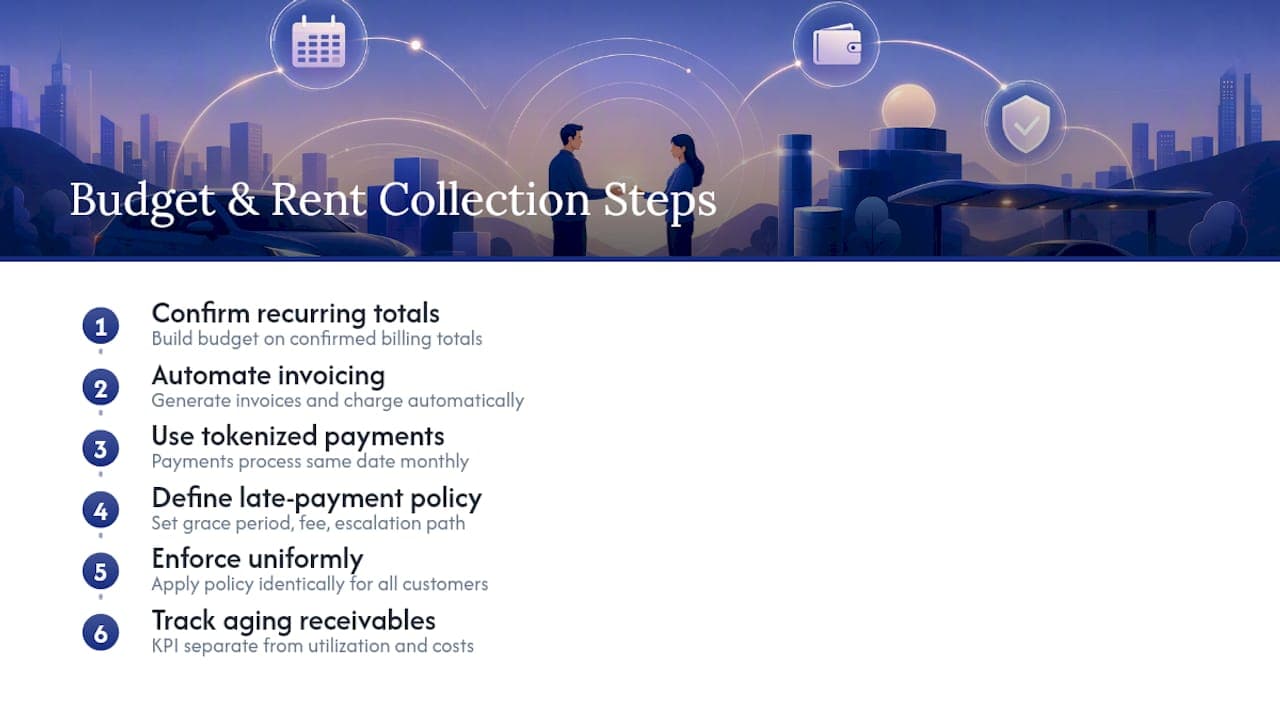
Automate invoice generation and payment collection through a tokenized payment system so charges process on the same date every month without manual intervention. Manual monthly invoicing across dozens of contracts is where administrative hours quietly disappear, and it's also where billing errors creep in.
Set a firm, written late-payment policy before you need to enforce it: a grace period (commonly three to five days), a defined late fee, and an escalation path if payment still hasn't arrived after a second notice. Apply that policy identically across every customer, corporate accounts included, because inconsistent enforcement is what turns a late payment into a legal dispute.
Track aging receivables as their own KPI, separate from utilization and cost metrics. A contract that's profitable on paper but 60 days past due isn't actually generating usable revenue yet, and a platform that surfaces aging automatically saves you from finding out during a cash flow crunch instead of during a routine weekly review.
How Should You Schedule Maintenance and Manage Vendors for Long-Term Fleets?
Maintenance scheduling for long-term rentals needs to run on usage data, not a calendar guess, because a vehicle covering 3,000 miles a month wears differently than one covering 800. Telematics-fed mileage and engine diagnostics should trigger service alerts automatically rather than relying on a renter to report a warning light.
Build a vetted vendor list by region if you operate across multiple locations, and negotiate standing rates with two or three shops per area rather than one, so a single vendor's scheduling backlog doesn't stall your entire maintenance queue. Track vendor turnaround time as its own metric. A shop that's cheap but takes five days for a brake job is often more expensive than a slightly pricier vendor who returns the vehicle in one, given how much unplanned downtime costs in lost rental revenue.
Preventive maintenance scheduled around actual usage data, rather than fixed calendar intervals, is one of the more reliable levers for cutting unplanned downtime across a rental fleet, a point covered in more depth in Nomora's guide to fleet maintenance management. When a vehicle finally reaches end-of-life for your fleet, resale channels matter too. Marketplace platforms increasingly play a structured role in fleet remarketing and disposal, which is worth factoring into your lifecycle planning well before a vehicle actually needs replacing.
What the Data Actually Tells You About Long-Term Rental Management
The conventional advice on this topic treats long-term rental management as a scaled-up version of daily rental operations, just with longer contracts. That framing is wrong, and it's why so many operators bolt long-term features onto software built for one-day transactions and end up fighting the system for years.
The real shift is that a long-term rental contract behaves more like a subscription than a transaction. It has recurring billing, mid-term amendments, and a lifecycle that stretches across months of maintenance decisions. Software designed around single-transaction logic, even good software, will always feel like it's fighting your operation instead of running it.
What gets underestimated is contract governance. Most operators invest heavily in booking and payment tools, then handle amendments through email and phone calls. That gap is where reconciliation problems actually originate, not in the booking engine. If you're prioritizing one fix first, prioritize signed, versioned amendment tracking before you prioritize a prettier dashboard. The dashboard shows you problems after they happen. Amendment governance prevents them.
How Nomora Puts This Checklist Into Practice
Every requirement covered above maps directly to something Nomora runs out of the box: a linked vehicle, driver, and contract register; recurring billing with a tokenized, PCI-aligned card vault; contract generation with digital signatures and amendment version control; and telematics connectors that feed maintenance alerts automatically. Onboarding typically takes 24 to 48 hours, not weeks, because the platform is purpose-built for rental operations rather than adapted from generic fleet software.
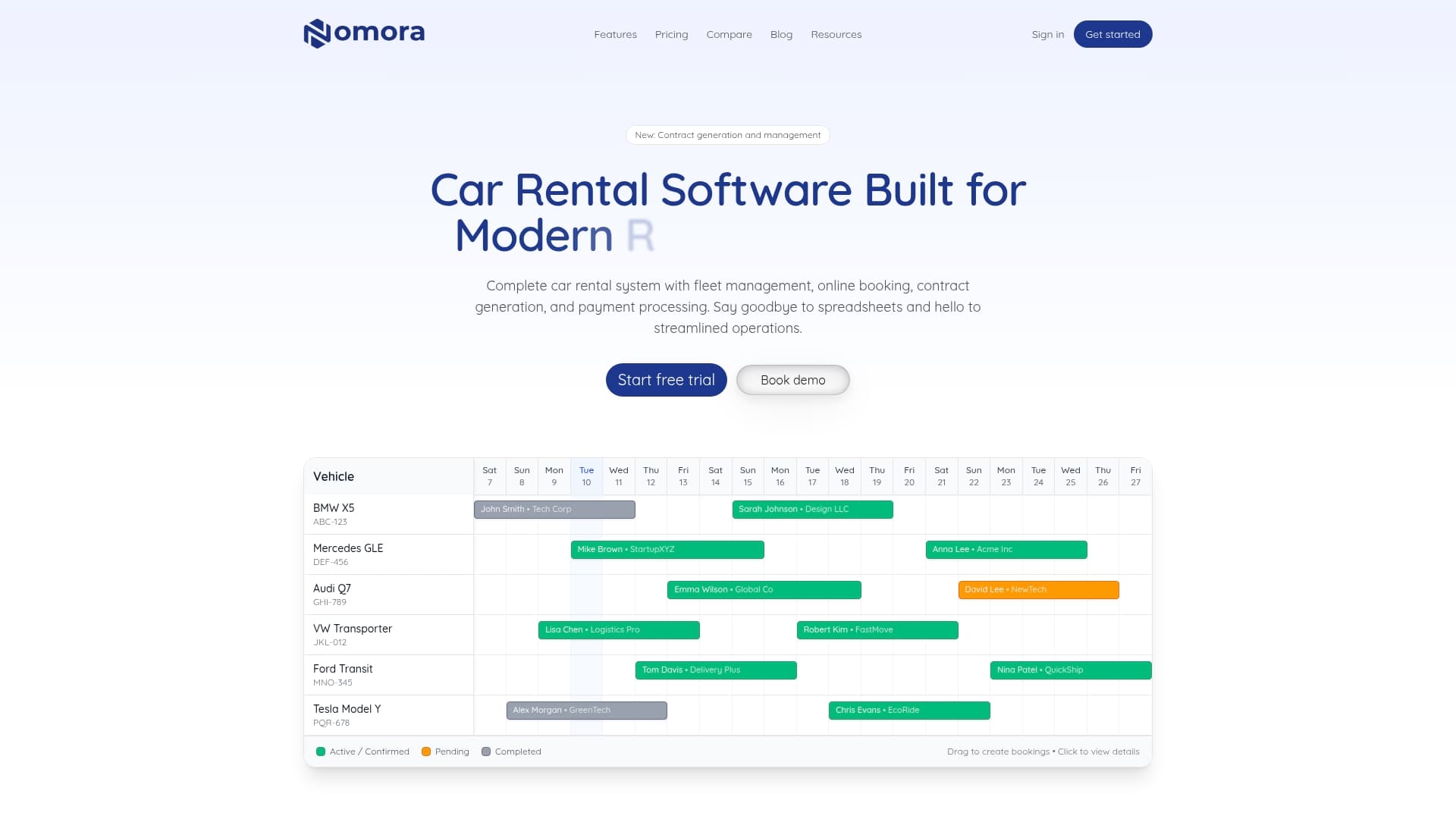
When you get on a demo, don't just watch a slideshow. Ask to see your own data migrated live, a recurring-billing cycle run end to end, a contract amendment created and versioned in real time, and a telematics connector pulling in a fault code. That's the actual test of whether a platform fits a long-term rental operation, and it takes about 30 minutes to confirm.
Nomora is built with GDPR compliance and cloud-based security as standard, so remote access and data protection aren't afterthoughts bolted on later. Explore how the platform fits your specific fleet size through the use cases by business type, or look at the corporate fleet management page if multi-month corporate contracts are your primary business. Either way, the next step is the same: schedule a demo and bring your current spreadsheet so you can watch it disappear.
Frequently Asked Questions
What is the difference between fleet management and long-term rental management?
Fleet management focuses on the vehicles themselves (maintenance, lifecycle, utilization), while long-term rental management adds the customer-facing layer: contracts, recurring billing, and amendment tracking across months-long agreements. A long-term rental platform needs both working together.
How long does it take to switch from spreadsheets to a dedicated platform?
With a purpose-built platform, core setup can take as little as 24 to 48 hours, though a full operational rollout with staff training and telematics integration typically runs on a 30 to 90 day timeline for mid-sized fleets.
What KPIs matter most for long-term rental fleets?
Utilization rate, revenue per vehicle, cost per mile, and downtime hours give the clearest month-to-month read on whether an operation is improving or drifting.
Do long-term rental contracts need digital signatures for amendments?
Yes. Treating every amendment as its own signed, versioned document is one of the most reliable ways to prevent the reconciliation disputes that arise when changes get agreed to verbally and never formally recorded.
How much can predictive maintenance reduce fleet downtime?
A data-driven lifecycle strategy combined with predictive maintenance can reduce unplanned downtime by up to 30%, based on usage-triggered service scheduling rather than fixed calendar intervals.
Sources
Recommended