Key takeaways
| Point | Details |
|---|
| Financial metrics drive cash flow clarity | Track NOI, cash-on-cash return, and delinquency rate to understand true profitability per unit. |
| Vacancy and turn time are linked | Controlling unit turn time directly prevents permanent revenue loss that rent increases cannot recover. |
| Tenant retention beats acquisition | Keeping renewal rates above 70% costs far less than replacing tenants who leave. |
| Advanced metrics give a complete picture | Combining RevPAR, DSCR, and revenue per unit reveals performance gaps that single metrics miss. |
| Technology turns data into decisions | Rental analytics tools automate KPI tracking and flag warning signs before they become costly problems. |
1. Financial metrics every rental business owner must know
Financial metrics are the foundation of measuring rental success. They tell you whether your properties are generating the returns you expected and where money is leaking out.
Cash flow per unit is the net income a single unit produces after all operating expenses. To calculate it, subtract total monthly expenses (mortgage, maintenance, insurance, taxes, and management fees) from gross rental income. Positive cash flow means the unit is self-sustaining. Negative cash flow is a warning sign that deserves immediate attention, not rationalization.
Net operating income (NOI) is your total rental income minus operating expenses, excluding debt payments. It is one of the clearest pictures of how well a property generates income independent of how it was financed. NOI also feeds into property valuation, making it a metric that matters both for daily management and long-term asset strategy.

Cash-on-cash return measures how much cash income you earn relative to the actual cash you invested. The formula is simple: annual pre-tax cash flow divided by total cash invested. Typical targets are 8-12%, though investors in expensive coastal markets may accept 5-7% when appreciation potential offsets lower yields. Knowing your target range helps you evaluate whether a unit is performing or underperforming relative to its cost.
Delinquency rate tracks the percentage of tenants who are late or behind on payments. Even a small rise in this rate signals cash flow instability. Calculate it by dividing the number of delinquent units by total occupied units. Tracking delinquency trends over time, alongside maintenance response data, uncovers operational risks before they escalate into collection problems or legal disputes.
Rent collection rate is the percentage of scheduled rent you actually collect each month. A healthy portfolio consistently hits 98% or above. Anything below 95% warrants a review of screening processes, payment systems, and tenant communication.
- Cash flow per unit: monthly gross income minus all operating expenses
- NOI: total income minus operating expenses (excludes debt service)
- Cash-on-cash return: annual cash flow divided by total cash invested
- Delinquency rate: delinquent units divided by total occupied units
- Rent collection rate: collected rent divided by total scheduled rent
Pro Tip: Benchmark your financial metrics against both local market averages and your own portfolio history. A cash-on-cash return that looks acceptable in isolation may reveal underperformance once you compare it to similar properties in your market.
2. Operational efficiency metrics that influence rental business success
Operational metrics answer a different question than financial ones. Instead of "how much are we making?" they ask "how well are we running?" These rental performance indicators reveal whether your processes are working or quietly bleeding revenue.
Vacancy rate is one of the most closely watched essential rental KPIs. The calculation is straightforward: divide vacant units by total units, then multiply by 100. Industry benchmarks place a healthy vacancy rate at 5-8%, with top-performing portfolios staying below 5%. The Q2 2025 industry average sat at 7.0%, which means if you are above that, you have a specific problem to address, not just a market trend to blame.
Unit turn time measures how many days pass between a tenant moving out and the next one moving in. Small portfolios of up to 100 units should target 14 days or fewer; larger portfolios of 101 to 400 units should aim for 10 days or fewer. Here is what most operators miss: vacancy loss from poor turn control is not recoverable by raising rent later. That revenue is simply gone. Scope drift and vendor delays are the most common culprits.
Maintenance response SLA tracks whether maintenance requests are addressed within your committed timeframe. The target is 85-90% on-time resolution, with a first-fix rate (issues resolved on the first visit) of 75-80%. Both metrics directly affect tenant satisfaction and retention.
Days to lease measures how long it takes to sign a new lease after a unit becomes available. Faster leasing compresses vacancy loss. Slow leasing often points to pricing misalignment, weak marketing, or a cumbersome application process.
Make-ready cost variance compares the budgeted cost to prepare a unit for a new tenant against the actual cost. Consistently high variance signals that your vendor relationships, scope-of-work definitions, or maintenance tracking need tightening.
- Vacancy rate: vacant units divided by total units, multiplied by 100
- Unit turn time: days from move-out to move-in of next tenant
- Maintenance SLA: percentage of requests resolved within committed timeframe
- Days to lease: days from availability to signed lease
- Make-ready cost variance: actual prep cost minus budgeted prep cost
Pro Tip: Using maintenance and leasing software that logs timestamps on every request and turn activity gives you the raw data to calculate these metrics accurately. Manual tracking in spreadsheets introduces gaps that make these KPIs unreliable.
3. Tenant-focused metrics for maximizing retention and reducing turnover costs
Financial and operational metrics tell you what is happening. Tenant-focused metrics tell you why. And often, the "why" behind rising vacancy or declining cash flow traces directly back to tenant satisfaction and retention.
Tenant renewal rate is the percentage of expiring leases where tenants choose to renew. This is one of the most telling rental performance indicators for long-term portfolio health. Small portfolios should target renewal rates above 70%, while larger ones should aim for 75% or higher. The current average sits at just 55.1%, which means most operators have significant room to improve.
Why does this matter financially? Turnover costs per unit typically run $1,000 to $4,000, factoring in cleaning, repairs, marketing, and lost rental income during vacancy. A tenant who renews at the same rate costs you nothing. A tenant who leaves can cost you a month's rent or more before you see a dollar from the next occupant.
Tenant satisfaction indicators are less direct than renewal rates but equally useful. Response time to maintenance requests, communication quality, and lease renewal offer timing all influence whether a tenant decides to stay. Retention strategies that reduce turnover costs often outperform aggressive rent increases in terms of net annual income per unit. The math is simple: a $75 monthly rent increase does not offset $2,500 in turnover costs if the tenant leaves because of it.
Owner churn rate, relevant for property management companies, measures how often property owners terminate management agreements. High owner churn is a leading indicator of deeper service quality issues and can destabilize your management revenue base faster than tenant turnover.
- Tenant renewal rate: renewing leases divided by total expiring leases
- Turnover cost per unit: cleaning, repairs, marketing, and vacancy loss combined
- Satisfaction indicators: maintenance response time, communication scores, and lease offer timing
- Owner churn rate (for managers): terminated management agreements divided by total agreements
4. Advanced metrics combining financial and operational insights
Once you have the foundational KPIs under control, these advanced rental property metrics give you a fuller picture of how your portfolio performs at scale.
Revenue per available unit (RevPAU) divides total rental revenue by total available units, including vacant ones. Unlike revenue per occupied unit, it penalizes vacancy directly in the metric itself, giving you a truer picture of income efficiency.
Debt service coverage ratio (DSCR) compares NOI to your total debt obligations (principal plus interest). A DSCR above 1.25 is generally considered healthy; it means your properties generate 25% more income than needed to service debt. Lenders pay close attention to this number, and so should you.
Operating expense ratio (OER) divides total operating expenses by gross operating income. Lower is better. A rising OER signals that costs are growing faster than income, often due to deferred maintenance, inefficient vendor management, or rising insurance premiums. Tracking this alongside NOI margin gives you two lenses on the same cost structure.
RevPAR (Revenue per Available Room or Unit) is a metric borrowed from hospitality but applies directly to short-term and vacation rentals. It combines occupancy and average daily rate into a single number that shows profitability regardless of whether a unit was booked. For short-term rental operators, RevPAR is a reliable profitability indicator that simultaneously captures pricing and occupancy performance.
| Metric | Definition | Target | Strategic Value |
|---|
| NOI | Revenue minus operating expenses | Positive and growing | Evaluates income before debt costs |
| Cash-on-cash return | Annual cash flow divided by cash invested | 8-12% | Measures investment performance |
| Vacancy rate | Vacant units divided by total units | Below 7% | Tracks revenue leakage from empty units |
| Tenant renewal rate | Renewing leases divided by expiring leases | 70-75%+ | Measures retention and reduces turnover costs |
| DSCR | NOI divided by debt service payments | Above 1.25 | Assesses financial stability |
| RevPAR | Total revenue divided by available room-nights | Benchmarked to market | Short-term rental profitability indicator |
| OER | Operating expenses divided by gross income | Below 50% | Controls cost growth relative to income |
5. How to apply key metrics effectively for rental growth
Knowing your metrics is step one. Using them to make better decisions is where rental businesses actually separate from the competition.
Set targets based on your portfolio size and market. A vacancy rate that is acceptable for a 200-unit portfolio in a high-demand urban market may be alarming for a 15-unit rural portfolio. Benchmarking KPIs against local market averages turns raw data points into strategies that maximize long-term asset value. Generic industry averages are a starting point, not a finish line.
Automate measurement wherever possible. Manually pulling data from spreadsheets introduces delays and errors that make your metrics less reliable and less timely. Property management and rental analytics tools that track KPIs in real time allow you to spot a rising vacancy rate or a slipping renewal rate weeks before it becomes a cash flow problem. The goal is to act on signals, not react to damage.
Prioritize metrics based on your current business stage. Early-stage portfolios should focus on cash flow per unit, vacancy rate, and unit turn time. As you scale, DSCR, OER, and revenue per available unit become more critical. Chasing every metric at once creates noise rather than clarity.
Act on warning signs without delay. A 2% rise in vacancy across a 50-unit portfolio is not a rounding error. It is one to two units generating zero income. The same logic applies to a 10-point drop in your maintenance SLA compliance rate. Both are signals that a specific process has broken down, and both are recoverable if you catch them early.
- Review financial KPIs monthly; operational KPIs weekly during high-turnover seasons
- Compare metrics against both prior periods and market benchmarks
- Use fleet reporting tools to automate utilization and turn-time tracking
- Assign ownership of each KPI to a specific team member or function
- Conduct quarterly performance audits to adjust targets as market conditions shift
Pro Tip: Schedule a quarterly KPI audit where you compare your current numbers against both your own prior quarters and published industry benchmarks. A metric that looks stable in isolation may show a troubling trend over three or four quarters.
My honest take on KPI-driven rental management
I've spent years watching rental operators confuse activity with performance. They know how many maintenance tickets were submitted last month. They can tell you the number of lease renewals processed. What they often cannot tell you is whether any of those activities moved the needle on profitability or just kept the lights on.
In my experience, the biggest mistake rental managers make is treating their reporting as a log rather than a diagnostic. Effective KPI reporting identifies risk early and prevents loss escalation. An activity log tells you what happened. A performance diagnostic tells you what it means and what to do next.
I've also seen operators chase rent increases at the cost of tenant relationships. The math almost never works in their favor. Tenant retention is more cost-effective than acquisition, and I've watched businesses with below-average rents outperform high-rent competitors simply because their renewal rates were 20 points higher.
My advice: start with three or four metrics that match your current portfolio stage, track them consistently for 90 days, and build from there. A metric you measure reliably every month is worth far more than a dozen you check occasionally and forget.
— Dizzy
Knowing which metrics matter is one thing. Having a system that captures, tracks, and surfaces them automatically is what separates reactive operators from those who stay ahead of problems.
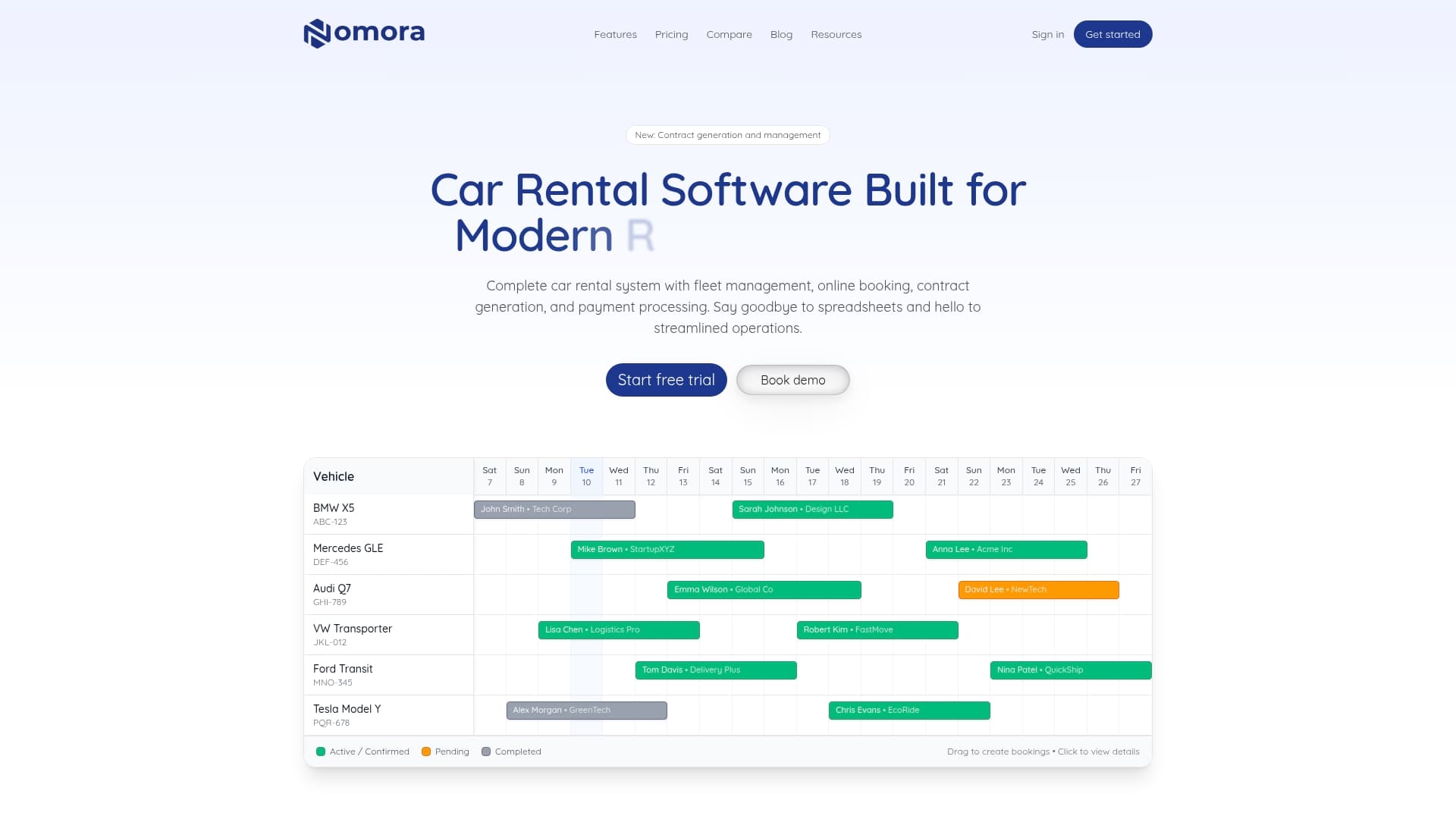
Nomora functions as the central nervous system of your rental operation. It replaces the spreadsheets and disconnected tools that make consistent KPI tracking nearly impossible. From automated payment processing that reduces delinquency rates to real-time fleet and reservation dashboards that show occupancy and turn time at a glance, Nomora gives you the data infrastructure that measuring rental success actually requires.
Whether you manage a small independent fleet or a large multi-location operation, Nomora's rental business use cases show exactly how the platform adapts to your specific operational model. You can also explore how it handles double booking prevention to protect your utilization rates. Setup takes 24 to 48 hours, and the reporting dashboards start delivering usable data from day one.
FAQ
What are the most important metrics for rental businesses?
The most critical key performance metrics for rentals include vacancy rate, tenant renewal rate, NOI, cash-on-cash return, and unit turn time. Together they cover financial health, operational efficiency, and tenant stability.
What is a good vacancy rate for a rental portfolio?
A healthy vacancy rate falls between 5-8%, with top portfolios targeting below 5%. The industry average in Q2 2025 was 7.0%, so anything above that warrants investigation.
How do I improve tenant renewal rates?
Target renewal rates of 70% or higher by addressing maintenance responsiveness, communicating lease renewal offers early, and ensuring rent increases are weighed against the full cost of turnover, which typically runs $1,000 to $4,000 per unit.
What is RevPAR and when should I use it?
RevPAR (Revenue per Available Room or Unit) combines occupancy and daily rate into a single profitability metric. It is most relevant for short-term and vacation rental operators who need to measure how pricing and booking performance work together.
Rental analytics tools automate data collection, calculate KPIs in real time, and flag performance gaps such as rising vacancy or declining maintenance SLA compliance before they escalate into significant revenue loss.
Recommended