Key Takeaways
| Point | Details |
|---|
| Centralized management | Integrated rental solutions unify fleet, contracts, and billing workflows to reduce complexity and save time. |
| Cost and productivity gains | Automation and data-driven insights lower fuel and maintenance costs while increasing staff efficiency. |
| Improved fleet utilization | Real-time tracking and optimized dispatch help maximize vehicle use without expanding fleet size. |
| Enhanced customer experience | Better communication and transparency improve satisfaction and loyalty with accurate rental info. |
| Fast ROI realization | Operators typically see 3–5x returns within the first year, often achieving positive ROI in just 60 days. |
Key criteria for choosing integrated rental solutions
Before evaluating any platform, you need a clear picture of what "integrated" actually means in practice. Many vendors use the word loosely to describe software that simply has more than one module. True integration means every function, contracts, fleet tracking, dispatch, billing, and customer records, shares a single data layer. When one piece updates, every connected piece updates automatically.
Here are the core criteria that distinguish a genuinely integrated solution from a loosely connected bundle:
- Centralized management: Contracts, fleet status, dispatch, and billing should all live in one interface with no manual transfer of data between tools.
- Real-time ERP and telematics integration: Your software should pull live data from GPS devices and financial systems, not batch updates from the previous day.
- Automated maintenance scheduling: The system should flag upcoming service needs based on mileage or time, not wait for a staff member to notice.
- Fuel monitoring: Integrated fuel tracking helps identify waste and flag unusual consumption patterns across individual vehicles.
- Reporting depth: Look for dashboards that show utilization rates, revenue per vehicle, and fleet performance without needing a separate reporting tool.
- Deployment flexibility: Cloud-based access means your team can manage operations from any location. Confirm the platform has a fully functional mobile app.
- Vendor support: Software that lacks responsive onboarding help and ongoing improvement resources becomes a liability, not an asset.
Fleet management software delivers measurable ROI through cost reduction and productivity improvement across fuel, maintenance, utilization, and administration. Understanding these categories helps you evaluate vendor claims against the specific problems costing your business the most. Explore car rental software use cases to see how different operator types apply these criteria in practice, or read a broader breakdown in this guide to fleet management explained.
With clear criteria in mind, let's explore the specific benefits integrated rental solutions provide.
How integrated rental solutions reduce costs and increase productivity
Think of integrated rental software as the central nervous system of your operation. It receives signals from every part of the business and coordinates responses automatically, without requiring a manager to relay information between departments manually.
The cost reduction happens across several distinct areas:
- Maintenance cost prevention: Automated scheduling catches service intervals before they become breakdowns. Emergency repairs cost two to three times more than planned maintenance, and unexpected downtime pulls a revenue-generating vehicle off the road.
- Fuel waste reduction: Fuel expenses, maintenance, and administrative overhead are the primary cost savings areas in integrated fleet software. Routing optimization and driver behavior monitoring can cut fuel costs noticeably without reducing fleet activity.
- Administrative labor savings: Duplicate data entry is one of the most expensive invisible costs in manual operations. When a booking automatically generates a contract, triggers a billing event, and updates fleet availability, you eliminate hours of repetitive clerical work every week.
- Real-time dispatch efficiency: A live dashboard showing vehicle locations and availability means dispatchers make faster, more accurate decisions. Fewer idle vehicles, better utilization.
- Proactive decision making: Analytics turn historical data into forward-looking action. You can spot which vehicles generate the lowest revenue per day and make informed decisions about rotation, pricing, or retirement.
"The difference between a reactive and a proactive rental operation often comes down to whether your data is connected in real time or assembled manually after the fact."
Pro Tip: Before purchasing any platform, calculate your current weekly hours spent on manual data entry across all staff. Multiply by your average hourly labor cost. That number is your baseline for measuring administrative savings after implementation.
For a deeper look at what good fleet maintenance management looks like in practice, and to understand the full financial picture, the car rental software ROI comparison offers a grounded breakdown.
Understanding cost reduction and productivity gains leads us to how these benefits compare across specific solution features.
Comparison of integrated rental solution features that drive fleet utilization
Fleet utilization, the percentage of time your vehicles are actively earning revenue, is the single most important metric for profitability. Integrated rental software improves utilization through better visibility, optimized dispatch, and real-time tracking, effectively increasing capacity without adding vehicles to your fleet.
The table below compares the core features of integrated rental platforms and their direct impact on operations:
| Feature | Impact on utilization | Admin efficiency gain | Customer satisfaction effect |
|---|
| Real-time vehicle tracking | High: reduces idle time and misplacement | Medium: faster dispatch decisions | High: accurate ETAs and transparency |
| Automated billing | Low direct impact | High: eliminates manual invoicing | Medium: consistent, error-free invoices |
| Maintenance integration | High: reduces unplanned downtime | High: no manual service reminders | Medium: more reliable vehicles |
| Dispatch optimization | High: matches demand to availability | High: fewer manual coordination steps | High: faster vehicle delivery |
| Data analytics dashboards | Medium: informs pricing and rotation | High: replaces manual reporting | Low direct, high strategic impact |
| Mobile app access | Medium: enables remote management | High: staff work from any location | Medium: faster on-site responses |
A few observations worth noting from this comparison. Real-time tracking and dispatch optimization have the highest combined impact across all three categories, making them the features to prioritize if you are evaluating platforms incrementally. Billing automation, while lower on utilization impact, generates the fastest, most visible administrative savings.
Here is what separates a unified platform from a collection of standalone modules:
- Synergy between modules: When tracking data feeds directly into dispatch, and dispatch updates billing automatically, the value compounds. Standalone tools that require manual data transfer break this chain.
- Scalability: A platform built on a single data architecture scales without the data conflicts that arise when you try to connect separate systems as your fleet grows.
- User adoption: Staff learn one interface instead of switching between multiple tools, which reduces training time and error rates.
Explore the rental inventory management approach and the full vehicle fleet management guide to understand how these features apply at different fleet sizes.
Now that we've compared features, let's examine how these advantages translate into improved customer experience and operational clarity.
Enhanced customer experience and operational transparency through integration
Customers do not see your backend systems. They experience the results of those systems: how fast their vehicle arrives, whether their invoice is correct, and whether someone responds quickly when they have a problem. Integration directly shapes all three.
Better reliability and communication improve customer satisfaction, and real-time tracking enables accurate ETAs, which reduces the most common source of customer frustration in rentals: uncertainty. Here is how integration creates that difference operationally:
- Faster response times: When staff can see every active rental, pending return, and available vehicle on one screen, they answer customer questions in seconds instead of minutes.
- Transparent tracking: Customers who can receive real-time updates on their vehicle status report higher satisfaction and generate fewer inbound calls to your team.
- Accurate contracts and billing: Centralized contract management eliminates the version confusion that leads to billing disputes. One system, one record, no contradictions.
- Automated notifications: Triggered messages at each rental stage, booking confirmation, pickup reminder, return due date, balance receipt, reduce the communication burden on staff while keeping customers informed.
- Proactive issue resolution: When your dashboard flags an anomaly, a vehicle delayed beyond its return window or a maintenance alert mid-rental, your team can act before the customer has to call.
Pro Tip: Map your current customer complaint categories before implementing integrated software. After 90 days of full use, revisit the same categories. Most operators find that communication and billing errors drop significantly, and those two categories typically account for the majority of complaints.
For operators serving business accounts, see how corporate vehicle rental solutions use these same transparency features to win and retain high-value clients.
With a clear view of customer and operational benefits established, let's explore practical steps to implement integrated rental solutions effectively.
Implementing integrated rental solutions: best practices for small to medium operators
The technology works. The variable is implementation quality. Many operators underinvest in the adoption process and then attribute poor results to the software rather than the rollout. These steps give you a more reliable path to results.
- Audit your current workflows before selecting software. Document every tool you currently use, every manual step your team performs, and every point where data gets re-entered. This audit defines your baseline and reveals which integration points matter most.
- Assign a dedicated implementation lead. This person owns the project, coordinates training, and serves as the internal expert. Without a named owner, adoption stalls.
- Phase your rollout starting with core modules. Begin with reservations, fleet tracking, and billing. Once staff are comfortable, expand to advanced analytics and third-party integrations. Overloading teams with every feature at once slows adoption.
- Use vendor support actively. Most platforms offer onboarding assistance. Use all of it. Ask for configuration advice specific to your operation, not just generic product training.
- Track KPIs from day one. Measure utilization rate, administrative hours per booking, and maintenance cost per vehicle before and after. Regular measurement tells you where the system is working and where your processes still need adjustment.
- Maintain data security and compliance throughout. Confirm that your platform is GDPR-compliant and uses encrypted data transfer. This matters especially if you operate across multiple locations or store customer payment information.
Most fleets achieve positive ROI within 60 days of full implementation, with benefits compounding as teams optimize their usage patterns. That timeline assumes genuine adoption across all staff, not partial use by a few early adopters.
For operators planning to connect external systems, a practical overview of the top car rental integrations helps prioritize which connections deliver the most immediate value.
Having covered practical steps, we now share a unique perspective on how embracing integration changes rental operations fundamentally.
Why integrated rental solutions are a game changer for small to medium car rental operators
Most conversations about rental software focus on features and pricing. That framing undersells what integration actually does to an operation. This is not a software upgrade. It is a structural change in how decisions get made, how problems get spotted, and how people do their jobs.
Manual operations are inherently reactive. A vehicle comes back damaged and someone finds out when the next customer complains. An invoice goes out wrong and the billing dispute takes three days to resolve. A maintenance window gets missed because the reminder was in someone's email. Every one of those failures has a cost, in time, in money, and in customer trust. Integrated systems do not just speed up existing processes. They eliminate entire categories of failure.
The bigger opportunity for small to medium operators specifically is competitive positioning. Larger fleet networks invested in integration years ago because they had the volume to justify it. Today, cloud-based platforms have brought those same capabilities to operators with ten vehicles or fifty. The operator who adopts early does not just run more efficiently. They can price more competitively, serve customers better, and reinvest the savings into fleet quality or marketing while competitors are still chasing down misplaced paperwork.
ROI from integration is also not purely financial. Staff who spend less time on repetitive, error-prone tasks report higher job satisfaction. Lower employee turnover is a real cost saving that rarely appears in software ROI calculators but compounds significantly over time. The software vs manual management ROI comparison captures the financial side well, but the operational confidence that comes from knowing your data is accurate and your processes are running automatically is genuinely difficult to put a number on.
The operators who treat integration as a technology decision will capture incremental gains. The ones who treat it as an operational transformation will build something their competitors cannot easily replicate.
Discover Nomora's integrated rental solutions for your car rental business
If everything you have read here describes the problems your operation is facing, Nomora was built to solve them.
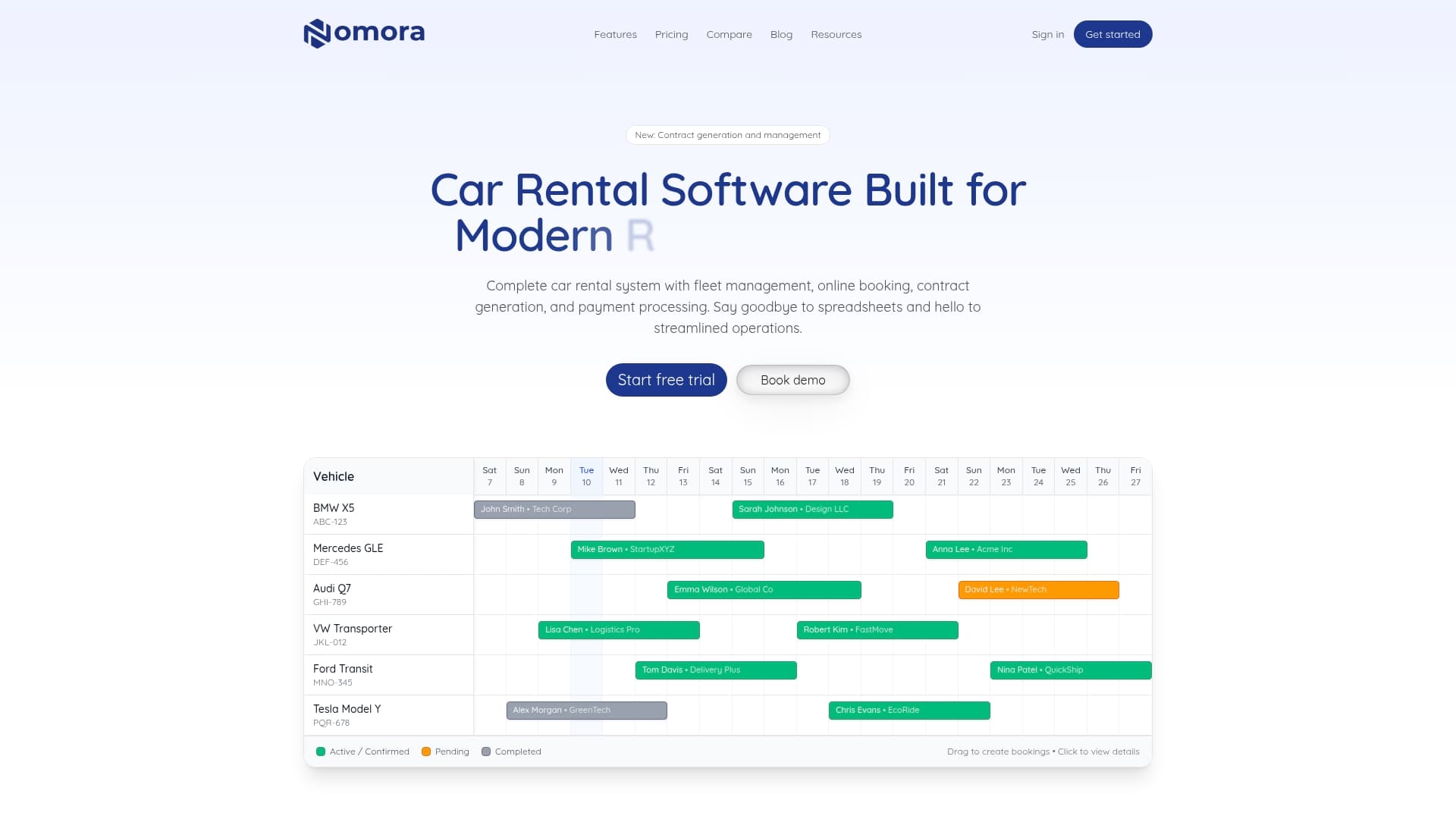
Nomora is a cloud-based car rental management platform that unifies reservations, fleet tracking, contract generation, payments, and customer data in one place. Setup takes 24 to 48 hours, and you can explore software use cases by business type to see how operators like yours have implemented it. The platform includes built-in tools for preventing double bookings and fully automated car rental payments, two of the most common sources of operational friction for growing fleets. Every plan includes expert onboarding support, GDPR-compliant data handling, and the flexibility to scale as your fleet grows.
Frequently asked questions
What are the main cost savings from using integrated rental solutions?
Fuel expenses, maintenance, and administrative overhead are the primary areas where integrated rental software generates savings, typically by automating manual processes and providing real-time visibility into vehicle costs.
How soon can small rental operators expect a return on investment?
Most fleets achieve positive ROI within 60 days of full implementation, with savings compounding as staff adopt optimized workflows and the system generates better operational data.
Can integrated rental solutions improve customer satisfaction?
Yes. Real-time tracking and communication features give customers accurate ETAs and consistent billing, which reduces the uncertainty and errors that drive most complaints in rental operations.
Are integrated rental systems suitable for small to medium operators or just large fleets?
Integrated rental solutions are designed to scale, and cloud-based platforms specifically have made advanced automation accessible to operators at any fleet size, not just large networks with large IT budgets.
Recommended