Cut rental no-shows by combining four moves: define no-show terms with a real penalty, collect money at booking, automate reminders and vehicle-ready alerts, and use a small, measured overbooking cushion. Together, these address the behavior, the risk, and the recovery, which is why they work better than any single fix alone.
- Write a clear no-show definition into your terms, following ACRISS guidance (example: no collection within 2 hours = no-show, one full day's charge).
- Add a deposit or prepay option at checkout.
- Automate a 24-hour reminder and a same-day SMS.
- Send vehicle-ready alerts to create a skip-the-counter flow.
- Layer in a small, class-specific overbooking cushion.
Published estimates put rental no-show rates as high as 30% in academic literature, and operator reports cite 10 to 20% of revenue lost to no-shows before intervention.
Key Takeaways
Reducing rental no-shows requires an enforceable policy, money collected upfront, automated reminders, and a measured overbooking cushion working together, not in isolation.
| Point | Details |
|---|
| Define the no-show window | Set an exact time limit (example: 2 hours past pickup) and an exact penalty in your terms. |
| Collect money at booking | Use a deposit or prepay discount to filter casual bookings and cut no-shows materially. |
| Automate the reminder cadence | Send confirmation immediately, a 24-hour reminder, and an optional 2-hour SMS for morning pickups. |
| Overbook cautiously by class | Start with a small cushion (around 5%) tied to each car class's historical no-show rate. |
| Track KPIs weekly at first | Watch no-show rate by channel, utilization, and pickup lag, then test one variable at a time. |
| Use an integrated platform | Nomora combines policy enforcement, deposits, reminders, and KPI tracking in one system. |
Table of Contents
How to Reduce Rental No-Shows in the First 90 Days
You don't need a system overhaul to see movement. You need a sequence.
Week 1: Rewrite your terms and conditions with an explicit no-show definition and penalty. Turn on automated booking confirmations if your system supports them.
Weeks 2 to 4: Require a deposit or prepayment on higher-risk channels (third-party aggregators, first-time bookers, long-lead reservations). Configure a 24-hour reminder and, for morning pickups, a 2-hour SMS.
- Assign one owner for policy language and one for reminder configuration.
- Add vehicle-ready notifications by week 6.
- Tune overbooking cushions by car class and location by week 8.
- Start tracking baseline no-show rate by week 12.
Small teams can run this without new hires. It's a matter of sequencing, not headcount.
Writing No-Show Terms Customers Actually Read
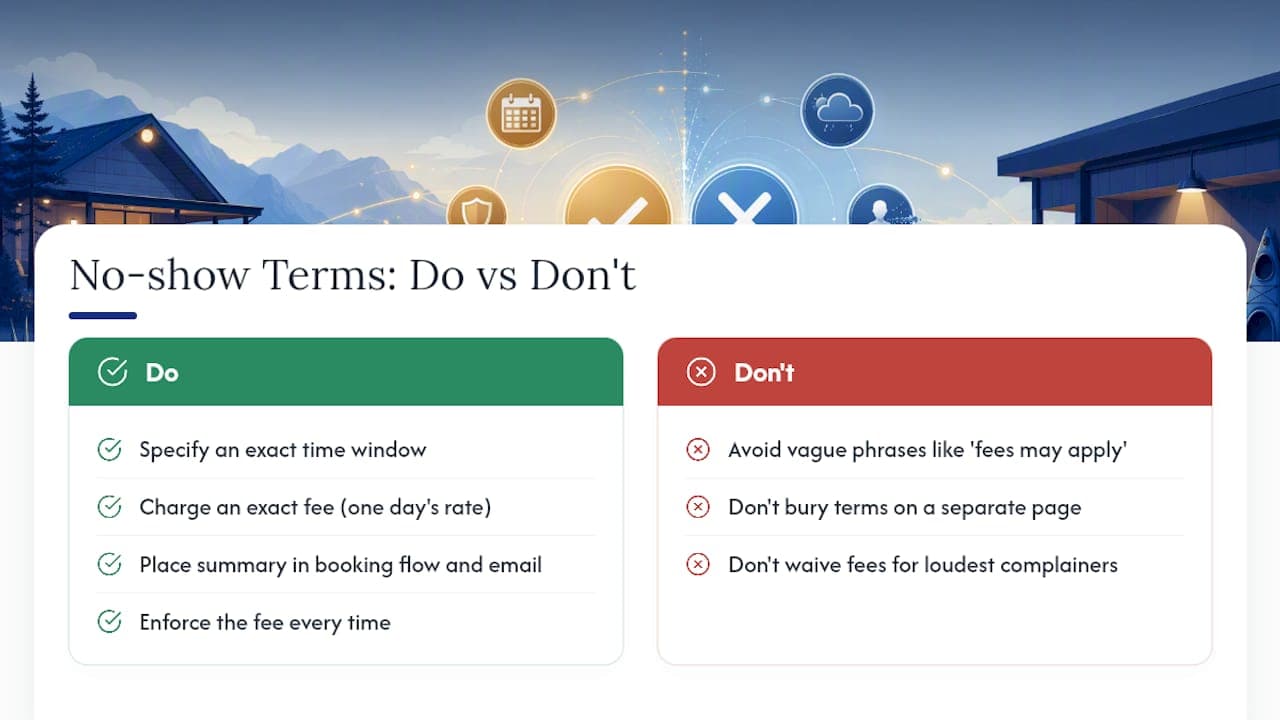
Vague cancellation language is the single most common reason enforcement fails. If your policy says "fees may apply," you have no policy. ACRISS recommends specifying an exact time window and an exact fee: for example, failure to collect the vehicle within 2 hours of the scheduled pickup counts as a no-show, and the penalty is one full day's rental charge, not a vague "surcharge."
Put the one-line summary where customers will actually see it, twice: once during the booking flow, before payment, and again in the confirmation email. ACRISS guidance also recommends stating cancellation cutoffs and modification limits at the same point, not buried in a separate terms page.
Sample line for your booking flow: "Vehicles not collected within 2 hours of scheduled pickup are billed as a no-show at one full day's rate." Sample confirmation footer: "Need to change your pickup time? Modify or cancel free up to 24 hours before pickup using the link below."
Pro Tip: Enforce the fee every time it applies. Waiving it for the customer who complains loudest teaches every future no-show that the policy is negotiable.
Should You Require a Deposit or Full Prepayment?
Money at stake changes behavior, and the size of that stake determines how much. Full prepayment reduces no-shows the most because the customer has already absorbed the cost of a missed pickup. A non-refundable deposit is a middle path: it filters out casual bookers without asking price-sensitive customers to commit fully upfront.
A two-option model works well here: offer a discounted prepaid rate alongside a higher flexible rate. Academic research on reservation policy design shows this segmentation captures both commitment-minded and flexibility-minded renters without losing either group. One operator documented in trade press saw no-shows drop from about 21% to roughly 11% after rolling out prepaid on select channels.
Common deposit levels run 25%, 50%, or full prepay, with no-show reduction scaling roughly with the amount at risk. Pair any deposit model with card-on-file pre-authorization at booking, and set a clear charge-timing rule (at booking, at 24 hours, or at the no-show window itself).
- No deposit: highest conversion, highest no-show exposure. Use only for low-risk, repeat, or corporate accounts.
- Partial deposit: balances conversion and commitment. Good default for most retail bookings.
- Full prepay: lowest no-show rate, some conversion loss on price-sensitive channels.
Pro Tip: Document your dispute-handling process before you launch deposits. Chargeback pushback is the most common early friction point, and having a written script for staff prevents inconsistent refunds.
Can Overbooking Actually Help Reduce No-Shows?
Overbooking recovers utilization that no-shows would otherwise strand, but car rental overbooking is harder than airline overbooking because you're managing multiple vehicle classes, not one seat map. An overbooked economy class might get resolved with a free upgrade; an overbooked luxury class might mean an expensive outsourced rental.
Start small. Overbooking models built for car rental show that simplified regression approaches can approximate optimal overbooking levels within a few percentage points of total cost, which means you don't need a data science team to start testing this responsibly.
Document your upgrade rules and outsourcing partners before you overbook a single class. Deposit and overbooking policies interact: a strong deposit policy actually reduces how much overbooking you need in the first place.
Pro Tip: Pilot overbooking on your lowest-cost class or a low-consequence location first. Measure the cost of occasional walk-outs against the utilization you recover before scaling it to premium inventory.
What Should Confirmation and Reminder Messages Say?
The reminder cadence matters more than the wording. Send a booking confirmation immediately, a 24-hour reminder as your highest-impact touch point, and an optional 2-hour SMS for morning pickups. Operators combining prepayment with automated reminders and enforced policy have reported no-show rates falling below 5% in smaller operations.
Every message should include the same core details: pickup time, counter or lot location, required documents, a one-tap cancellation or reschedule link, and a short policy reminder. Use SMS for the 2-hour touch and email for the 24-hour reminder, since SMS open rates dominate in the final hours before pickup while email works better for detailed instructions sent a day out.
- Booking confirmation: pickup window, location, and a link to modify.
- 24-hour reminder: full detail plus the no-show policy line.
- 2-hour SMS: short, urgent, "we're expecting you" tone.
- Vehicle-ready alert: signals the car is prepped and waiting, encouraging a skip-the-counter arrival.
Vehicle-ready alerts do double duty. They cut no-shows by making the customer feel expected, and they shorten the counter line for everyone else.
Which Operational Controls Prevent No-Shows Before They Happen?
Policy and payments change the incentive. Operations and software change what actually happens on pickup day. The checklist worth asking your software vendor about: enforced booking holds, card-on-file pre-authorization, automated reminder scheduling, vehicle-ready notifications, conflict-free availability, channel-specific rules, and automated refund or charge logic.

The highest-leverage workflow connects your fleet prep team to your customer messaging through webhooks: when a vehicle is cleaned, fueled, and staged, that event triggers an automatic "vehicle ready" SMS, which routes the customer to a skip-the-counter pickup. One anonymized operator workflow built on this exact chain, prep completion triggers SMS triggers skip-counter arrival, cut measurable pickup delays and reduced staff time spent on manual confirmation calls.
Nomora is one example of an integrated platform built around these exact triggers: conflict-free reservation holds, card-on-file pre-authorization, automated reminder sequences, and webhook-driven vehicle-ready alerts all run from one system rather than three disconnected tools. When you're evaluating software for this purpose, ask specifically for event-triggered notifications, channel-level rule configuration, and real-time fleet utilization dashboards rather than generic "automation" claims.
Pro Tip: Ask any vendor to demo the exact webhook path from "car is ready" to "customer notified." If they can't show you that trigger live, the feature probably doesn't exist yet.
How Do You Know If Your No-Show Fixes Are Working?
Track no-show rate by channel, car class, and booking lead time, not as one blended number. Pair it with fleet utilization, revenue recovered per previously-lost booking, pickup lag, and your cancellation-to-reschedule ratio.
- Calculate your current baseline no-show rate before changing anything.
- Set a realistic target based on that baseline (moving from 15% to 8% is a meaningful first milestone).
- A/B test one variable at a time: reminder cadence, deposit amount, or prepay discount size.
- Run weekly operational checks for the first 8 weeks, then shift to monthly revenue reviews and quarterly policy tuning.
- Track no-show rate by channel and car class separately.
- Watch pickup lag as an early-warning signal before a full no-show.
- Review cancellation-to-reschedule ratio to catch customers who are trying to comply but hitting friction.
What Actually Changed for Operators Who Tried This
Operators who paired a real no-show penalty with prepayment and automated reminders describe the first few weeks as the hardest part. Customers push back on new fees they weren't expecting, and staff want to make exceptions for regulars. The fix isn't flexibility. It's explaining the policy clearly at booking, so nobody is surprised at pickup, and holding the line once it's published.
How Nomora Supports Every Step of This Playbook
Nomora is built to run this exact playbook from a single dashboard instead of stitching together a booking tool, a texting app, and a spreadsheet for tracking who actually showed up. Terms and deposit rules live directly in your booking flow, card-on-file pre-authorization and prepay options are configured per channel, and automated confirmations, 24-hour reminders, and vehicle-ready SMS alerts fire without a staff member touching a keyboard.
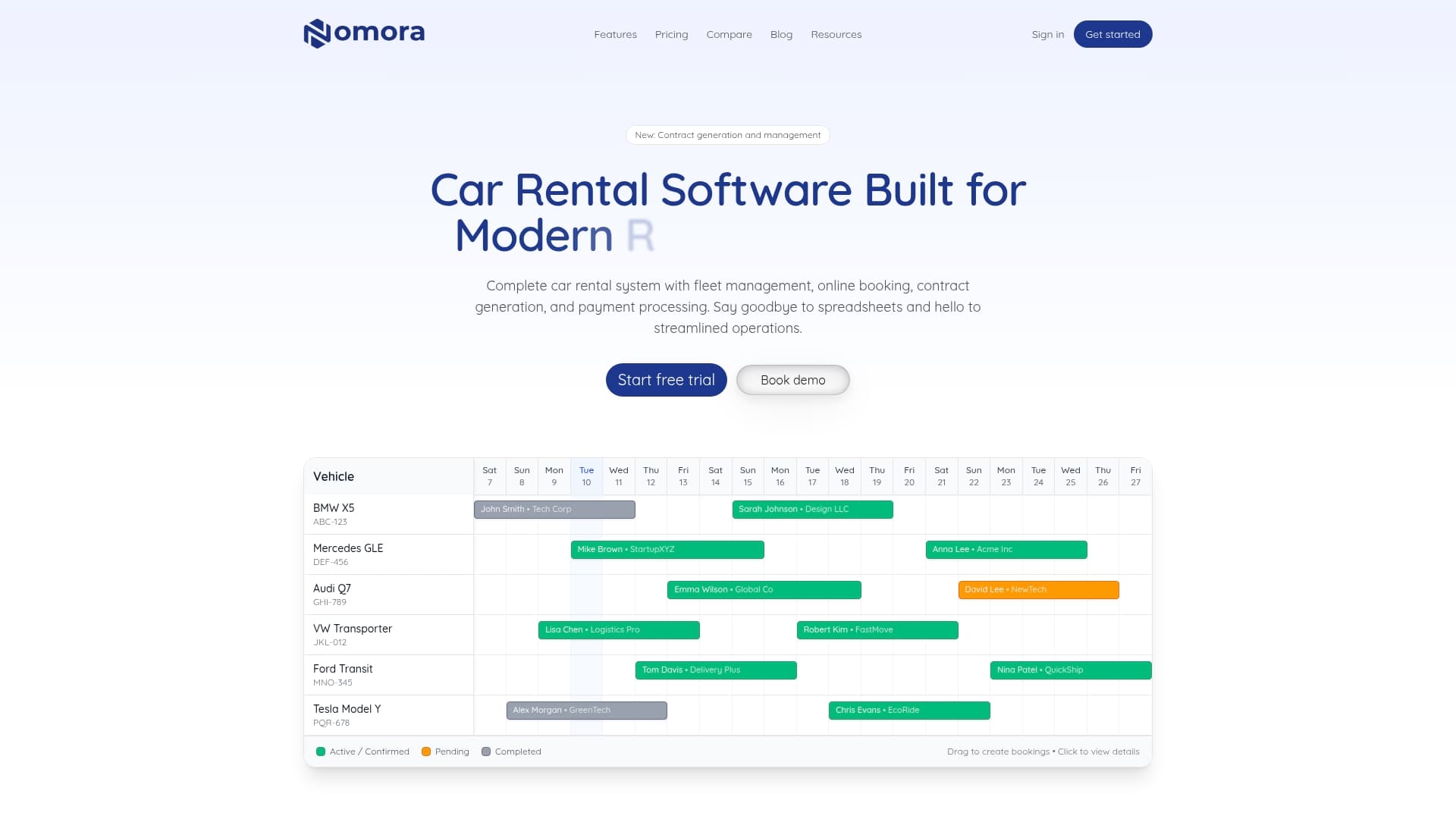
Conflict-free availability means your overbooking cushion never accidentally double-books the same car, and built-in KPI dashboards track no-show rate, utilization, and recovered revenue as you tune each lever. Setup typically takes 24 to 48 hours, so you're not waiting months to see whether these changes actually move your numbers.
If you're ready to see how this fits your fleet size and channel mix, look at Nomora's car rental software or check the use cases by business type to find the setup closest to your operation, then request a demo to walk through your specific policy and payment configuration.
Sources
For policy wording and standard timing windows, ACRISS's Policy Best Practices offers the industry's clearest guidance on defining no-shows and specifying fees precisely. For the revenue-management math behind deposits and overbooking, ScienceDirect's research on reservation policy design and the eScholarship paper on deposit policies lay out the trade-offs in detail.
For real-world results, Auto Rental News's coverage of prepaid reservations documents operator outcomes after launching prepay on specific channels. Nomora's own blog library covers implementation detail on fleet utilization, demand forecasting, and automated bookings for operators building out each piece of this playbook.
Recommended
Ready to streamline your car rental business?
Book 30 minutes with the founder. We set up everything in this guide on your own vehicles, and migrate you out of Excel for free.