TL;DR:
- Proper rental onboarding transforms signed agreements into active tenancies by systematically managing documents, compliance, and property preparation to prevent disputes.
- A structured, multi-stage workflow with clear responsibilities and triggers ensures consistency and legal compliance throughout the process, including move-in day.
- Automation tools like Nomora support these workflows by streamlining payments, inspections, and communication, reducing errors and enhancing tenant relationships.
Rental client onboarding is defined as the structured process of converting a signed rental agreement into a fully active tenancy by coordinating administrative records, compliance documents, billing setup, and property handover. Done correctly, this process eliminates the gaps that cause deposit disputes, billing errors, and tenant dissatisfaction. Most rental businesses underestimate how much of their downstream management quality depends on what happens in the first 72 hours of a tenancy. This guide walks you through every stage of the rental client onboarding process, from tenant screening to post-move-in follow-up, with a focus on building workflows that scale.
How to onboard rental clients: the key steps
Structured, multi-stage workflows turn signed agreements into active tenancies by coordinating records, billing, and compliance tasks in a defined sequence. Each step below represents a distinct phase with a clear owner and a defined completion standard.
-
Collect and verify tenant information. Gather full identification, proof of income, and references before any agreement is signed. Tenant screening requires written consent to legally pull credit and background reports, keeping you compliant with frameworks like the Fair Credit Reporting Act. Online application systems improve audit trails and standardize how you evaluate every applicant.
-
Explain lease terms and facilitate signing. Walk the tenant through every clause before they sign. Cover rent amounts, payment schedules, maintenance responsibilities, and termination conditions. Tenants who understand their lease from day one generate fewer disputes and fewer calls to your office.
-
Deliver required compliance documents. Depending on your jurisdiction, this includes gas safety certificates, energy performance certificates, and written statements of tenancy terms. Under new tenancy law in England effective May 1, 2026, a Written Statement of tenancy terms must be provided before any agreement is signed, and requesting rent or deposits beforehand is prohibited. This is a hard legal requirement, not a best practice.
-
Collect deposits and first payment. Under the Tenant Fees Act 2019, permitted payments include refundable security deposits capped at five weeks' rent and a holding deposit of up to one week's rent. Rent cannot be requested before lease signing. Register the deposit with an approved scheme within 30 days.
-
Prepare the property. Conduct a pre-move-in inspection, confirm all appliances function, and address any outstanding maintenance. A property that is not ready on move-in day damages tenant trust immediately and creates a paper trail of complaints.
-
Schedule and confirm move-in logistics. Send confirmation of key collection timing, parking arrangements, and building access at least 24 to 48 hours before move-in. This reduces the number of calls you receive on the day itself.
-
Hand over keys and conduct orientation. Introduce the tenant to building rules, waste collection schedules, and emergency contact procedures in person or through a written orientation packet.
-
Follow up post-move-in. Contact the tenant within 72 hours to confirm everything is in order, log any issues they report, and schedule the first routine inspection.
Pro Tip: Set a formal 72-hour reporting window after move-in for tenants to flag pre-existing issues. This single practice prevents the majority of deposit disputes at the end of a tenancy.
How to structure your onboarding workflow for consistency
The single biggest onboarding failure is treating the process as an informal checklist. Informal checklists have no defined owner, no completion standard, and no audit trail. A structured workflow fixes all three.
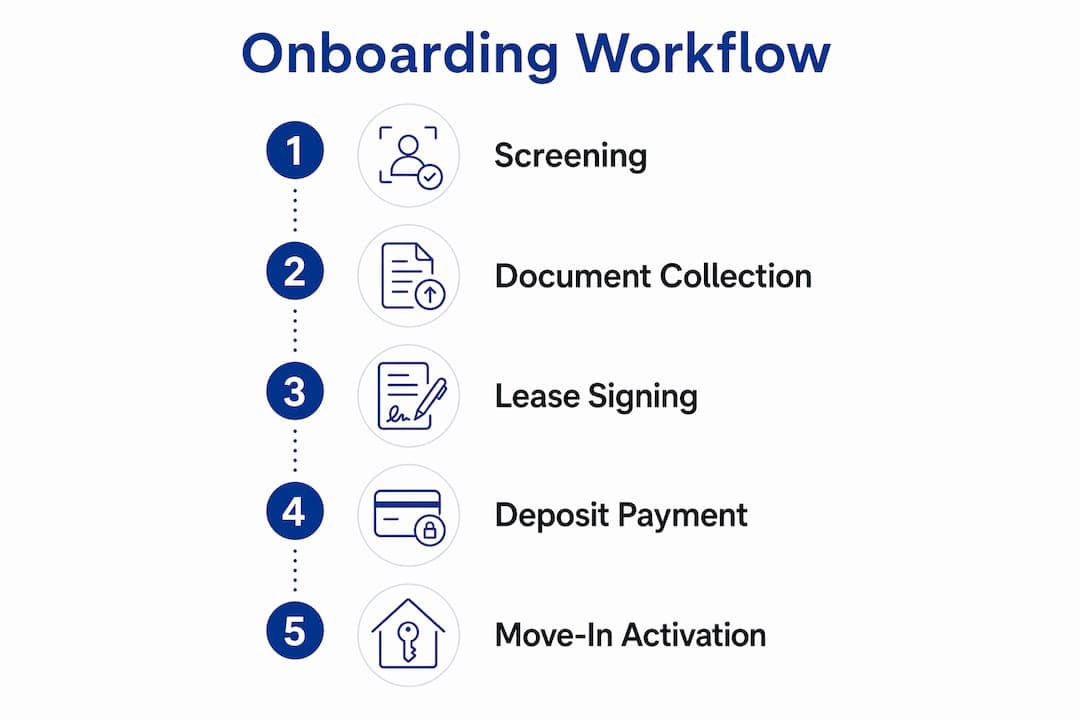
A well-built rental client onboarding workflow moves through four distinct stages:
- Pre-tenancy: Application processing, screening, and document collection
- Agreement stage: Lease signing, compliance document delivery, and deposit collection
- Move-in stage: Property preparation, inspection, key handover, and tenant orientation
- Activation stage: Billing configuration, tenancy record confirmation, and post-move-in follow-up
Each stage should have assigned responsibilities and a defined trigger that moves the workflow to the next phase. For example, the move-in stage should not begin until the agreement stage is marked complete, meaning all documents are signed and all payments are received.
| Workflow stage | Key task | Completion trigger |
|---|
| Pre-tenancy | Screening and document collection | Signed consent and verified ID on file |
| Agreement | Lease signing and deposit collection | Countersigned lease and deposit registered |
| Move-in | Inspection and key handover | Signed move-in report from both parties |
| Activation | Billing setup and record confirmation | First invoice generated and tenancy file complete |
Linking task assignment, document collection, and billing configuration means the tenancy starts without misconfigurations or missing files. This approach also creates an audit trail that protects you in any future dispute.
Pro Tip: Treat your onboarding record as a live system. Verify that the first invoice generates correctly before marking the tenancy as active. Billing errors discovered after activation are significantly harder to correct without damaging the tenant relationship.
What legal and compliance requirements apply during onboarding?
Legal compliance during onboarding is not optional, and the consequences of getting it wrong range from financial penalties to unenforceable tenancy agreements. The following requirements apply to rental businesses operating in England, though many principles translate to other jurisdictions.
-
Right to Rent checks: Landlords in England must conduct Right to Rent checks consistently and apply them to every prospective tenant without discrimination. These checks must be recorded and documented uniformly. Selective application of these checks exposes you to discrimination claims even when the underlying intent is compliant.
-
Written Statement requirement (from May 2026): The Renters' Rights Act requires a Written Statement of tenancy terms before any agreement is signed. This is a new obligation that changes the sequence of your onboarding workflow. Compliance documents must now precede the agreement, not follow it.
-
Deposit rules: Security deposits are capped at five weeks' rent for annual rents under £50,000. Holding deposits are capped at one week's rent. Both must be handled through approved schemes, with deposit registration completed within 30 days of receipt.
-
Prohibited payments: Charging fees not permitted under the Tenant Fees Act 2019 results in financial penalties. Prohibited payments include administration fees, referencing fees, and credit check fees charged to tenants.
-
Document retention: Retain signed copies of all compliance documents, screening records, and payment receipts. A complete audit trail is your primary defense in any enforcement action or tenancy dispute.
Non-compliance with the Renters' Rights Act provisions effective May 2026 can render a tenancy agreement unenforceable and expose landlords to civil penalties. Review your onboarding sequence now to confirm it meets the new pre-signing document delivery requirements.
How to execute move-in day and property handover effectively
Move-in day is the moment where your onboarding workflow becomes visible to the tenant. Everything that happens on this day sets the tone for the entire tenancy. Preparation and documentation are the two factors that determine whether move-in day builds trust or erodes it.
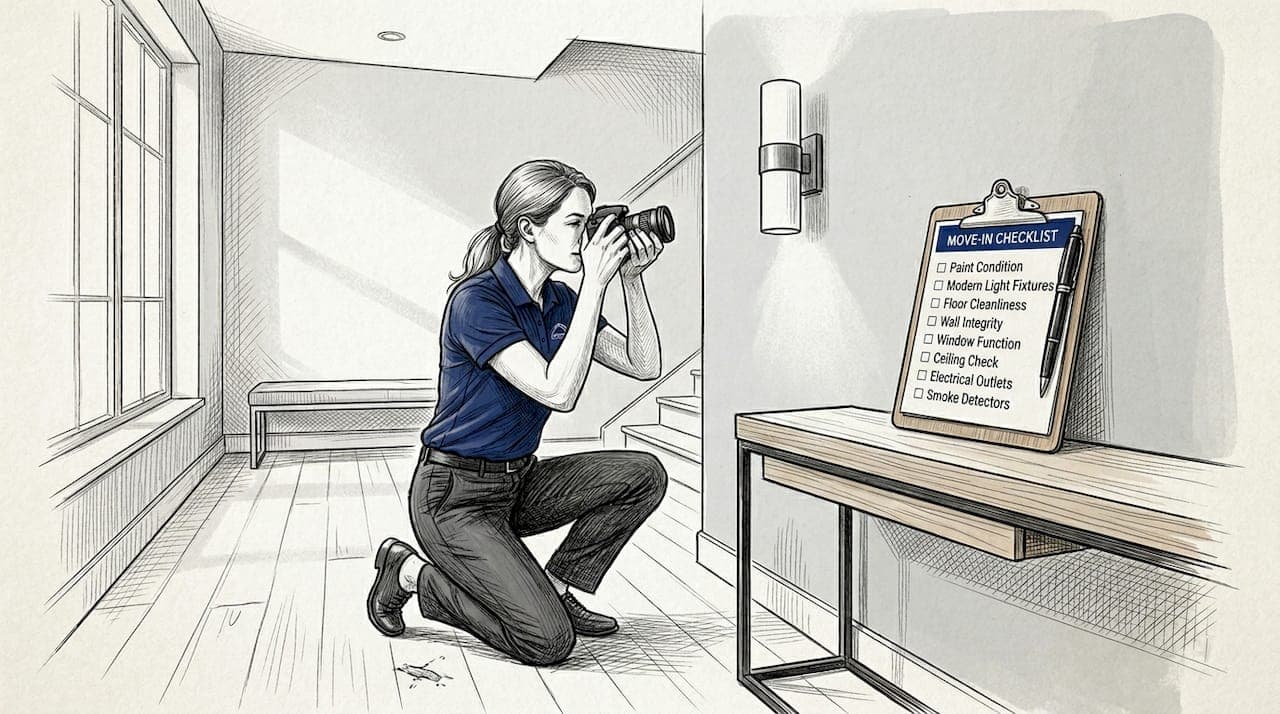
Detailed move-in inspection forms with photographic evidence labeled by room and date are critical for settling deposit disputes and proving responsibility for damages. A room-by-room walkthrough signed by both parties is not a formality. It is a legally significant document that defines the baseline condition of the property.
| Without signed inspection report | With signed inspection report |
|---|
| Deposit disputes rely on memory and verbal claims | Disputes resolved by reference to documented baseline |
| Tenant can claim pre-existing damage at move-out | Pre-existing damage is clearly recorded and dated |
| No clear responsibility for specific items | Room-by-room responsibility is established |
| Higher likelihood of tribunal or legal action | Faster resolution with lower legal exposure |
Pre-move-in communications should include key collection timing, maintenance request processes, and emergency reporting instructions sent 24 to 48 hours before move-in. This backward-planning approach means the tenant arrives informed and ready, which reduces the number of issues that surface on the day itself.
Operational excellence in onboarding requires translating your backend system setups into clear tenant-facing guidelines and orientation packets delivered before possession. A one-page orientation document covering emergency contacts, maintenance request procedures, waste collection days, and parking rules takes 20 minutes to create and prevents dozens of avoidable calls over the course of a tenancy.
Pro Tip: Photograph every room in sequence before the tenant arrives, and number each photo to match the inspection form. This creates an unambiguous visual record that holds up in deposit dispute resolution.
Key takeaways
A structured, multi-stage onboarding workflow is the single most reliable way to convert signed rental agreements into active, dispute-free tenancies.
| Point | Details |
|---|
| Define each workflow stage | Move from pre-tenancy through activation with clear triggers and assigned owners at every step. |
| Comply with 2026 legal changes | Deliver the Written Statement before signing and never request rent or deposits beforehand. |
| Document move-in conditions | Use signed, photographic inspection reports to establish a baseline that protects both parties. |
| Verify billing before activation | Confirm the first invoice generates correctly before marking the tenancy as active. |
| Follow up within 72 hours | Post-move-in contact resolves early issues and builds the tenant relationship from day one. |
What I've learned from watching onboarding go wrong
Most rental businesses do not have an onboarding problem. They have a consistency problem. The process works fine when the same experienced person handles every new tenancy. It breaks down the moment a second team member gets involved, a busy period compresses timelines, or a tenant asks an unexpected question during lease signing.
What I have seen repeatedly is that the businesses with the fewest disputes are not necessarily the ones with the most experience. They are the ones with the clearest workflows. When every task has an owner and every stage has a completion trigger, the outcome does not depend on who is in the office that day. That is the real value of formalizing your car rental software onboarding process: it removes the dependency on individual memory and replaces it with a system.
The other pattern worth noting is that post-move-in follow-up is almost universally skipped. Rental managers treat move-in day as the finish line when it is actually the start of the relationship. A brief check-in call or message within 72 hours catches minor issues before they become formal complaints. It also signals to the tenant that you are a professional operation, which changes how they behave for the rest of the tenancy.
Automation tools and platforms like Nomora exist precisely to remove the friction from these steps. But the technology only works if the underlying workflow is already defined. Build the process first, then use software to run it at scale.
— Dizzy
How Nomora supports your rental onboarding process
Nomora functions as the central nervous system of your rental operation, connecting contract generation, payment collection, inspections, and client communication in one cloud-based platform.
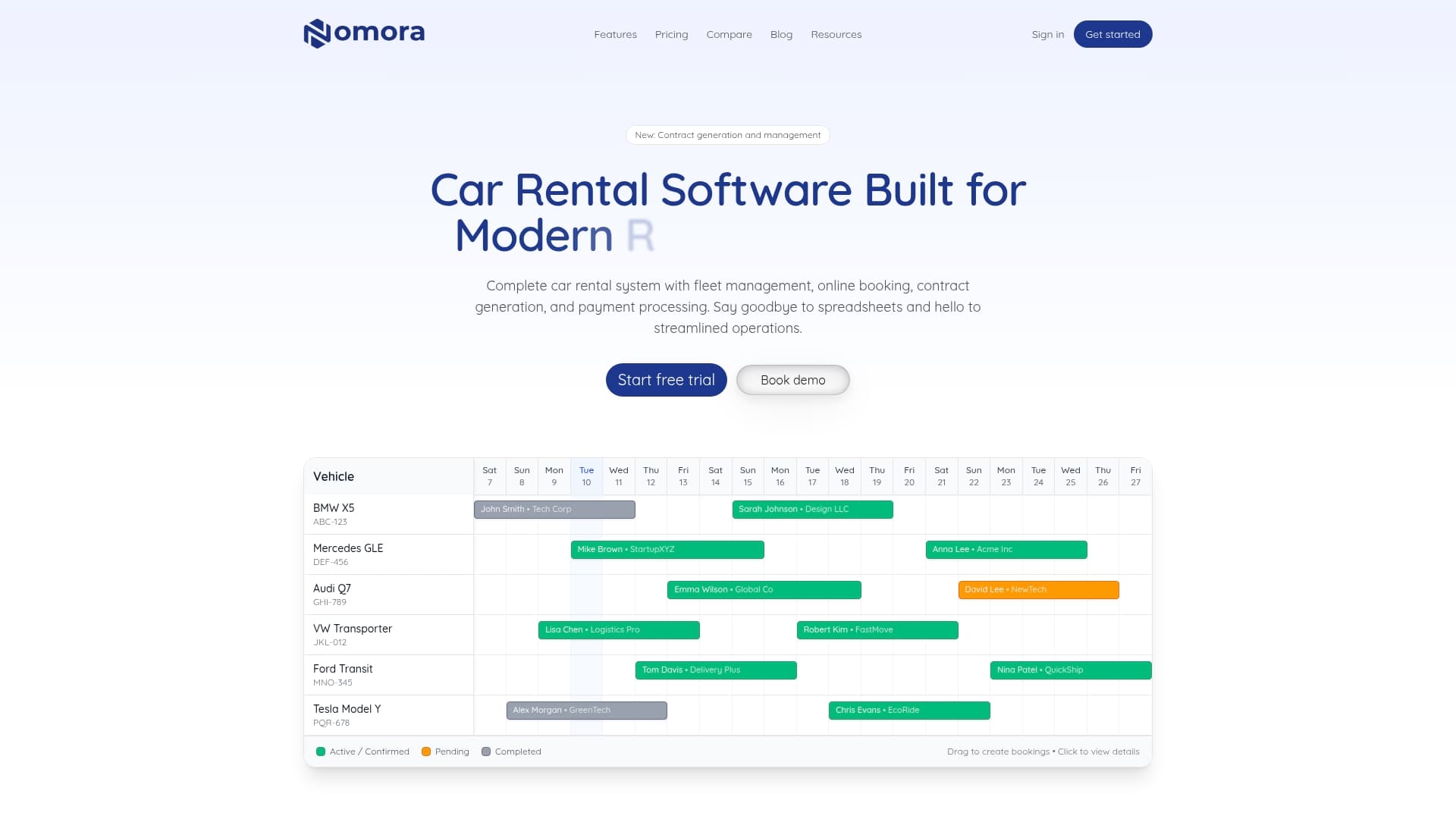
For rental businesses building or refining their onboarding workflows, Nomora handles the stages that are most prone to error: automated deposit and payment collection that stays compliant with current regulations, digital inspection records with photographic documentation, and task-based workflows that prevent tenancy activation until every required step is confirmed complete. The platform's automated payment tools cover deposit handling and first-payment collection with built-in compliance guardrails. Explore the full range of Nomora's rental use cases to see how the platform maps to your specific business type and onboarding requirements.
FAQ
What is rental client onboarding?
Rental client onboarding is the process of converting a signed rental agreement into an active tenancy by completing all administrative, compliance, and operational tasks in a defined sequence. It covers everything from tenant screening and document delivery to move-in inspection and billing activation.
What are the key steps in the tenant onboarding process?
A 10-step onboarding process covers tenant screening, lease signing, compliance document delivery, deposit collection, property preparation, move-in scheduling, key handover, orientation, billing setup, and post-move-in follow-up. Each step should have a defined owner and a completion standard.
What legal documents are required during onboarding in England?
From May 1, 2026, the Renters' Rights Act requires a Written Statement of tenancy terms to be delivered before any agreement is signed. Additional required documents include gas safety certificates, energy performance certificates, and deposit protection confirmation within 30 days.
How do I prevent deposit disputes during onboarding?
Conduct a room-by-room move-in inspection with photographic evidence labeled by room and date, signed by both parties. Set a formal 72-hour reporting window after move-in for tenants to flag pre-existing issues, and retain all signed inspection records throughout the tenancy.
What fees can I charge tenants during onboarding?
Under the Tenant Fees Act 2019, permitted charges include a security deposit of up to five weeks' rent and a holding deposit of up to one week's rent. Administration fees, referencing fees, and credit check fees charged to tenants are prohibited and carry financial penalties.
Recommended
Ready to streamline your car rental business?
Book 30 minutes with the founder. We set up everything in this guide on your own vehicles, and migrate you out of Excel for free.