| Dimension | Nomora | Entry-level field apps | Telematics-first stacks | Enterprise fleet platforms | Subscription/marketplace systems |
|---|
| Best for | Small to large U.S. rental operators needing an all-in-one SaaS | Micro-fleets (under 15 vehicles) with simple booking needs | Operators prioritizing vehicle health, CAN data, and OTA updates | Multi-location franchises and corporate fleet managers | Operators testing flexible, bundled pricing models |
| Core features | Reservations, fleet management, contract generation, payments, customer data | Reservations, basic scheduling, manual contracts | Device provisioning, CAN bus logging, fleet tracking, OTA updates | Full reservations, advanced reporting, role-based access, contracts | Bundled maintenance/insurance, monthly billing, listing management |
| Telemetry & API support | GPS tracking, open API integrations, payment gateway connections | Minimal to none | CAN-FD capture, OAuth2, OEM-grade data via platforms like Smartcar | Varies; often proprietary APIs with limited OEM data | Typically none; marketplace-layer only |
| Pricing model | Tiered subscription SaaS; flexible plans by business size | Low flat monthly fee or per-booking | Per-device or usage-based telematics fees | Enterprise licensing; often annual contracts | Monthly subscription bundled with services |
| Typical onboarding | 24–48 hours | 1–3 days | 1–4 weeks (hardware provisioning) | 4–12 weeks | 1–2 weeks |
| Common integrations | GPS, payment gateways, accounting tools | Basic calendar/payment | GPS hardware, cloud storage, edge-compute layers | ERP, accounting, multi-location GPS, HR | Insurance APIs, payment processors |
| Support & training | Dedicated onboarding support, documentation | Community/self-serve | Technical documentation, developer support | Dedicated account management, SLAs | Platform help center, community |

Pro Tip: Use the "telemetry & API support" row as your first filter. If your operation depends on real-time vehicle health data, a telematics-first stack or Nomora's GPS integration will serve you far better than an entry-level field app that has no API layer at all.
Vendor profiles: what each category actually delivers
Nomora
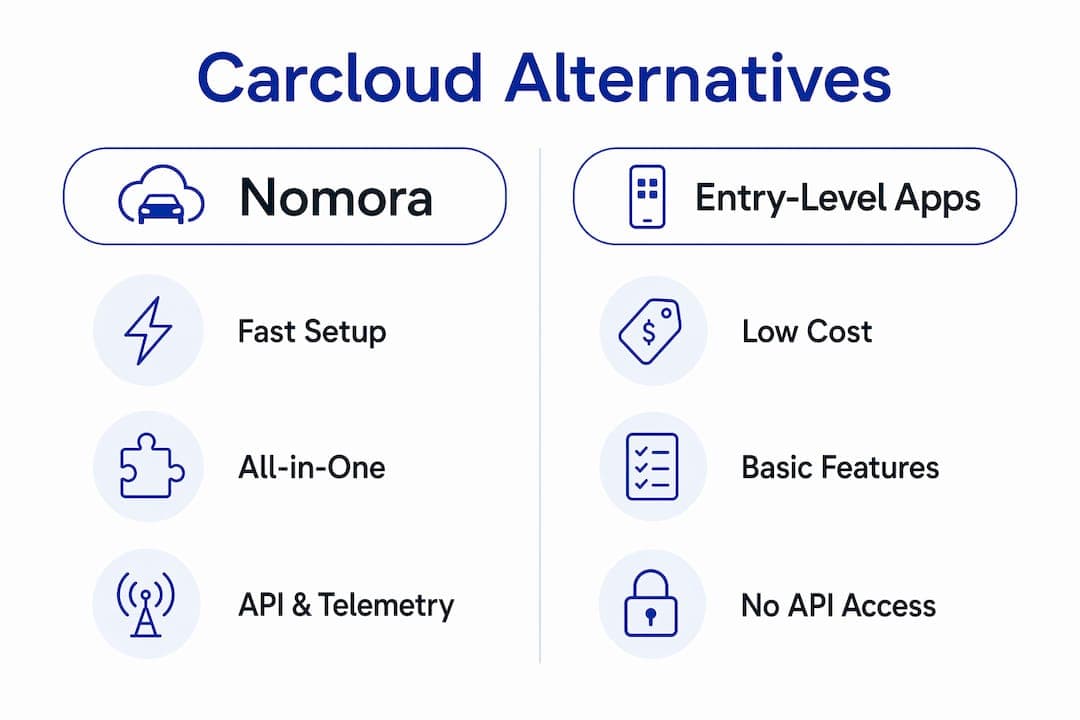
Nomora functions as the central nervous system of a rental operation, connecting every workflow from the moment a customer books to the moment a vehicle is returned and invoiced. Its core capabilities cover conflict-free reservations, automated contract generation, integrated payment processing, GPS fleet tracking, and customer data management, all accessible from any device via the cloud.
Best for: Independent rental operators, specialty and luxury vehicle fleets, and growing businesses that want to replace spreadsheets without a multi-month implementation project. Rental businesses of all sizes can configure Nomora to their workflow rather than the other way around.
Onboarding: The brand claims a 24–48 hour setup window, which is unusually fast for a platform with this feature depth. That speed matters when you are switching mid-season.
Trust signals: GDPR compliance and cloud-native security are built into the platform. API integrations with GPS providers and payment gateways are documented and available for pre-purchase review.
Pros:
- All-in-one: reservations, contracts, payments, and GPS in a single subscription
- Fast onboarding relative to enterprise alternatives
- Flexible tiered pricing that scales with fleet size
- Open API and integration support for GPS and accounting tools
Cons:
- Telematics depth (CAN bus, OTA updates) is less specialized than dedicated device-layer platforms
- Larger enterprise operators with complex multi-region reporting may need additional configuration
Entry-level field apps
These tools are designed for operators running fewer than 15 vehicles who need digital booking and basic fleet visibility without committing to a full SaaS subscription. Think of them as a step up from a shared spreadsheet: they handle reservations and simple scheduling, but they rarely expose an API, offer no telemetry, and tend to cap out as fleets grow. For a small fleet just getting off paper-based processes, they can be a reasonable starting point.
Pros: Low cost, fast setup, minimal training required.
Cons: No API access, no vehicle data integration, limited reporting, and you will likely outgrow them within 12–18 months.
Telematics-first stacks
These platforms lead with hardware and vehicle data. Platforms in this category, such as those built on AutoPi Cloud, provide CAN-FD capture, Docker-native edge compute, OTA firmware updates, and full device provisioning pipelines. They are purpose-built for operators who need to know what is happening inside the vehicle, not just where it is parked.
The tradeoff is complexity. Hardware provisioning typically adds 1–4 weeks to deployment, and the pricing model is usually per-device rather than per-seat. Rental-specific workflows like contract generation and customer billing are often secondary features or require third-party integrations.
Pros: Deep vehicle health data, predictive maintenance capability, OTA update management.
Cons: Longer setup, higher per-device cost, weaker rental-workflow coverage.
Built for scale, these systems target multi-location operators, franchise networks, and corporate fleet managers who need role-based access controls, advanced reporting, and dedicated account management. They typically come with annual contracts, formal SLAs, and implementation timelines measured in weeks rather than hours.
Corporate vehicle rental operations with 50+ vehicles and multiple locations are the natural fit. The cost and complexity are harder to justify for a single-location operator with 20 cars.
Pros: Deep reporting, multi-location support, formal SLAs, dedicated support teams.
Cons: Long implementation timelines (4–12 weeks), higher licensing costs, often inflexible contract terms.
Subscription/marketplace systems
This category covers two distinct models that sometimes get conflated. The first is the all-inclusive subscription model, where maintenance, insurance, and service costs are bundled into a predictable monthly fee, appealing to operators who want cost predictability. The second is the peer-to-peer marketplace model, where individual vehicle owners list cars on a platform to earn revenue. These platforms are structurally different from fleet management SaaS and are not a direct replacement for Carcloud.com's operational features.
Statistic callout: Edge-cloud database architectures used in telematics-first stacks can reduce network bandwidth usage by approximately 97% and cut cloud storage costs by approximately 98%, according to GreptimeDB Edge product claims. For high-volume fleets generating continuous telemetry, those figures represent a meaningful long-term cost difference.
Pros: Predictable monthly costs, flexible terms, low operational overhead for marketplace models.
Cons: Limited operational control, no fleet management depth, marketplace models serve a fundamentally different business case.
How do you choose the right alternative for your rental business?
Pick the option that matches your telemetry requirements, team size, and integration needs first. Everything else follows from those three constraints.
Prioritized selection checklist:
- Business-size fit — Does the platform scale from your current fleet size to where you expect to be in three years? A tool built for 10 vehicles will create friction at 40.
- Telemetry and API needs — Do you need CAN bus data and OTA updates, or is GPS tracking and open API access sufficient? The answer determines whether you need a telematics-first stack or a SaaS-first platform like Nomora.
- Onboarding speed — If you need to be live within a week, a 4–12 week enterprise implementation is not a realistic option. Verify the vendor's actual onboarding timeline, not just the marketing claim.
- Total cost of ownership — Consumer Reports recommends evaluating costs over a multi-year window, and the same logic applies to software. Factor in subscription fees, integration costs, training time, and what it costs to exit.
- Integrations — Does the platform connect to your GPS hardware, payment processor, and accounting software? Gaps here create manual workarounds that erode the efficiency gains.
- Support SLA — What is the guaranteed uptime? What is the response time for critical issues? Get this in writing before signing.
- Data ownership — Who owns your customer data and vehicle records if you cancel? This is non-negotiable. Confirm it in the contract.
Questions to ask vendors during a demo:
- Can you share full API documentation before we sign?
- What is the telemetry data latency, and how long is data retained?
- What does the onboarding timeline look like, step by step?
- Do you provide migration support for existing data?
- Is there a sandbox or test environment available pre-purchase?
- What are your uptime SLA and incident response commitments?
- Are you SOC2 certified or GDPR compliant?
- What are the cancellation terms, and are there exit fees?
Red flags to watch for:
- A vendor who will not share API documentation before you sign is telling you something about how they handle transparency after you sign.
- Long fixed contracts (12–24 months) with heavy exit fees indicate the vendor knows switching is painful. That cost lands on you.
- Vague answers on data ownership. If the contract does not explicitly state you own your data, assume you do not.
Pro Tip: Build a 30–60 day evaluation timeline into your procurement plan. Week 1–2: shortlist and demo. Week 3–4: sandbox testing with real data scenarios. Week 5–8: onboarding and parallel running. This schedule gives you enough time to catch integration gaps before you are fully committed.
Why do telemetry, open APIs, and cloud architecture matter for your fleet?
Platforms that integrate OEM-grade telemetry and open APIs reduce maintenance surprises and lower long-term total cost of ownership. That is not a marketing claim — it is a structural consequence of how modern vehicle data works.
Google Cloud's automotive solutions framework illustrates the shift: cloud-native infrastructure now enables large-scale real-time vehicle data ingestion and processing that was previously only available to OEMs. For rental operators, this means platforms built on these architectures can surface actionable vehicle health signals before a breakdown happens, rather than after.
CAN bus data is the specific mechanism. Every modern vehicle broadcasts hundreds of signals on its internal network, covering engine load, battery state, brake wear, and more. Platforms that capture this data at the edge and sync it to the cloud give fleet managers a predictive maintenance window that GPS-only systems simply cannot provide.
The security layer matters equally. Smartcar's OAuth2-based consent flow covers 40+ automakers and gives applications OEM-grade vehicle data without requiring proprietary hardware hacks or manual data entry. When evaluating any platform's API posture, asking whether it uses OAuth2 for vehicle data consent is a fast way to separate production-grade integrations from workarounds.
Edge-cloud architecture also has a direct cost impact. Optimized edge-cloud deployments can compress telemetry at the device layer before syncing to cloud storage, with product claims from GreptimeDB Edge citing approximately 97% network reduction and approximately 98% storage cost savings. For a fleet generating continuous telemetry across dozens of vehicles, that compression translates directly into lower monthly infrastructure costs.
Integration checklist for vendor demos:
- Request sample CAN frames or telemetry payload examples.
- Review full API documentation, including rate limits.
- Confirm data retention policy and who owns historical records.
- Ask about OTA update support and device provisioning workflow.
- Test device provisioning in a sandbox environment before committing.
- Verify cloud storage and sync architecture, specifically how edge compression is handled.
Pro Tip: Ask vendors for sample telemetry payload sizes during trials. Mismatches between expected and actual payload sizes are a common hidden cost after deployment. A vendor who cannot produce a sample payload during a demo likely cannot support production-grade telemetry at scale.
Key Takeaways
Nomora is the most practical all-in-one alternative to Carcloud.com for U.S. rental operators who need fast onboarding, integrated payments, GPS tracking, and contract automation without a multi-week implementation project.
| Point | Details |
|---|
| Start with Nomora | Nomora's 24–48 hour onboarding and all-in-one feature set make it the fastest path to replacing Carcloud.com for most U.S. operators. |
| Check telemetry needs first | If CAN bus data and OTA updates are critical, evaluate a telematics-first stack alongside Nomora before deciding. |
| Evaluate TCO over multiple years | Factor in subscription fees, integration costs, training, and exit terms — not just the monthly price — when comparing options. |
| Ask for API docs before signing | Vendors who withhold API documentation pre-sale are a procurement red flag; production-grade platforms provide docs and sandbox access upfront. |
| Run a 30–60 day evaluation | A structured evaluation window covering demo, sandbox testing, and parallel onboarding prevents costly integration surprises post-commitment. |
The trade-offs nobody talks about when switching off Carcloud
Switching rental management platforms is rarely as clean as a vendor demo makes it look. The onboarding timeline is usually the easy part. What catches operators off guard is data migration: customer records, historical contracts, vehicle maintenance logs, and payment histories rarely map cleanly from one system to another. Field names differ, date formats conflict, and what was a single field in the old system becomes multiple fields in the new one. Budget for this work explicitly, or it will consume the time you thought you saved on onboarding.
The telemetry trade-off is worth naming directly. A SaaS-first platform like Nomora gets you live fast and covers the full rental workflow, but if your operation genuinely depends on CAN bus data for predictive maintenance, you will eventually want to layer in a telematics-first tool or verify that your chosen platform's GPS integration goes deep enough. Most small-to-mid-sized U.S. rental operators do not need CAN-level data today. But as vehicle costs rise and margins tighten, the operators who can predict a brake job two weeks out will have a real cost advantage over those who cannot.
Pay-as-you-grow pricing is genuinely attractive, but watch the scaling math. A platform priced per vehicle can look affordable at 10 cars and expensive at 50. Run the numbers at your projected fleet size in year three, not just today. And read the cancellation clause before you sign anything. Vendor lock-in in this category usually comes not from technical barriers but from contracts that make leaving expensive.
Nomora gives rental operators a faster, cleaner path forward
Rental operators who have been running on Carcloud.com or evaluating alternatives face a real decision: a telematics-first stack with a long hardware setup, an enterprise platform with a 12-week implementation, or a purpose-built rental SaaS that is live in 48 hours. Nomora is built for the third scenario.
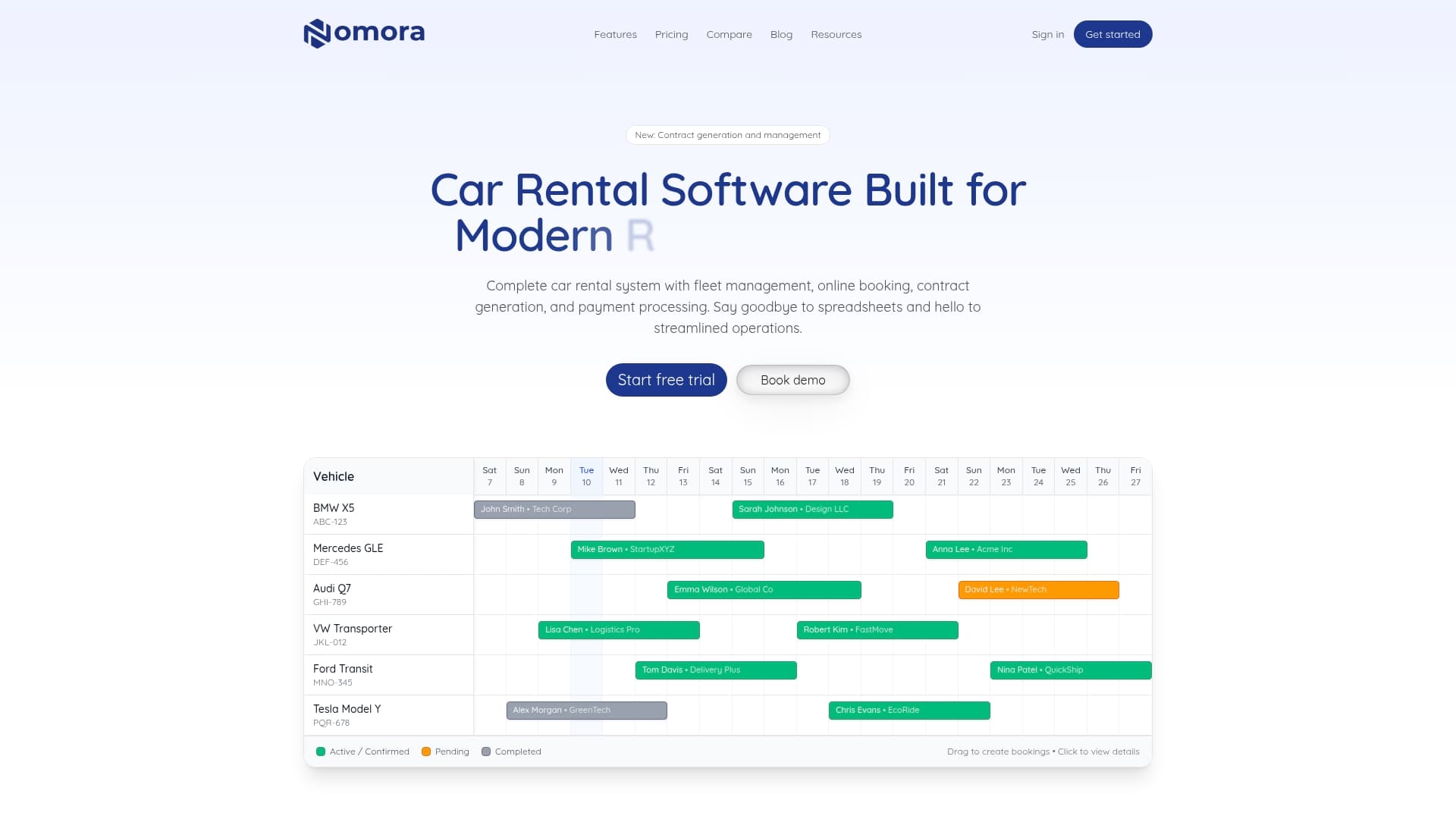
Nomora covers every core workflow in a single subscription: reservations with conflict-free booking, automated contract generation, integrated payment processing, GPS fleet tracking, and customer data management. Pricing scales with your fleet size, there are no long-term lock-in contracts forcing a multi-year commitment, and the onboarding process is designed to get your team operational within 24–48 hours. For a rental business evaluating its options, that combination of speed and depth is difficult to match in the alternatives market.
When you book a demo, come prepared: ask for API documentation, request a telemetry sample if GPS integration is a priority for your operation, and confirm the onboarding timeline step by step. The demo is your best opportunity to validate whether the platform's claims hold up against your actual workflow.
Start a trial or book a demo at Nomora to see how it maps to your fleet size and use case.
Useful sources and further reading
The following sources informed the research and claims in this article. They are worth bookmarking for technical teams evaluating telemetry architecture and procurement teams comparing pricing models.
Research and technical sources:
- Google Cloud Automotive Solutions — Cloud-native frameworks for real-time vehicle data ingestion and processing at scale.
- AutoPi Cloud: Fleet and Device Management — CAN-FD capture, OTA update management, Docker-native edge compute, and device provisioning for automotive IoT deployments.
- Smartcar: Car API Platform — OAuth2-based OEM vehicle data access covering 40+ automakers; the reference standard for secure API-based vehicle data consent.
- GreptimeDB Edge-Cloud Solution — Edge-cloud architecture for telemetry compression and sync; source of the ~97% network reduction and ~98% storage cost figures cited in this article.
- SIXT+ Car Subscription — Reference for bundled subscription pricing models in the vehicle rental market.
- Consumer Reports: Leasing vs. Buying — Framework for multi-year total cost of ownership evaluation applicable to software procurement decisions.
Nomora further reading for rental operators:
Recommended