Key Takeaways
| Point | Details |
|---|
| Data analytics boosts efficiency | Applying analytics to operations reveals hidden inefficiencies and increases overall profitability for car rental businesses. |
| Predictive tools drive fleet optimization | Using advanced forecasting minimizes idle inventory and meets customer demand more accurately. |
| Dynamic pricing maximizes revenue | Machine learning and segment-specific approaches fine-tune rates to balance occupancy and profit. |
| Tailored strategies yield best results | Prioritize analytics projects that address your business's specific challenges for highest impact. |
Why data analytics matters in car rentals
Data analytics, in the context of car rental operations, means systematically collecting and interpreting information about reservations, customer behavior, fleet usage, pricing, and market demand to make better decisions faster. It is not just about building reports. It is about creating a feedback loop that tells you what happened, why it happened, and what is likely to happen next.
The operational challenges facing rental businesses are real and persistent. Demand swings unpredictably with seasons, local events, and economic shifts. Pricing set too low leaves money on the table, while pricing set too high drives customers to competitors. Fleets that are too large create carrying costs and depreciation drag. Fleets that are too small cause missed bookings and frustrated customers. Each of these problems has a data-driven solution.
The core value that analytics delivers comes down to three outcomes:
- Increased operational efficiency through better scheduling, maintenance planning, and resource allocation
- Improved customer experience by matching the right vehicle to the right customer at the right time and price
- Higher profitability through dynamic pricing, reduced idle time, and smarter fleet investments
"The application of OR methodologies including time series analysis, regression, machine learning, stochastic programming, and MILP offers car rental companies powerful tools for demand forecasting, fleet sizing, and revenue management."
Understanding data analytics for fleet optimization is the starting point for any rental business that wants to shift from reactive firefighting to confident, forward-looking operations.
With analytics positioned as essential, let's unpack the actual tools and techniques driving real improvements. Several distinct methods each serve a specific purpose in the rental business context.
Time series analysis looks at historical rental data over time to identify patterns and trends. It works best for spotting seasonal peaks, weekly demand cycles, and long-term growth trajectories. If you know that compact cars spike every summer weekend at your airport location, time series analysis made that visible.
Regression models identify relationships between variables. For example, regression can reveal how local hotel occupancy rates, fuel prices, or even weather forecasts influence your daily rental volume. These models help you understand why demand moves, not just that it moves.
Machine learning (ML) takes pattern recognition further by training algorithms on large datasets to generate predictions with improving accuracy over time. ML is particularly effective for demand forecasting and pricing because it can process many variables simultaneously, including competitor pricing, booking lead times, and customer segment behavior.
Stochastic programming is used when uncertainty is unavoidable. It builds models that account for multiple possible demand scenarios and optimizes decisions across all of them. It is especially useful for fleet sizing decisions where overstocking and understocking both carry real costs.
Mixed Integer Linear Programming (MILP) is a powerful optimization method that solves allocation problems with constraints, such as distributing vehicles across multiple locations while minimizing repositioning costs and idle time.
| Technique | Best use case | Difficulty to implement |
|---|
| Time series analysis | Seasonal and weekly demand forecasting | Low to moderate |
| Regression models | Understanding demand drivers | Moderate |
| Machine learning | Dynamic pricing and churn prediction | Moderate to high |
| Stochastic programming | Fleet sizing under uncertainty | High |
| MILP | Multi-location vehicle allocation | High |
When combined, these OR methodologies create a layered analytics infrastructure that covers everything from daily pricing decisions to long-term fleet investment planning. The good news is that you do not need to implement all of them at once.
According to rental revenue management strategies used by leading operators, even deploying one or two of these techniques in the right area of your business can produce measurable gains within a single quarter.
Pro Tip: Start with demand forecasting before investing in anything else. Every other improvement, including pricing, fleet sizing, and staff scheduling, becomes more accurate when you know what customer volume to expect.
Predictive analytics for fleet management: less guesswork, more utilization
Having covered analytics tools, let's see fleet management as a prime application where data-driven decisions manifest tangible gains. Predictive analytics refers to the use of historical data, statistical algorithms, and machine learning models to forecast future outcomes, in this case, where vehicles will be needed, when, and in what quantity.
Traditional fleet management is largely reactive. A location runs out of compact cars on a Friday afternoon because no one anticipated the demand spike from a nearby conference. Vehicles pile up at one branch while another sits empty. Maintenance is handled when something breaks rather than when models predict it is about to. These patterns are expensive and entirely preventable.

The shift to data-driven fleet management produces concrete results. Consider the difference in outcomes between the two approaches:
| Metric | Traditional approach | Analytics-driven approach |
|---|
| Fleet utilization rate | 60 to 70 percent | 80 to 90 percent |
| Idle vehicle days per month | 12 to 18 days | 4 to 6 days |
| Repositioning costs | High, unplanned | Optimized and scheduled |
| Maintenance downtime | Reactive, longer | Predictive, shorter |
| Booking fulfillment rate | 75 to 82 percent | 90 to 96 percent |
These numbers reflect real patterns seen across the industry when OR methodologies are applied to fleet sizing and allocation.
Adopting fleet analytics does not require a complete overhaul of your operation overnight. A staged approach works far better:
- Collect and centralize your data. Gather reservation history, return data, maintenance logs, and location-level performance into a single system. Fragmented data sitting in spreadsheets or disconnected tools will limit every analytics effort downstream.
- Choose a model suited to your fleet size and data maturity. A small independent operator with one location may start with a simple time series model, while a multi-location chain may benefit from MILP-based allocation optimization.
- Run recurring reviews. Predictive models need to be updated as new data flows in. Set a schedule, monthly at minimum, quarterly for deeper strategic analysis, to revisit your assumptions and retrain your models as needed.
- Act on the outputs. A forecast sitting in a report that no one reads is worthless. Build clear processes where analytics outputs directly inform purchasing, repositioning, and scheduling decisions.
The comprehensive fleet management guide for 2026 outlines how operators at various stages of maturity can begin applying these principles without disrupting day-to-day operations. And for those focused on profitability, the fleet profitability strategies available to data-driven businesses are substantially stronger than those available to operators still working from gut feel.
Pro Tip: Analyze your reservation data by season, day of week, and local event calendar before finalizing your annual fleet plan. Preventing a summer shortage of SUVs is far cheaper than scrambling to source them at peak rental rates.
Customer insights and dynamic pricing: driving smarter revenue
Beyond managing assets, analytics also unlock customer-centric growth and smart pricing strategies. Understanding who your customers are, how they behave, and what drives them to book or cancel is just as valuable as knowing where your vehicles are.
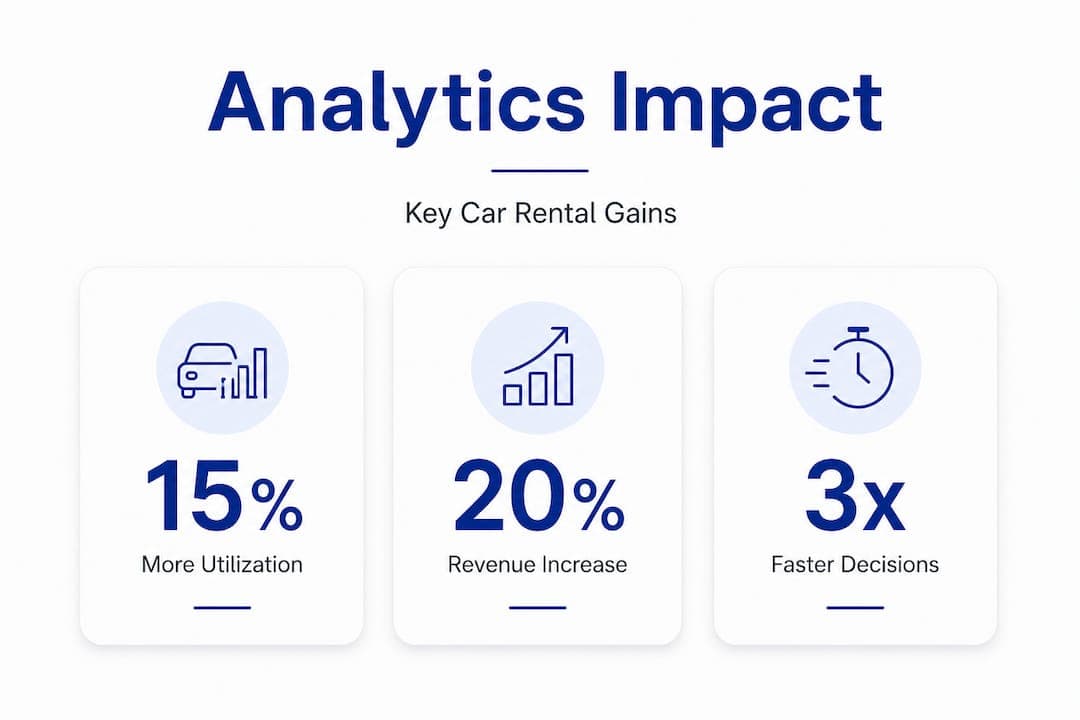
Analytics tools can break your customer base into meaningful segments: business travelers booking last-minute, leisure travelers planning weeks ahead, local residents renting for moving or events, and corporate accounts with recurring needs. Each segment responds differently to pricing, promotions, and service features. Treating them all the same guarantees you are leaving money on the table with some and overcharging others.
Machine learning models have shown particular strength in churn prediction by segment. For example, Transformer models perform well for predicting churn among one-time renters, while XGBoost models are more effective for infrequent but returning customers. Recognizing this distinction means you can tailor retention campaigns and pricing incentives to the customers most likely to respond, rather than applying a blanket discount that erodes margin across the board.
Dynamic pricing, powered by machine learning and real-time demand data, adjusts your rental rates automatically based on current and forecasted conditions. When a large event drives demand up at your downtown location, prices rise accordingly. When weekday midday demand is soft, targeted discounts fill gaps without sacrificing peak revenue. Businesses that implement dynamic pricing consistently report meaningful revenue gains per vehicle compared to flat-rate pricing models.
The top customer insights that analytics can surface for your rental business include:
- Average booking lead time by segment, so you can time promotions to capture early planners and last-minute bookers differently
- Vehicle preference patterns by customer type, enabling more accurate fleet composition decisions
- Price sensitivity thresholds for each segment, showing the point at which demand drops when rates increase
- Churn risk scores for repeat customers, so account managers can intervene before a loyal customer defects to a competitor
- Geographic demand patterns, revealing which neighborhoods or feeder markets generate the highest lifetime value customers
Exploring vehicle rental pricing strategies through an analytics lens changes the conversation from "what should we charge?" to "what is this specific customer willing to pay, and when?" That shift alone can boost rental profitability in ways that feel immediate and measurable.
Turning analytics into action: Steps for car rental success
With analytics' potential clear, here's how to take the first steps toward building your data-driven car rental operation. The gap between knowing analytics is valuable and actually using it to drive decisions is where many businesses stall. A structured roadmap helps.
- Assess your current analytics maturity. Do you have centralized data? Are you tracking reservation patterns, fleet utilization, and customer behavior in any systematic way? Honest self-assessment tells you where to start. Businesses using disconnected spreadsheets need foundational data infrastructure before advanced modeling.
- Set specific, measurable goals. "We want to use analytics" is not a goal. "We want to increase fleet utilization from 68 percent to 80 percent within six months" is. Clear goals align your team and give you a benchmark to evaluate whether your analytics investments are paying off.
- Select software built for your business type. A platform designed for car rental operations will have the data structure and integrations you need from day one, rather than requiring extensive customization. Look for tools that connect reservations, payments, GPS tracking, and customer data in one place. The right software to boost rental profits is one that surfaces actionable insights without requiring a data science degree to interpret them.
- Address adoption resistance early. Most analytics initiatives fail not because of bad data but because staff resist changing how they work. Involve your team in the process, show them how outputs reduce their workload, and celebrate early wins visibly.
- Pilot before scaling. Apply analytics to one process, one location, or one customer segment first. Measure the results. Refine your approach. Then expand.
The OR methodologies that power enterprise-level analytics are increasingly accessible to businesses of all sizes through modern SaaS platforms, removing the barrier that once limited these tools to large chains with dedicated data teams.
Pro Tip: Start small and prove value quickly. A successful pilot on demand forecasting at a single location builds internal confidence and budget justification for broader analytics adoption far more effectively than any external argument.
Rethinking the data advantage: Insights car rental owners often overlook
Here is an uncomfortable truth that most analytics articles skip over: having a dashboard full of metrics does not automatically make your business more profitable. The operators who gain the most from analytics are not those who buy the most sophisticated tools. They are the ones who identify one or two specific bottlenecks and apply data to solve those problems precisely.
Conventional wisdom in the rental industry treats analytics as a technology question. In practice, it is a business clarity question. Before you evaluate any platform or model, ask yourself which decision you are making badly right now, and what information would make it better. That focus prevents the common trap of investing in analytics infrastructure that generates reports nobody reads.
Small local branches and niche rental segments are also consistently underserved by analytics strategies. A regional operator running 30 vehicles in a college town has different demand patterns than an airport chain. Generic demand forecasting tools may miss the rhythms of academic calendars, graduation weekends, or local sports seasons entirely. Tailored analytics, even simple ones built on local reservation history, can provide a meaningful edge that larger players with standardized national models cannot replicate.
Another overlooked area is inventory management for profits. Most operators focus analytics energy on pricing or customer acquisition, while inventory rotation and vehicle lifecycle decisions remain largely intuitive. Knowing precisely when a vehicle's depreciation curve crosses its revenue contribution curve is the kind of insight that changes how you think about fleet replacement, not just fleet utilization.
The businesses that extract the most value from analytics are also the ones that build a culture of measurement. They pilot, measure, adjust, and then scale. They treat every analytics output as a hypothesis to test, not a conclusion to accept. That mindset turns data from a reporting function into a genuine competitive advantage.
Move from insight to impact with Nomora's solutions
Understanding analytics strategy is one thing. Having the right infrastructure to execute it is another entirely. Nomora is built specifically to give car rental businesses the data visibility and automation they need to put these strategies into practice.
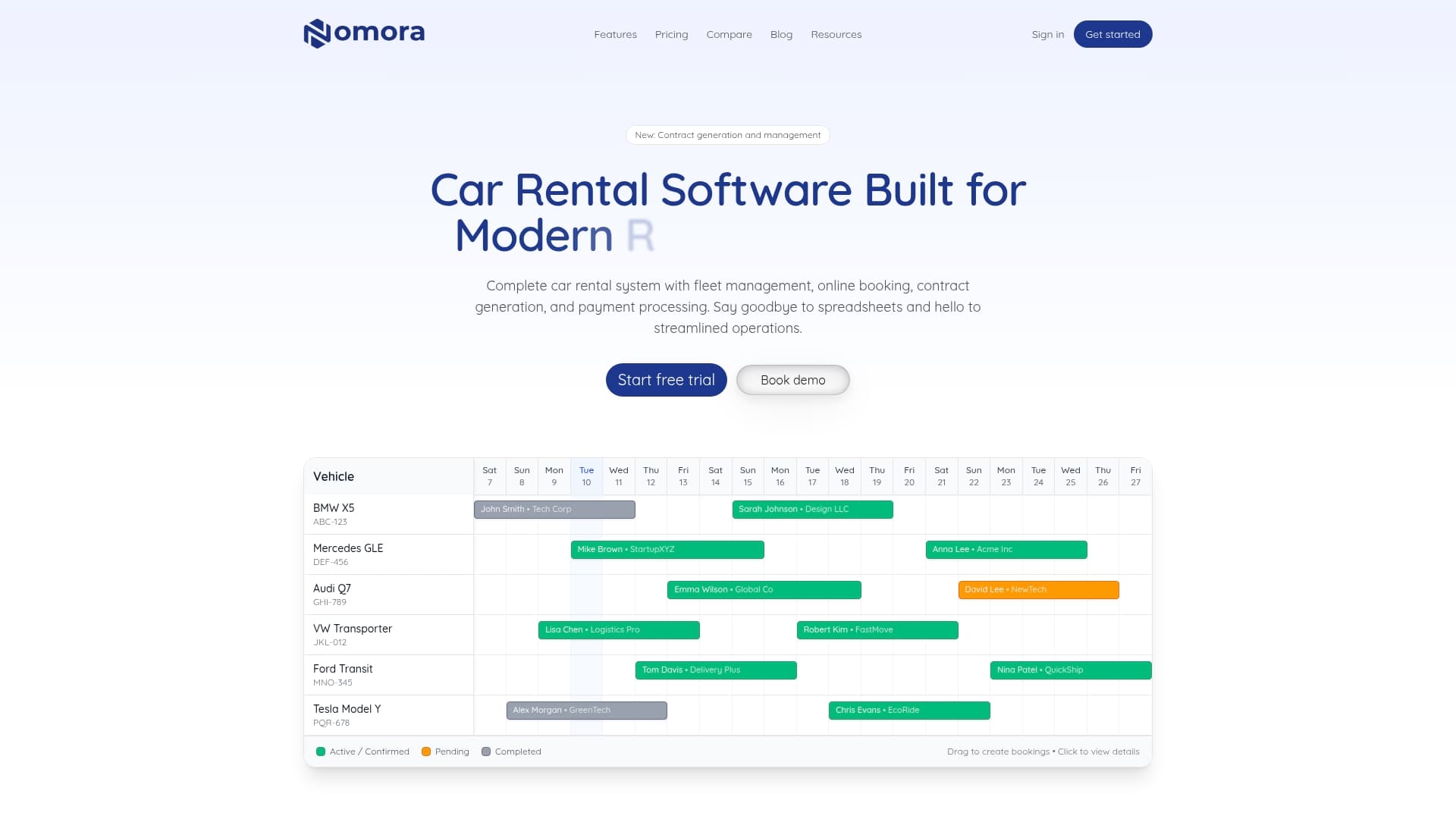
Nomora's platform connects fleet management, reservation data, dynamic pricing inputs, customer records, and automated payment solutions in a single cloud-based system. That means the data feeding your analytics is clean, centralized, and current, which is the foundation every forecasting and optimization model depends on. You can explore analytics use cases for car rentals to see how operators across business types are using Nomora to move from reactive management to confident, data-driven decisions. With onboarding completed in as little as 24 to 48 hours, the path from insight to impact is shorter than you might expect.
Frequently asked questions
What is the first step to implement data analytics in my car rental business?
Begin by identifying your business's most pressing operational challenges, then centralize the data related to those areas before selecting any analytics tools. Applying OR methodologies to disorganized or incomplete data produces unreliable outputs, so data quality comes before model sophistication.
How does predictive analytics improve fleet management efficiency?
Predictive analytics allows operators to anticipate demand by location, vehicle type, and time period, enabling smarter vehicle allocation and maintenance scheduling that reduces idle days and costly last-minute repositioning. OR-based fleet sizing methods like stochastic programming model uncertainty directly, so your decisions are robust even when conditions shift unexpectedly.
What analytics techniques are most impactful for car rental pricing?
Dynamic pricing powered by machine learning adjusts rates in real time based on demand signals, competitor pricing, and booking lead times, which consistently outperforms static pricing in revenue per vehicle. Research on ML models by customer segment confirms that tailoring pricing logic to different renter profiles, such as using XGBoost for infrequent renters, further sharpens revenue outcomes.
Can small car rental businesses benefit from analytics, or is it just for large chains?
Small operators can realize strong returns from analytics without enterprise-level investments by focusing on one or two high-impact areas like seasonal demand forecasting or vehicle utilization tracking. The OR methodologies that power these improvements are now embedded in accessible SaaS platforms designed for businesses at every scale.
Recommended