Use short, typo-resistant alphanumeric booking codes, an affiliate_reference_id idempotency key, AAMVA DLDV driver-license checks, and transaction-id tracing together. These four elements form the technical backbone of a rental operation that is auditable, fraud-resistant, and conflict-free. In the US rental context, "hire car code" refers to the reservation ID and license-verification token your software generates and manages, not a short-lived sharing code from a foreign licensing authority.
Minimum fields to add to your Create Booking flow:
booking_code: 8-character uppercase alphanumeric, excluding O, 0, I, and 1affiliate_reference_id: your own unique booking reference, sent on every Create call and reused on retriestransaction-id: HTTP header forwarded through every API call and written to logslicense_image_hash: SHA-256 of the captured license image, stored for auditverification_result and verification_timestamp: AAMVA DLDV response fields, retained per your retention policy
Run the AAMVA DLDV check at prepickup by default. For high-value or long-term rentals, run it at reservation time as well.
Key Takeaways
Booking-code design, AAMVA DLDV verification, idempotency, and transaction tracing are the four non-negotiable foundations of a fraud-resistant, conflict-free US rental operation.
| Point | Details |
|---|
| Use 8-char alphanumeric codes | Exclude O, 0, I, 1; add a unique DB index on the public code column. |
Always send affiliate_reference_id | Persist it before the API call; reuse it on every retry to prevent duplicate bookings. |
| Run AAMVA DLDV at prepickup | For high-value rentals, also check at reservation time and log both results. |
| Enable transaction-id tracing | Forward a UUID header through every API call and write it to logs with booking context. |
| Nomora as your managed platform | Nomora delivers all four patterns with a quick onboarding process at Nomora. |
Table of Contents
How should you design hire car booking codes to prevent duplicates?
The booking reference a customer reads aloud to your counter agent is not the same thing as your internal database ID. Conflating the two is one of the most common mistakes in rental software design, and it creates real problems: sequential numeric IDs expose your booking volume, long UUIDs are impossible to communicate verbally, and non-indexed public codes cause slow lookups under load.
The right pattern separates concerns. Keep an internal auto-incrementing integer as your primary key. Generate a separate, short alphanumeric booking reference for customer-facing use, store it in its own column, and add a unique index on that column. Collisions become a database constraint violation rather than a silent data corruption.
For character set, use uppercase letters and digits, then remove the four ambiguous characters: O (looks like 0), 0 (looks like O), I (looks like 1), and 1 (looks like I). That leaves a 32-character set. Optionally strip vowels to reduce the chance of generating offensive words. Group characters in blocks of four (XXXX-XXXX) for readability on printed contracts and confirmation emails.
| Code length | Possible combinations (32-char set) | Practical use case |
|---|
| 6 chars | ~1.07 billion | Small fleets, low volume |
| 7 chars | ~34.4 billion | Mid-size operators |
| 8 chars | ~1.1 trillion | Multi-location, high volume |
| 9 chars | ~35 trillion | Enterprise / franchise networks |
GetYourGuide's engineering team moved from numeric-only IDs to uppercase alphanumeric strings precisely because the larger symbol set expands capacity while keeping codes short and human-readable. An 8-character code is the right default for most US rental operators.
Idempotency is the other half of duplicate prevention. Per Expedia Rapid car launch requirements, every Create Booking call must carry your own affiliate_reference_id. Reuse the same value on every retry for that booking attempt. The platform detects the duplicate and returns the existing booking rather than creating a second one.
Pro Tip: Generate your affiliate_reference_id before the first API call, persist it immediately to your database, and never regenerate it on retry. If your server crashes between generating and persisting, you will create a duplicate. Persist first, call second.
How does AAMVA DLDV driver-license verification work for US rentals?
AAMVA is the federation that connects all US state DMVs. Its Driver's License Data Verification service lets authorized businesses query the issuing state's DMV directly, returning a match/no-match result and status flags in near real time. There is no central consumer database involved. The check goes to the source.
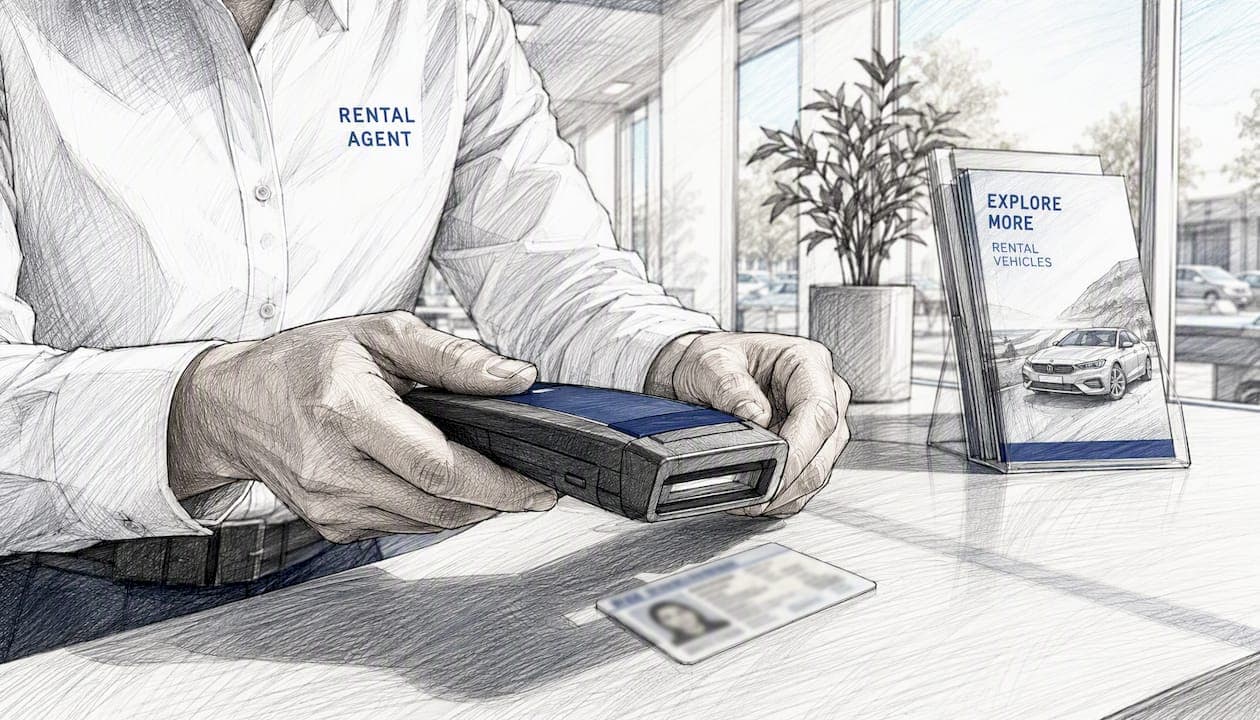
Direct integration vs. vendor-mediated flow:
| Dimension | Direct AAMVA integration | Verification vendor (e.g., Vouched) |
|---|
| Coverage | All participating states | Varies by vendor contract |
| Compliance burden | High: you manage credentialing, audits | Lower: vendor holds certifications |
| Engineering effort | Significant: SOAP/XML APIs, state-specific quirks | Lower: REST API, SDK |
| Maintenance | Ongoing: state schema changes | Vendor-managed |
| Audit trail | You build it | Vendor provides it |
For most independent and mid-size operators, a vendor-mediated flow is the practical choice. Direct AAMVA integration makes sense when you process high volumes and want to eliminate per-query vendor fees at scale.
Timing the check. Run AAMVA DLDV at prepickup for standard rentals. This catches suspensions that occurred after reservation. For high-value vehicles or rentals longer than seven days, run the check at reservation time as well, then recheck at pickup. Log both results with timestamps.
Modern verification flows combine OCR, template authenticity checks, and liveness/face matching before the AAMVA query. That sequence produces an auditable trail: capture, OCR output, authenticity score, liveness result, then the DMV match flag. Store the trail, not the raw image.
Handling failures. When AAMVA returns a no-match or the verification service is unavailable, do not flatly reject the customer. Build a fallback: request a secondary document, route to manual review, or allow a supervised desktop verification at pickup. Flat rejection on a first attempt due to glare or a low-light image is a poor experience and an unnecessary revenue loss.
Collect consent before capturing any license image. Display a plain-language notice stating what data you collect, why, and how long you keep it. Log the consent timestamp alongside the verification record.
How do you prevent double bookings across multiple channels?
Conflict-free inventory depends on database-level locking. Without it, two agents booking the same vehicle at the same moment will both succeed, and you will have one vehicle assigned to two customers.
Use pessimistic row-level locking (SELECT ... FOR UPDATE) when checking availability and assigning a vehicle. This blocks concurrent transactions from reading the same row as available until the first transaction commits or rolls back. Optimistic locking (version counters) works for lower-concurrency scenarios but requires retry logic at the application layer when a conflict is detected.
For multi-channel operations, treat your rental platform as the single source of truth for inventory state. All channels, whether a direct booking site, an OTA feed, or a walk-in agent terminal, must write through the same availability service. Distributed locks (Redis SETNX with a TTL) can coordinate across services, but they add failure modes. A single transactional database service with row locking is simpler and more reliable for most operators.
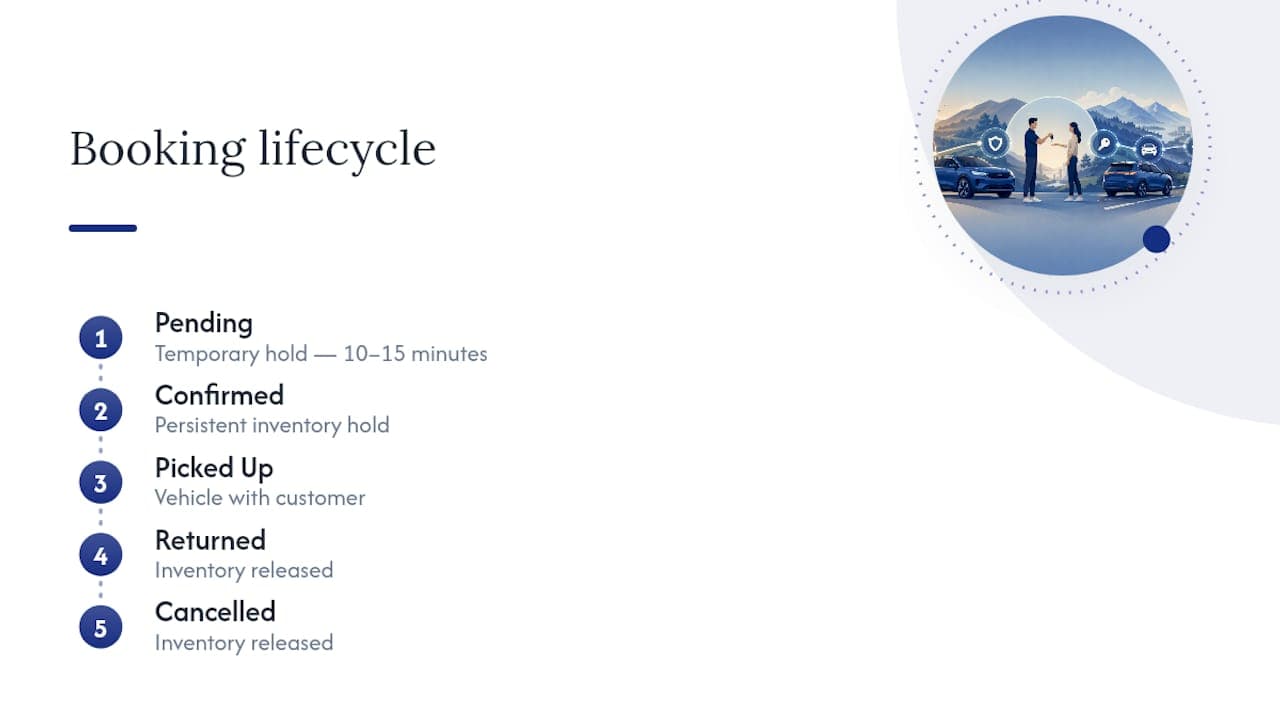
Model your booking lifecycle as a state machine:
Pending → Confirmed → Picked Up → Returned → Cancelled
Only a Confirmed booking holds inventory. A Pending booking should hold inventory for a short window (typically 10–15 minutes) then expire automatically if payment or verification does not complete. This prevents abandoned carts from locking out real customers.
Pro Tip: Wrap availability-change deployments in a feature flag. A bad availability query in production is harder to roll back than a feature flag.
For a deeper look at conflict-free booking workflows and the specific database patterns that support them, Nomora's engineering blog covers the implementation in detail.
What is the correct Create Booking → Retrieve API pattern?
- Generate your
affiliate_reference_id and persist it to your database before making any API call.
- Call Create Booking with
affiliate_reference_id, customer name, email, vehicle selection, and payment token.
- On success, store
itinerary_id, booking_code, and links.retrieve.href from the response.
- On timeout or 5xx, wait your retry window, then call Retrieve using the same
affiliate_reference_id before attempting a new Create.
- On 400 with duplicate-affiliate error, call Retrieve immediately. The booking already exists.
- On 404 in-progress, the booking is still processing. Poll Retrieve at intervals until you get a terminal state.
Per Expedia Rapid booking guidance, most bookings complete in seconds, but some take minutes. Your system must support polling and retries without creating duplicate reservations.
| HTTP response | Meaning | Action |
|---|
| 200/201 | Booking created | Store itinerary_id and booking_code |
| 404 (in-progress) | Still processing | Poll Retrieve with same affiliate_reference_id |
| 400 (duplicate affiliate id) | Already exists | Retrieve immediately, do not re-create |
| 5xx transient | Server error | Retry Create with same affiliate_reference_id after backoff |
Require a transaction-id HTTP header on every outbound API call. Generate it as a UUID at the start of each request, forward it through all downstream calls, and write it to your logs alongside the user ID, affiliate_reference_id, and booking state. When something goes wrong, this single field lets you reconstruct the full call chain in seconds.
External dependencies like fraud checks and payment gateways add latency. Budget for them in your retry windows and set independent timeouts per dependency rather than a single global timeout.
What data should you collect and how long should you keep it?
Collect only what the verification requires. A license image, the OCR output, and the AAMVA match result are sufficient for most rental operations. Raw biometric inputs, including facial images captured for liveness checks, should be deleted automatically once verification completes unless a specific legal obligation requires retention.
Encrypt license images and OCR outputs in transit (TLS 1.2 minimum) and at rest (AES-256). Apply role-based access controls so only compliance officers and senior operations staff can query raw verification logs. Counter agents should see only a pass/fail status.
Suggested retention timeline:
- Verification assertions (pass/fail result, timestamp, AAMVA match flag): retain for the duration of the rental plus your standard dispute window, typically 12–18 months.
- Raw license images and OCR outputs: delete within 24–72 hours of verification completion unless local law requires longer retention.
- Contract attachments referencing verification: retain per your contract retention policy, typically 3–7 years.
Retention policy decisions belong to your legal counsel, not your engineering team. Consult an attorney for state-specific mandates, particularly in California (CCPA), Virginia (VCDPA), and Colorado (CPA), where consumer data rights create specific deletion obligations.
For a detailed walkthrough of securing customer data in a rental context, including encryption standards and access control patterns, Nomora's guide covers the full compliance posture.
How should you test and monitor your booking and verification flows?
Test plan:
- Unit tests: booking-code generation (uniqueness, character set, length),
affiliate_reference_id persistence logic
- Integration tests: Create → Retrieve round trip, duplicate-affiliate handling, AAMVA mock responses (match, no-match, service unavailable)
- End-to-end tests: full reservation flow including payment, verification, and contract generation
Staged rollout: Deploy availability changes behind a feature flag. Run a canary at 5–10% of traffic. Keep a fallback verification route (manual review queue) active during the first two weeks of any new verification integration.
Monitoring metrics to track:
- Booking success rate (target: above 99%)
- Verification pass rate and no-match rate by state
- Average Create → Retrieve latency
transaction-id error rate (missing or malformed headers)- Duplicate
affiliate_reference_id conflict count per hour
Nomora's typical onboarding takes 24–48 hours, which means operators evaluating a managed platform can reach a production-ready state quickly rather than spending weeks on custom infrastructure.
What is the minimum implementation checklist for your engineer?
Required fields for Create Booking and Retrieve:
customer_name, customer_email: provided by frontendaffiliate_reference_id: generated and persisted by backend before API callitinerary_id, booking_code: returned by platform, stored by backendtransaction-id: generated per request, forwarded as HTTP header, loggedlicense_image_hash: SHA-256 of captured image, stored by backendverification_result, verification_timestamp: returned by AAMVA/vendor, stored by backend
Tie each booking_code to a digitally signed rental agreement so the verification record, contract, and booking reference are linked in a single auditable chain.
Why these patterns matter more than most operators realize
The technical patterns in this guide are not engineering abstractions. They are the difference between a pickup that takes three minutes and one that takes twenty, between a fraud dispute you can resolve in an hour and one that costs you a vehicle. Idempotency prevents the duplicate reservations that generate chargebacks. AAMVA DLDV catches suspended licenses before keys change hands. Transaction-id tracing turns a support call into a two-minute log search.
The operators who invest in these patterns early find that their counter staff spend less time resolving booking conflicts and more time with customers. Auditable verification trails also shorten insurance claim cycles, because the documentation is already there.
Onboarding speed matters too. A platform that takes weeks to configure delays every other improvement. The 24–48 hour onboarding window is not a marketing claim; it is an operational constraint that determines how quickly you can respond to fleet changes, new channel integrations, or regulatory updates.
Nomora handles all of this for you out of the box
Rental operators who have worked through the checklist above know how much engineering effort these patterns require to build and maintain correctly. Nomora is built around exactly these requirements: conflict-free booking with database-level inventory locking, automated booking-code generation, affiliate_reference_id idempotency, AAMVA/DLDV vendor integration support, transaction-id tracing across all API calls, and GDPR/US privacy tooling with configurable retention policies.
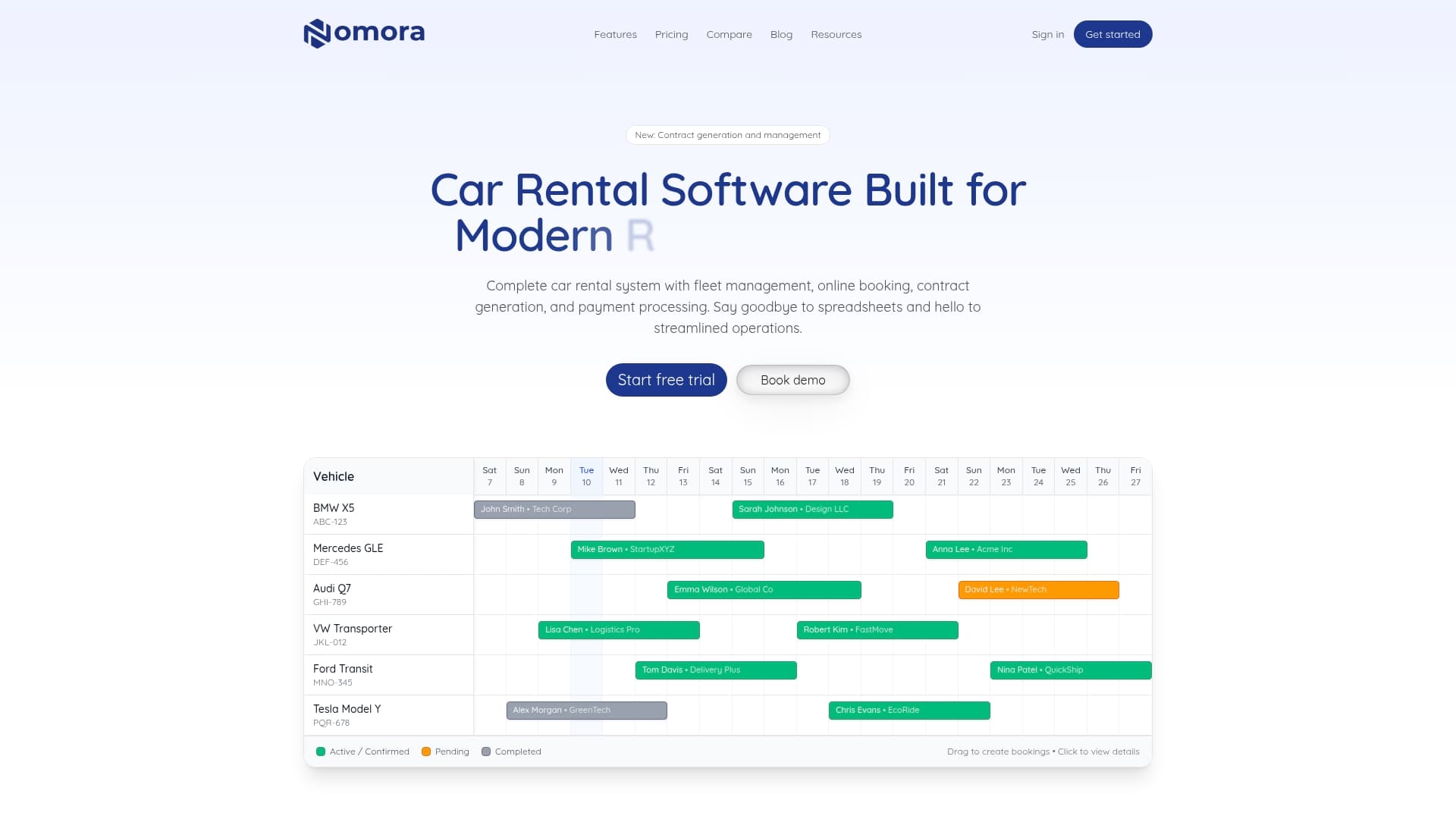
Onboarding takes 24–48 hours. You get audit logs, role-based access controls, real-time fleet visibility, and integrated contract generation from day one, without building any of it yourself. Operators across fleet sizes use Nomora to replace spreadsheets and fragmented tools with a single system that handles reservations, verification, payments, and compliance in one place. See how Nomora maps to your operation at Nomora.
Sources
Recommended