Independent car rental operators face a sobering reality: 62% fail in their first year, while franchise operators see a 92% survival rate over the same period. That gap is not a coincidence. Franchise vehicle rental models give small and medium-sized operators access to proven systems, established brand recognition, and centralized technology that would take years to build independently. This article breaks down exactly how franchise vehicle rental works, what it costs, what you gain, and where the real risks hide, so you can make a fully informed decision.
Table of Contents
Key Takeaways
| Point | Details |
|---|
| High survival rates | Franchise vehicle rentals offer one of the highest business survival rates for SMEs compared to independent operations. |
| Significant initial investment | Operators need to budget for franchise fees, fleet acquisition, and ongoing royalties—which can run into millions. |
| Major tech and network benefits | Franchisees get access to reservation systems, global networks, and marketing support that streamline operations. |
| Critical risk factors | Internal contract terms, margin erosion, and lack of flexibility are key risks that franchise operators must evaluate carefully. |
| Optimizing with software | Efficient franchise operations depend on leveraging specialized software for reservations, fleet management, and payments. |
Defining franchise vehicle rental: Structure and industry context
Franchise vehicle rental is a business model where an independent operator (the franchisee) runs a rental location under an established brand name. According to the Sixt franchise overview, franchise vehicle rental refers to a model where franchisees operate rental locations using the franchisor's technology, systems, and brand support. The franchisor provides the infrastructure. The franchisee provides the capital, local management, and day-to-day operations.
Major brands operating this way include Sixt, Hertz, Dollar, Thrifty, and U-Save. Each positions itself differently in the market. Sixt targets premium travelers, while U-Save focuses on value-driven local and regional rentals. Hertz's franchise model has expanded aggressively into international markets, making it a strong option for operators in high-tourism regions.
The core structure works like this:
- Franchisee rights: You gain the legal right to operate under the brand name in a defined territory
- Centralized systems: Reservation platforms, pricing tools, and fleet management software are provided or mandated
- Brand leverage: Customers trust the name before they ever meet you
- Ongoing support: Training, marketing materials, and operational guidance come from the franchisor
Here is how the franchise model compares to running an independent rental business:
| Factor | Franchise model | Independent rental |
|---|
| Brand recognition | Immediate, established | Built from scratch |
| Technology access | Provided by franchisor | Self-sourced |
| Startup survival rate | 92% (year 1) | 62% (year 1) |
| Operational flexibility | Limited by SOPs | Full control |
| Marketing costs | Shared/pooled | Entirely self-funded |
| Support network | Franchisor + peer network | None by default |
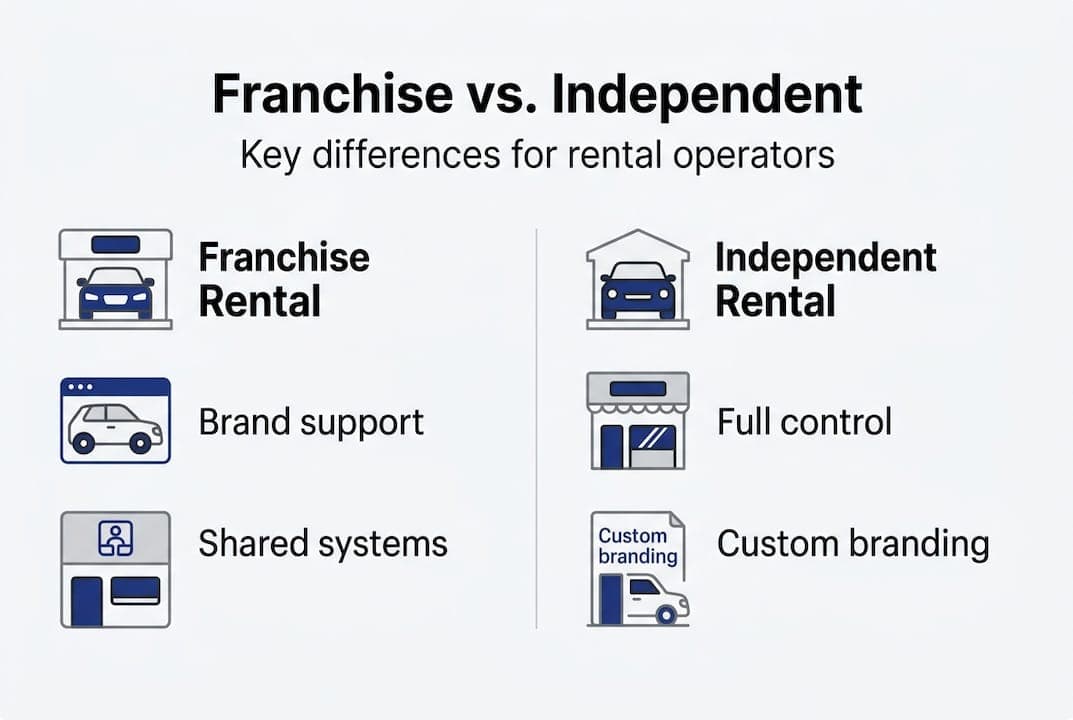
For SMEs exploring use cases for car rental franchises, this structure offers a faster path to profitability than building a brand from zero.
Franchise fees, investment, and revenue: What to expect
The numbers are the first thing most operators want to see, and they vary widely. Franchise investment ranges from an initial fee of $10,000 to $125,000, fleet acquisition or lease costs of $450,000 to $15 million or more, royalties of 4 to 8% of gross revenue, and marketing fees of 2 to 4%. Average unit revenue for Thrifty franchisees runs between $184,000 and $1.2 million, while U-Save franchise units average around $388,000 per year.
| Cost category | Typical range |
|---|
| Initial franchise fee | $10,000 to $125,000 |
| Fleet acquisition/lease | $450,000 to $15M+ |
| Royalties (% of gross) | 4% to 8% |
| Marketing fees | 2% to 4% |
| Average annual revenue (Thrifty) | $184,000 to $1.2M |
| Average annual revenue (U-Save) | ~$388,000 |
Here is the typical process SMEs follow to get started:
- Research and shortlist franchise brands that match your market and capital capacity
- Request the Franchise Disclosure Document (FDD) to review all fees, obligations, and territory rights
- Secure financing for fleet acquisition, which is usually the largest cost
- Complete franchisor training before opening
- Launch operations using the franchisor's reservation and fleet management systems
Understanding how a rental reservation system integrates with your franchise platform early on saves significant time and money during setup.
Pro Tip: The FDD will list the initial fee and royalties, but hidden costs often include vehicle maintenance reserves, insurance minimums, technology platform fees, and local compliance costs. Budget an additional 15 to 20% above the stated investment range to cover these.
Benefits for small and medium-sized rental operators
For SMEs, the franchise model's biggest advantage is speed. You skip the years it takes to build brand trust and customer acquisition channels. As noted in the Rentalux franchise overview, franchising accelerates entry for SMEs, enables management via franchisor technology, and suits operators focused on streamlining reservations, fleet operations, and customer interactions.
The operational benefits stack up quickly:
- Reservation technology: Franchisor platforms handle online bookings, availability calendars, and conflict prevention automatically
- Real-time fleet tracking: GPS integrations and fleet dashboards give you live visibility into vehicle location and status
- Global distribution: Your inventory appears on major booking platforms and travel aggregators from day one
- Training programs: Structured onboarding reduces the learning curve for new staff
- Pooled marketing: National advertising campaigns drive customers to your location without you funding the entire effort
The Sixt franchise technology stack is a strong example of how franchisors deliver software infrastructure that would cost hundreds of thousands to build independently. For operators who want to understand how software directly impacts the bottom line, the connection between boosting profits with rental software and franchise performance is direct and measurable.
"Franchising accelerates entry for SMEs, enables management via franchisor tech, and suits streamlining reservations, fleet, and customer interactions." — Rentalux Franchise Opportunity
Pro Tip: When evaluating franchise brands, ask specifically whether their software allows third-party integrations. Franchisors that lock you into rigid, closed platforms limit your ability to add tools like payment gateways, GPS providers, or CRM systems as your business grows. A vehicle reservation system that integrates with your existing tools is worth prioritizing.
Risks, downsides, and edge cases: What to watch out for
The benefits are clear, but committing to a franchise vehicle rental model without understanding the downsides is a costly mistake. The key risks include high capital requirements for fleet acquisition, strict regulatory compliance obligations, termination risks if performance benchmarks are not met, dependency on franchisor standard operating procedures (SOPs), and hidden costs that erode margins over time.
Here is a breakdown of the most common pitfalls:
- Margin erosion: Royalties of 4 to 8% plus marketing fees of 2 to 4% can consume 10 to 12% of gross revenue before you account for fleet costs
- Contract termination clauses: Many franchise agreements allow the franchisor to terminate if you miss revenue targets or violate operational standards
- SOP rigidity: You may be required to use specific vendors, vehicle types, or pricing structures that do not suit your local market
- Regulatory barriers: Vehicle rental businesses face licensing, insurance, and consumer protection rules that vary by state and city
- Maintenance reserves: Fleet upkeep costs are often underestimated, especially for operators running older or high-mileage vehicles
Reviewing Thrifty franchise risk disclosures before signing any agreement gives you a realistic picture of what termination and compliance obligations look like in practice.
"The independence of owning your own rental business gives you pricing and fleet flexibility that no franchise can match, but you trade that for the brand power and systems that franchises provide."
Understanding rental contract essentials is critical before you sign a franchise agreement. The terms governing your relationship with the franchisor are just as important as the terms you set with your own customers.
Critical success factors and benchmarks in franchise rental
Data separates guesswork from strategy. Franchise success rates sit between 85 and 93% after five years, compared to significantly lower rates for independent operators. ROI averages 15 to 20% per year for well-run franchise units. Location quality, fleet utilization rates, and multi-unit operations are the three factors most consistently linked to above-average performance.
| Metric | Franchise operators | Independent operators |
|---|
| Year 1 survival rate | 92% | 62% |
| 5-year survival rate | 85% to 93% | Significantly lower |
| Average annual ROI | 15% to 20% | Varies widely |
| Breakeven period | 2 to 4 years | 3 to 6 years |
Practical strategies that move the needle for franchise operators:
- Maximize fleet utilization: Aim for 70 to 80% utilization rates. Vehicles sitting idle are the fastest way to destroy margins. Resources on optimizing your rental fleet show how data-driven scheduling improves this metric significantly.
- Use a fleet checklist: A structured vehicle rental checklist reduces damage disputes, speeds up turnaround, and protects your franchise compliance record
- Invest in the right software features: The key rental software features that drive efficiency include automated booking confirmations, real-time availability, and integrated payment processing
- Consider multi-unit expansion: Operators running two or more locations consistently outperform single-unit franchisees on ROI. A multi-location fleet management strategy becomes essential once you cross that threshold
- Track your franchise success statistics against industry benchmarks quarterly, not annually
Location selection deserves special attention. High-traffic areas near airports, train stations, and hotels consistently outperform suburban or rural locations for vehicle rental franchises. If your target territory lacks these demand drivers, negotiate a lower initial fee or a longer ramp-up period before royalties kick in.
Streamline franchise operations with specialized rental software
Running a franchise rental location means managing reservations, fleet availability, customer contracts, and payments, often across multiple channels at once. The operational complexity grows fast, especially when your franchisor's built-in tools do not cover every workflow you need.
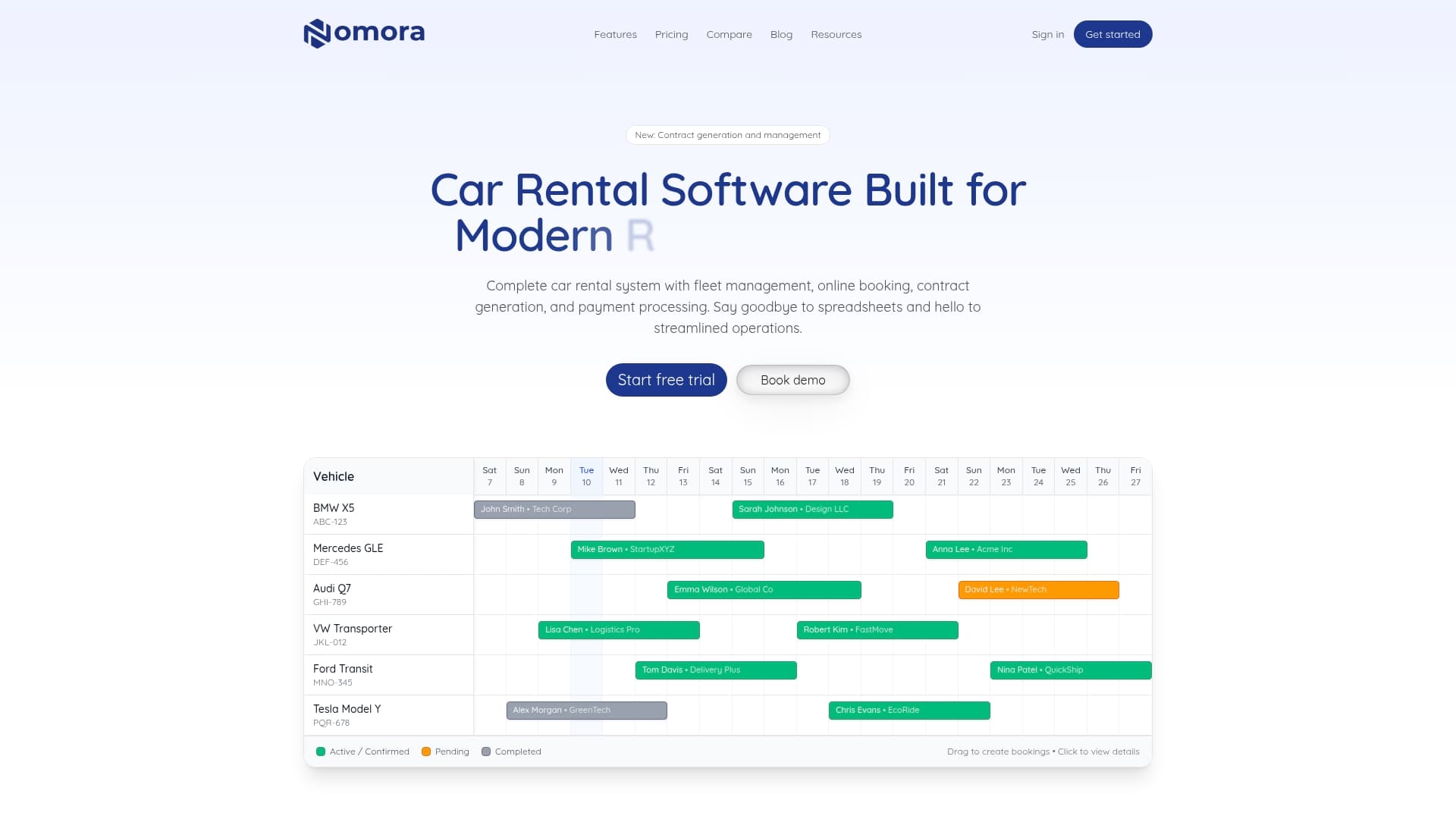
Nomora is a cloud-based car rental management platform built specifically for rental operators who need more than a basic booking calendar. The platform covers car rental software use cases from conflict-free reservations and automated contract generation to fleet management solutions with real-time GPS tracking. Automated payment solutions reduce manual processing time and improve cash flow visibility. Setup takes 24 to 48 hours, so you are not losing weeks to onboarding. For franchise operators who want tighter control over their day-to-day numbers, Nomora fills the gaps that franchisor platforms often leave open.
Frequently asked questions
What is the typical cost to start a franchise vehicle rental business?
Startup costs range from $165,000 to $15.8 million depending on fleet size, brand, and location. Fleet acquisition is almost always the largest single expense.
How do franchise royalties and fees impact profitability?
Royalties of 4 to 8% combined with marketing fees of 2 to 4% can consume up to 12% of gross revenue, making tight cost management essential from day one.
What software features help SMEs manage franchise vehicle rentals?
Franchisor technology typically covers reservations, fleet tracking, and customer management, but third-party integrations for payments and GPS often add critical functionality.
Is it safer to operate a franchise location versus an independent car rental?
Yes. Franchises show a 92% year-one survival rate and 85 to 93% after five years, compared to just 62% for independent operators in year one.
Recommended
Ready to streamline your car rental business?
Book 30 minutes with the founder. We set up everything in this guide on your own vehicles, and migrate you out of Excel for free.