Key Takeaways
| Point | Details |
|---|
| Preventive schedules pay off | Regularly scheduled maintenance reduces costs and avoids breakdowns in rental fleets. |
| Digital tools boost efficiency | Implementing CMMS and telematics saves time, improves data accuracy, and drives smarter decisions. |
| Standardization is scalable | Using fixed checklists and inspection routines means even small teams can operate at high standards. |
| Continuous improvement matters | Tracking KPIs lets you spot trends and optimize for more uptime and lower costs over time. |
What is fleet maintenance management?
Fleet maintenance management is the system of processes, workflows, and tools that keeps every vehicle in your rental fleet roadworthy, legally compliant, and available for booking. It is not simply scheduling oil changes. Think of it as the central nervous system of your rental operation, connecting every decision about vehicle care to your bottom line.
A common misconception is that maintenance management is only relevant for large fleets with dedicated mechanics. In reality, even a 10 to 20 vehicle operation benefits enormously from a structured approach. Without it, small issues accumulate into costly repairs, inspection failures, or vehicles sitting off the road when demand is at its highest.
The primary goals of fleet maintenance management are clear:
- Minimize downtime by catching issues before they ground a vehicle
- Improve safety through regular inspections and documented compliance
- Control costs by shifting from reactive repairs to scheduled, lower-cost work
- Extend vehicle life so that your asset investment goes further
You can read more about the bigger picture in fleet management explained and in the vehicle fleet management guide for rental companies.
Key insight: The most effective fleet maintenance programs are not about spending more money. They are about spending the right amount at the right time, before a breakdown forces your hand.
The core methodologies behind a well-run program include preventive maintenance using OEM schedules, driver vehicle inspection reports (DVIRs), work order workflows, parts inventory with reorder points, and vendor tracking. Each of these components plays a specific role, and together they form a system that scales from a small independent operator to a regional franchise network.
The foundation: Preventive maintenance and inspection routines
Preventive maintenance (PM) is the cornerstone of any efficient fleet operation. The basic idea is straightforward: service vehicles on a predictable schedule so that wear and potential failures are addressed before they become expensive problems. But the execution varies significantly depending on vehicle type.
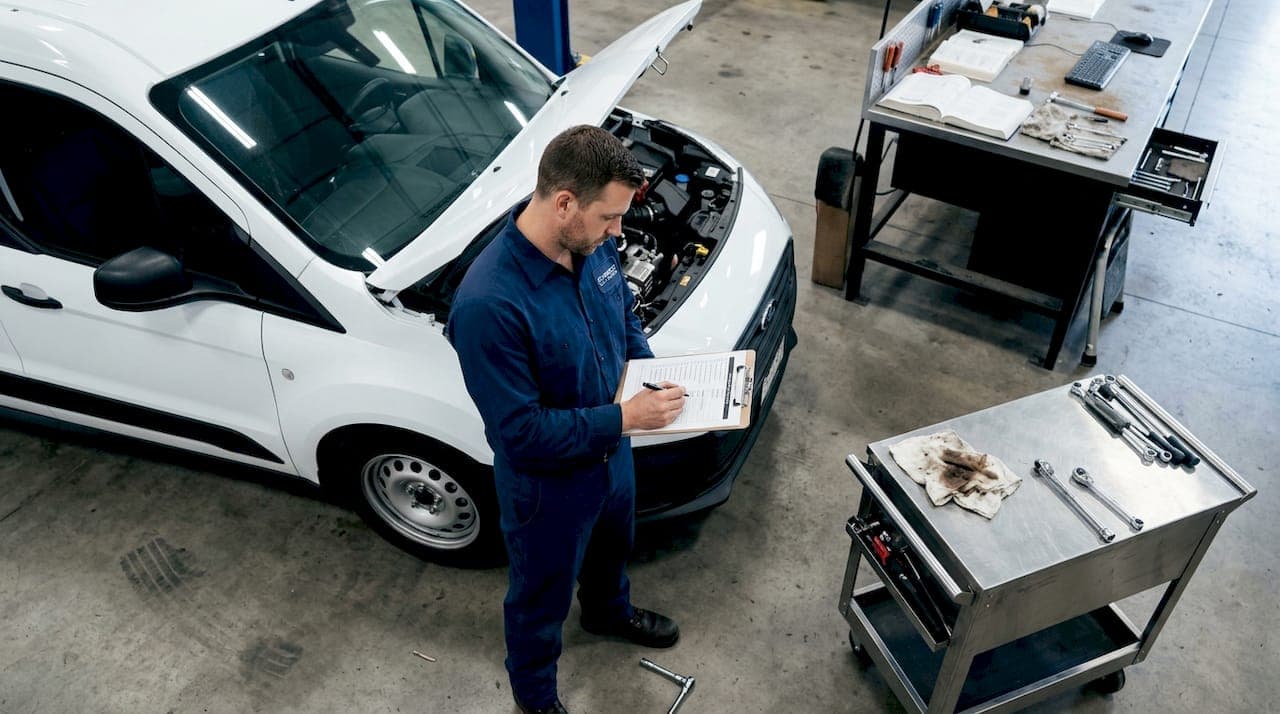
Rental fleets today are rarely uniform. You may operate standard passenger cars, light trucks, cargo vans, or even electric vehicles (EVs). Each category demands a distinct PM routine.
A practical PM schedule looks like this:
- Passenger cars: Oil changes every 5,000 to 7,000 miles, tire rotations every 5,000 miles, brake inspection every 15,000 miles, cabin and engine air filters annually or every 15,000 to 20,000 miles.
- Light trucks and vans: More frequent oil changes (every 3,000 to 5,000 miles under heavy use), transmission fluid checks every 30,000 miles, and load-bearing component inspection at regular intervals.
- Heavy equipment: Maintenance based on operating hours rather than mileage: 250-hour, 500-hour, and 1,000-hour service intervals are standard practice.
- Electric vehicles: Battery health checks every 6 months or every 6,000 miles, brake fluid monitoring (regen braking affects fluid differently), software update checks, and cooling system inspections.
Using a detailed rental vehicle checklist ensures nothing gets missed between rentals and during scheduled service appointments.
Pro Tip: Create separate PM checklists for each vehicle category in your fleet. A one-size-fits-all checklist leads to missed EV-specific checks or unnecessary services on vehicles that don't require them, both of which waste time and money.
Beyond scheduled service, Driver Vehicle Inspection Reports (DVIRs) are one of the highest-value habits you can build into your operation. A DVIR is a structured inspection completed by the driver or rental agent before and after each rental. It covers brakes, lights, fluids, tire pressure, exterior damage, and general safety indicators. The goal is to catch anything that changes between services.
Digital DVIRs take this further. When inspections are completed on a tablet or smartphone and logged to a central system, you get a timestamped record of every issue reported, who reported it, and when it was resolved. This protects you legally, improves accountability, and creates data that informs your next maintenance cycle.
According to industry data, standard PM intervals for EVs include battery checks every six months or 6,000 miles, making consistent digital tracking not just helpful but essential as EV fleets grow.
Building an efficient fleet maintenance program: Tools and workflows
Understanding what needs to be done is only half the challenge. The other half is building the workflows and selecting the tools that make execution consistent at scale. This is where many small and medium rental companies fall short.
A maintenance checklist tells you what to do. A maintenance program tells you who does it, when, how it is documented, what parts are needed, and what happens when something goes wrong. The difference between these two things is the difference between occasional success and reliable operational efficiency.
Here is how the most effective programs are structured, compared to the typical reactive approach:
| Approach | PM compliance rate | Average repair cost per incident | Annual downtime per vehicle |
|---|
| Reactive (fix when broken) | Below 50% | High, often $800 to $2,000+ | 12 to 18 days |
| Scheduled PM only | 60 to 75% | Moderate, $300 to $700 | 6 to 10 days |
| PM + digital tools + telematics | 90%+ | Low, $150 to $400 | 2 to 4 days |
The numbers above reflect why digital transformation in fleet maintenance is not a luxury. It is a competitive requirement.
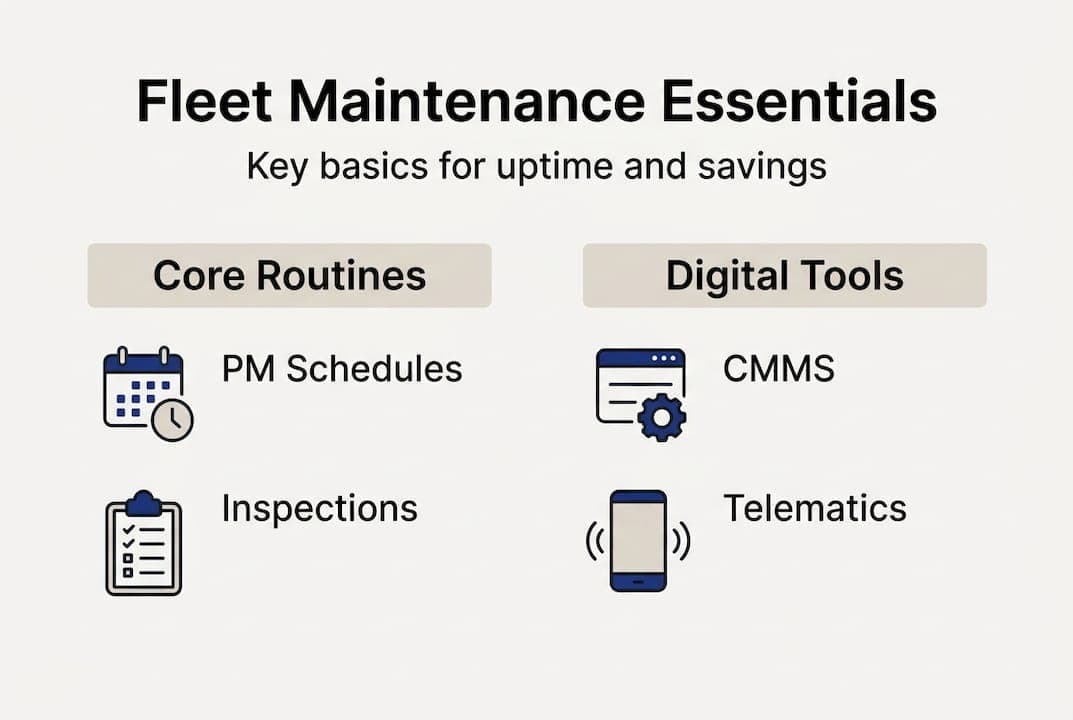
Computerized Maintenance Management Systems (CMMS) are the software backbone of a modern fleet maintenance program. A CMMS lets you schedule and track all PM tasks, generate and close work orders, manage parts inventory with automatic reorder triggers, and log vendor relationships and costs. The result is a single source of truth for every maintenance decision.
Telematics adds another dimension. By integrating GPS and vehicle diagnostic data, telematics platforms detect early warning signs such as unusual engine temperatures, brake wear indicators, or battery degradation before a driver notices anything is wrong. Telematics for predictive maintenance on high-value assets can cut maintenance costs by 20 to 30 percent and significantly improve uptime.
Work order workflows and parts inventory management with reorder points are considered best-practice methodologies for a reason. When a technician identifies a worn brake pad during a DVIR, a properly designed workflow immediately generates a work order, checks parts availability, and schedules the repair before that vehicle leaves the lot again.
Key benefits of adopting digital tools and structured workflows include:
- Reduced human error in scheduling and documentation
- Faster turnaround times because parts and labor are pre-planned
- Cost visibility through centralized reporting on spend by vehicle, service type, and vendor
- Audit-ready records that protect you during insurance claims or liability disputes
- Scalability so that adding five more vehicles does not mean five more spreadsheets
Pro Tip: When evaluating a CMMS or fleet management platform, prioritize systems that offer API integrations with telematics providers and payment tools. Disconnected systems mean manual data entry, which reintroduces the errors you were trying to eliminate.
For rental operators, tools that connect inventory management for rentals with maintenance scheduling create a powerful feedback loop. When a vehicle is flagged for service, it can be automatically marked as unavailable for booking, preventing customer-facing conflicts and protecting your reputation. Investing in fleet reporting in car rental also helps you visualize trends across your entire fleet and make smarter decisions about when to retire aging vehicles.
Key metrics and strategies for continuous improvement
Setting up a maintenance program is not a one-time project. The operators who consistently outperform their competitors are the ones who treat maintenance as a living system, reviewing performance data regularly and adjusting accordingly.
To do this effectively, you need to measure the right things. The most valuable fleet maintenance KPIs for rental companies are:
- Downtime percentage: The proportion of time each vehicle is off the road due to maintenance or repair. Target below 5 percent for a well-run fleet.
- PM compliance rate: The percentage of scheduled maintenance tasks completed on time. Best-in-class fleets achieve 90 percent or higher.
- Cost per mile: Total maintenance spend divided by total miles driven. Tracking this over time reveals whether your program is becoming more or less efficient.
- Inspection pass rate: The percentage of vehicles that pass pre-rental inspections without requiring corrective action. A declining pass rate signals a systemic issue.
- Mean time between failures (MTBF): How long, on average, a vehicle operates between unplanned breakdowns. A rising MTBF means your PM program is working.
Centralizing data for KPIs is essential for accurately assessing productivity and efficiency across your fleet. Without a centralized view, you are making decisions based on incomplete information.
Here is a comparison of what maintenance performance typically looks like before and after implementing a structured digital approach:
| KPI | Before digital tools | After digital tools |
|---|
| PM compliance rate | 55% | 91% |
| Average cost per repair | $780 | $320 |
| Annual downtime per vehicle | 14 days | 3.5 days |
| Inspection pass rate | 68% | 94% |
| Parts inventory waste | High | Minimal (reorder automation) |
These shifts are not hypothetical. They reflect what happens when fleet managers move from reactive maintenance to a data-driven, continuous improvement model.
The improvement cycle follows a simple but disciplined rhythm. Review your KPIs monthly. Identify the two or three metrics most out of line with your targets. Trace root causes, whether that is a specific vehicle model, a particular vendor, or a gap in your inspection process. Apply a targeted fix. Then measure again the following month. Over 12 months, this process compounds into significant cost savings and a more reliable fleet.
Exploring fleet management best practices gives you a broader framework for tying maintenance performance to overall fleet utilization and profitability goals.
Our perspective: What really sets top rental fleets apart
Here is something most operational guides won't tell you: the majority of rental companies that invest in better software still don't see the results they expected. The technology was fine. The program design was fine. The problem was execution, and more specifically, the gap between what the system was supposed to do and what the team actually did every day.
The fleets that genuinely pull ahead are not running the most expensive CMMS or using the newest telematics hardware. They are the ones that have turned maintenance habits into muscle memory for every person who touches a vehicle. That means front-line staff completing DVIRs thoroughly every single time, not just when a manager is watching. It means a supervisor reviewing the weekly maintenance report on Tuesday morning, not when something breaks.
There is a popular belief in fleet operations that once you build a good system, it mostly runs itself. That belief is why so many programs degrade within 18 months of launch. Systems require ongoing feedback loops. A CMMS that nobody checks, a checklist that gets skimmed, or a telematics alert that goes unacknowledged for three days is worse than no system at all, because it creates a false sense of control.
The operators who consistently outperform, as seen across discussions of real-world best practices, share a specific trait: they invest as much in training and team accountability as they do in technology. They conduct brief weekly reviews of maintenance flags. They recognize staff who identify problems early. They treat a DVIR catch as a win, not a nuisance.
This is the uncomfortable truth about fleet maintenance management. The strategy is not complicated. The tools are widely available. What separates average operations from excellent ones is the daily discipline to follow through on the basics, consistently, across every vehicle and every rental cycle.
Next steps: Simplify and streamline your fleet maintenance
Managing a rental fleet at the standard this guide describes requires more than good intentions. It requires a connected platform that brings together scheduling, inspection records, maintenance tracking, and real-time fleet visibility in one place.
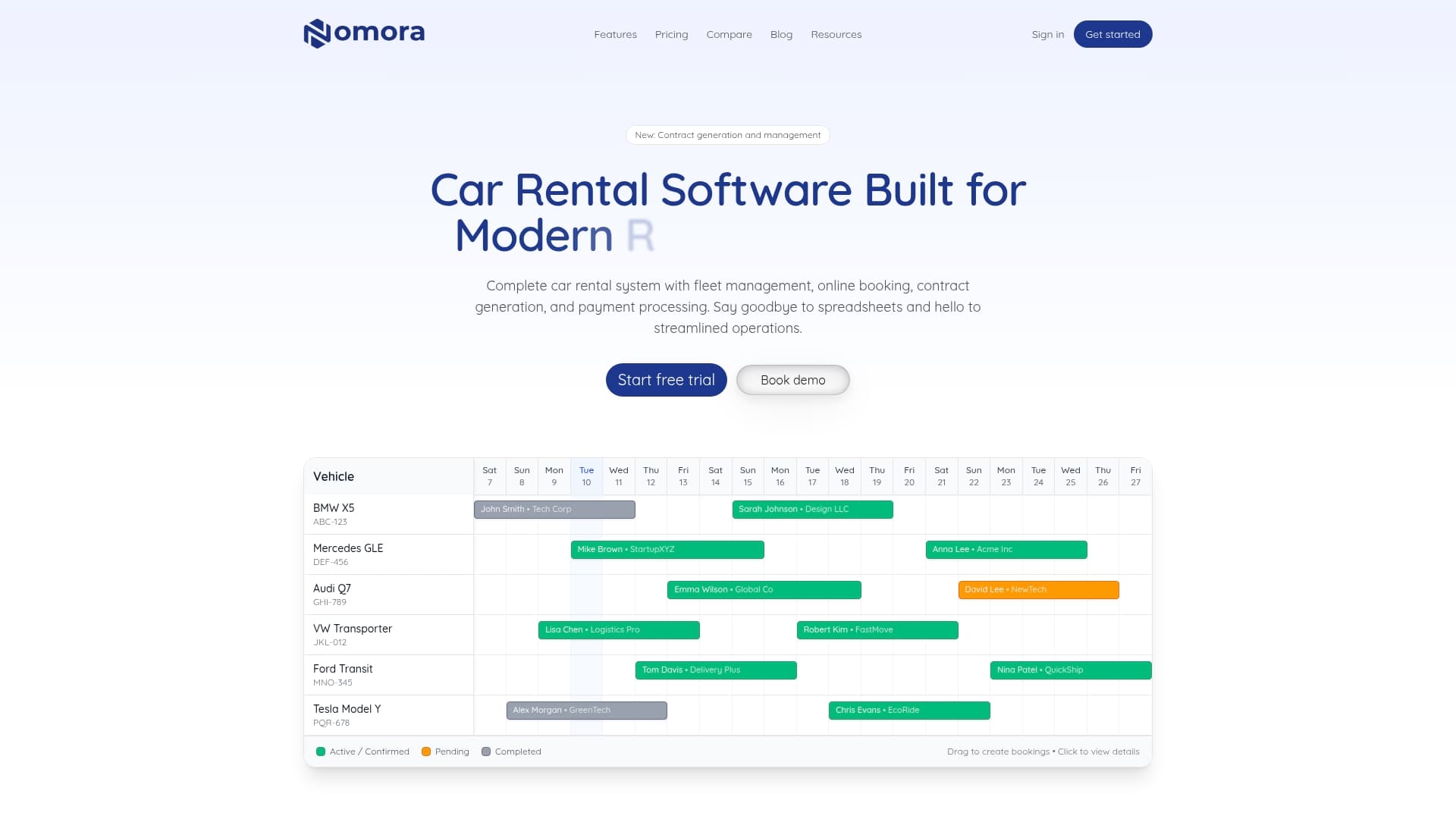
Nomora is built specifically for rental operators who want to replace scattered spreadsheets and manual processes with a single cloud-based system. Explore the Nomora use cases to see how fleet managers across different rental business types use the platform to automate maintenance workflows, reduce downtime, and protect margins. You can also see how Nomora handles operational challenges like preventing double bookings and managing automated car rental payments, keeping every part of your operation running without unnecessary friction. Setup takes 24 to 48 hours, so the path from where you are now to a more efficient operation is shorter than you might think.
Frequently asked questions
What is the difference between preventive and predictive maintenance?
Preventive maintenance follows a fixed schedule based on time or mileage, while predictive maintenance uses telematics and vehicle data to determine the exact moment service is needed. Predictive approaches can cut maintenance costs by 20 to 30 percent by avoiding both premature and delayed service.
How often should rental vehicles get basic maintenance?
Rental cars should receive oil changes every 5,000 to 7,000 miles and tire rotations every 5,000 miles. EVs require battery checks every six months or 6,000 miles, making consistent digital tracking especially important as electric vehicles become more common in rental fleets.
What does a Driver Vehicle Inspection Report (DVIR) include?
A DVIR typically covers brakes, lights, fluid levels, tire condition, exterior damage, and general safety indicators. DVIRs are a core methodology for improving fleet safety and creating a documented record of vehicle condition before and after each rental.
How can technology save costs in fleet maintenance?
Tools like telematics and CMMS platforms centralize maintenance data and automate scheduling, reducing both repair costs and vehicle downtime. The combination of real-time diagnostics and structured work order workflows removes the guesswork and delays that make reactive maintenance so expensive.
Recommended