Key Takeaways
| Point | Details |
|---|
| Dynamic pricing defined | It’s a flexible system that regularly adjusts rental rates to match demand and market shifts. |
| Proven profit growth | Data shows dynamic pricing can boost revenue by over 30% for small to medium-sized fleets. |
| Method options | Operators can choose rules-based, occupancy-based, or advanced AI-driven models. |
| Risk management | Guardrails and transparent communication help prevent customer backlash and protect brand trust. |
| Actionable adoption steps | Assess data, choose technology, and iterate with A/B tests to master dynamic pricing. |
Understanding dynamic pricing in car rentals
Dynamic pricing is a revenue management strategy where rental rates change automatically or semi-automatically in response to market conditions rather than following a fixed schedule. In the car rental context, those conditions include booking lead time, local demand spikes, fleet occupancy levels, and competitor rates in the same market.
The core purpose is straightforward: a car sitting idle overnight is revenue you can never recover. Because rental inventory is perishable, pricing must reflect real-time supply and demand rather than last month's spreadsheet. Operators who boost car rental profitability consistently do so by treating pricing as an active lever, not a passive label.
Several distinct dynamic pricing frameworks exist, and understanding them helps you choose the right fit for your operation:
- Rules-based pricing: Simple if/then triggers. If occupancy exceeds 75%, raise rates by 10%. Fast to set up, but limited in nuance.
- Demand-based pricing: Rates track historical booking patterns and forward demand curves. Useful for predictable seasonal businesses.
- Occupancy-based pricing: Rates respond directly to real-time fleet fill rates rather than forecasts alone.
- Competitive-based pricing: Rates adjust when competitor prices move, keeping your offer relevant in the market.
- AI and machine learning models: Algorithmic systems that process dozens of variables simultaneously and update pricing on a schedule that no human team could match manually.
According to research on pricing methodologies, these approaches span demand-based, occupancy-based, competitive-based, and AI-driven algorithmic optimization, and most mature operations combine more than one.
A common misconception is that dynamic pricing is predatory. In reality, it is the same principle airlines and hotels have practiced for decades. You are not gouging customers; you are matching the price of a time-sensitive asset to the value the market places on it at that moment.
"Pricing a perishable asset at a static rate is not customer-friendly; it is just imprecise. Dynamic pricing done well benefits both the business and the customer who books at the right time."
Core methodologies: How dynamic pricing works
With a foundation set, it is crucial to see how dynamic pricing gets implemented day-to-day. The methodology you choose shapes everything from your technology requirements to your staff training needs.
AI and ML-driven systems represent the most sophisticated end of the spectrum. These algorithms can analyze 50-200+ variables and update pricing every 15 to 60 minutes, reacting to signals like a local concert announcement, a sudden weather shift, or a competitor pulling inventory offline.

| Methodology | Update Frequency | Key Input Data | Best Fit For |
|---|
| Rules-based | Manual or scheduled | Occupancy thresholds | Small fleets, simple markets |
| Demand-based | Daily or weekly | Historical bookings, seasons | Seasonal businesses |
| Competitive-based | Hourly or daily | Competitor rate feeds | Price-sensitive urban markets |
| AI/ML algorithmic | Every 15-60 minutes | 50-200+ variables | Mid-to-large fleets, complex markets |
Here is a realistic sequence for implementing demand-based pricing at an operator with 20 to 80 vehicles:
- Collect baseline data. Pull 12 months of booking history, including lead times, cancellation rates, and peak versus slow periods.
- Define occupancy bands. Set thresholds, for example 60%, 75%, and 90% fleet fill, where pricing rules trigger automatically.
- Build pricing rules around triggers. Local events, school holidays, and weekend surges are the first candidates.
- Integrate competitive data. Monitor at least two to three direct competitors in your core market, either manually or via a rate-shopping tool.
- Implement guardrails. Cap maximum rate increases at a defined percentage to prevent runaway prices that damage trust. Expert guidance on vehicle rental pricing strategies consistently emphasizes that guardrails protect brand equity as much as they protect customers.
- Review and calibrate weekly. No model is accurate on day one. Treat the first 60 days as a pilot, not a permanent configuration.
The Strategy pattern in software engineering refers to building your pricing engine so different algorithms can be swapped in or out without rewriting the whole system. For operators evaluating rental software, this means looking for platforms that let you adjust pricing logic without calling a developer every time.
Pro Tip: Start with occupancy-based rules before adding AI layers. Simple triggers teach your team how dynamic pricing behaves and build internal confidence before complexity increases.
Quantifying the upside: Revenue and utilization gains
Understanding the mechanics is powerful. Seeing real-world business impact is even more convincing.
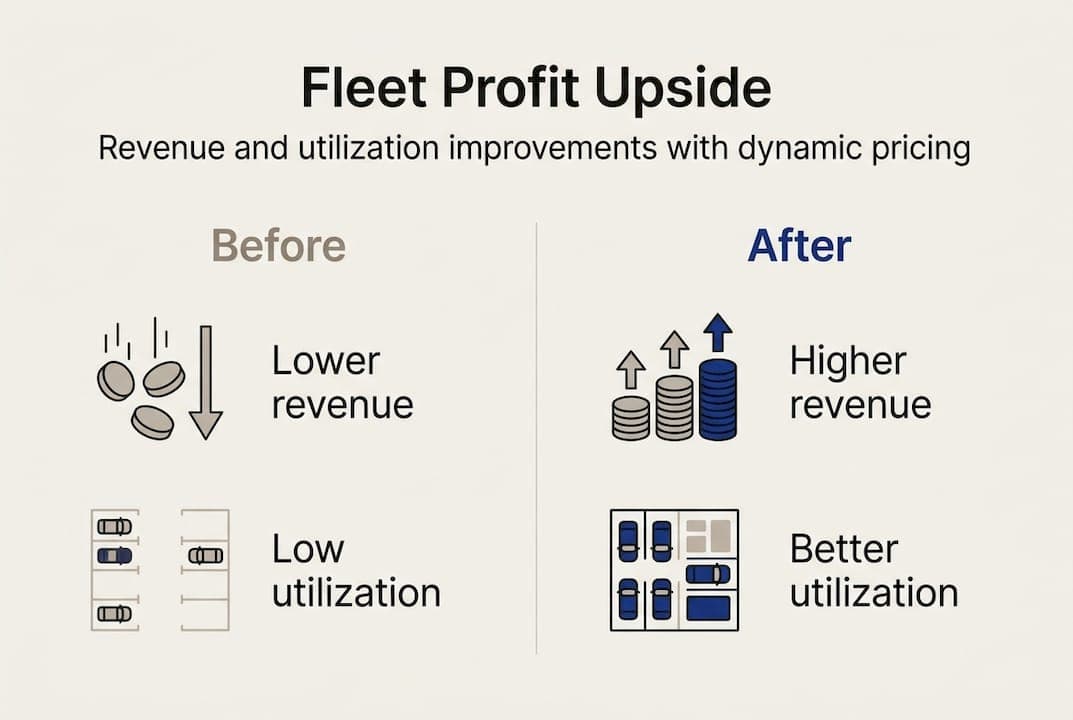
The benchmark data is compelling. Operators adopting AI-driven dynamic pricing have recorded 20-35% revenue growth, 15-25% improvement in fleet utilization, and 12-18% profit margin growth within the first year. A 50-vehicle fleet in one documented case generated an additional $540,000 in annual revenue after implementing a structured dynamic pricing program.
| Metric | Pre-Dynamic Pricing | Post-Dynamic Pricing | Typical Improvement |
|---|
| Annual revenue growth | Baseline | +20-35% | High impact |
| Fleet utilization rate | 55-65% | 75-85% | 15-25 percentage points |
| Profit margin | Baseline | +12-18% | Significant |
| Daily rate accuracy | Low | High | Ongoing |
For context on utilization targets, Enterprise adjusts rates 27 times per day on average, and industry utilization targets typically sit between 65% and 85%. If your fleet consistently runs below 65%, you are pricing too high or not surfacing availability effectively. Above 90%, you risk disappointing customers and damaging repeat bookings.
Key metrics to track before and after implementation:
- Revenue per available vehicle per day (RevPAV): Your clearest measure of pricing efficiency
- Fleet utilization rate: Total rented days divided by total available vehicle days
- Average daily rate (ADR): Tracks whether pricing changes are actually moving in the right direction
- Booking lead time distribution: Reveals whether customers are shifting to last-minute or advance bookings in response to your prices
Even modest improvements matter at scale. A 5% utilization gain across a 40-vehicle fleet adds meaningful revenue over 12 months. Robust car rental revenue management practice starts with measuring these baselines before any pricing change goes live, so you have a clean comparison. Operators who review rental pricing optimization data monthly consistently outperform those who set rates quarterly.
Risks, edge cases, and customer perception
Profit is essential, but not at the expense of reputation or regulatory trouble. Dynamic pricing carries real risks that every operator should understand before going live.
The most cited failure mode is customer alienation. When a customer sees the same car listed at three different prices within a 24-hour window and feels no explanation was offered, trust erodes fast. Research on pricing customer perception confirms that unmanaged volatility can backfire, leading to negative reviews and lost repeat business.
Overbooking is another critical edge case. Many operators intentionally overbook by 5-10% to offset no-shows, a practice that works statistically until it does not. Overbooking and weather or event spikes require careful management, especially for smaller fleets where one unexpected cluster of arrivals can strand multiple customers simultaneously.
Key risks to plan for:
- Event-driven price spikes: Local festivals, sports events, and conferences create sudden demand that can push prices to levels customers find shocking if no cap is in place
- Luxury and specialty vehicles: These segments require special handling because the customer base is less price-elastic and more brand-sensitive. Detailed guidance on luxury vehicle rental pricing underlines that rate volatility on premium vehicles damages perceived exclusivity
- Weather-triggered surges: A major storm can spike demand for SUVs or AWD vehicles. Without guardrails, prices can jump in ways that feel exploitative
- Regulatory exposure: Some jurisdictions are beginning to scrutinize algorithmic pricing in consumer markets, so document your pricing logic clearly
Solid fleet management strategies create the operational discipline that makes dynamic pricing sustainable rather than chaotic.
"Transparency is not a weakness in pricing strategy. Customers who understand why rates fluctuate are far more likely to accept them than customers who feel surprised."
Pro Tip: Always A/B test pricing rules on a subset of your fleet before rolling them out fleet-wide. Communicate any policy changes clearly in your booking flow to reduce friction and complaints.
Turning insight into action: Steps for successful dynamic pricing adoption
After covering the hazards, you are ready to apply best practices for a smooth and effective transition. Here is a practical roadmap built for operators at the small to mid-sized level.
- Audit your current pricing approach. Document every rate card, seasonal rule, and discount policy you currently use. You cannot improve what you have not mapped.
- Assess your data infrastructure. Do you have at least 12 months of clean booking data? If your rental data analytics are limited, collecting that baseline is your first priority.
- Choose software with dynamic pricing support. Evaluate platforms on their ability to automate rate adjustments, integrate competitive data, and apply guardrails without requiring custom code for every change.
- Set clear KPIs before launch. Define target RevPAV, utilization rate, and customer satisfaction scores upfront, so success has a measurable definition from day one.
- Run a pilot on 20-30% of your fleet. Test your pricing rules on a controlled segment before expanding. This limits downside and generates real data for calibration.
- Apply the Strategy pattern principle. Structure your pricing setup so you can swap methodologies as you learn, moving from rules-based to AI-driven without rebuilding from scratch. Guardrails and flexible implementation are what separate responsible dynamic pricing from chaotic experimentation.
- Review demand drivers monthly. Seasons shift, local competitors enter or exit, and customer behavior evolves. Static rules in a dynamic system produce stale results.
Connecting your pricing engine to a well-managed car rental fleet management system ensures that rate decisions are always grounded in accurate real-time availability data.
Pro Tip: Track your booking lead time distribution each month. A shortening lead time often signals that your prices are too high and customers are waiting to see if rates drop, a behavioral pattern that erodes your yield.
Our take: The uncomfortable truth about dynamic pricing in car rentals
Here is something most dynamic pricing guides will not tell you: the algorithm is the easy part. The hard part is organizational discipline and customer trust.
Many operators implement a pricing tool, watch revenue tick up for 60 days, and then stop reviewing the guardrails. Six months later, a local event triggers a price that looks absurd in a screenshot, and that screenshot ends up on social media. Even major brands navigate this tension carefully. Hertz's approach to pricing acknowledges the constant balance between squeezing perishable fleet utilization and maintaining a consistent brand experience that drives loyalty.
For smaller operators, that balance is even more consequential. You do not have the brand equity buffer of a national chain. One viral complaint about surge pricing can undo months of marketing investment. The operators who win long-term with advanced pricing strategies are the ones who treat dynamic pricing as a discipline, not a shortcut. They audit their rules regularly, communicate pricing logic transparently, and keep customer satisfaction metrics on the same dashboard as revenue numbers. Yield and trust are not opposites. Managed well, they reinforce each other.
Unlock dynamic pricing with the right technology partner
Dynamic pricing is only as effective as the platform powering it. Manual rate updates in a spreadsheet cannot match the speed or precision that real-time demand signals require.
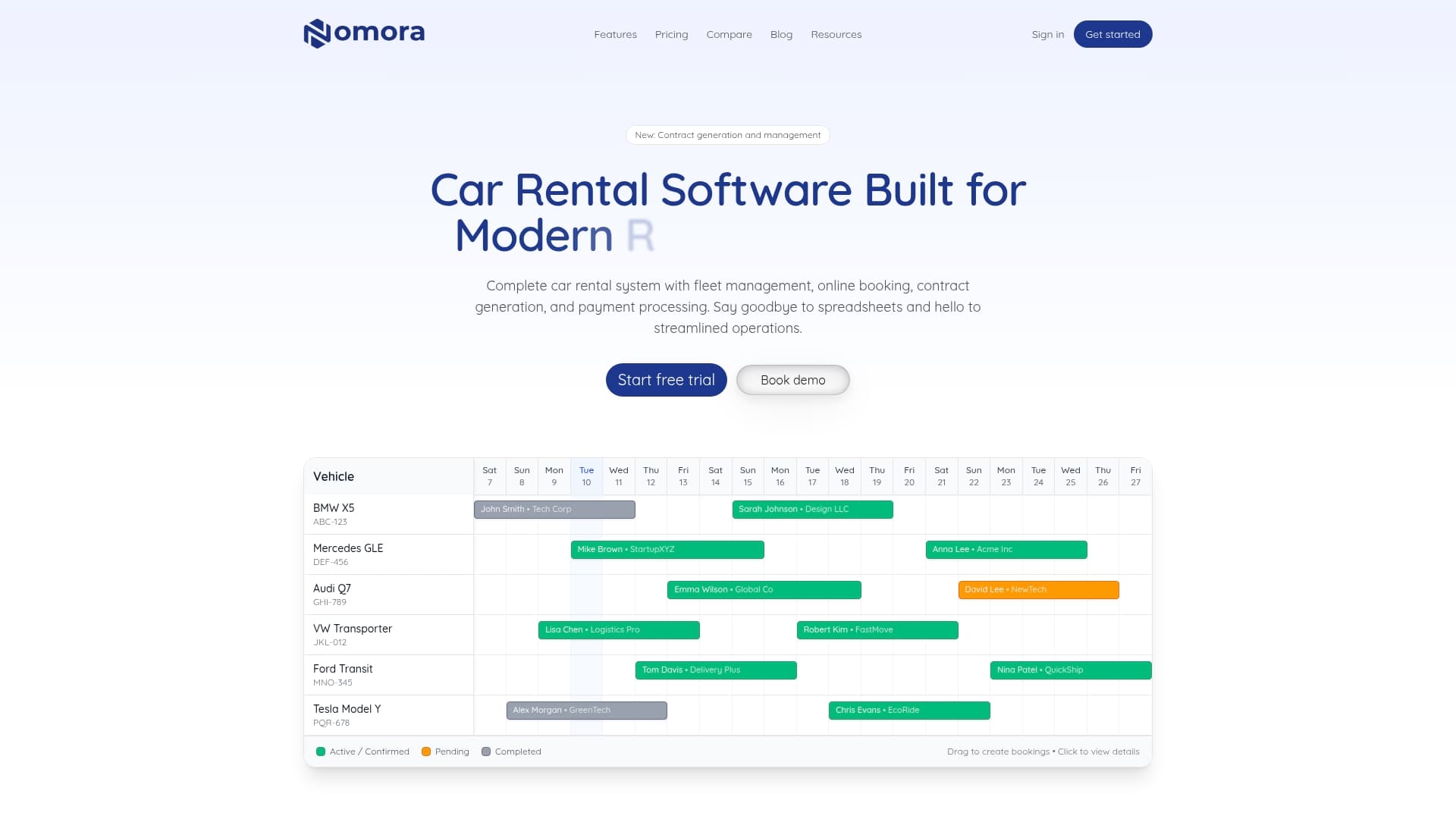
Nomora gives car rental operators the infrastructure to move from static rates to data-driven pricing with confidence. Explore car rental software use cases to see how operators like yours are automating rate management, improving utilization, and capturing revenue they previously left behind. Built-in tools help you prevent double bookings while maintaining accurate fleet availability, and automated payments for rentals eliminate the manual steps that slow your team down. From setup to scale, Nomora is built to grow with your operation.
Frequently asked questions
What is dynamic pricing in car rental?
Dynamic pricing in car rental is a strategy that automatically adjusts rental rates in real time based on demand, availability, and competitive market conditions to optimize revenue and fleet utilization.
How much more revenue can dynamic pricing generate?
Empirical benchmarks show dynamic pricing delivers a 20-35% revenue increase and up to 18% profit margin growth in the first year of adoption for car rental operators.
What are the risks of dynamic pricing for car rental businesses?
The primary risks include customer alienation from perceived unfairness, unmanaged price volatility during demand spikes, and operational errors in overbooking or luxury vehicle management.
How do top car rental brands manage overbooking and volatility?
Leading operators use AI-driven no-show estimates, implement rate guardrails, and cap surge pricing during local events to limit volatility while maintaining customer trust.
What first steps should a car rental operator take to adopt dynamic pricing?
Begin by auditing your current pricing, collecting at least 12 months of booking data, and piloting demand-based software on a portion of your fleet with clearly defined performance metrics before full deployment.
Recommended