If a rental company has flagged your account, the fix usually starts with one phone call. A do not rent list is a private blacklist a company keeps internally, not a government record, so your first move is to confirm the flag with that specific company, settle any money you owe, and get written proof once it's cleared. Bans tied to unpaid balances or damage disputes are often reversible. Bans tied to threats, aggression, or fraud usually are not.
TL;DR:
- Most flags related to unpaid charges or billing disputes are reversible once payments are settled and documentation is provided; behavioral or criminal flags are typically permanent.
- Contacting the specific company directly and requesting written confirmation is the only reliable way to verify or contest your DNR status; no public database exists.
- Resolving a flag involves paying outstanding balances, gathering evidence, and requesting a formal review, which can take from weeks to several months depending on the issue.
- Rental blacklisting often extends across all brands within a company's portfolio due to shared internal databases, making workarounds like using fake profiles ineffective.
- Maintaining detailed records from the start, such as photos, receipts, and clear contract adherence, significantly reduces the risk of ending up on a DNR list.
Table of Contents
What Is a Do Not Rent (DNR) List and Who Uses One?
A do not rent list, often shortened to DNR, is a private database a company keeps to flag customers it won't do business with again. Car rental companies use them most visibly, but the practice extends into hospitality and, in a looser form, some residential landlords who track problem tenants informally or through screening vendors. These are proprietary records, not public files, and companies generally aren't required to notify you when you land on one, according to LegalClarity's breakdown of DNR practices.
The mechanics differ depending on who's keeping the list. A single rental branch might just add a note to your customer profile after a dispute. A large national brand runs something closer to a shared internal database that every location and every sister brand can see. Independent operators, meanwhile, often lack the infrastructure to build their own system, so many rely on third-party services instead.
- Internal corporate lists: Maintained by one company across all its locations and often its owned brands.
- Third-party operator databases: Services like Donotrent let independent rental businesses log verified incidents and check new customers against a shared risk pool.
- Informal landlord networks: Property managers sometimes share notes about problem tenants, though this is far less standardized than car rental blacklisting.
There's no single public lookup tool that covers all of this, and that absence is deliberate. Companies treat these lists as proprietary risk management data, similar to how a store might track shoplifting suspects internally rather than publishing a public registry. For you as a renter, it means the only reliable way to check your status is to ask the specific company directly. No aggregator site, no government portal, and no universal search will tell you.
Why Do People End Up on a Rental Blacklist?
Most DNR flags trace back to one of four categories, and they don't carry equal weight when it comes to getting removed. Some are simple accounting problems. Others are conduct problems that companies treat as permanent risk signals.
- Unpaid charges and financial disputes. Late tolls, unpaid parking fines, disputed damage fees, or an account that went to collections are the most common triggers, and they're also the most fixable.
- Contract violations. Letting an unauthorized driver take the wheel, exceeding a geographic boundary written into the agreement, driving off-road in a vehicle rated for pavement only, or blowing past a mileage cap all count as breaches the company can act on.
- Chargebacks disputed in bad faith. Filing a credit card dispute on a legitimate charge, rather than resolving it directly with the company, is one of the fastest ways to escalate a billing disagreement into a permanent flag, according to The Points Guy's reporting on rental bans.
- Behavioral and safety incidents. Threatening staff, showing up intoxicated, presenting fraudulent identification, or causing a safety incident sits in a different category entirely. These are the flags companies rarely reverse.
- Serious criminal conduct. Theft, extensive fraud, or incidents involving law enforcement tend to produce bans that last indefinitely, sometimes described by companies themselves as permanent.
If you're trying to figure out why you were flagged, work down that list in order. Financial issues are usually a paperwork problem. Behavioral issues are a trust problem, and trust is much harder to rebuild with a company that has no obligation to give you a second look.
How Do You Check If You're on a Do Not Rent List?
Because there's no public database, checking your status means contacting the company directly, and you'll get further faster if you come prepared. Start with customer service, but be ready to ask specifically for the risk management or DNR review department, since front-line agents often can't access that information.
Have these details ready before you call:
- Full legal name and any name variations used on past rentals
- Driver's license number and issuing state
- Approximate dates of the rental or stay in question
- Confirmation or reservation number, if you still have it
- The specific location or branch where the incident occurred
Ask the representative directly whether your account is flagged, and if so, request the reason in writing. Companies aren't obligated to explain their internal decisions, but many will provide at least a general category (unpaid balance, contract violation, and so on) once you've verified your identity, according to LegalClarity's guidance on resolving a DNR listing.
Pro Tip: Send a follow-up email summarizing what the representative told you on the phone, and ask them to confirm it in writing. Verbal confirmations disappear. Email threads don't, and they become your evidence if you need to escalate later.
If the company won't engage, or if you suspect the flag stems from a debt sent to a collections agency, you have the right to request debt validation under federal law. If you believe a landlord's informal blacklist violates fair housing protections, that's a separate track worth raising with a tenant rights attorney or your local housing authority.
How to Get Off a Do Not Rent List: A Step-by-Step Approach
Getting removed from a DNR list works best as a sequence, not a single ask. Skipping steps, or leading with anger, tends to slow things down rather than speed them up.
- Resolve any outstanding balance first. Call the billing department, confirm the exact amount owed, and pay it or negotiate a settlement. Get an itemized receipt showing a zero balance.
- Gather your evidence if you're disputing the charge. Pickup and return photos, the signed rental agreement, fuel receipts, toll statements, and any police or accident report all strengthen your case.
- Submit a calm, documented request for review. State the facts, attach your evidence, and ask specifically what would need to happen for the flag to be lifted.
- If a collections agency is involved, request debt validation before paying anything, then negotiate a settlement in writing once the debt is confirmed.
- Confirm the company has actually updated its internal records once resolved, and ask for that confirmation in writing, not just a verbal assurance.
Timelines vary widely depending on what triggered the flag. A straightforward billing dispute can be resolved within a few weeks once payment or documentation is submitted. A dispute involving a collections agency can take longer, since debt validation and settlement negotiations add steps.
Behavioral bans are a different story. Ombudsman case reporting has documented rental bans that stretch on for decades, and in at least one widely cited case, close to a century, tied to incidents companies classified as safety threats, according to the Elliott Report's investigation into rental blacklisting. If your flag falls into that category, expect the company to treat your request as a long shot rather than a formality, and prepare accordingly with an attorney if the stakes justify it.
How to Avoid Ever Landing on a DNR List
Prevention is far less painful than remediation, and most of it comes down to documentation habits you can build into every rental from the start.
- Photograph the vehicle or room at pickup and return. Capture existing dents, scratches, odometer reading, and fuel level before you drive off, and repeat the process when you bring it back. A rental vehicle inspection routine removes the ambiguity that turns into a billing dispute.
- Keep every receipt tied to the rental. Fuel, tolls, and any authorized add-on charges should have paper trails, and using your own toll transponder account, rather than the company's pay-per-use toll program, tends to be both cheaper and easier to verify later.
- Read the contract's fine print before you sign it. Mileage caps, geographic restrictions, and authorized-driver rules are spelled out clearly, and a quick read of the rental contract essentials for renters can save you from an accidental violation.
- Resolve disputes directly with the company rather than filing an immediate chargeback. Chargebacks on legitimate charges are one of the most common actions that escalates a routine disagreement into a permanent flag.
Pro Tip: Take your return photos with a timestamp visible, either through your phone's metadata or a photo that includes a clock or your phone's lock screen. Companies sometimes dispute when damage occurred, and a timestamped photo settles that argument before it starts.
Does One Ban Follow You Across Every Rental Brand?
Rental industry consolidation means a DNR flag with one company can quietly follow you to brands you've never even rented from. Many major rental corporations own multiple brands under one umbrella, and internal risk databases are often shared across that entire corporate family, according to reporting from First Quarter Finance on rental company DNR policies. A ban at one brand can block you at its sister brands without any separate incident on your part.
Trying to work around this by booking under a nickname or creating a new customer profile rarely works and can make things worse. Matching systems now cross-reference driver's license numbers, birth dates, and legal names, so an attempt to slip past a flag often reads as an aggravating factor rather than a clever workaround, based on case reporting from the Elliott Report. Independent, unaffiliated operators are the exception. A flag with one small local company typically doesn't extend beyond that single business, since there's no shared corporate database behind it.
What Rental Operators Actually Document (and Why It Matters to You)
Every dispute review comes down to whose paper trail is more complete, and operators tend to keep more detailed records than most renters expect. A typical incident file includes pickup and return photos, a written incident report from staff, timestamps for every interaction, the specific contract clause allegedly violated, and a full payment history.

Rental management platforms have made this recordkeeping far more systematic than it used to be. A system like Nomora's rental risk checklist approach ties photos, contract terms, and payment status to a single reservation record, so when a dispute comes in, staff aren't reconstructing events from memory. That structure works in your favor too, since a well-documented operator can often resolve a legitimate dispute faster than one relying on scattered notes and email chains.
If you're trying to build a case for removal, mirror that structure yourself:
- A simple timeline of what happened, in order
- Every receipt tied to the rental period
- Your own photos, with timestamps if possible
- Copies of any emails or chat logs with the company
Present it as a single, organized packet rather than a scattered series of follow-up calls. Reviewers move faster on a case they can read in five minutes than one they have to reconstruct themselves.
A Calm Approach Gets You Off the List Faster
The single biggest mistake renters make when they discover a DNR flag is treating the first phone call as a fight. Staying calm and organized doesn't just feel better. It changes the outcome, because the person reviewing your case is far more likely to advocate for you when you've made their job easy.
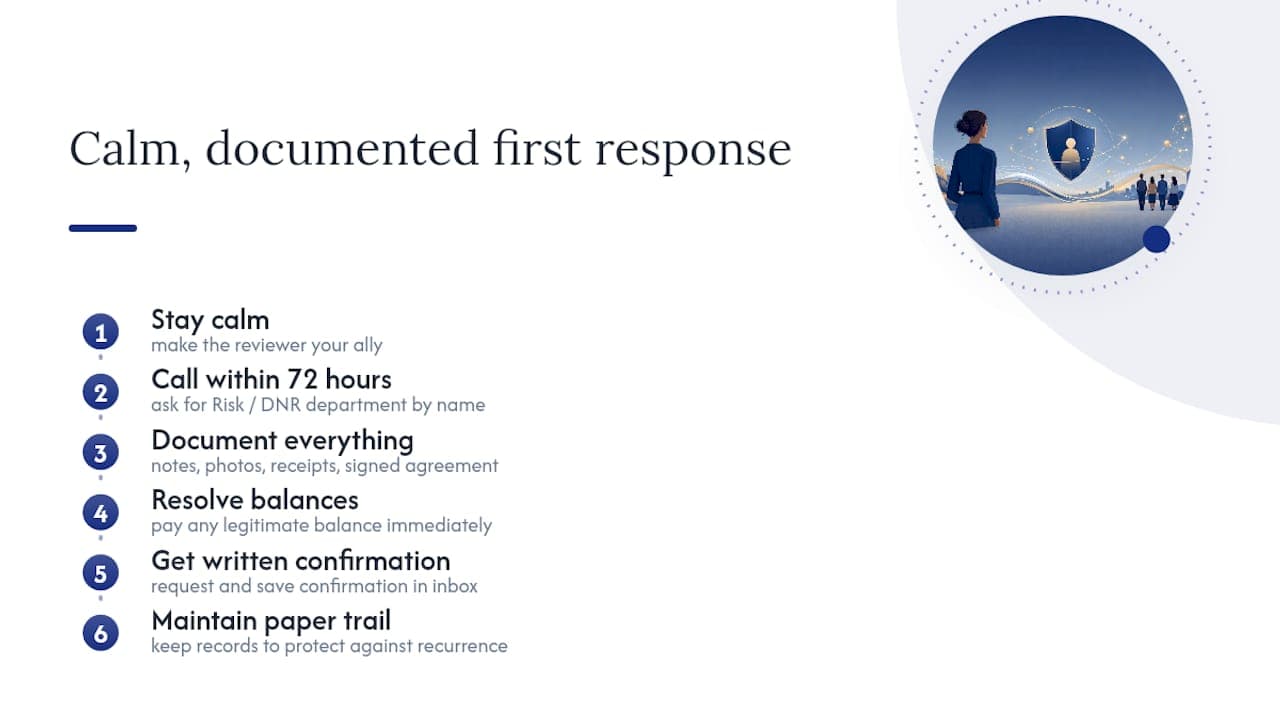
In the first 72 hours after discovering a flag, call the company and ask for the risk or DNR department by name. Document everything they tell you, submit any evidence you have (photos, receipts, the signed agreement), and pay off any legitimate balance immediately if one exists. Then ask, explicitly, for written confirmation once the matter is resolved.
Every step after that first call should leave a paper trail. Verbal promises get forgotten or denied. A written confirmation, saved in your inbox, is the only thing that protects you if the same flag resurfaces six months later.
— Dizzy
<br>
Ready to see how better recordkeeping prevents disputes before they start? Nomora's car rental software helps rental operators document every reservation, from pickup photos to payment history, in one system, reducing the ambiguity that leads to DNR disputes on both sides. If you manage a rental fleet and want to see how automated contracts and organized incident records cut down on billing disagreements, explore Nomora's use cases by business type to find the setup that fits your operation.
Recommended
Ready to streamline your car rental business?
Book 30 minutes with the founder. We set up everything in this guide on your own vehicles, and migrate you out of Excel for free.