Key Takeaways
| Point | Details |
|---|
| Definition clarified | A digital rental agreement is an electronic contract that handles all terms, signatures, and storage online. |
| Major benefits | Digital agreements speed up vehicle rentals, improve compliance, and reduce manual errors for your business. |
| Legal requirements | Legally valid electronic agreements require proper eSignatures, mutual consent, and secure storage. |
| Smooth transition path | Moving to digital can be phased in quickly using case studies, stepwise adoption, and modern contract software. |
| Mindset shift required | Real value comes from rethinking your rental process, not just digitizing old paper forms. |
Understanding digital rental agreements
With the confusion of paperwork in mind, let's clarify what a digital rental agreement actually is and how it compares to the traditional approach.
A digital rental agreement is an electronically created, signed, and stored contract that governs a vehicle rental transaction between a business and a renter. Unlike a paper contract, it exists entirely online, from the moment the document is generated to the point where both parties sign and the record is archived. This is not the same as scanning a physical form and emailing a PDF. True digital agreements are built within software platforms, linked to specific reservations, and structured to pull in renter data, vehicle details, and payment terms automatically.
As digital contracts overview research confirms, electronic contracts streamline and enhance rental procedures for automotive companies, cutting down administrative time while improving accuracy across the board.
Core components of a digital rental agreement
Every solid digital rental agreement includes the following elements:
- Renter and owner information: Full legal names, contact details, and identification references
- Vehicle details: Make, model, year, license plate, and current condition with photo documentation
- Rental terms: Start and end dates, mileage limits, permitted use zones, and late return fees
- Payment information: Agreed rental rate, deposit amount, accepted payment methods, and refund conditions
- Digital signature: A legally valid electronic signature from both the renter and the rental business representative
- Condition report: Pre-rental and post-rental vehicle condition records, often with timestamped images
Beyond simply replacing paper, a well-built digital agreement connects directly with your reservation system. That means the contract populates automatically based on the booking, and there is far less room for transcription error or missing fields.
Paper vs. digital rental agreements
| Feature | Paper agreement | Digital agreement |
|---|
| Signing method | Handwritten signature | Electronic signature |
| Storage | Physical filing cabinet | Cloud-based, searchable database |
| Access | On-site only | Anywhere, any device |
| Error risk | High (manual entry) | Low (auto-populated fields) |
| Contract retrieval | Time-intensive | Instant search and filter |
| Integration with systems | None | Syncs with reservations, payments, fleet |
| Audit trail | Paper copies, often incomplete | Automatic, timestamped logs |
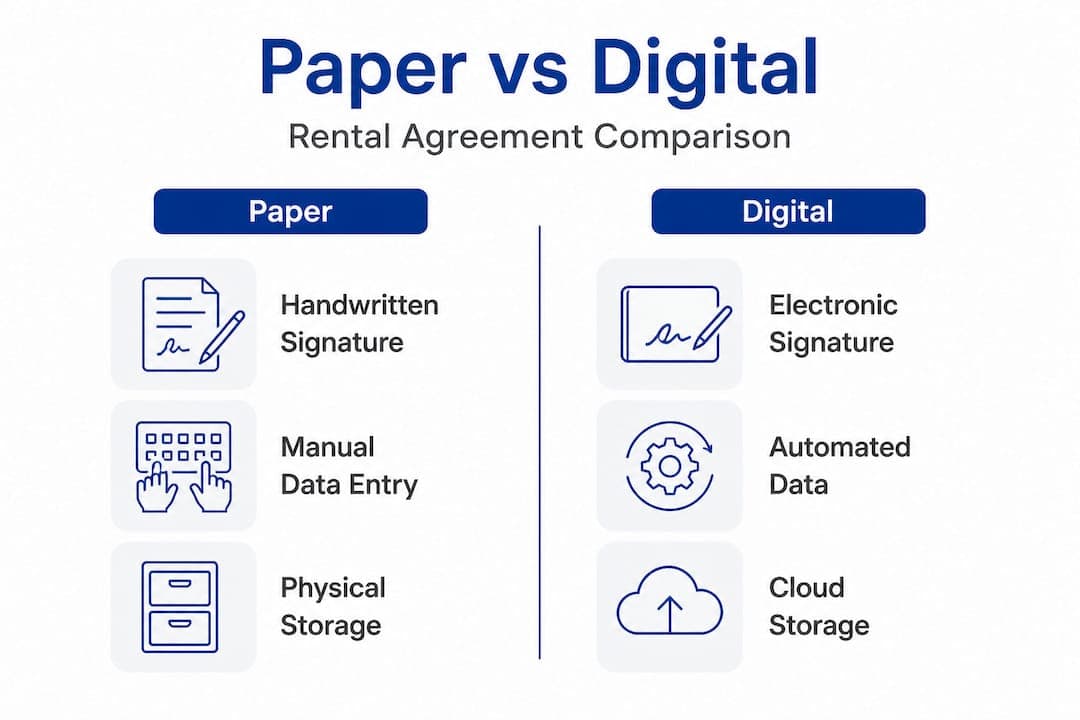
When you streamline contract process workflows this way, the shift from paper to digital is less about technology and more about removing friction from every transaction your team handles daily.
Key benefits for vehicle rental businesses
Once we understand what digital agreements are, it's vital to see why they're so transformative for modern rental businesses.
The first and most obvious benefit is speed. A customer who books online can receive their rental agreement before they even arrive at your location. Your staff doesn't spend time retyping details or chasing down physical signatures. Renewals, extensions, and amendments are just as fast because the base contract already exists in the system and only the changed fields need to be updated.

Fewer errors are another major gain. Paper processes rely on staff entering data correctly every single time. Digital systems pull directly from the booking, so the name, vehicle details, and dates are always consistent. This also reduces disputes at pickup and return because the terms are unambiguous and agreed to digitally.
Customer experience improvements
Renters expect fast, modern service. Long waits at a counter while contracts are prepared by hand creates a poor first impression. With digital agreements, you can send the contract to the renter's phone or email ahead of time, let them review and sign from home, and have a fully executed agreement ready before they walk in.
This kind of experience builds trust and encourages repeat bookings. Customers who feel the process is professional and efficient are far more likely to leave positive reviews and return.
Consider the impact on fleet utilization too. When contracts are signed faster, vehicles turn over faster. This directly affects how many rentals you process per day and how efficiently your fleet earns revenue. Businesses that boost efficiency with self-service confirm that digital contracts increase efficiency and enhance customer service, with some reporting up to a 42% efficiency improvement through digital self-service options.
Risk reduction through clear documentation
A digital audit trail is one of the most underappreciated risk management tools available to rental businesses. Every action taken on a digital agreement, including when it was sent, when it was opened, when it was signed, and by whom, is logged automatically. If a dispute arises about vehicle condition or payment terms, that trail gives you clear, timestamped evidence.
Fraud prevention is another genuine benefit. Paper contracts can be altered, forged, or "lost" by bad actors. A digital agreement tied to a verified email address, a payment method, and an electronic signature is much harder to tamper with.
Reviewing key software features available on modern rental platforms, audit-trail functionality is increasingly standard and should be a non-negotiable when you evaluate any digital agreement tool.
Pro Tip: Make your digital agreements mobile-ready. Many renters will sign on a smartphone, so ensure your agreement platform renders correctly on small screens and supports touch-based signatures. This eliminates one of the most common friction points in the digital sign-off process.
Legal, compliance, and security essentials
While the benefits are clear, you also need to be confident your digital agreements are compliant and secure.
Digital rental agreements are legally binding in most jurisdictions, provided they meet a defined set of requirements. The core conditions for enforceability are mutual consent, clear and complete contract terms, and a legally valid electronic signature. In the United States, this is governed primarily by the ESIGN Act and the Uniform Electronic Transactions Act (UETA), both of which confirm that electronic contracts carry the same legal weight as paper ones.
To stay fully protected, every digital rental agreement process should include the following:
- Compliant eSignature support: Use an eSignature provider that meets ESIGN, UETA, or eIDAS standards depending on your operating region. Not all signature tools are equal, and some may not hold up in a legal dispute.
- Secure cloud storage with access control: Contracts must be stored in an encrypted environment where only authorized personnel can access or amend records.
- Automatic audit trails: Every agreement interaction should generate a timestamped log. This includes initial send, read confirmation, signature event, and any subsequent modifications.
- Data retention policies: Understand how long your platform stores contracts and whether this aligns with your local legal requirements. Some jurisdictions require records to be kept for several years.
- GDPR and data privacy compliance: If you operate in or serve customers from regions covered by privacy regulations, your digital agreement system must handle personal data lawfully and transparently.
As detailed in contract compliance essentials, digital rental agreements have unique legal and data security considerations that rental businesses must address proactively to avoid liability.
"A digital rental agreement that lacks a compliant eSignature or a verifiable audit trail is not a contract you want to rely on in a dispute. Legal validity comes from the quality of the process, not just the format."
Security is equally important. Data breaches in the rental sector have exposed customer identity documents, payment details, and personal information. Choosing a platform with strong encryption, multi-factor authentication, and regular security audits is not optional; it is a baseline requirement.
Pro Tip: Before signing up with any eSignature or contract management provider, confirm their compliance certifications directly. Ask specifically about SOC 2 compliance, GDPR data handling, and audit-trail export capabilities. A credible vendor will provide documentation without hesitation.
Getting started: how to implement digital rental agreements
Now that you're clear on the essentials, here's how you can put digital rental agreements into action for your business.
Transitioning from paper or even a hybrid process does not need to be overwhelming. Most businesses can complete the initial move in a matter of days, not weeks, especially when working with a purpose-built rental management platform.
Adoption roadmap
- Choose a platform designed for vehicle rentals: Generic document tools are not sufficient. You need a system that integrates contract generation with reservations, payments, and fleet tracking. This is the foundation everything else is built on.
- Digitize your existing contract templates: Take your current paper agreements and rebuild them as digital templates in the platform. Ensure all standard clauses, terms, and customizable fields are carried over correctly.
- Train your staff: Even the best system fails if staff are unsure how to use it. Run focused training sessions before going live. Focus on the signing workflow, how to retrieve contracts, and how to handle disputes using audit trail data.
- Integrate with your other systems: Connect your digital agreement tool to your payment gateway, reservation calendar, and fleet management system. This is where the real efficiency gains appear.
- Test before full rollout: Start with one contract type, such as daily rentals, and run it digitally for two to three weeks before switching all agreement types. This gives your team time to adjust and helps you catch any workflow issues early.
Process comparison
| Process type | Admin time per contract | Error rate | Customer wait time | Dispute resolution |
|---|
| Paper only | 10-20 minutes | High | Long | Difficult and slow |
| Hybrid (partial digital) | 5-10 minutes | Moderate | Moderate | Inconsistent |
| Fully digital | Under 2 minutes | Very low | Minimal | Fast, with audit trail |
The data is clear. Moving to a fully digital process is not just a convenience; it is a direct competitive advantage.
Real-world case studies show that businesses transitioning from paper to digital saw meaningful improvements in processing speed and customer satisfaction scores. Reviewing the integration guide for connecting your contract tool with other platforms is a practical next step once your templates are ready.
Perspective: what most vehicle rental operators miss with digital agreements
With the how-to steps laid out, it's time for a deeper look at what truly sets successful digital rental agreement strategies apart.
Here is the uncomfortable truth: most rental businesses that adopt digital agreements underperform their potential because they treat the shift as a formatting change, not a process redesign. They take a paper form, convert it to a fillable PDF, add a signature tool, and call it "digital." The paperwork is lighter, but the workflow is still manual, still fragmented, and still slow.
The businesses that see genuine transformation think about digital agreements differently. They ask: what happens before the contract is signed, and what happens after? A digital agreement connected to your booking engine means the contract generates automatically when a reservation is confirmed. Connected to your payment system, it triggers deposit collection without a separate step. Connected to your fleet tracking, it feeds vehicle condition reports directly into the contract record. This is the difference between using a digital signature as a standalone feature versus building it into the central nervous system of your entire operation.
Operators also frequently underestimate the data advantage. Every completed digital agreement is a structured data point. Over time, this data tells you which contract terms generate the most disputes, which vehicle types see the most damage claims, and how seasonal demand patterns align with contract extension requests. That intelligence shapes better fleet planning, pricing strategy, and risk management.
The biggest wins come not from signing paperwork faster but from redesigning the rental lifecycle around real-time, connected data. As digital transformation strategies confirm, digital transformation amplifies impact far beyond replacing paper with PDFs. The operators who recognize this early are the ones building genuinely scalable, resilient rental businesses.
How Nomora can help you go digital today
If you're ready to capitalize on the advantages of digital rental agreements, Nomora is built specifically to support this transition for vehicle rental businesses of every size.
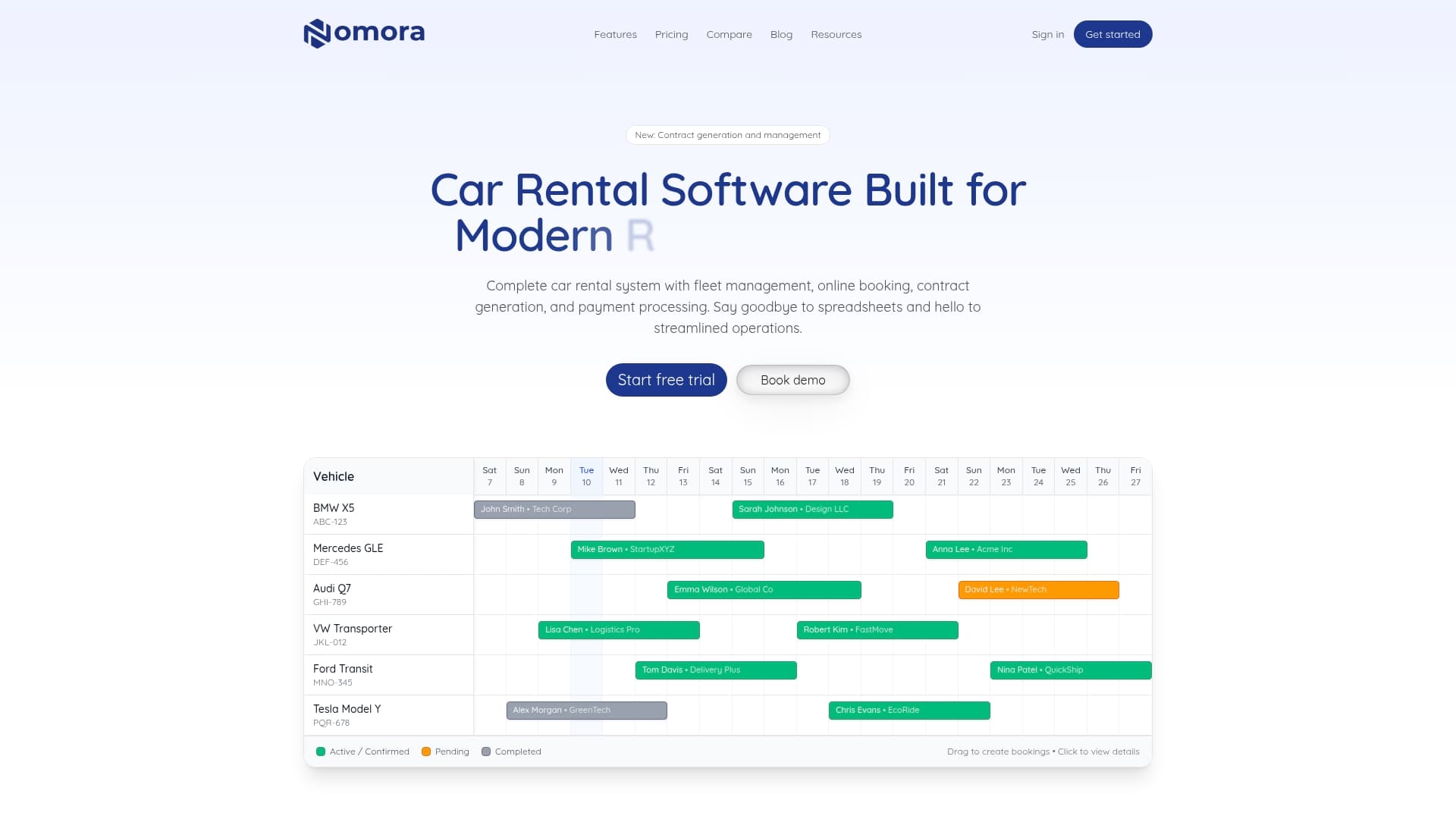
Nomora automates the full contract lifecycle, from template creation and reservation-linked agreement generation to automated rental payments and secure cloud storage. Whether you manage a small local fleet or a multi-location operation, the platform brings every part of your process into one connected system. You can explore car rental software use cases tailored to your business type, or learn how Nomora helps you prevent double bookings and contract conflicts that cost you revenue. Most businesses are fully operational within 24 to 48 hours of setup, making this one of the fastest paths to going fully digital available in the market today.
Frequently asked questions
What makes a digital rental agreement legally binding?
A digital rental agreement is legally binding if it includes clear terms, mutual consent, and a legally valid electronic signature. Ensuring your platform meets legal compliance requirements under frameworks like ESIGN or UETA is essential for enforceability.
Are digital agreements secure against fraud?
Secure digital agreement systems use audit trails and authorized eSignatures to minimize fraud risk. Platforms that log every signature event and store records in encrypted environments make fraudulent alterations far more difficult than with paper contracts.
What is the difference between an electronic and a digital rental agreement?
A digital rental agreement is fully created, signed, and stored online within an integrated system, while an electronic agreement may simply involve a scanned copy or an emailed PDF with a typed signature. True digital agreements are system-native and linked to reservation and payment data.
How fast can I transition to digital rental agreements?
Many rental businesses can start going digital in days by digitizing templates and setting up eSignature software. As use cases confirm, firms transitioning from paper to digital processes see measurable efficiency gains quickly, especially when using a purpose-built rental platform.
What ROI can be expected from switching to digital?
Rental businesses can see operational efficiency improve by up to 42% with digital self-service agreements. Beyond raw efficiency, businesses also gain from fewer disputes, faster vehicle turnovers, and stronger compliance documentation that reduces legal risk.
Recommended