A contactless car rental operation is a business capability, not a consumer app. It means your rental company runs on a cloud-based management platform connected to a booking engine, digital contracts, PCI-compliant payments, ID verification, and telematics, so customers complete the entire rental cycle without visiting a counter and your team manages the fleet remotely.
Your core stack looks like this:
- Booking engine: Mobile-first website or widget that handles real-time availability and reservations
- Rental management SaaS: The central nervous system of the operation (Nomora quickly onboards core functionality (https://nomora.io) )
- Payments: Stripe or Square for tokenized, flat-fee transactions
- ID verification/KYC: Jumio for remote identity checks before vehicle release
- Telematics/GPS: Geotab or Samsara for automated check-in/out and theft prevention
- Digital contracts: E-signature generation built into the rental platform
Cloud-based car rental software is the practical default for mobile-first operations because it supports remote workflows, continuous updates, and modern security without the overhead of on-premise infrastructure.
Key Takeaways
Building a contactless rental operation requires a cloud-based rental platform, direct booking channel, and integrated payments, ID verification, and telematics working together from day one.
| Point | Details |
|---|
| Start with an audit | Map your current systems, booking flow, and gaps before selecting any platform. |
| Prioritize native integrations | Stripe, Square, Jumio, Geotab, and Samsara all integrate natively with leading rental SaaS platforms. |
| Run a pilot before scaling | Test the full booking-to-return flow on a small fleet subset to catch failures before go-live. |
| Track utilization and idle time | Fleet utilization rate and average idle time are your two most direct ROI signals post-launch. |
| Nomora onboards in 24–48 hours | Core setup is fast; use the time saved to focus on pilot testing and staff training. |
Table of Contents
Think of your rental management platform as the central nervous system of the entire operation. Every other tool connects to it, and every customer touchpoint depends on it functioning correctly. These are the non-negotiable capabilities:
- Reservations and availability engine: Conflict-free booking that prevents double-allocations in real time
- Real-time fleet visibility: Vehicle location, availability status, and maintenance data consolidated in one dashboard, which reduces idle time and helps prevent theft
- Digital contract generation and e-signatures: Customers sign before they arrive, cutting counter time to near zero
- PCI-compliant payments and deposit management: Tokenized card storage, automated deposit capture, and refund workflows
- ID verification/KYC: Remote document checks integrated into the booking flow, not bolted on afterward
- Automated check-in/check-out workflows: Telematics triggers that log vehicle departure and return without staff involvement
- Damage capture: Photo evidence tools that timestamp and geo-tag images at pickup and return
- Maintenance scheduling: Alerts tied to mileage or calendar intervals so vehicles don't go out of service unexpectedly
- Reporting and analytics: Utilization rates, revenue per vehicle, and booking-source attribution
- Role-based access and multi-location support: Managers see everything; staff see only what they need
On compliance: any cloud vendor you evaluate should be able to speak to PCI DSS scope for payment data and demonstrate GDPR-aware data handling practices. Even for U.S. operations, GDPR-aligned security posture signals a vendor that takes data protection seriously. Confirm data export rights in writing before signing.
Integrations are where low-touch operations either hold together or fall apart. A platform with strong native integrations reduces implementation time and long-term vendor lock-in. Ask vendors for example API playbooks during evaluation.
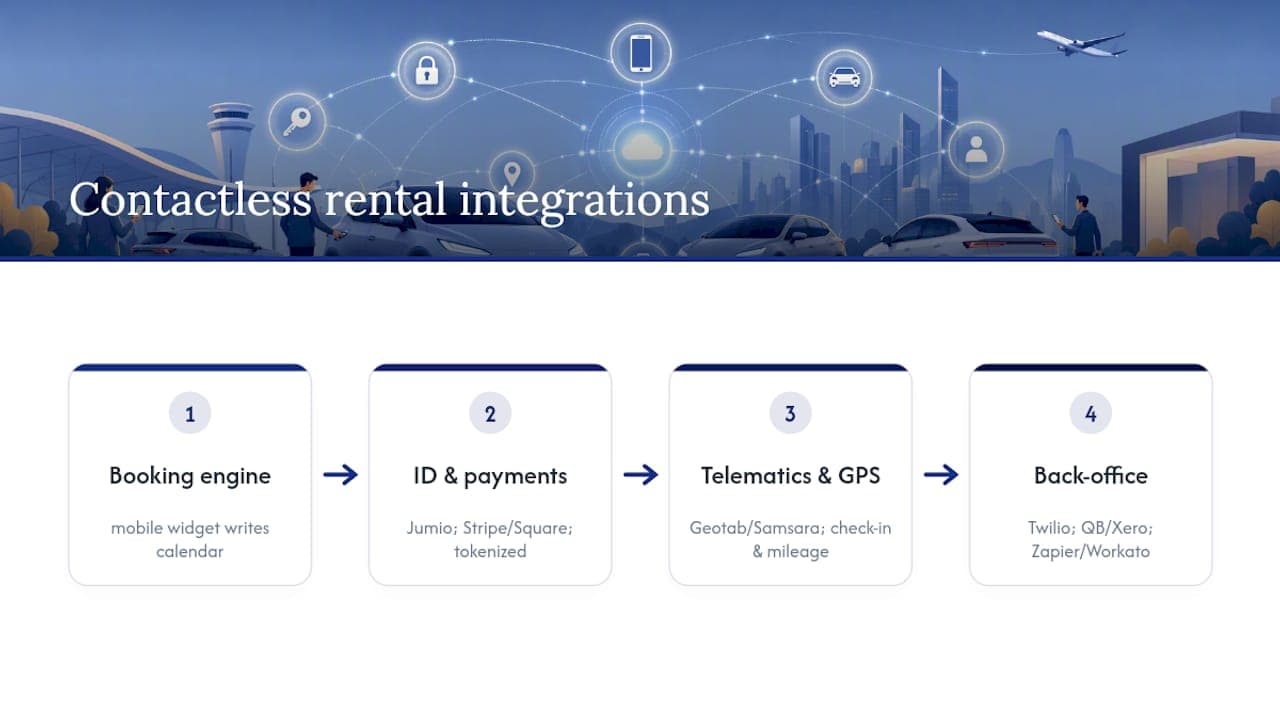
Payment gateways. Stripe and Square are the two most practical choices for U.S. operators. Both offer flat-fee transaction pricing that makes direct booking channels affordable and both support tokenized card storage for deposits and recurring charges.
Telematics and GPS. Geotab and Samsara are the leading U.S. fleet telematics providers. In a contactless flow, telematics does more than track location: it can trigger automated check-in when a customer unlocks a vehicle and log return mileage without staff involvement.
ID verification. Jumio handles remote document verification and liveness checks, integrating via API into the booking confirmation step. Customers upload their license before pickup; your system approves or flags the booking automatically.
Booking engine. A mobile-first direct booking page or widget is the customer-facing entry point. Prioritize native integrations over third-party middleware here; the booking engine must write directly to your rental platform's availability calendar.
Accounting. QuickBooks and Xero both offer API connections that sync invoices, deposits, and refunds automatically, eliminating manual reconciliation.
Notifications. Twilio or a comparable SMS provider handles booking confirmations, pickup reminders, and return alerts without staff involvement.
For lightweight operators, middleware tools like Zapier or Workato can bridge gaps between systems that lack native connectors. Use them as a short-term solution while you evaluate platforms with broader native integration catalogs.
A staged rollout protects you from operational surprises. Four phases, roughly 8–12 weeks total:
-
Audit (weeks 1–2). Inventory every system you currently use: booking source, contract format, payment method, vehicle tracking hardware, and staff workflows. Identify gaps: no telematics, manual contracts, phone-based bookings. Document your current booking-to-fulfillment time as a baseline KPI.
-
Select (weeks 3–6). Shortlist platforms that cover your required capabilities. Validate native integrations against your target stack. Request onboarding timelines and ask for references from operators of similar fleet size. Cloud-hosted platforms eliminate VPN complexity, hand backups to the vendor, and support the integrations that on-premise systems struggle to deliver.
-
Pilot (weeks 7–9). Run one location or a subset of 5–10 vehicles. Test every step of the flow before opening to customers.
-
Scale (weeks 10–12+). Staged rollout to remaining locations with staff training, customer-facing FAQ, and a defined support escalation path.
Pilot checklist:
- Conflict-free booking confirmed across overlapping reservations
- Digital contract sent, signed, and stored automatically
- Deposit captured and refund processed end-to-end
- ID verification approved and flagged cases handled
- Telematics check-in and check-out logged correctly
- Damage photo workflow completed on a test vehicle
- Support escalation path tested for an offline vehicle scenario
| Phase | Activity | Timeline |
|---|
| Audit | System inventory, gap analysis, baseline KPIs | Weeks 1–2 |
| Select | Platform shortlist, integration validation, references | Weeks 3–6 |
| Pilot | 1 location or fleet subset, end-to-end flow testing | Weeks 7–9 |
| Scale | Full rollout, staff training, measurement cadence | Weeks 10–12+ |
Operators who replace spreadsheets with an integrated system gain real-time availability, secure deposit tracking, and mobile admin that measurably reduces administrative hours.

What should you ask vendors before signing a contract?
Use this checklist in every demo. A vendor that can't answer these questions clearly is a red flag in itself.
- Can you complete core setup in 24–48 hours? What does that scope include?
- What is your native integration list, and do you publish a public API with webhooks?
- What is your uptime SLA, and how are backups handled?
- Are you PCI DSS compliant, and can you provide documentation?
- Who owns the data if we leave, and can we export it in a standard format?
- What training and support SLAs are included in the base plan?
- Can you provide references from operators with a similar fleet size and business model?
Red flags to stop a procurement process: closed proprietary integrations with no API access; vague or undocumented data ownership terms; no PCI scope or missing backup documentation; onboarding timelines stated as "it depends" with no reference case; zero references in your segment.
Pro Tip: Request a sandbox account before signing. Run one complete end-to-end flow: booking → ID verification → payment → contract signing → telematics check-in. If the vendor can't provide a sandbox, treat that as a disqualifying gap.
Contactless operations create measurable outcomes. Track these from day one so you can demonstrate ROI and identify where the workflow needs adjustment.
| KPI | What to measure | Target direction |
|---|
| Fleet utilization rate | Revenue-generating days / total available days | Increase |
| Average idle time per vehicle | Days between rentals per unit | Decrease |
| Booking-to-fulfillment time | Minutes from confirmed booking to vehicle release | Decrease |
| Contract completion rate | % of contracts signed digitally before pickup | Increase toward 100% |
| Payment authorization rate | % of transactions approved on first attempt | Maintain a high level |
| Damage claim rate | Claims per 100 rentals | Decrease over time |
| Customer satisfaction (NPS) | Post-rental digital survey score | Increase |
Cloud-based fleet visibility consolidates location, availability, and maintenance data in real time, giving you the data foundation to act on every KPI above. Operators using integrated systems report faster decisions and shorter theft windows because the data is current, not a day old.
Direct bookings also shift the margin picture. Building a direct booking channel and owning customer data gives you control over pricing, repeat business, and communications that aggregator-dependent operations simply cannot replicate.
Most implementation failures are predictable. Here is where operators lose time and money, and how to avoid each one:
- Overreliance on aggregator channels. If your booking flow runs entirely through a third-party platform, you own no customer data and pay commission on every transaction. Build a direct booking channel with local SEO from day one.
- Data silos between systems. A payment system that doesn't talk to your rental platform creates manual reconciliation work that defeats the purpose of going contactless. Prioritize native integrations.
- Poor mobile UX. A booking flow that breaks on a phone screen loses customers before they reach payment. Test every step on iOS and Android before launch.
- Insufficient pilot testing. Skipping the pilot phase and going straight to full rollout is the single most common cause of go-live failures. The pilot checklist in the implementation section exists for this reason.
- Ignoring edge cases. Late returns, offline vehicles, and failed ID verifications happen. Design a manual fallback process for each scenario before you go live.
- Inadequate staff retraining. Low-touch doesn't mean no-touch. Staff need to know how to handle escalations, override workflows, and support customers who struggle with digital steps.
Pro Tip: Route all customer support contacts through a single channel (SMS or email) and set auto-responses that acknowledge the issue and give a resolution timeframe. In a low-touch model, silence after a problem feels worse than the problem itself.
This stack covers a mid-size U.S. operator running 20–100 vehicles across one to three locations. Adapt layers to your fleet size and budget.
- Customer touchpoint: Mobile-first booking website with real-time availability widget
- Rental management SaaS: Nomora (reservations, fleet visibility, digital contracts, payments, telematics integrations)
- Payments: Stripe or Square (tokenized cards, deposit automation, flat-fee pricing)
- ID verification: Jumio (remote document check integrated at booking confirmation)
- Telematics: Geotab or Samsara (GPS tracking, automated check-in/out triggers)
- Notifications: Twilio SMS (booking confirmations, pickup reminders, return alerts)
- Accounting sync: QuickBooks or Xero (automated invoice and reconciliation)
- Middleware (if needed): Zapier or Workato for non-native connections
Flow: Customer books online → Jumio verifies ID → Stripe tokenizes payment and captures deposit → Nomora generates and sends digital contract for e-signature → Geotab or Samsara logs vehicle departure → automated return alert triggers reconciliation → deposit released or damage claim initiated.
A small family-owned rental that moved from WhatsApp bookings to this kind of integrated stack saw measurable improvements in manual work and online conversions(https://ezywebpro.com/blog/son-daughter-car-rental-case-study/) within weeks of launch. The technology itself is not the barrier; the barrier is committing to the integration work upfront.
Small and mid-size fleets have the most to gain from going contactless, and the most to lose from staying manual. Smaller operations running on spreadsheets and phone bookings are paying a hidden tax: staff time, booking errors, missed utilization, and commission leakage to aggregators. A contactless stack eliminates most of that overhead and, more importantly, puts the customer relationship back in the operator's hands.

Direct bookings mean you own the customer's email, rental history, and preferences. That data compounds over time into repeat business and referrals that no aggregator can replicate. The margin difference between a direct booking and an aggregator booking is real and grows with every transaction.
The operators who build this infrastructure now, while the tooling is affordable and onboarding windows are short, will be significantly harder to displace than those who wait.
Running a low-touch rental operation means your software has to handle what your staff used to do. Nomora covers the full stack: real-time reservations, fleet visibility, automated digital contracts, integrated payment processing, and telematics connections to providers like Geotab and Samsara. Core setup takes 24–48 hours, not weeks, and the platform is cloud-based with GDPR-aligned security so your data is protected and accessible from anywhere.
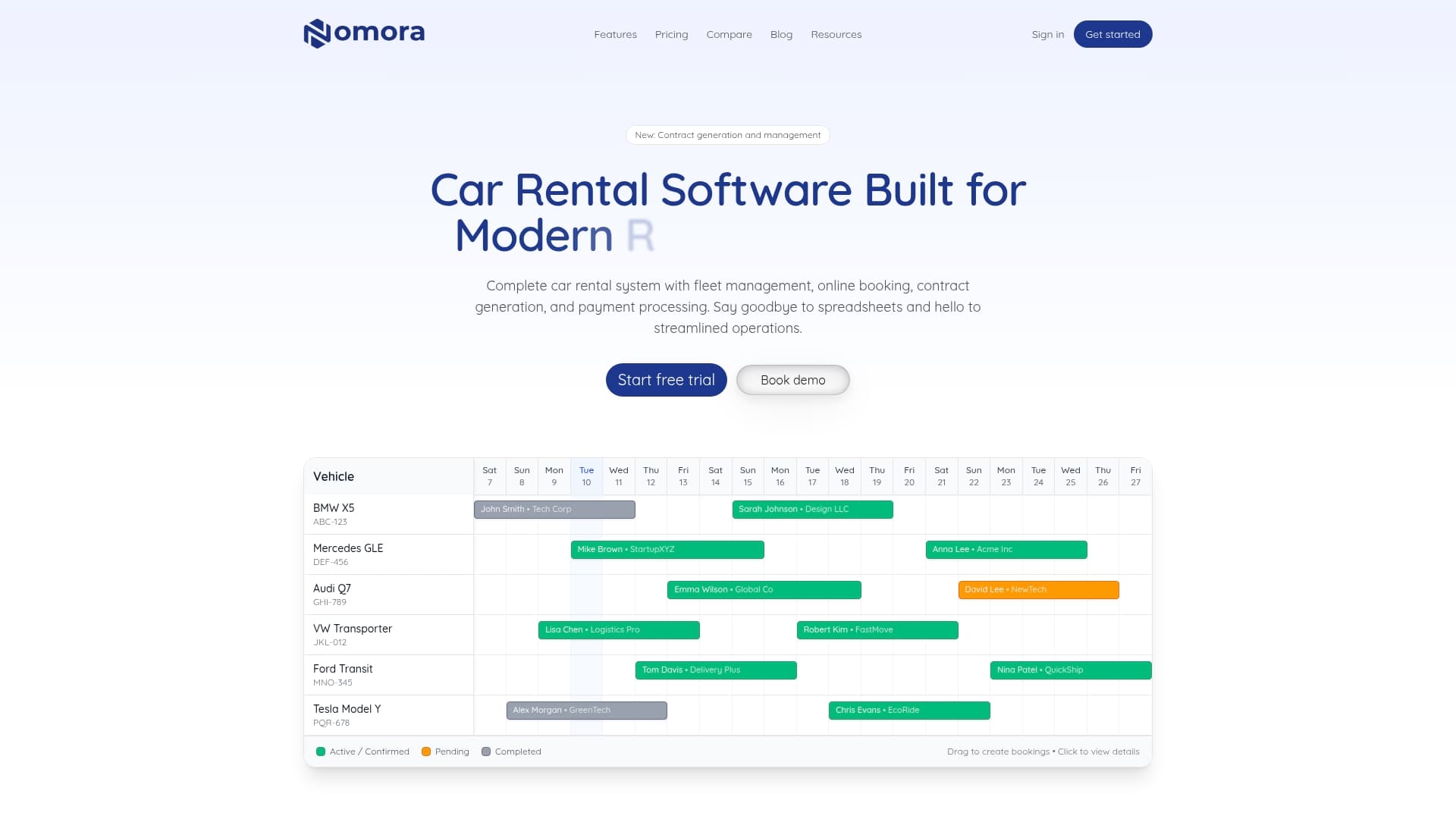
For operators ready to move from manual workflows to a fully digital rental operation, Nomora's integration catalog and fast onboarding make it a practical starting point rather than a long-term project. See how it fits your business type and fleet size at Nomora's use cases page, or go straight to the car rental software overview to request a demo and run your first end-to-end test booking.
Sources
These sources informed this guide and are worth bookmarking for deeper research:
Recommended
Ready to streamline your car rental business?
Book 30 minutes with the founder. We set up everything in this guide on your own vehicles, and migrate you out of Excel for free.