Conflict-Free Booking Workflow for Rental Businesses
Discover the benefits of a conflict-free booking workflow for rental businesses. Learn how to prevent double bookings and enhance customer satisfaction.
A conflict-free booking system uses database transactions, exclusion constraints, and hold states to prevent overlapping reservations. These mechanisms ensure only one confirmed booking per resource and time slot, reducing customer frustration and operational issues. Implementing real-time checks, automatic holds, and server-side validation helps rental companies grow without booking conflicts.
A conflict-free booking workflow is an automated system that prevents overlapping or double bookings by enforcing transaction-safe availability checks, database exclusion constraints, and hold states during multi-step reservations. For rental business owners and fleet managers, a single double booking does not just frustrate a customer. It triggers a chain reaction: emergency vehicle reassignment, staff overtime, refund processing, and lasting damage to your reputation. Platforms like Nomora are built around this exact problem, using concurrency controls and real-time availability logic to eliminate booking conflicts before they reach your customers. Understanding how these systems work gives you a clear framework for evaluating and improving your own booking operations.
What technical mechanisms enforce a conflict-free booking workflow?
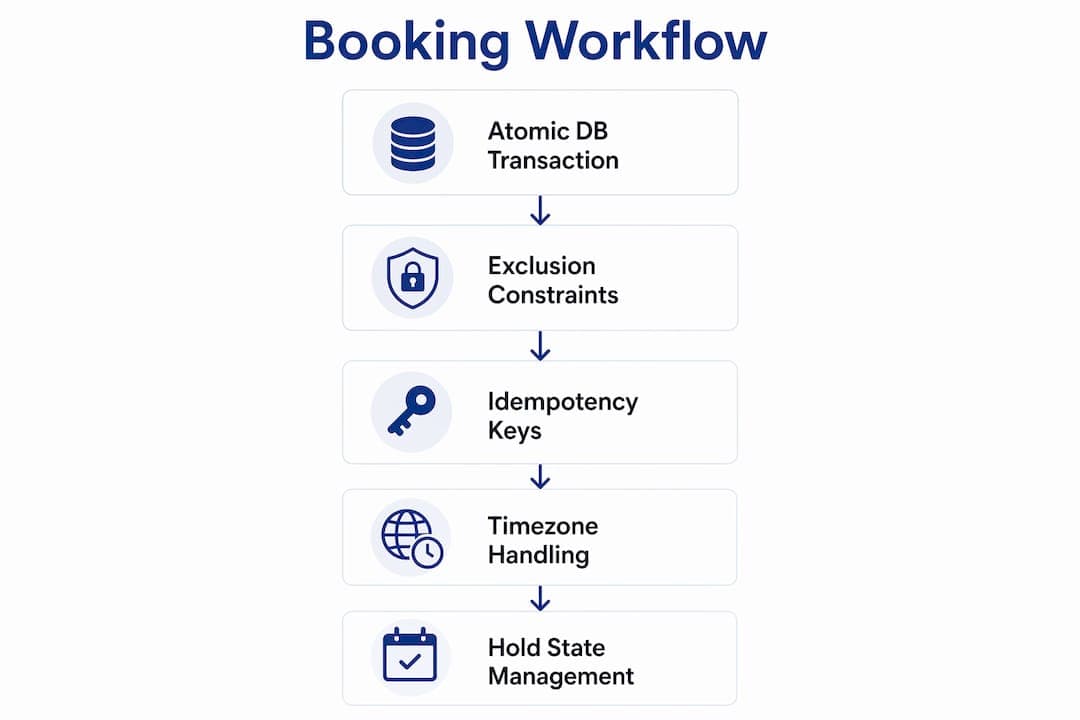
The foundation of any reliable booking system is the database transaction. Atomic availability checks wrap both the availability check and the booking insert into a single operation. PostgreSQL's transaction isolation ensures that when two customers request the same vehicle at the same time, only one booking confirms. The other receives a clean "slot not available" error instead of a silent double booking.
Database exclusion constraints take this a step further. PostgreSQL exclusion constraints using tstzrange and EXCLUDE USING GIST forbid the insertion of any overlapping booking for the same resource. This means the database itself rejects the conflict, not just the application layer. The result is a system that holds even under heavy concurrent traffic.
Idempotency keys are the third pillar. Idempotency keys at the booking endpoint prevent duplicate bookings caused by client retries. When a customer's browser retries a failed payment request, the system returns the original booking result rather than creating a second reservation. Idempotency is not just retry hygiene. It is a core concurrency control primitive for any distributed, stateless API.
Timezone handling is often overlooked but critical. Booking times stored in UTC via TIMESTAMPTZ columns and converted properly at API boundaries prevent phantom overlaps caused by timezone mismatches. A fleet operating across multiple time zones cannot rely on local timestamps for accurate conflict detection.
Here is a summary of the core mechanisms and how they compare:
Mechanism
What it does
Where it enforces
Atomic DB transaction
Wraps check and insert together
Database layer
Exclusion constraints (GIST)
Rejects overlapping time ranges
Database layer
Idempotency keys
Prevents duplicate bookings on retry
API/application layer
Hold states with TTL
Blocks slots during multi-step checkout
Application + database
UTC timestamp storage
Prevents timezone-based phantom conflicts
Database layer
Pro Tip:Use half-open intervals [start, end) when modeling time ranges in your exclusion constraints. This precise interval modeling avoids phantom conflicts and allows back-to-back rentals to hand off at the exact boundary time without any overlap or workaround.
How to design a conflict-free booking process for fleet management
Building a reliable booking process requires a clear sequence of steps. Each step must close the window for conflicts before the next one opens.
Display real-time availability. Pull availability directly from the database at the moment of request. Never cache availability data for more than a few seconds in high-demand environments. Stale data is the first source of conflicts.
Create a tentative hold immediately. The moment a customer selects a vehicle and begins checkout, create a hold record with a time-to-live (TTL). Held bookings participate in exclusion constraints to block other requests for the same slot. If the customer abandons checkout, the hold expires automatically and releases the vehicle.
Run an atomic booking creation. When the customer confirms and payment processes, wrap the final availability check and booking insert in a single database transaction. If another booking slipped in during the hold window, the transaction fails cleanly and the customer is notified immediately.
Assign an idempotency key to every booking request. Generate this key client-side before the request fires. Persisting idempotency results keyed by client-generated IDs ensures retries return the original outcome without re-executing side effects.
Validate server-side before confirming. Never trust the client's availability display as the final word. Re-run the conflict check on the server with the latest schedule data, including buffer times between rentals.
Apply buffer times and minimum notice rules. Build in a minimum gap between consecutive rentals for the same vehicle. This prevents near-overlaps caused by cleaning, inspection, or late returns.
Pro Tip:Set your hold TTL to match your average checkout completion time, typically 10–15 minutes for most rental flows. A TTL that is too short releases vehicles before customers finish paying. A TTL that is too long blocks inventory unnecessarily during slow periods.
The automated booking process built into platforms like Nomora handles steps 2 through 5 automatically, removing the need for manual intervention at each stage.
What are the common challenges in scheduling without conflicts?
Even well-designed systems encounter edge cases. Knowing where conflicts hide helps you fix them faster.
Race conditions between concurrent requests. Two customers can pass the availability check simultaneously before either booking is written. Without atomic transactions and exclusion constraints, both bookings confirm. The fix is always at the database layer, not the application layer.
Stale availability on the client side. A customer views an available vehicle, spends five minutes deciding, and submits a booking after another customer already confirmed the same slot. Server-side re-validation with real-time schedule data, including buffer rules, catches this before confirmation.
Missing holds in multi-step checkouts. Multi-step checkouts without enforced holds create a double-booking window between the availability display and the final confirmation. This is one of the most common developer oversights in rental system design.
Retry loops without resolution. A customer retries a failed booking request repeatedly, each time hitting the same conflict error without understanding why. Idempotency keys stop duplicate creation, but you also need clear user-facing error messages that explain the conflict and offer alternatives.
Timezone mismatches in global fleets. A booking entered in one timezone and stored without UTC conversion can appear to overlap with a booking that does not actually conflict. Always store and compare timestamps in UTC.
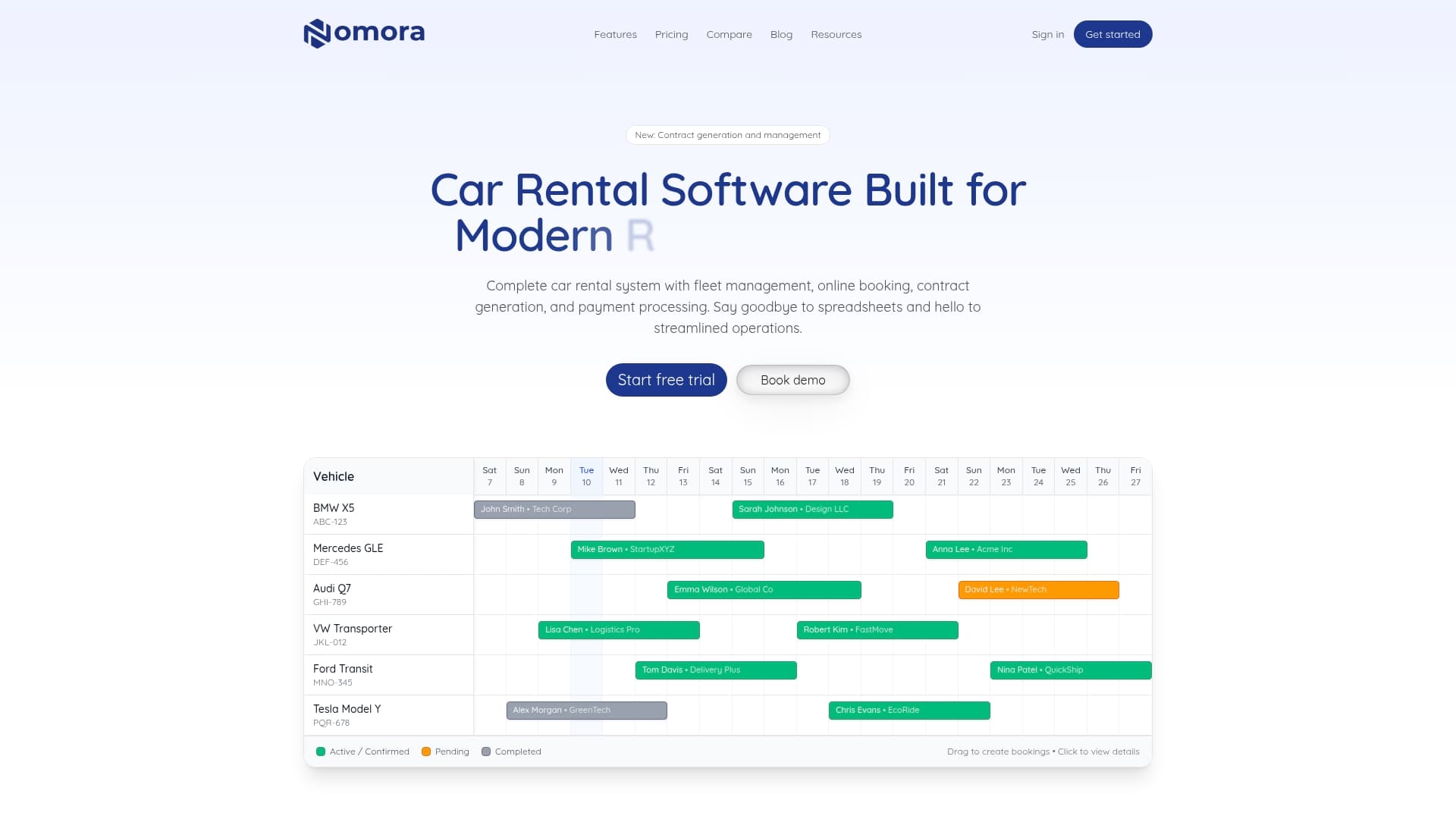
Operational troubleshooting for booking conflicts starts with your booking calendar and asset reservation views. Identify the conflicting slot and owner, then resolve by canceling the duplicate, shortening one booking, or releasing the hold manually. Never retry a conflicting booking without first clearing the underlying overlap.
For fleet managers handling high vehicle turnover, a booking conflict resolution process should be documented and accessible to your operations team, not just your developers.
How do conflict-free booking methods compare for rental scalability?
Not all approaches to preventing booking conflicts perform equally as your fleet grows. The method you choose today will determine how much pain you feel at scale.
Application-level check-then-insert is the most common starting point. The application checks availability, then inserts the booking in two separate steps. This approach is easy to build but inherently race-prone. Under concurrent load, two requests can pass the check before either insert completes. Enforcing invariants at the database level produces more reliable and scalable systems than relying on application logic alone.
Database exclusion constraints move the conflict check into the database engine itself. PostgreSQL exclusion constraints using range types are the cleanest approach for enforcing mutually exclusive time reservations. They perform well under concurrency because the database handles locking internally, without the application needing to manage it.
Tentative holds with TTL expiration add a layer of customer experience on top of the technical controls. Tentative holds allow customers to express interest without permanently blocking a vehicle. This reduces abandoned checkouts while keeping inventory protected during the payment window.
Method
Reliability
Complexity
Scalability
Customer experience
App-level check-then-insert
Low
Low
Poor
Neutral
Atomic DB transactions
High
Medium
Good
Neutral
DB exclusion constraints
Very high
Medium
Excellent
Neutral
Idempotency keys
High
Medium
Excellent
Improved
Tentative holds with TTL
Very high
High
Excellent
Best
Pro Tip:Combine all three database-level methods: atomic transactions, exclusion constraints, and idempotency keys. Each one closes a different gap. Using only one or two leaves your system vulnerable to the edge cases the others cover.
For rental businesses evaluating types of reservation systems, the combination of exclusion constraints and tentative holds represents the current best practice for high-demand fleet environments.
Key takeaways
A conflict-free booking workflow requires atomic database transactions, exclusion constraints, and idempotency keys working together. No single mechanism is sufficient on its own.
Point
Details
Atomic transactions are non-negotiable
Wrap availability checks and booking inserts in one transaction to eliminate race conditions.
Database constraints beat app logic
PostgreSQL exclusion constraints enforce conflict prevention at the engine level, not the application layer.
Holds protect multi-step checkouts
A TTL-based hold blocks the slot during payment, preventing double bookings in the checkout window.
Idempotency stops retry duplicates
Client-generated idempotency keys return consistent results on retries without creating extra bookings.
Server-side validation is the last line
Always re-validate availability on the server before confirming, regardless of what the client displayed.
The 42-Point Car Rental Operations Checklist
The exact checks profitable rental operators run every week — free, straight to your inbox.
Fleet readiness & handover
Bookings & no-show prevention
Pricing & revenue reviews
Contracts & compliance
Payments & invoicing
Maintenance & fleet health
One email with the checklist. No spam, unsubscribe anytime.
Why I think most rental systems get this wrong from the start
Most rental businesses I have seen build their first booking system with application-level checks. It works fine at low volume. Then the business grows, a busy weekend hits, and suddenly two customers show up for the same car. The instinct is to add more checks in the application code. That is the wrong direction entirely.
The real fix is to push conflict enforcement down into the database layer and leave it there. PostgreSQL exclusion constraints do not care how many concurrent API requests arrive. They enforce the rule at write time, every time, without any coordination logic in your application code. That reliability is worth the added setup complexity.
The piece I see missed most often is the hold state in multi-step checkouts. Developers build a clean availability check and a clean booking confirmation, but leave a gap in between. That gap is where double bookings live. Treating holds as first-class booking states that participate in exclusion constraints closes that gap permanently.
Idempotency also gets underestimated. Most teams add it as an afterthought to handle network retries. The better mental model is to treat idempotency as a concurrency primitive from day one. It makes your entire booking API deterministic, which simplifies debugging, monitoring, and customer support.
My advice to fleet managers: do not wait for your first conflict incident to audit your booking system. Ask your software provider directly whether they use database-level exclusion constraints and hold states. If they cannot answer that question clearly, you have your answer.
— Dizzy
Nomora's approach to automated, conflict-free bookings
Rental businesses that want these protections without building them from scratch have a direct path forward with Nomora.
Nomora acts as the central nervous system of your rental operation, handling reservations, fleet availability, contract generation, and payments inside one integrated platform. Its booking engine applies real-time conflict detection, automated hold management, and payment-integrated confirmation flows out of the box. You do not need a development team to get these protections in place. Nomora's onboarding takes 24–48 hours, and the platform covers everything from automated payment processing to fleet-wide availability visibility. See how different rental business types use these features at Nomora's use case library.
FAQ
What is a conflict-free booking workflow?
A conflict-free booking workflow is an automated reservation process that uses atomic database transactions, exclusion constraints, and hold states to prevent overlapping or duplicate bookings. It guarantees that only one confirmed booking exists for any given vehicle and time slot.
How do PostgreSQL exclusion constraints prevent double bookings?
PostgreSQL exclusion constraints using tstzrange and EXCLUDE USING GIST reject any insert that overlaps an existing booking for the same resource. The database enforces this rule at write time, making it impossible for concurrent transactions to create a double booking.
What is a hold state in a booking system?
A hold state is a temporary reservation created when a customer begins checkout. It blocks the slot for other customers during the payment window and expires automatically via a TTL if the customer does not complete the booking.
Why are idempotency keys important for booking workflows?
Idempotency keys ensure that retried booking requests return the original result without creating duplicate reservations. They are a core concurrency control tool for any booking API that handles network failures or client retries.
How should rental businesses handle booking conflict errors?
Check your booking calendar and asset reservation views to identify which existing booking overlaps the conflicting request. Resolve the conflict by canceling the duplicate, shortening one booking, or manually releasing the hold before retrying.