A webhook is an HTTP POST that your rental software sends to a URL you control the moment something changes, such as a booking confirmed, a vehicle returned or a payment settled. Instead of your systems asking "anything new?" every few seconds, the platform tells you once, when it happens. To use webhooks well, you need three things: a clear list of events worth reacting to, an endpoint that verifies and acknowledges each call, and a process that survives retries, duplicates and out-of-order delivery.
This guide is for developers, product managers and operations leads at rental companies who connect a rental platform to accounting, CRM, telematics, messaging or payment tools. You will leave with a working framework: what to subscribe to, how to secure the endpoint, how to handle failures, and how to keep the integration alive when schemas change.
TL;DR
- Webhooks push events to your server when something changes; polling makes your server ask repeatedly. For frequently changing data such as reservations and vehicle status, push is the better default.
- Subscribe to a small set of business events (reservation, pickup, return, payment, vehicle status) and map each to one concrete action in your other systems.
- Verify every call with an HMAC signature and a timestamp, return a 2xx immediately, and do the real work asynchronously.
- Design for duplicates and out-of-order events: store event IDs, and re-fetch current state from the API when in doubt.
- Test with a sandbox endpoint, log every delivery, and plan for versioned event types before the schema changes.
Table of Contents
Webhooks vs. polling in a rental operation
Polling means your application repeatedly sends GET requests to a resource until it notices a state change. Asaas describes polling in exactly those terms and contrasts it with webhooks, which notify your application when the change occurs.
The difference matters most in rental because the data moves constantly. A car is booked, extended, picked up early, returned late, flagged for damage. If your accounting tool checks for new reservations every minute across a fleet of 200 vehicles, most of those requests return nothing. Vehicle-data provider Smartcar says webhooks are preferable for real-time or frequently updated data because they cut repeated polling, server load, rate-limit consumption and the risk of stale data.
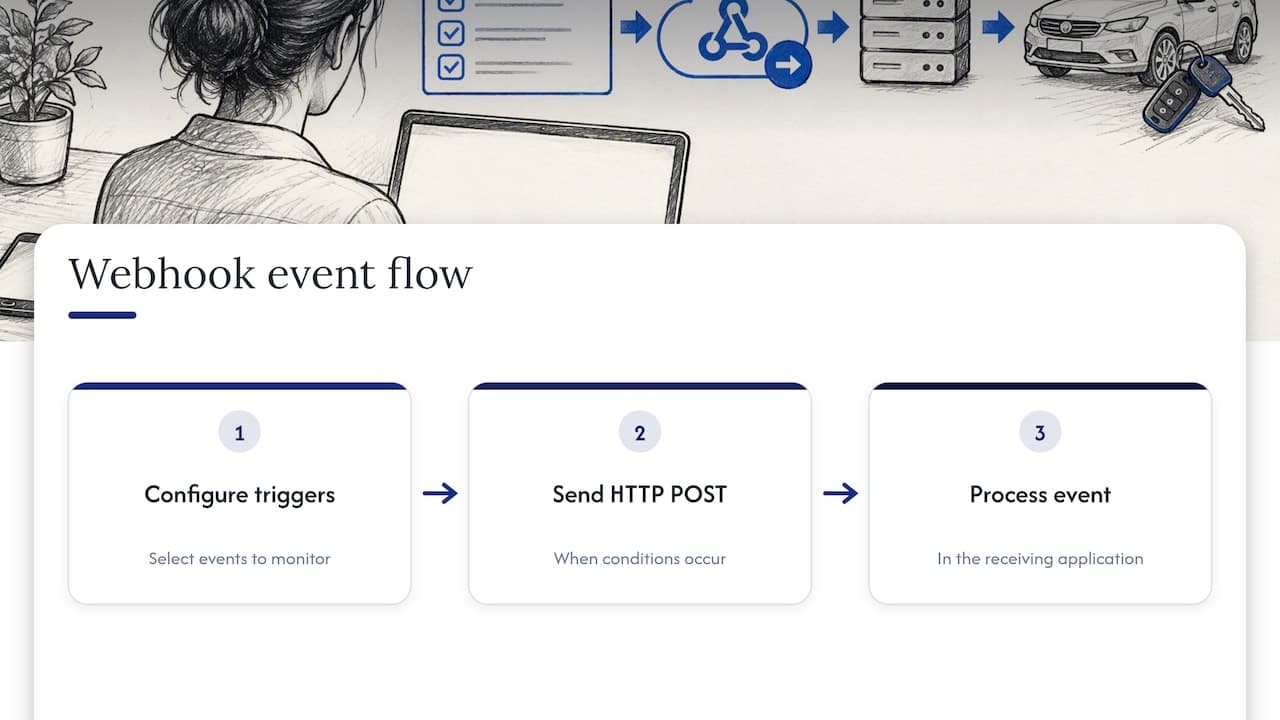
The mechanics are simple. Smartcar's webhook overview describes the flow: you configure the triggers you care about, the platform sends an automatic HTTP POST when the conditions occur, and your application processes the event.
Polling still has a place. Use it for a nightly reconciliation job, or as a fallback to confirm state after a missed event. Think of webhooks as the fast path and a scheduled API read as the safety net.
Which rental events deserve a webhook
Most teams start by subscribing to everything and drown in noise. Start from the action instead. For every event, write down what should happen downstream. If nothing should, do not subscribe.
The table below is a starting map. Event names vary by platform, so treat these as categories and check your provider's documentation for exact names and payload fields.
| Business moment | Typical event category | Useful downstream action |
|---|
| New or changed booking | Reservation created, updated, cancelled | Block or release the vehicle on partner channels; update the CRM |
| Customer arrives | Pickup or check-out completed | Start the billing clock; send a welcome message with return instructions |
| Vehicle comes back | Return or check-in completed | Trigger cleaning and inspection tasks; make the car available again |
| Money moves | Payment succeeded, failed, refunded, deposit released | Mark the invoice paid in accounting; alert staff to a failed card |
| Vehicle state changes | Status change, maintenance due, location or GPS alert | Pull the car from availability; open a service ticket |
Reservations and availability
Availability is where webhooks pay for themselves. When a booking is created or cancelled, every channel that sells your cars needs to know quickly, or you risk double bookings. A reservation event should update availability elsewhere, and the receiving system should treat the platform as the source of truth.
Pickups and returns
Pickup and return events are the cleanest triggers for operational work: cleaning, fuel and mileage checks, deposit release, review requests. Keep the handler small. It should create a task in the tool that owns that work, not try to run the work itself.
Payments
Payment events need the most care, because acting on a forged or stale one costs real money. We cover that in the security section. If you want the payments side of the workflow in depth, our page on automated car rental payments shows how charging, deposits and reconciliation fit together, and our payment security tips for rentals cover the safeguards around them.
Building a secure webhook endpoint
Your endpoint is a public URL that triggers business actions. Treat it like any other internet-facing login-free API: assume strangers will find it.
- Use HTTPS only. Reject plain HTTP and keep certificates current.
- Verify a signature on every request. The platform signs the payload with a shared secret; you recompute the signature and compare.
- Check the timestamp. A signature without a time limit can be captured and replayed.
- Acknowledge fast. Return a 2xx as soon as the payload is stored.
- Process asynchronously. Hand the stored event to a background worker.
- Log everything. Keep the event ID, receipt time, signature result and outcome.
Signatures and replay protection
Current guidance on webhook signing recommends HMAC-SHA256 over the raw request body plus a timestamp, verified with a constant-time comparison and a replay window of roughly five minutes. Two practical consequences follow:
- Sign and verify the raw bytes. If your framework parses the JSON and re-serializes it before you compute the HMAC, the signature will not match. Capture the raw body first.
- Never compare signatures with a plain equality operator. Use your language's constant-time compare function.
Also keep the secret out of source control and rotate it on a schedule. When you rotate, accept both the old and new secret briefly so no events are rejected during the switch.
Do not trust the payload alone for money
For anything touching payments, OWASP's guidance for third-party gateway integrations is blunt: redirect parameters are untrusted and can be manipulated, so authenticate callbacks and verify payment status server-side before you fulfill an order. In rental terms, do not mark a deposit as received or release a car because a webhook said so. Call the payment gateway, confirm the status, then act.
Limit what you receive
Subscribe only to the events you act on, and request only the fields you need. Rental payloads can carry driver names, license details and contact data. Fewer events and fewer fields mean less personal data passing through your logs and queues, which also shrinks your exposure if an endpoint is misconfigured. If your provider offers scoped subscriptions, use them.
Acknowledge first, process second
The most common webhook bug is doing too much inside the request. Your handler parses the payload, updates three systems, sends an email and then responds. If any step is slow, the sender times out and retries, and now you process the event twice.
The pattern recommended in Smartcar's best-practices guide is to decouple receipt from processing: persist the raw payload immediately, return a 2xx, then run business logic in background workers.
A minimal handler does this, in order:
- Read the raw body and headers.
- Verify signature and timestamp. If invalid, return 401 or 403 and stop.
- Write the raw payload and event ID to durable storage or a queue.
- Return 200.
- A worker picks up the stored event and performs the business action.
Storing the raw payload also gives you a replay tool. When a bug in your worker corrupts invoices, you can fix the code and reprocess the stored events instead of begging the sender to resend them.
Retries, duplicates and out-of-order events
Any reliable webhook system delivers at least once, not exactly once. That means three things will happen in production, and your design should expect all of them.
Duplicates
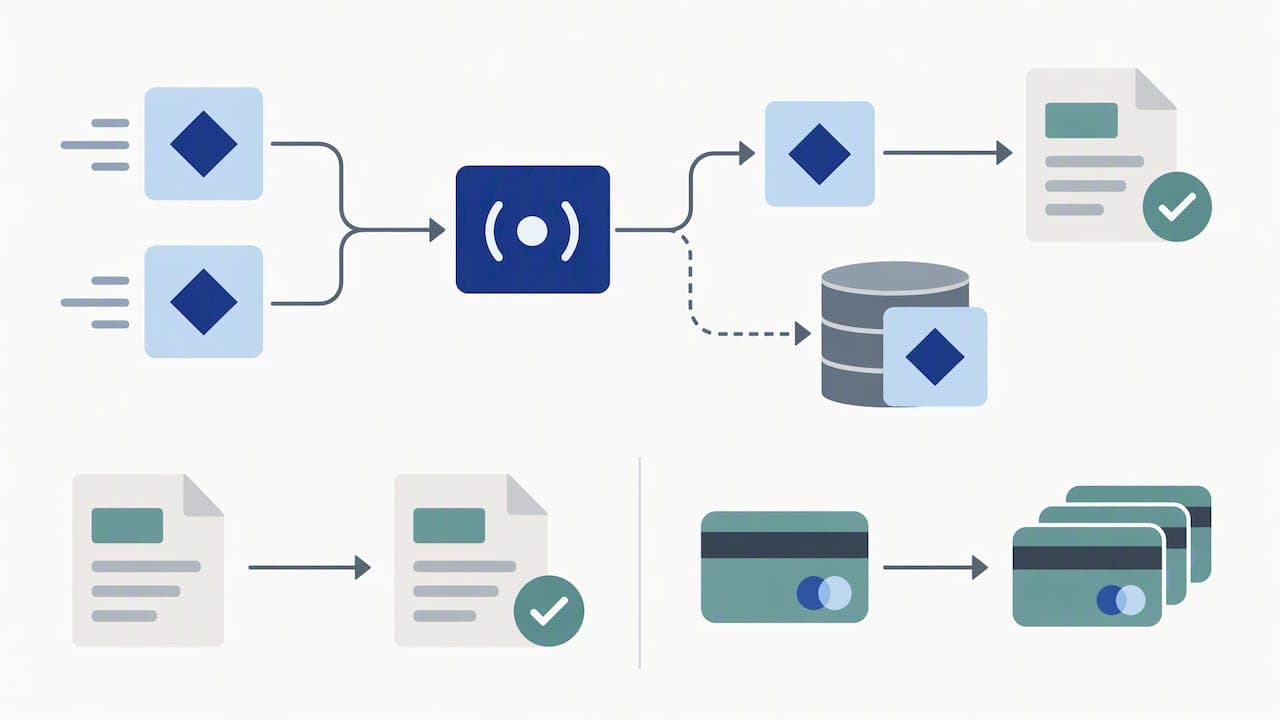
If your server is slow or returns an error, the sender retries. Give each event a unique ID and record it. When an ID arrives a second time, acknowledge it and skip the work. Make the action itself idempotent where you can: "set invoice 1042 to paid" is safe to repeat, while "add a €120 payment" is not.
Out-of-order delivery
A "reservation updated" event can arrive before the "reservation created" event it follows, especially after retries. Do not assume the order you receive is the order things happened. Two defenses work well:
- Compare the event's timestamp or version with what you have stored, and ignore anything older.
- Treat the event as a signal, not the full truth: when the sequence looks wrong, fetch the current state of the reservation from the API and write that.
This is the approach rental-software API documentation commonly recommends: acknowledge immediately, deduplicate by event ID, and re-fetch current state if you suspect an event is out of sequence.
Failures on your side
If your worker fails, keep the stored event, retry with backoff, and move it to a dead-letter queue after a sensible number of attempts so a human sees it. A daily reconciliation job that compares your records with the platform's API closes the remaining gaps.
Testing, monitoring and troubleshooting
Test in a sandbox before any production event reaches the endpoint. A good rental API gives you a way to send a test event and inspect delivery attempts. Use it to confirm three things: the endpoint is reachable, the signature check passes with the right secret, and a deliberately broken signature is rejected.
In production, the useful signals are the ones that point to trouble early. OWASP's payment guidance suggests logging payment attempts and callback outcomes and alerting on unexpected order statuses, excessive callback attempts and repeated payment failures. Those translate directly to rental:
- A spike in non-2xx responses from your endpoint.
- Growing lag between event time and processing time.
- The same event ID arriving many times.
- Signature failures, which suggest either a rotated secret or someone probing the URL.
- Payment events for reservations your system does not know.
When a delivery fails, work from the outside in: check the sender's delivery log for the response code and timing, then your own receipt log, then the worker queue. Most incidents turn out to be an expired certificate, a changed secret, a firewall rule or a handler that exceeded the timeout.
Keeping integrations alive as schemas change
APIs evolve, and a webhook payload is a contract. FreeCodeCamp's guide on API and event schemas lists the changes that break consumers: renaming or removing fields, changing data types, making a field newly required, changing formats or meanings, and tightening constraints. It recommends preserving existing attributes, testing drafts and versioning when a break is unavoidable.
On the consumer side, build defensively:
- Ignore fields you do not recognize. Additive changes should never crash your parser.
- Validate only what you use. Strict validation of the whole payload turns harmless additions into outages.
- Watch for versioned event types. Some providers version the event itself, for example an
order.shipped.v1 and order.shipped.v2 pair, and give consumers time to migrate before retiring the older one. Subscribe to the new version in a test environment, compare payloads, then switch.
- Keep a contract test. Save a sample payload for every event you consume and run it through your parser in CI.
Our perspective: software is the nervous system, webhooks are the signals
We think of a rental platform as the central nervous system of the operation. Reservations, fleet status, contracts, payments and customer records live in one place, and everything else, from accounting to messaging to GPS, depends on that place being right. Webhooks and APIs are how the signals leave it.
That is why we keep two principles in mind when we talk to rental owners about integrations. First, the source of truth must be one system. When a booking exists in a spreadsheet, an inbox and a portal, no webhook can fix the conflicts. Moving off spreadsheets to a single platform with conflict-free booking comes before any event plumbing. Second, start with the smallest useful automation. One reliable event that closes an invoice or frees a car beats ten fragile ones.
We also see integration trouble most often at the edges: unclear ownership of the endpoint, no log of what arrived, and nobody watching failures. These are process problems more than coding problems, and a short runbook solves most of them.
If you are mapping which API calls support which business needs, our guide on mapping car rental API use cases to exact calls walks through it step by step, and our overview of how to approach car rental API integration covers planning and sequencing. For a no-code route to the same outcomes, see Zapier for car rental.
— Dizzy
Where Nomora fits
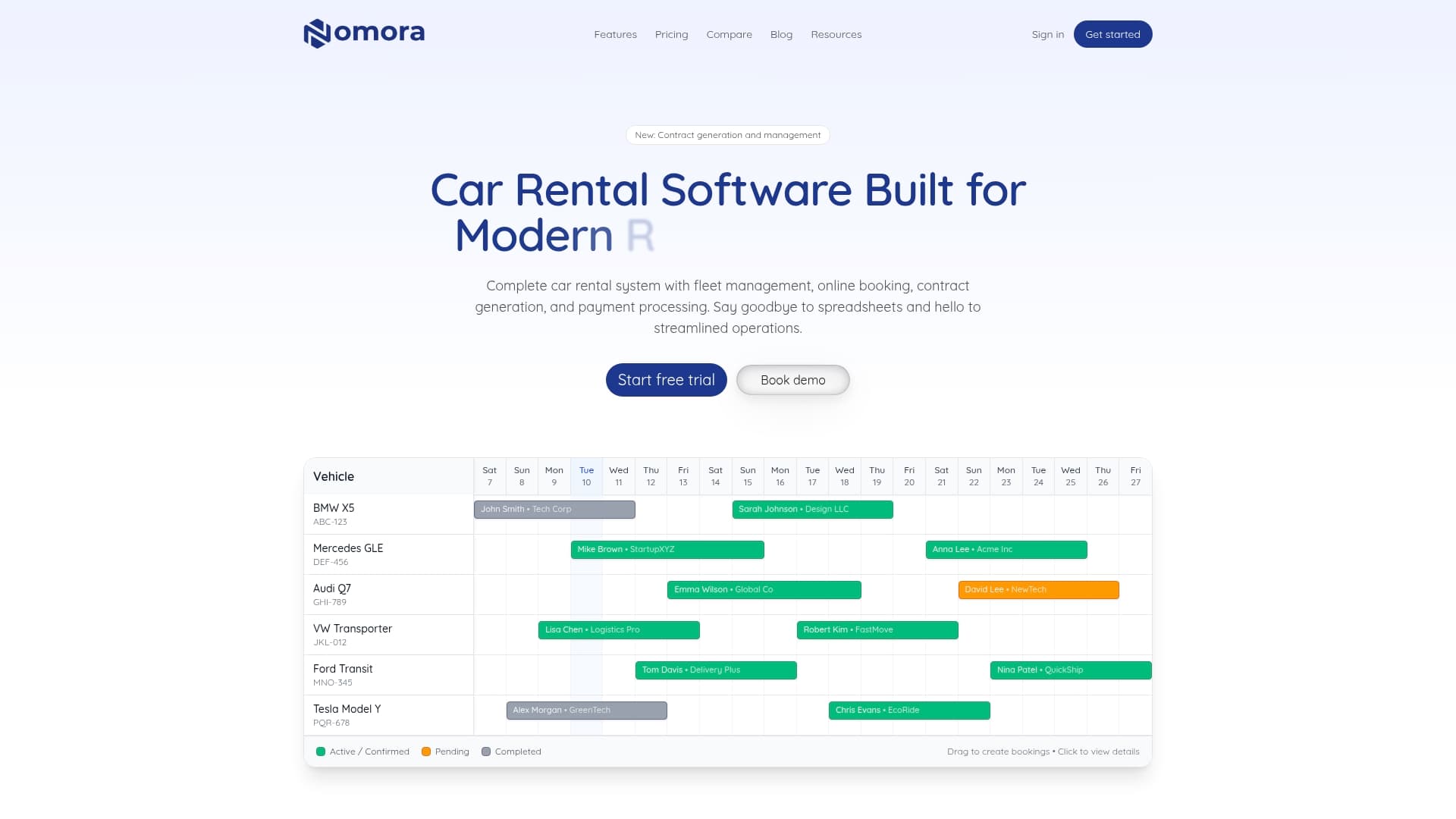
Nomora is a cloud-based rental management platform that brings reservations, fleet management with GPS tracking, automated contracts, payments and customer data into one system, with integrations to the tools around it. Onboarding typically takes 24 to 48 hours, and every plan includes all features with no hidden fees.
Plans start at €45 per month for Starter, with Business at €2.80 per vehicle per month and Fleet at €2.20 per vehicle per month. Enterprise and payment processing fees are not published, so those are quoted on request. See the details on the pricing page, or explore Nomora's car rental software.
If you want to compare integration options before deciding what to automate, our car rental software integrations guide and the list of top integrations for fleet operations are good places to start.
A pre-launch checklist
- Each subscribed event maps to one named downstream action and one owner.
- The endpoint uses HTTPS, verifies signature and timestamp, and stores the raw payload.
- The handler returns a 2xx quickly and processes in the background.
- Event IDs are stored; handlers are idempotent.
- Payment events trigger a server-side status check before any fulfillment.
- Out-of-order events lead to a re-fetch of current state.
- Delivery logs, failure alerts and a dead-letter queue exist.
- A daily reconciliation compares your data with the platform's.
- Sample payloads run through a contract test in CI.
- The secret has a rotation plan.
FAQ
Are webhooks better than polling for car rental software?
For data that changes often, such as reservations and vehicle status, usually yes. Webhooks deliver changes as they happen and avoid the wasted requests and rate-limit use of constant polling. Keep a scheduled API read as a backup to catch anything missed.
What should my endpoint return when it receives a webhook?
Return a 2xx status as soon as you have verified the signature and stored the payload. Do the business logic afterward in a background worker. Slow responses can trigger retries and duplicate events.
How do I stop duplicate webhook events from double-charging or double-booking?
Store each event's unique ID and skip any ID you have already processed. Make the underlying action idempotent too, for example by setting a status instead of adding an amount. For payments, also confirm the status with the gateway before acting.
What if events arrive out of order?
Compare timestamps or version numbers and ignore older data. If the sequence looks wrong, fetch the current state of the reservation or vehicle from the API and overwrite your copy with it.
Can I automate rental workflows without writing webhook code?
Often yes. Automation tools can connect rental events to accounting, messaging and spreadsheets without custom code, which suits smaller fleets. Our guide to workflow automation for car rentals shows where that approach works best.
Sources
Recommended