A practical, phased rollout — planning → pilot → data migration → integrations → staff training → test and go-live — lets most U.S. car rental operations complete car rental software implementation within a few weeks to a few months, depending on fleet size and the number of integrations required. The payoff is a single system that handles reservations, fleet tracking, contracts, and payments in one place, replacing the spreadsheets and manual handoffs that cause double bookings and slow check-ins.
Here is the high-level roadmap:
- Phase 0 (Week 1): Audit current workflows, define scope, and set measurable success metrics.
- Phase 1 (Weeks 1–2): Vendor selection, account setup, and admin configuration.
- Phase 2 (Weeks 2–3): Fleet data entry, pricing rules, and pilot testing with a small vehicle subset.
- Phase 3 (Weeks 3–5): Data migration — customer records, active reservations, maintenance history.
- Phase 4 (Weeks 4–6): Integrations — payment gateway, accounting export, telematics/GPS, channel manager.
- Phase 5 (Weeks 5–8): Staff training, SOP updates, and role-based access configuration.
- Phase 6 (Weeks 7–12): Acceptance testing, go-live, and 90-day post-launch monitoring.
The operations manager or owner should start now by mapping the current rental workflow on paper. This exercise surfaces the scope, the data gaps, and the integration requirements before a vendor conversation ever happens.
Key Takeaways
A successful car rental software implementation follows a phased sequence from scope definition through post-launch monitoring, with each phase gated on measurable criteria before the next begins.
| Point | Details |
|---|
| Start with a workflow audit | Map every step from inquiry to vehicle return before evaluating any vendor or feature. |
| Phase your rollout | Activate reservations, fleet inventory, and payments first; add telematics and channel managers in Phase 2. |
| Clean data before migration | Audit and de-duplicate source records before import to avoid errors that compound after go-live. |
| Test every integration in sandbox | Run payment, accounting, and telematics connections in a test environment before connecting to production. |
| Nomora for a supported rollout | Nomora provides cloud-based reservations, GPS tracking, automated contracts, and 24–48 hour basic setup for fleets of all sizes. |
Table of Contents
How do you assess your current operations before implementing rental software?
Before touching any software, map what you actually do today. Walk through a rental transaction from inquiry to vehicle return and write down every step: how a booking is created, how availability is checked, how contracts are signed, how payments are collected, and how the vehicle condition is recorded at drop-off. Do the same for fleet maintenance scheduling and invoicing. This workflow map becomes your project scope.
Involve the right people from the start. The owner sets the budget and the non-negotiable requirements. The operations manager owns the day-to-day process detail. Counter staff know where the current system breaks down. Finance knows the accounting and reporting gaps. If you have an IT contact, bring them in early for integration and data security questions.
Set measurable success criteria before you evaluate a single vendor. Vague goals like "faster check-ins" are hard to track and easy to declare victory on prematurely. Specific targets give you a real baseline:
- Fleet utilization rate: current percentage vs. a target (e.g., from 62% to 75%).
- Double-booking rate: how many per month today, target of zero.
- Average check-in time: current minutes per transaction, target reduction.
- Time spent on manual invoicing: hours per week, target after automation.
- Reservation confirmation time: how long from inquiry to confirmed booking.
Small operations sometimes start with a minimal viable feature set, similar to what a basic booking plugin provides, then expand. Larger fleets with multiple locations tend to require a broader scope from day one. Either way, the scope document you produce here drives every decision in the phases that follow.
What core features does car rental software need to cover daily operations?
Think of your rental management platform as the central nervous system of the operation. Every transaction, every vehicle status update, and every customer record flows through it. Missing a critical module means staff will work around the system, which defeats the purpose of implementing one.
The table below outlines the non-negotiable modules and the key capabilities each must deliver.
| Module | Must-Have Capabilities |
|---|
| Reservations and booking engine | Conflict-free bookings, real-time availability, online and counter booking, extras and add-ons |
| Fleet inventory and vehicle status | Per-vehicle records, availability calendar, damage log, status flags (available, rented, in maintenance) |
| Maintenance scheduling | Scheduled service alerts, mileage triggers, maintenance history per vehicle |
| Payments | Integrated gateway, deposits, split payments, refunds, receipts |
| Digital contracts | Auto-generated agreements, e-signature, damage capture at pickup and return |
| Pricing and rate rules | Daily and weekly rates, seasonal pricing, discount tiers, location-based rates |
| Reporting and dashboards | Utilization, revenue per vehicle, booking source, outstanding payments |
Beyond the module list, a few capabilities deserve extra attention. Resource-based availability, where each vehicle is treated as an assignable unit, is what prevents double bookings. Without it, two agents can confirm the same car to two customers simultaneously. Real-time availability sync matters especially if you take bookings through multiple channels. Telematics integration, connecting GPS tracking data to vehicle records, adds location visibility and supports mileage-based billing.
On security and compliance: any platform handling U.S. customer payment data must meet PCI DSS standards for card processing. Customer data storage should use encryption at rest and in transit. If you serve international customers or collect personal data that may fall under state-level privacy laws (California's CCPA is the most relevant for U.S. operators), confirm the vendor's data handling practices before signing a contract.
Pro Tip: In Phase 1, configure reservations, fleet inventory, and payments first. Defer telematics, channel manager connections, and advanced reporting to Phase 2. Getting the core booking-to-payment loop working cleanly is worth more than having every feature active on day one.
Research on ERP-based car rental platforms confirms that centralizing these modules in a single architecture improves cross-team visibility and simplifies reconciliation, because every team reads from the same data source rather than reconciling separate spreadsheets.
What does a phased car rental software implementation plan look like?
A step-by-step implementation follows a consistent sequence regardless of fleet size: requirements and scope, admin setup, fleet configuration, pricing rules, payment and website integration, digital agreements, end-to-end testing, and phased launch with post-launch iteration. The phases below translate that sequence into a schedule with clear ownership.
Phase-by-phase checklist
- Planning (Week 1): Owner and operations lead finalize scope, success metrics, and vendor selection. Sign contract, receive credentials.
- Admin setup and pilot config (Weeks 1–2): IT/config specialist or vendor PM creates user accounts, sets role-based permissions, and configures a pilot subset of 5–10 vehicles. Operations lead verifies settings.
- Data migration (Weeks 2–4): Operations lead exports current vehicle records, customer profiles, and active reservations. IT/config specialist maps fields and imports into the new system. Finance validates pricing rules.
- Integrations (Weeks 3–6): IT/config specialist connects payment gateway, accounting export, and telematics. Vendor PM supports API connections. Each integration is tested in a sandbox before production.
- Staff training (Weeks 5–7): Operations lead runs role-specific training sessions. Counter staff, dispatch, and managers each receive a tailored session. SOPs are updated.
- Acceptance testing (Weeks 6–8): A designated test group runs end-to-end scenarios. Operations lead signs off on each test case. Owner reviews reporting output.
- Go-live (Week 8–12): Full fleet activated. Monitoring plan in place. Vendor support on standby for first 48 hours.
- Post-launch iteration (Months 2–3): Weekly KPI reviews. Phase 2 integrations activated. Staff feedback incorporated into SOP updates.
Sample timeline by operation size
- Small fleet (under 25 vehicles, single location): 4–6 weeks total. Planning and pilot can overlap; training is a single session.
- Medium fleet (25–100 vehicles, 1–3 locations): 6–10 weeks. Data migration and integrations require dedicated time; training needs multiple role-based sessions.
- Larger operation (100+ vehicles or multi-location franchise): 10–14 weeks. Parallel workstreams for migration and integrations; formal UAT phase with sign-off gates.
Decision gates
At the end of each phase, ask one question before moving forward: "Does the output of this phase match the success criteria we set in Phase 0?" If fleet data is incomplete, do not start integrations. If payment processing fails in sandbox testing, do not go live. These gates feel like friction in the moment but prevent far more expensive problems after launch.
How do you migrate your data into a new car rental system?
Data migration is where most implementations slow down, and the reason is almost always poor data hygiene in the source system. Before you export anything, audit what you have.

The table below covers the main data categories, common field-mapping issues, and the validation check for each.
| Data Category | Common Field-Mapping Issues | Validation Check |
|---|
| Vehicle records | VIN format differences, status labels (e.g., "In Service" vs. "Maintenance") | Count vehicles in old vs. new system; spot-check 10 records |
| Active reservations | Date format mismatches (MM/DD/YYYY vs. ISO standard), timezone offsets | Confirm each active booking appears with correct dates and vehicle assigned |
| Customer profiles | Duplicate records, inconsistent phone/email formats | De-duplicate before import; verify 20 random profiles |
| Pricing rules | Rate names, extras pricing, seasonal overrides | Run a test quote for each rate category and compare to current system output |
| Maintenance history | Odometer units (miles vs. km), service type labels | Spot-check 5 vehicles with known service history |
A few gotchas that catch teams off guard: date formats are the most common source of silent errors, where a reservation shifts by a day or a month because the import tool read MM/DD as DD/MM. Always specify the format explicitly in your import template. Unique IDs for vehicles and customers must not collide with any auto-generated IDs in the new system, so map them to a dedicated legacy-ID field rather than overwriting the new system's primary keys.
For rollback planning: keep your previous system active in read-only mode for at least 30 days after go-live. Do not delete source data until you have completed a full month of operations in the new system and reconciled revenue figures. If a critical data error surfaces in the first week, the rollback trigger is simple: any active reservation that cannot be located or corrected in the new system within two hours reverts to the old system for that transaction.
Which integrations and hardware should you prioritize first?
Not all integrations carry equal business risk. Connect the ones that touch money and vehicle availability first; everything else can follow.
Priority integrations by business impact:
- Payment gateway (highest priority): No rental business can go live without this. Stripe, Square, and Authorize.net are common choices for U.S. operators. Test authorization, capture, refund, and partial payment flows before launch. Nomora's integrations guide covers secure payment gateway connections and the testing sequence in detail.
- Accounting export (high priority): QuickBooks Online and Xero are the most widely used platforms among U.S. rental operators. Confirm that rental revenue, deposits, and refunds map to the correct chart-of-accounts categories before go-live.
- Telematics and GPS (medium-high priority): OBD-II units or API connections to fleet tracking providers give you real-time vehicle location, mileage, and ignition status. This data feeds directly into maintenance scheduling and mileage billing. Nomora's fleet tracking integrates GPS data into vehicle records so location and status are visible from the same dashboard.
- Channel manager and OTA connections (medium priority): If you list vehicles on third-party booking sites, a channel manager prevents availability conflicts. Activate this after the core booking engine is stable.
- ID and driver's license verification (medium priority): Services like Stripe Identity or dedicated ID verification APIs reduce fraud at pickup. Configure and test this before go-live, but it does not block the launch if delayed by a week.
Hardware checklist:
- POS terminal compatible with your payment gateway.
- Barcode or QR scanner for key tracking if your operation uses physical key tags.
- OBD-II telematics units for vehicles not already equipped with a tracker.
- Tablets or workstations at counter locations with browser access to the platform.
Pro Tip: Run every integration in a sandbox environment for at least one full business day before connecting it to production. The most common non-obvious failure modes are timezone mismatches (a booking created at 11:45 PM EST appears on the wrong date in UTC), daylight saving time transitions that shift reservation windows by one hour, and location-code mismatches between your rental system and the accounting platform's branch codes.
How do you train staff and manage the change to a new system?
Training is not a one-time event. It is a process that starts before go-live and continues through the first 90 days of operation. The biggest adoption risk is not that staff cannot learn the new system. It is that they revert to old habits under pressure, especially during busy periods.
Structure training by role, because counter staff, dispatch, and managers each use the system differently.
Counter staff: Focus on the booking creation workflow, check-in and check-out process, damage capture, and payment collection. A two-hour hands-on session with real test scenarios is more effective than a slide deck. Run at least three practice transactions per person before go-live.

Dispatch and operations: Cover fleet status management, vehicle assignment, maintenance flag handling, and multi-location transfers. These users need to understand how status changes in one part of the system affect availability elsewhere.
Managers and owners: Reporting, dashboard interpretation, rate rule management, and user access administration. A separate session focused on the reporting module pays dividends quickly, because managers who can read their own dashboards stop asking staff for manual reports.
Update your SOPs before go-live, not after. Every procedure that references the old system needs a revised version that maps to the new workflow. Key SOPs to update: daily opening checklist, vehicle check-in and check-out, payment handling, damage reporting, and end-of-day reconciliation.
Set role-based permissions carefully. Counter staff should not have access to rate rule configuration or financial reporting. Managers should not be able to delete vehicle records without an audit trail. Limiting access by role reduces errors and makes it easier to trace problems when they occur.
For ongoing support: designate one internal "super user" per location who receives advanced training and serves as the first escalation point. This person contacts vendor support for issues the team cannot resolve internally. Confirm the vendor's support SLA before go-live: response time, hours of coverage, and escalation path for critical outages.
What should your go-live checklist and acceptance testing cover?
Acceptance testing is the final gate before you commit real customers to the new system. Run it with a dedicated test group, not with live bookings.
Functional test cases to complete:
- Create a reservation for each vehicle category and confirm availability updates correctly.
- Process a payment, issue a receipt, and verify the transaction appears in the accounting export.
- Apply an extra (insurance, GPS add-on, additional driver) and confirm it appears on the contract and invoice.
- Cancel a reservation and verify the refund processes correctly and availability is restored.
- Complete a vehicle check-out with damage photos and a check-in with a new damage flag.
- Transfer a vehicle between locations (if multi-location) and confirm availability reflects the move.
Edge cases that reveal system weaknesses:
- Attempt to book the same vehicle for overlapping dates from two browser sessions simultaneously.
- Process a split payment (partial deposit now, balance at pickup) and verify both amounts record correctly.
- Handle a no-show: cancel the reservation after the pickup window and confirm the deposit handling matches your policy.
- Report a vehicle as damaged mid-rental and verify it is flagged as unavailable for the next booking.
- Test a refund on a card that has been replaced since the original charge.
Go-live checklist:
- All vehicle records verified and active in the new system.
- Payment gateway tested and confirmed live (not sandbox).
- Staff training completed and sign-off recorded for each role.
- SOPs updated and distributed.
- Vendor support contact confirmed and on standby for launch day.
- Rollback plan documented and accessible to the operations lead.
- Customer-facing booking page or widget tested on mobile and desktop.
- Automated confirmation emails tested and sending correctly.
Rollback criteria: If more than one active reservation cannot be located or corrected within two hours of go-live, or if payment processing fails for more than two consecutive transactions, pause new bookings and revert to the previous system for that location. Document the issue, contact vendor support, and reschedule go-live after the root cause is resolved.
Which KPIs should you track in the first 90 days after launch?
The first 90 days after go-live are when the implementation either delivers on its promise or reveals the gaps that were missed during testing. Track a focused set of KPIs weekly, not monthly, so problems surface before they compound.
Suggested KPI set:
- Fleet utilization rate: vehicles rented vs. total available, by week. A drop below your pre-launch baseline signals a booking or availability configuration problem.
- Double-booking rate: should be zero after go-live. Any occurrence needs immediate investigation.
- Average check-in time: measure from customer arrival to vehicle handoff. Improvement here is one of the fastest visible wins from a new system.
- Booking confirmation time: how long from inquiry to confirmed reservation. Automation should reduce this significantly.
- Revenue per vehicle: weekly revenue divided by active fleet size. Useful for spotting underperforming vehicle categories.
- Payment failure rate: failed or declined transactions as a percentage of total. Elevated rates often indicate a gateway configuration issue.
Monitoring cadence:
- Daily: Review the operations dashboard for failed payments, unassigned reservations, and vehicles overdue for return.
- Weekly: Pull utilization, booking volume, and check-in time trends. Compare to the baseline metrics set in Phase 0.
- Monthly: Full business review covering revenue per vehicle, booking source mix, and any recurring support issues. Use this meeting to decide which Phase 2 features or integrations to activate next.
Efficiency gains from digitizing car rental operations tend to compound over the first quarter as staff become more confident with the system and manual workarounds are eliminated. Prioritize fixes by business impact: a double-booking bug takes priority over a reporting label that is slightly off.
What are the most common car rental software implementation mistakes?
Most implementation failures are predictable. The same mistakes appear across operations of every size, and each has a straightforward mitigation.
- Skipping the pilot phase: Going live with the full fleet before testing a small subset means every problem affects every customer simultaneously. Always pilot with 5–10 vehicles and a controlled group of bookings first.
- Poor data hygiene before migration: Importing duplicate customer records, inconsistent vehicle status labels, or misformatted dates creates errors that are expensive to untangle after go-live. Clean the source data before the first import, not after.
- Under-training staff: A two-hour group walkthrough is not enough for counter staff who will use the system under pressure. Role-specific, hands-on practice with real test scenarios is the minimum standard.
- Ignoring integration testing: Assuming a payment gateway or accounting export "just works" because the vendor says it does is a common and costly mistake. Test every integration end-to-end in a sandbox before connecting it to production.
- No rollback plan: If go-live fails and the previous system has already been decommissioned, you have no fallback. Keep the old system in read-only mode for at least 30 days.
- Unclear data ownership: Confirm in writing before signing any vendor contract that you own your data and can export it in a standard format at any time. Ambiguity here becomes a serious problem if you ever need to switch platforms.
Red flags during vendor onboarding:
- The vendor cannot provide a sandbox or test environment before go-live.
- Support SLAs are not defined in the contract (response time, coverage hours, escalation path).
- The vendor cannot explain how your data is stored, encrypted, and backed up.
- There is no documented data export process.
Each of these red flags is worth raising directly with the vendor before you sign. A vendor that cannot answer these questions clearly is a vendor that will be difficult to work with when something goes wrong.
How does a Nomora implementation work in practice?
A representative Nomora rollout for a mid-sized independent rental operation, around 40 vehicles across two locations, illustrates how the phased approach works in practice.
Scope and timeline: The operation ran its initial setup within 48 hours of account activation, covering admin configuration, user accounts, and a pilot group of 10 vehicles. Full fleet configuration, pricing rules, and the payment gateway integration were completed by the end of week three. Staff training ran across two role-specific sessions in week four. The operation went live in week six, with telematics and accounting export connections activated in weeks seven and eight.
Onboarding checklist items verified during pilot:
- All pilot vehicles entered with correct VIN, category, and status.
- Conflict-free booking confirmed: simultaneous booking attempts for the same vehicle returned an availability error.
- Payment gateway processed a test authorization, capture, and refund successfully.
- Digital contract generated automatically on booking confirmation and captured e-signature at pickup.
- Automated confirmation email delivered within 60 seconds of booking.
Observed benefits: Check-in time dropped from an average of 12 minutes to under 5 minutes once digital contracts replaced paper forms. The double-booking rate, which had been running at two to three incidents per month on the manual system, reached zero within the first 30 days. Fleet utilization visibility improved immediately because managers could see real-time vehicle status across both locations from a single dashboard rather than calling each location for updates.
A 120-user usability assessment of ERP-based car rental platforms reported a mean satisfaction score of 4.34 out of 5, with the centralized data model cited as the primary driver of operational efficiency gains. Nomora's architecture follows the same single-source-of-truth principle, which is why reporting and reconciliation become significantly faster after go-live.
Nomora supports multiple rental business types, from small independents to corporate fleet managers, with onboarding paths tailored to each. The 24–48 hour basic setup claim applies to account activation and initial configuration; a full production rollout with integrations and training follows the phased timeline described throughout this guide.
What experienced managers know that first-time implementers often miss
The most common trade-off in any car rental software implementation is scope versus speed. Every manager wants every feature active on day one. The operations that go live fastest are the ones that deliberately cut scope for the initial launch and add features in planned iterations afterward.
What typically gets cut from Phase 1 scope: advanced reporting customization, channel manager connections to secondary OTA platforms, and telematics for the full fleet. These are real capabilities that add value, but none of them block the core booking-to-payment loop. Activating them in Phase 2, once staff are comfortable with the system, produces better results than trying to configure everything simultaneously.
One wrinkle that appears in almost every multi-location rollout: the locations that are most resistant to the new system are usually the ones with the most experienced staff. Experienced counter agents have built efficient workarounds in the old system and are skeptical that a new platform will be faster. The fix is not more training slides. It is putting those agents in the pilot group first, letting them find the problems, and giving them credit for the fixes. They become advocates rather than resistors.
For managers running the project: set a weekly 30-minute check-in with the vendor PM and your internal super user throughout the implementation. Most problems that derail timelines are discovered in these conversations, not in formal status reports. Keep the check-ins short and focused on blockers, not progress updates.
Nomora makes a supported rollout straightforward
Replacing spreadsheets and manual processes with a system that actually works is the goal. Nomora delivers cloud-based reservations, GPS fleet tracking, automated contract generation, and integrated payments in one platform, with basic account setup completed in 24–48 hours and a full production rollout achievable in 4–12 weeks depending on fleet size and integrations.
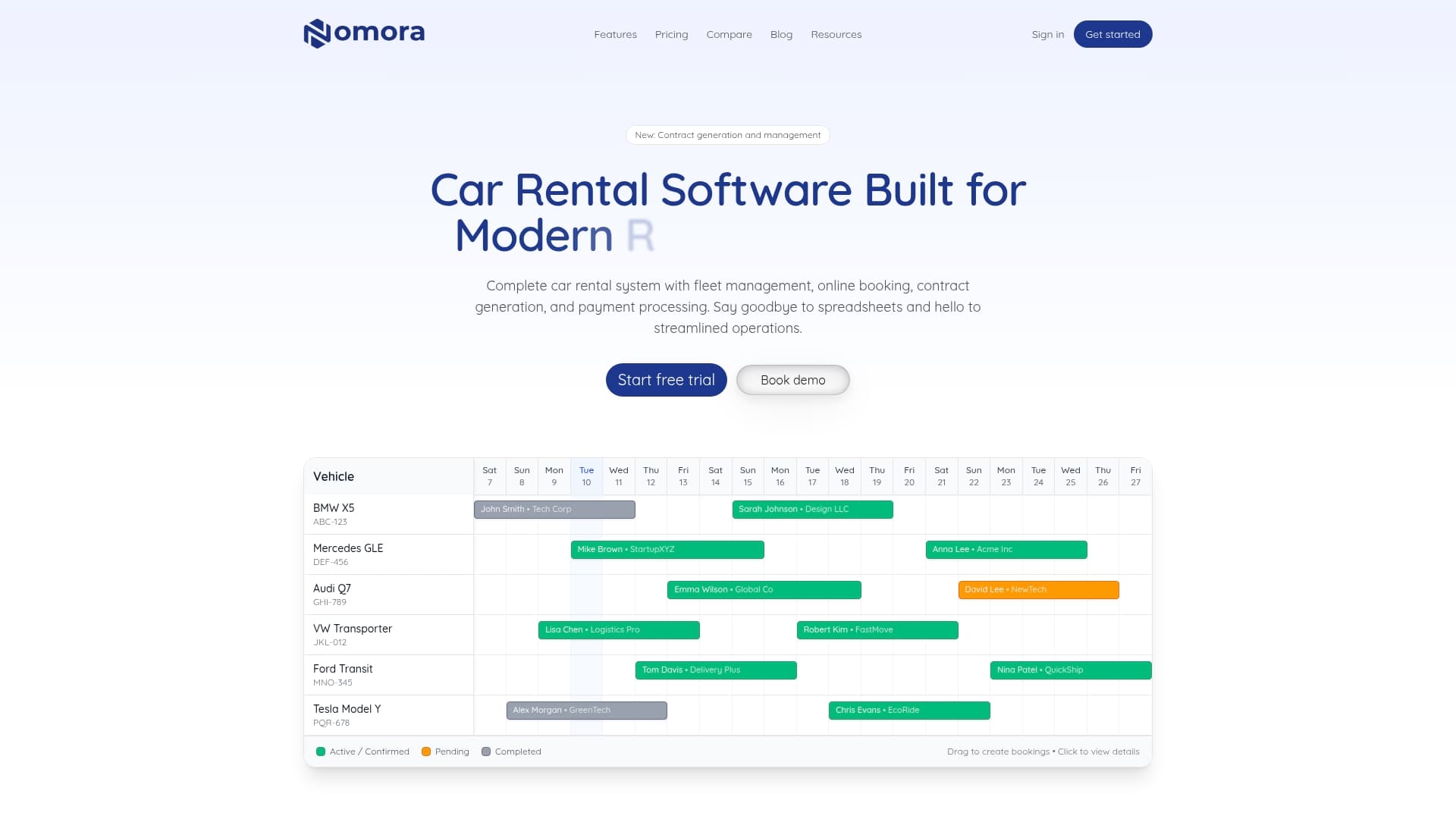
The difference between a smooth rollout and a stalled one is usually the quality of onboarding support. Nomora's onboarding process is structured around the same phased approach this guide describes, with configuration support, integration guidance, and training resources included. Whether you operate a 10-vehicle independent fleet or a multi-location franchise, Nomora's use-case library shows how the platform adapts to your specific operation type.
Schedule a demo to see the platform configured for your fleet size and get a realistic timeline for your rollout.
Sources
- A Step-by-Step Guide to Setting Up Car Rental Software
Recommended