TL;DR:
- Small and midsize car rental businesses often fail due to terminology gaps affecting decision-making.
- Understanding key metrics like FUR, ADR, and RevPAC improves fleet management and profitability.
- Clear, shared terminology enhances team accountability and operational efficiency.
Most small and midsize car rental businesses are leaving money on the table, not because of bad service or poor location, but because of terminology gaps. When your team doesn't share a common language around metrics like fleet utilization or cost structures like total cost of ownership, decisions get made on gut feeling instead of data. This guide breaks down the most important car rental industry terms in plain English, from profitability metrics and waiver definitions to operational charges and vehicle cost analysis. By the end, you will have a clear framework to communicate more effectively, manage smarter, and run a more profitable operation.
Table of Contents
Key Takeaways
| Point | Details |
|---|
| Know your key metrics | Understanding FUR, ADR, and RevPAC is essential for boosting fleet profitability. |
| Read waivers carefully | CDW and LDW details often exclude major items—always clarify what's covered. |
| Disclose fees transparently | Clear communication about surcharges and one-way fees builds trust and reduces disputes. |
| Track true vehicle costs | Total cost of ownership includes more than purchasing—factor every expense for smarter business decisions. |
| Use software to your advantage | The right digital tools streamline operations and ensure accurate use of industry terms. |
Understanding fleet utilization and profitability metrics
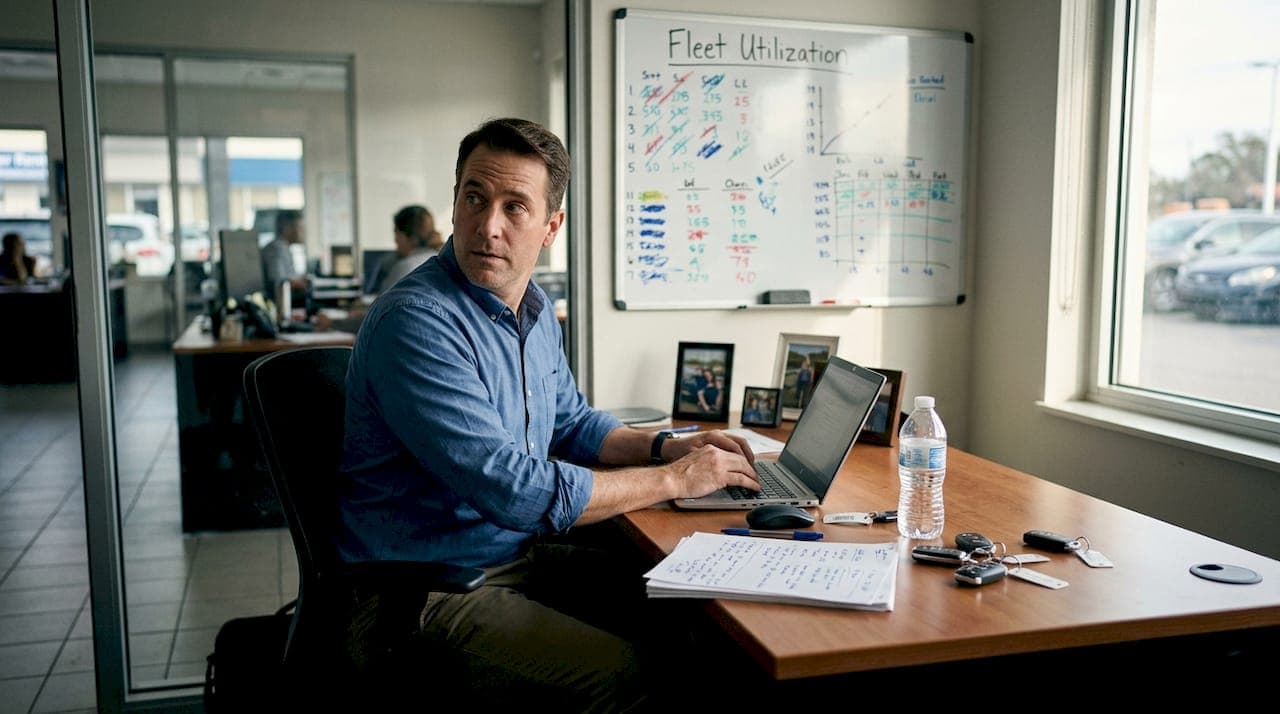
Three metrics sit at the center of every profitable car rental business: Fleet Utilization Rate (FUR), Average Daily Rate (ADR), and Revenue Per Available Car (RevPAC). Understanding each one individually is useful, but understanding how they interact is where real operational insight comes from.
Fleet Utilization Rate (FUR), sometimes called the Utilization Occupancy Rate (UOR), measures the percentage of your fleet that is actively rented at any given time. The formula is straightforward: divide rented vehicle days by total available vehicle days, then multiply by 100. According to FUR benchmarks, a rate between 75% and 85% is considered optimal for profitability. Below 75%, you are carrying too many idle vehicles. Above 85%, you risk maintenance strain and customer dissatisfaction from unavailability.
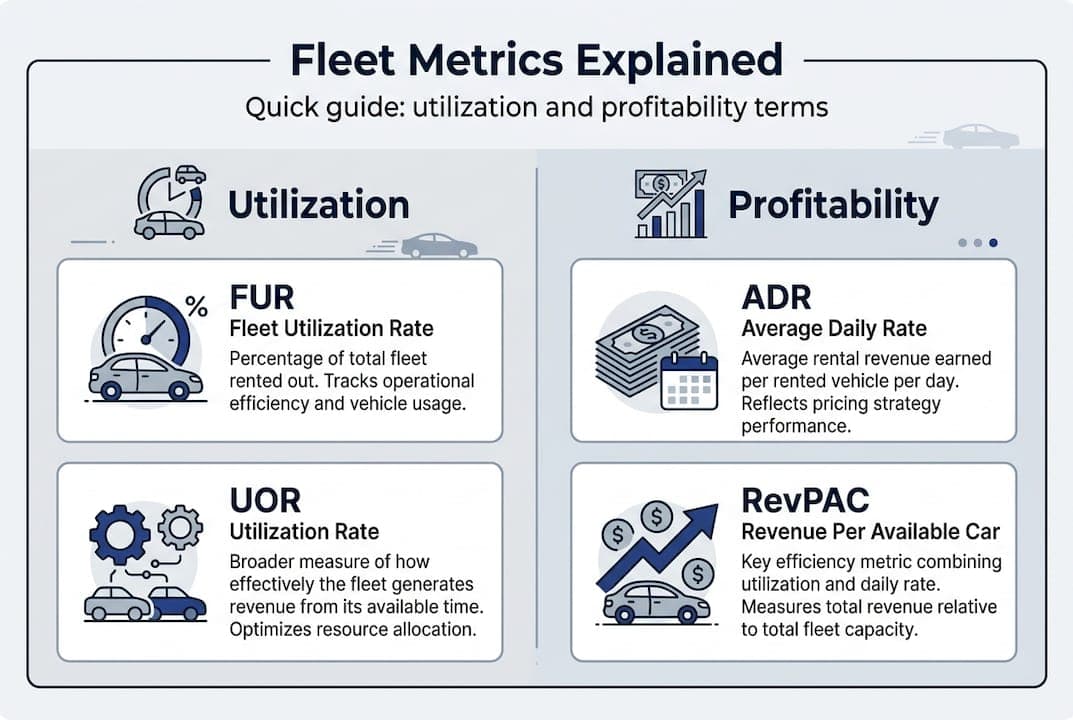
Average Daily Rate (ADR) is the average revenue earned per rented vehicle per day. In North America, ADR figures for standard segments typically range from $45 to $85 per day depending on vehicle class, season, and market. Operators who use dynamic pricing, adjusting rates based on demand, local events, or competitor pricing, consistently outperform those using flat rates.
RevPAC ties these two metrics together. It is calculated by multiplying your ADR by your FUR. If your ADR is $60 and your FUR is 80%, your RevPAC is $48 per car per day. This single number tells you more about fleet health than either metric alone. Explore fleet optimization tips and fleet reporting strategies to see how operators use RevPAC to guide pricing and fleet size decisions.
| Metric | What it measures | Optimal range | Common pitfall |
|---|
| FUR | % of fleet rented | 75% to 85% | Over-fleeting or over-utilization |
| ADR | Revenue per rented car/day | Varies by market | Flat pricing ignoring demand |
| RevPAC | Combined revenue efficiency | Depends on ADR x FUR | Tracking metrics in isolation |
Key factors that affect each metric include:
- FUR: Seasonal demand, fleet size relative to market, vehicle availability after maintenance
- ADR: Competitor pricing, vehicle class mix, booking channel (direct vs. OTA)
- RevPAC: The combined effect of pricing strategy and fleet availability
For utilization best practices, most operators benefit from reviewing these three metrics weekly rather than monthly.
Pro Tip: Running above 90% utilization might look great on paper, but it quietly accelerates wear and reduces the buffer for unplanned maintenance. Vehicles that never rest cost more to keep on the road long-term.
Decoding waivers and insurance: CDW, LDW, and common exclusions
Few areas of car rental terminology create more confusion than waivers. Customers often assume they are buying insurance. They are not. And when operators fail to clarify this distinction upfront, disputes and chargebacks follow.
Collision Damage Waiver (CDW) is a contractual agreement, not an insurance policy. When a renter accepts a CDW, the rental company agrees to waive its right to hold the renter financially responsible for collision damage to the vehicle, up to the limits stated in the contract. The key word is "waiver." No insurer is involved. The rental company absorbs the risk.

Loss Damage Waiver (LDW) builds on CDW by adding theft protection. If the vehicle is stolen and the renter has accepted an LDW, the company waives its right to recover the vehicle's value from the renter. However, both CDW and LDW come with exclusions that are easy to overlook. CDW and common exclusions such as tires, glass damage, and underbody damage are typically not covered under either waiver. Roof damage is another frequent exclusion.
| Feature | CDW | LDW |
|---|
| Collision damage | Covered (with limits) | Covered (with limits) |
| Theft | Not covered | Covered |
| Tires and glass | Excluded | Excluded |
| Underbody damage | Excluded | Excluded |
| Requires deductible | Often yes | Often yes |
Here is a practical process to verify waiver coverage before finalizing any rental contract:
- Read the full exclusion list in your standard rental agreement, not just the summary.
- Confirm whether a deductible applies and at what dollar amount.
- Check whether the waiver is voided by specific renter behaviors, such as driving on unpaved roads.
- Ensure your team can explain the difference between CDW and LDW in plain language.
- Review your rental contract essentials to make sure exclusions are clearly disclosed before signing.
"Waiver disputes are among the most common sources of post-rental conflict. Clear disclosure at the counter, not buried in fine print, is the single most effective way to reduce them."
Pro Tip: Single-vehicle incidents, such as a renter backing into a pole in a parking lot, are among the most frequently disputed claims. Many contracts quietly exclude damage that occurs when the vehicle is stationary or moving at very low speed. Make sure your contract language addresses this directly.
Operational charges: airport surcharges, one-way fees, and other fees explained
Beyond the base rental rate, operational charges are often where customer trust is won or lost. If a customer feels surprised by fees at pickup or return, that experience shapes every review they write afterward.
Airport surcharges, sometimes listed as a Concession Recovery Fee (CRF), are charges that rental companies operating at or near airports pass on to customers to cover the cost of airport access agreements. These fees are set by the airport authority and are typically calculated as a percentage of the base rental rate, often ranging from 10% to 15% of the total rental cost. They are not optional for operators who hold airport concession agreements.
One-way rental fees apply when a vehicle is picked up at one location and returned to another. The rationale is straightforward: someone has to drive that car back, and that costs money. For small operators, this rebalancing cost is often underestimated. The fee typically reflects the distance between locations, demand imbalance, and the labor cost of repositioning.
| Fee type | Typical range | Reason charged |
|---|
| Airport surcharge (CRF) | 10% to 15% of rental cost | Airport concession agreement |
| One-way fee | $50 to $300+ depending on distance | Vehicle repositioning cost |
| Young driver surcharge | $15 to $35 per day | Higher actuarial risk |
| Additional driver fee | $5 to $15 per day | Administrative and insurance cost |
For more context on these definitions, the fee glossary from Alpha Car Hire provides clear explanations of standard car rental fee terms. You can also use your rental operations checklist to ensure all charges are disclosed consistently.
Best practices for transparent fee disclosure include:
- List all applicable fees in the booking confirmation, not just at pickup
- Train your team to explain each fee in one sentence when asked
- Display a fee summary on your booking page before the customer enters payment details
- Avoid abbreviations like CRF without a plain-language explanation nearby
Pro Tip: For small operators managing one-way returns, consider partnering with a nearby operator to swap vehicles rather than paying staff to reposition. This informal network approach can cut repositioning costs significantly while building local business relationships.
Total cost of ownership (TCO): what every fleet manager should know
Revenue metrics tell you how well your fleet is performing. Total Cost of Ownership (TCO) tells you what that performance is actually costing you. Without both sides of the equation, profitability analysis is incomplete.
TCO in the car rental context refers to all costs associated with owning and operating a vehicle across its full lifecycle. According to the TCO definition in standard rental industry usage, this includes acquisition cost, depreciation, scheduled and unscheduled maintenance, insurance premiums, fuel, registration, and the revenue lost during downtime. Each of these components erodes margin in a different way, and most operators only track a few of them consistently.
Hidden costs that frequently blindside operators include:
- Opportunity cost of downtime: Every day a vehicle sits in the shop is a day it earns nothing
- Residual value miscalculation: Overestimating resale value inflates apparent profitability
- Tire and consumable cycles: Often tracked separately from maintenance, leading to budget gaps
- Administrative labor: The staff time spent managing a vehicle's paperwork and compliance
- Technology and telematics costs: GPS units, software subscriptions, and integration fees
Operators who invest in predictive maintenance strategies see measurable results. Lean-TPM (Total Productive Maintenance) approaches have demonstrated cost reductions of up to 18% and vehicle availability improvements of 10% to 20% for SME fleets. Tracking fleet depreciation costs by vehicle segment, rather than averaging across the whole fleet, reveals which models are genuinely profitable and which are dragging down margins. You can also review software features for TCO and technology investment costs to understand how modern tools support this analysis.
Pro Tip: Segment your TCO analysis by vehicle class. Compact cars and luxury vehicles rarely have the same cost profile, and treating them as one group masks the true profitability of each segment. This single change often reveals which vehicles to expand and which to phase out.
Industry terms matter more than you think: Lessons from real operators
Here is something most industry guides won't tell you: terminology is not just about communication. It is about accountability. When your team uses the same definitions for FUR, ADR, and TCO, they can be held to the same standards. When those definitions are vague or inconsistent, performance conversations become arguments about what the numbers even mean.
We have seen operators lose revenue not because their fleet was too small or their pricing was wrong, but because their team was measuring utilization differently across locations. One manager counted vehicles under repair as "available." Another didn't. The result was a 12-point gap in reported FUR that made one branch look far more efficient than it actually was.
CDW confusion is equally costly. When front-desk staff can't clearly explain the difference between CDW and LDW, customers either decline coverage they need or dispute charges after the fact. Both outcomes hurt the business.
"The operators who grow fastest are not always the ones with the biggest fleets. They are the ones whose entire team speaks the same operational language."
Using shared terminology as a training tool, not just a reporting tool, is one of the highest-leverage changes a small operator can make. Centralized systems and Lean-TPM show that standardization at the process level, including language, drives measurable efficiency gains. Pairing that with the right efficiency features turns terminology mastery into operational results.
Take the next step: Smarter operations with Nomora
Understanding car rental industry terms is the foundation. Putting them into practice every day is where the real work happens.
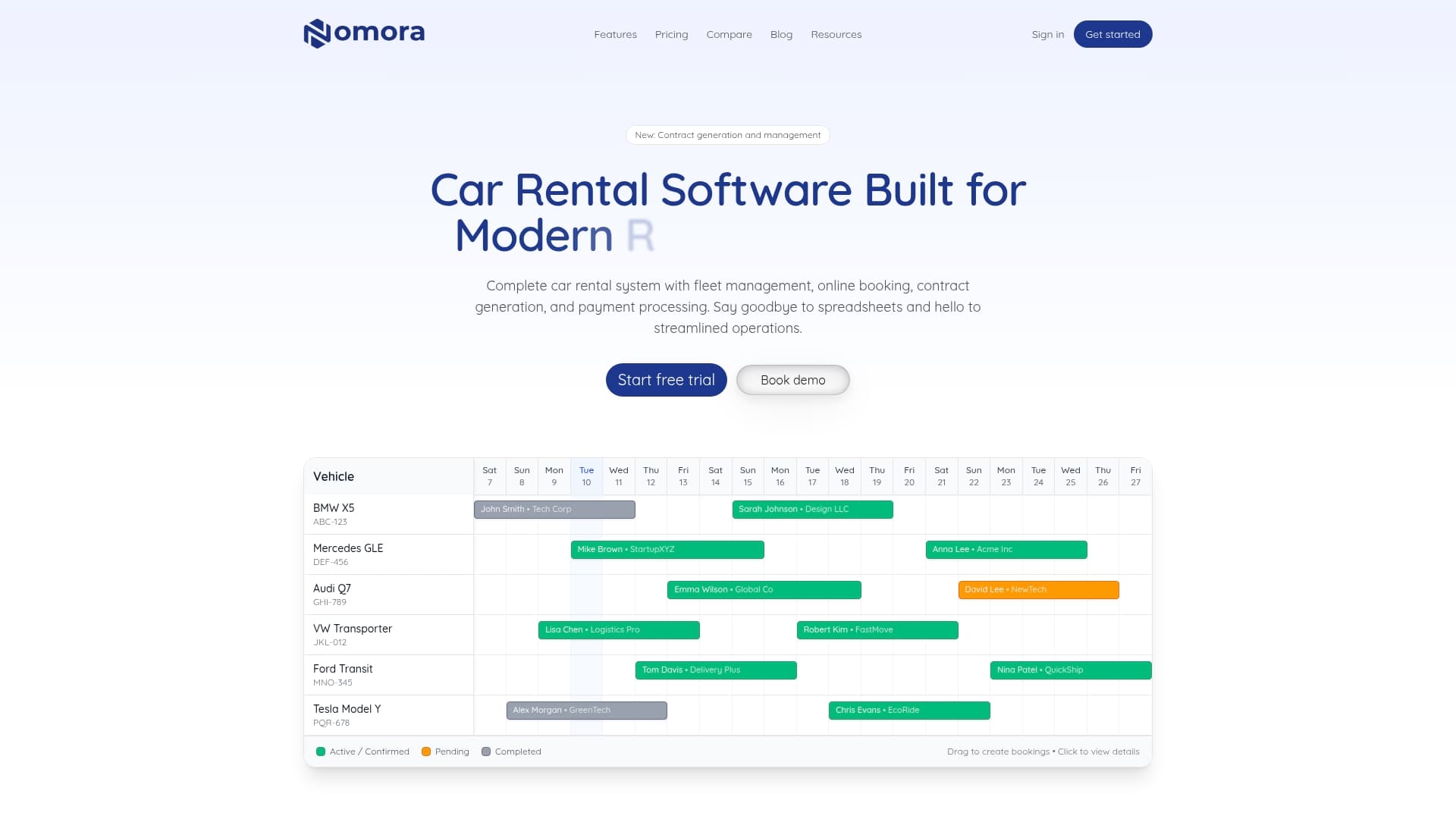
Nomora is built specifically for small and mid-sized rental operators who want to move beyond spreadsheets and manual tracking. The platform acts as the central nervous system of your operation, connecting reservations, fleet data, contracts, and payments in one place. You can explore real-world software use cases to see how operators like you are applying these metrics in practice. Features like conflict-free scheduling help you prevent double bookings, while built-in tools let you automate payment processes and reduce administrative overhead. If you are ready to turn terminology into results, Nomora makes the transition straightforward.
Frequently asked questions
What is a good fleet utilization rate for car rental companies?
A fleet utilization rate between 75% and 85% is considered optimal, as rates above or below this range signal either excess inventory or unsustainable demand pressure on your fleet.
How do CDW and LDW differ in car rental agreements?
CDW covers collision damage only, while LDW also includes theft protection, but both waivers typically exclude tires, glass, and underbody damage regardless of which option a renter selects.
Why do airport car rentals often cost more?
Airport rentals include a concession recovery fee that operators pass on to cover the cost of airport access agreements, which are mandatory for any company operating from an airport facility.
What does total cost of ownership (TCO) mean for rental fleets?
TCO covers every cost tied to a vehicle across its full lifecycle, and tracking it accurately is the only reliable way to know which vehicles in your fleet are genuinely profitable.
How can software help manage car rental operations using these terms?
Modern rental software tracks FUR, ADR, and maintenance cycles automatically, and technology-driven fleet management reduces reporting errors while giving managers real-time visibility into the metrics that matter most.
Recommended