A booking cut-off time is the last moment a customer can reserve a vehicle online before the pickup. Set it by working backward from the real work behind each rental: vehicle preparation, staff on shift, payment checks and paperwork. Then pair it with a clear hold period, the time you keep a vehicle for a customer who has not yet arrived or paid. This guide shows how to choose both numbers, how to use lead-time data to adjust them, and how to keep every channel consistent.
TL;DR
- A cut-off time closes online booking a set number of hours or days before pickup. A hold period controls how long you keep a vehicle for a customer who has not collected it or completed payment.
- Base the cut-off on preparation time and staffing, not on a rule of thumb. Different vehicle classes and locations often need different cut-offs.
- Review your lead-time distribution (how far ahead customers book) before changing any rule, then revisit it each season.
- Write exceptions down: who may approve an after-cutoff booking, and what must be checked first.
- Keep all channels on the same live availability so a cut-off never produces a double booking.
Table of Contents
What the terms mean in car rental
Four phrases get mixed up, so define them before you set a number.
- Booking cut-off time: the minimum gap between a booking and the pickup. A two-hour cut-off means a 3:00 p.m. pickup can be booked online until 1:00 p.m.
- Reservation cut-off (by day): the same idea for longer horizons, such as requiring bookings for a specialty vehicle at least one day ahead.
- Reservation hold period: how long a vehicle stays reserved for a customer after the scheduled pickup, or while a payment or approval is pending.
- Lead time: the gap between the day a customer books and the day they pick up. It is a measurement, not a rule, and it is what tells you where a sensible cut-off sits.
Cut-off and hold are two sides of one promise. The cut-off protects your team from bookings it cannot prepare for. The hold protects your fleet from sitting idle for a customer who may never show.
Why the cut-off matters more in rental than in most businesses
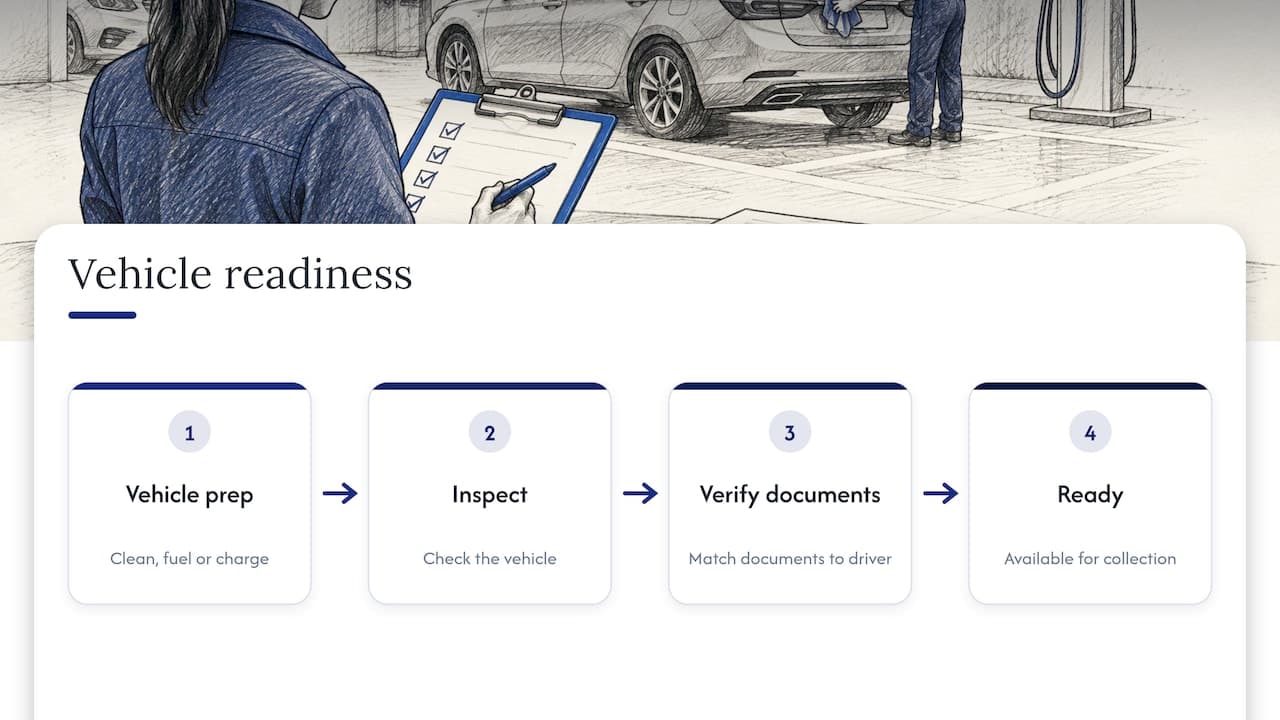
A tour operator sells a seat. A rental company sells a specific vehicle class that has to be cleaned, fueled or charged, inspected and matched to a driver whose documents you need to verify. A vehicle's status can shift several times in one day: reserved, ready, collected, returned, being cleaned, under inspection, awaiting maintenance or temporarily unavailable. A booking that arrives 20 minutes before pickup may be technically available in your calendar and still be impossible to deliver.
A cut-off that is too loose creates rushed handovers, skipped inspections and disputes about condition. One that is too strict loses profitable walk-up and same-day demand, which for many US renters (travelers whose plans changed, drivers with a car in the shop) is exactly the customer with the least price sensitivity.
How to choose your cut-off: work backward from the work
Start with the tasks that must be finished before a customer can drive away, and add their durations.
Map the steps behind a booking
List what happens between "booking received" and "keys handed over":
- Confirming the vehicle class is actually free, not just shown as free
- Cleaning, fueling or charging, and an inspection
- Verifying the driver's license and any required customer information
- Taking payment or a deposit
- Preparing the contract
- Moving the vehicle if it sits at another location
A team that can turn a returned compact around in 45 minutes needs a shorter cut-off for compacts than for a 15-passenger van that needs a longer walk-around inspection. That is why a single cut-off for the whole fleet is usually the wrong design.
Use different cut-offs for different products
A practical starting grid looks like this. Treat the numbers as placeholders to replace with your own turnaround times.
| Vehicle type | What drives the cut-off | Typical starting point to test |
|---|
| Economy and compact | Cleaning and quick inspection | Short, a few hours |
| SUVs and minivans | Inspection, child-seat or accessory fitting | Moderate, half a day |
| Luxury and specialty | Detailed inspection, deposit authorization, extra document checks | Longer, one day or more |
| Corporate fleet assignments | Approval workflow, driver eligibility | Set by internal policy |
| Delivery or airport pickup | Travel time and staffing at the other location | Based on route time plus buffer |
Luxury and specialty operators in particular benefit from a longer cut-off, because each handover involves more verification and a higher-value deposit.
Check whether late bookings are profitable
A late booking is not automatically good business. Compare the revenue from same-day reservations against the extra labor, the chance of rushed condition reports and the cancellation rate on those bookings. If same-day customers cancel or no-show more often, either tighten the cut-off or require full payment at booking. Our guide to stopping car rental no-shows with deposits and online payment covers the payment side of that trade-off.
Reservation hold periods: how long to keep the vehicle
A hold period answers a different question: when is the customer late enough that the vehicle can go back into inventory?
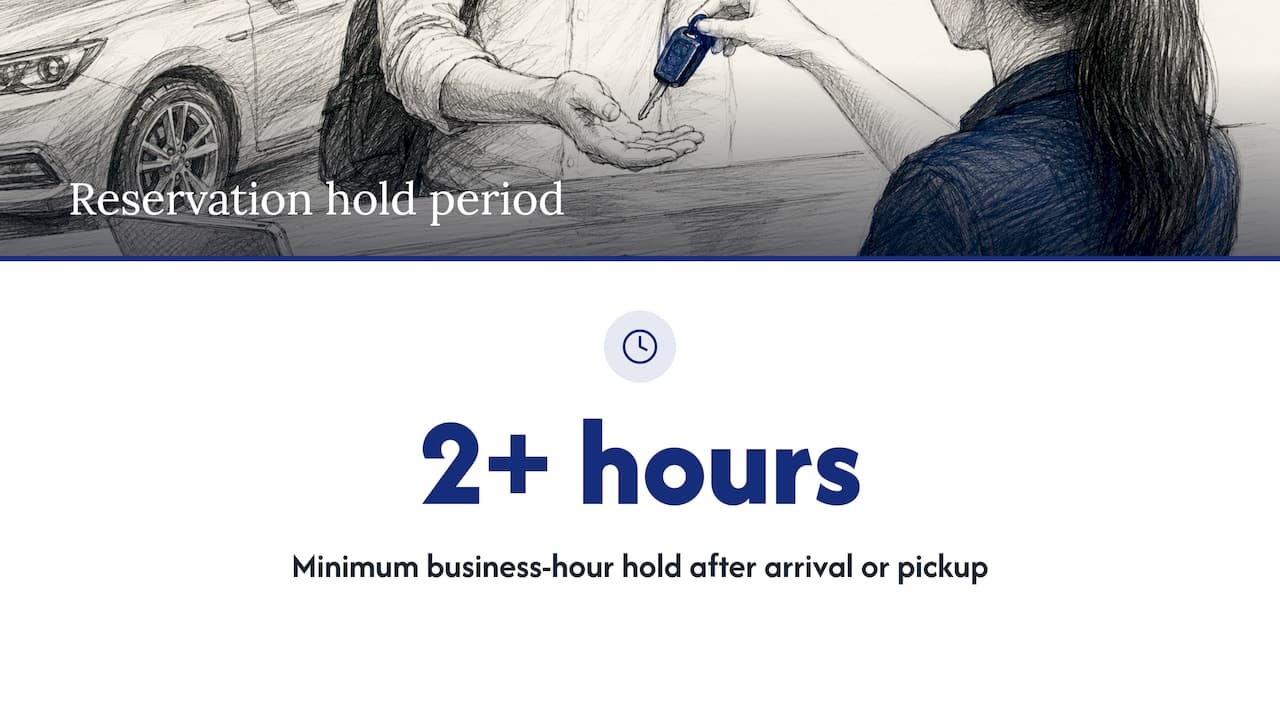
The clearest public example comes from the federal government. The U.S. Government Rental Car Agreement used for official travel says a confirmed reservation is held for at least two normal business hours after the scheduled flight arrival, or after the scheduled pickup time when the flight time is unknown. You can read the wording in the U.S. Government Rental Car Agreement. Your own policy can differ, but the structure is a good model: it ties the hold to a flight or a stated pickup time and counts business hours, so a late-night arrival is treated fairly.
Three hold situations to define separately
- Late arrival after a confirmed, paid booking. Decide how long you wait, whether the clock follows a flight arrival, and how you contact the customer before releasing the car.
- Pending payment or approval. If a booking needs a deposit, a document check or manager approval, set a window in which it stays held, and what happens when it lapses.
- Held but unpaid web booking. A short timer works best, because every hour a vehicle is held for no one is an hour it cannot be sold to someone else.
Do not treat a displayed reservation as a confirmed rental unless you have defined the state change that makes it so. Decide in writing which event confirms it: a successful payment, a deposit authorization, an approved license check, or all three. Then make your confirmation message state the same thing.
Vehicle readiness affects the hold
A hold is only fair if the car is ready when the customer arrives. That depends on maintenance as much as cleaning. Operators in the Dallas area, for example, can plan service windows around reservations with fleet maintenance in Richardson, so vehicles are not pulled from service on the day they are promised.
Use lead-time analysis to adjust the rules
Do not set cut-offs from instinct alone. Your booking history already shows how customers behave.
Measures worth tracking
- Lead-time distribution: what share of bookings arrive same day, one to three days out, one to four weeks out, and beyond
- Booking velocity: how quickly reservations accumulate ahead of a date
- Booking status: confirmed, completed, cancelled, no-show
- Cancellations and no-shows, split by lead time
- Booking source: your website, phone, partners or marketplaces
- Revenue and average order value by rental duration
- Utilization: current and forecast, by vehicle class
The question that makes these numbers useful is a split: do same-day bookings cancel more often than bookings made a week ahead? Does a booking from one channel carry more no-shows than another? The answer tells you whether to shorten the cut-off, add a deposit requirement for late bookings, or leave the rule alone.
A worked example
Suppose a 40-vehicle operator reviews three months of bookings and finds:
- 18% of bookings are made on the day of pickup
- Those same-day bookings are mostly compacts and midsize cars
- SUVs and vans are booked, on average, several days ahead
A sensible response is a short cut-off for compacts and midsize cars, with payment at booking, and a one-day cut-off for SUVs and vans. These figures are illustrative, not benchmarks. The point is that the rule follows the pattern in the data, class by class.
Let seasons and locations change the answer
Lead times stretch before summer travel and holiday weekends, and shrink in quiet months. A location at an airport sees a different mix than a neighborhood branch near a repair shop. Review the distribution each season and by pickup location, and change cut-offs only when the pattern holds across several weeks. For the forecasting side, see our piece on demand forecasting for car rental, and for the utilization side, our guide to maximizing rental utilization.
Handle late bookings with a written exception process
Exceptions are where cut-offs usually break. A counter agent accepts a 20-minute-notice booking as a favor, the car is not ready, and the customer's first impression is a delay.
Control exceptions instead of improvising them:
- Name who can approve an after-cutoff booking.
- Check capacity: is a vehicle of that class truly free and ready, or about to return?
- Check payment status: full payment or a deposit authorization before you promise the car.
- Check staffing: will someone be at the counter or the delivery point?
- Collect required customer information before the booking goes live.
- Confirm preparation time and tell the customer the realistic pickup time.
Only then enter the booking into your live system. If a customer is turned away, offer the next best option, such as a different class or a later pickup, or add them to a waitlist. Our waitlist management guide explains how to turn declined requests into later revenue.
Keep every channel on the same availability
A cut-off is only as good as the data behind it. If your website, phone desk and marketplace listings each hold their own copy of the calendar, a cut-off set in one place will be ignored in another. The result is overbooking, double bookings and apologetic calls.
Make sure all sales channels read from the same live availability, and that the same cut-off logic applies everywhere a customer can book. Read more in our guides on preventing double bookings and on overbooking controls at the counter.
Write the policy down and show it at booking
The cut-off and hold rules must be visible before the customer pays and repeated in the confirmation. A clear policy page and confirmation should state:
- The cut-off for each vehicle class or location
- What confirms a reservation
- How long you hold a vehicle after the scheduled pickup
- Deposit, payment, cancellation and no-show terms
- How the customer can reach you if they are running late
Keep a record of the terms that applied to each booking. When a dispute comes up over a released vehicle or a charged no-show fee, the confirmation the customer received is your evidence. For payment and cancellation wording, see our 2026 guide to managing rental cancellations. Check your state's rules on fees and card holds with your own counsel or state consumer agency before you publish terms, because they vary.
Our perspective
Think of your rental software as the central nervous system of the operation. Every cut-off, hold and exception is only as reliable as the signal that reaches the people acting on it.
We see the same pattern in rental companies that run on spreadsheets. The cut-off exists in someone's head, the calendar lives in three places, and a booking taken at 4:50 p.m. for a 5:00 p.m. pickup collides with a car that was already promised. The rule was fine. The system could not enforce it.
That is why we built Nomora around real-time reservation and fleet tracking, conflict-free bookings, automated contracts and integrated payments in one cloud platform. When availability, payment status and vehicle information sit in one place, a policy stops depending on memory. Your team can see what is ready, what is held and what is paid, from any device.
Our advice: start with a cut-off by vehicle class, tie confirmation to payment, write down who approves exceptions, and review your lead-time data each season. Teams that do this spend less time on avoidable admin and more time on customers.
Dizzy
Put your cut-off rules to work
If your rules live in a spreadsheet and a few habits, moving them into one system is the fastest way to make them stick. Nomora is cloud-based rental management software covering reservations, fleet management with GPS tracking, contract generation, payments and customer data, and we aim to get you fully operational in 24 to 48 hours.
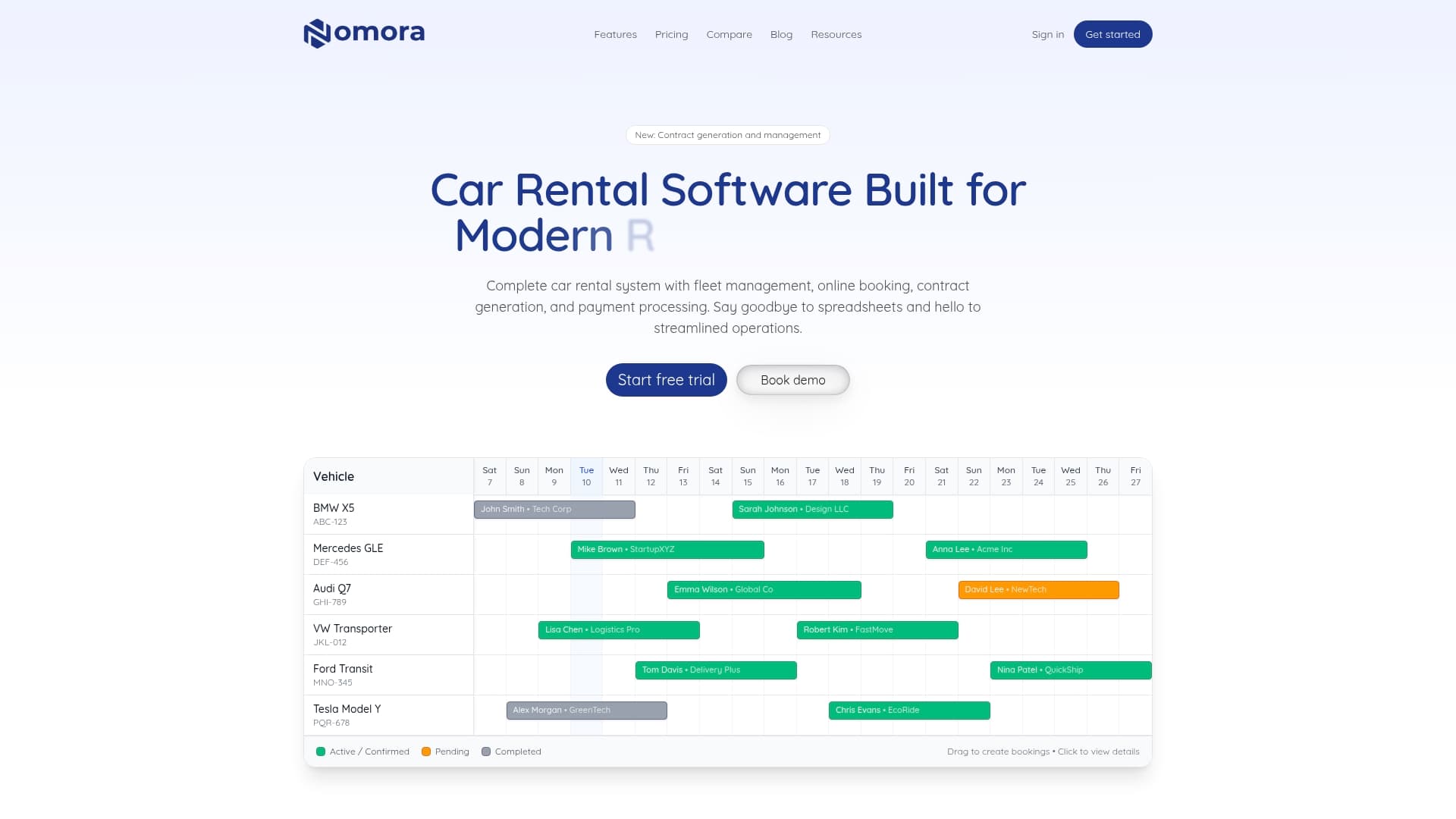
Plans start with Starter at €45 per month. Business is €2.80 per vehicle per month and Fleet is €2.20 per vehicle per month, with every feature included in each plan. Enterprise has no published price. See the Nomora pricing page for details, or look at how we handle automated car rental payments to confirm bookings at the moment of reservation.
FAQ
What is a good booking cut-off time for a car rental company?
There is no universal number. Work backward from your real preparation time for each vehicle class, then add a buffer for staffing and payment checks. Compacts may support a cut-off of a few hours, while luxury and specialty vehicles often need a day or more.
How long should you hold a reservation for a late customer?
Choose a window and state it in the confirmation. For reference, the U.S. Government Rental Car Agreement holds a confirmed reservation for at least two normal business hours after the scheduled flight arrival or pickup time. Contact the customer before you release the vehicle, and record the attempt.
Should same-day bookings be allowed?
Often yes, if you can prepare the vehicle and verify the driver in time. Compare same-day revenue with its extra labor and cancellation rate. If late bookings are riskier, require full payment at booking or shorten the window rather than closing it entirely.
How do you analyze reservation lead times?
Group bookings by how far ahead they were made, then compare cancellations, no-shows, utilization and revenue across those groups. Split the results by vehicle class, booking source, season and pickup location. Change a cut-off only when the pattern holds over several weeks.
How do cut-offs prevent double bookings?
They do so only when every channel reads from the same live availability. The cut-off stops late bookings your team cannot prepare for, and a single shared calendar stops two customers being promised the same car.
Sources
Recommended