ACH (Automated Clearing House) is the U.S. bank-to-bank transfer network, and a rental company can use it to collect deposits, rental charges and recurring corporate fleet invoices without card fees on every payment. It works well when three things are in place: a written or electronically authenticated authorization for each customer, a clear picture of when funds can be relied on, and a payment record tied to the reservation and the vehicle. That last part is where most small operators lose time, and it is where a rental management platform like Nomora earns its place, because reservations, contracts, payments and customer data sit in one system instead of in a bank portal and a spreadsheet.
This guide is for owners and managers of small and mid-sized rental companies, luxury and specialty rental operators, and corporate fleet managers. It does not cover consumers who want to pay for a rental.
TL;DR
- ACH moves money between U.S. bank accounts in batches. Debits settle one or two business days after they are sent, so plan your release of a vehicle around that, not around the click of a button.
- You are the "Originator" of the debit, which means you must hold a valid authorization and keep it for as long as the rules require.
- Use the right transaction type. Consumer codes on a business account give the account holder a much longer window to dispute.
- Return codes, return-rate thresholds and fraud controls are your operating risk. Watch them like you watch damage claims.
- Every ACH payment should be matched to a reservation, a contract and a vehicle. Software that links them removes most reconciliation work.
Table of Contents
What ACH is and why rental companies use it
The Federal Reserve describes the ACH as a nationwide network in which depository institutions send each other batches of electronic credit and debit transfers. The Reserve Banks and Electronic Payments Network are the two national operators, and the network now handles one-time debits, including payments authorized over the phone or the internet, not only payroll and recurring bills (Federal Reserve Board).
For a rental business, that opens several uses:
- Security deposits and balances from customers who would rather pay from a bank account than a card.
- Monthly invoices to corporate accounts, dealerships, insurance replacement programs and long-term renters.
- Recurring payments for subscription-style or multi-month rentals, where the same amount leaves the same account on a schedule.
Two cautions shape everything below. ACH only moves money inside the United States (Capital One), so it suits domestic customers and corporate accounts, not an international tourist at the counter. And ACH is slower than a card authorization, so it fits bookings made in advance, invoiced accounts and recurring billing better than a walk-up rental.
You are the originator: what that means
Nacha, the body that writes the ACH rules, uses a vacation-rental example to make a point that applies directly to you. A rental business collecting payments from renters is the Originator of the ACH debit, because it obtains the authorization on its own behalf. Collecting from the renter and passing proceeds on to anyone else are two separate transaction types (Nacha ACH Operations Bulletin #2-2014).
In practice, the Originator carries the compliance duty. Your bank (the ODFI, or originating depository financial institution) sends your files into the network, but the authorization, the record keeping and the customer relationship are yours.
Setting up ACH collection step by step
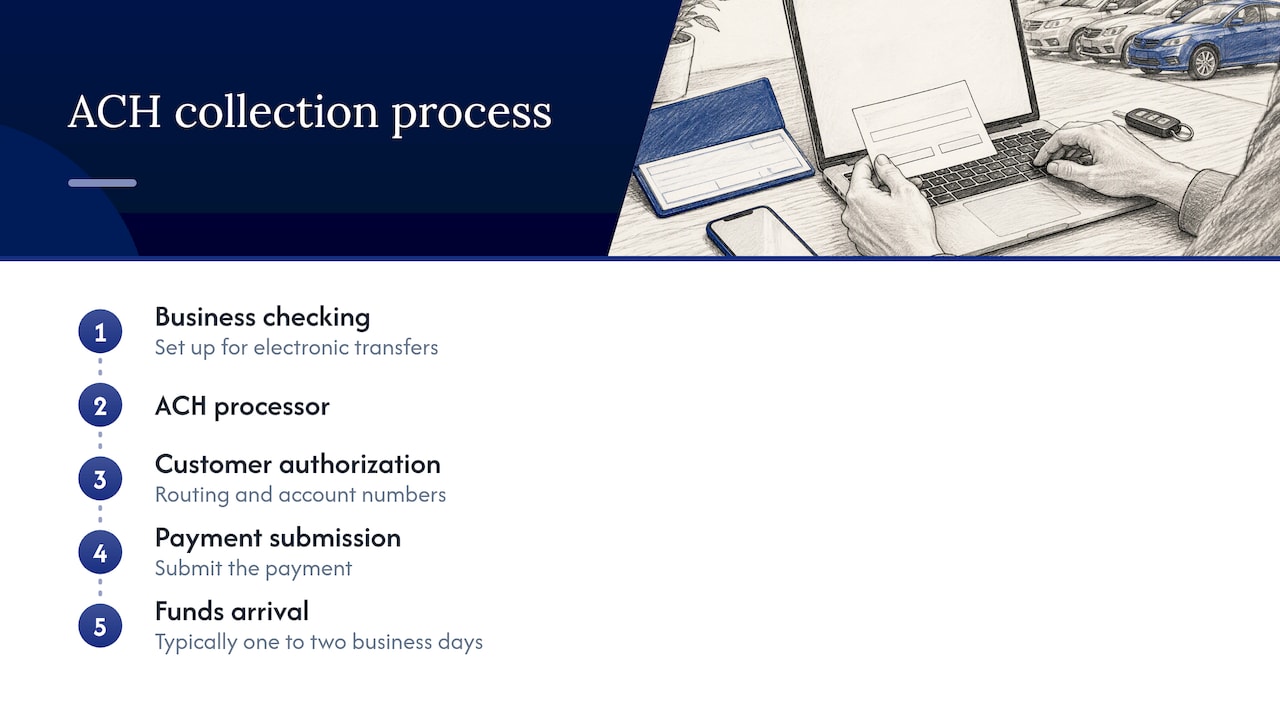
Capital One's guide lays out the basic sequence: a business checking account set up for electronic funds transfers, an ACH processor, the customer's authorization with their routing and account numbers, and then submission of the payment. Funds typically reach your account in one to two business days (Capital One). Here is how that looks for a rental operation.
1. Open the right account and choose how you will originate
Talk to your bank about ACH origination or about a payment processor that originates on your behalf. Ask about daily and per-file limits, cutoff times and fees. The FDIC tells examiners to look at limit structures and customer exposure limits, both single-day and multi-day (FDIC), so expect your bank to set limits based on your volume and risk. A company with a handful of luxury vehicles and large deposits needs different limits than a 300-car fleet billing monthly.
Where it goes wrong: Operators discover a limit only when a large deposit batch is rejected. Settle the limits before you promise customers ACH.
2. Write an authorization that meets the rules
Nacha's developer guide says consumer debit authorizations must be in writing or similarly authenticated, with clear and readily understandable terms. For recurring debits, you must tell the customer how to revoke (Nacha ACH Developer Guide).
A bank's origination guide spells out what a consumer authorization for PPD (prearranged) or WEB (internet-initiated) debits must state: whether it covers a single, recurring or standing entry, the amount or how it is determined, timing and frequency, the customer's name, the account to be debited, the authorization date and how to revoke. The guide also requires keeping the authorization for two years after cancellation or termination (Cornerstone Bank origination guide, 2024).
For a rental company, the wording has to fit how rentals really work. A single authorization often needs to cover the base rental, a deposit, and possibly later charges such as tolls, fuel or damage. If the authorization does not say how those amounts are determined, a debit for them can be returned as not in accordance with the authorization terms.
What to do: Put the ACH authorization inside the rental contract or the online booking flow, with the amount logic stated in plain words and a stored, dated record. With Nomora, contracts are generated automatically and linked to the reservation and customer record, so the signed terms and the payment sit side by side.
3. Validate accounts and identity
For internet-initiated (WEB) debits, the same bank guide lists extra duties: an annual audit of how financial information is protected, a commercially reasonable fraud-detection system that screens transactions, validation of account numbers before first use and after any change, authentication of the person authorizing the payment, and validation of the routing number before processing (Cornerstone Bank).
These are not extras for large companies only. A rental business sees stolen identities and bad accounts precisely because a vehicle is a high-value item that can leave the lot.
4. Submit the debit and track its status
Once the payment is submitted, it is not final. A debit can be returned, and you need to see that return against the right booking quickly. This is the step where spreadsheets fail, since the bank statement shows an amount and a date, while the booking shows a customer and a car.
Timing: when you can rely on the funds
The FFIEC handbook says ACH transactions are sent in batches one or two business days before settlement. Reserve Bank settlement of credits is final at 8:30 a.m. ET on the settlement day and of debits at 11:00 a.m. ET, assuming sufficient funds and no returns (FFIEC IT Examination Handbook).
For same-day processing, Nacha raised the Same Day ACH limit to $1 million per payment (Nacha), which is far above any single rental charge, though your own bank's limits and cutoffs still apply.
What this means for your counter and your calendar:
- Collect early. For a reservation made a week ahead, pull the deposit at booking and the balance several business days before pickup.
- Mind weekends and holidays. A Friday-evening debit does not start settling until the next business day. A Saturday pickup funded by a Friday debit is a risk you are carrying.
- Set a release rule. Decide whether keys are released on submission, on settlement, or only after the return window for your risk level, and apply it the same way every time.
A settled debit is also not a guaranteed one. Returns for properly authorized debits must be made no later than the second banking day after settlement. For debits that were not properly authorized, the bank's exposure can run up to 60 days from when the consumer's periodic statement is sent (FFIEC IT Examination Handbook, ACH).
Pick the right transaction type for the customer
The origination guide lists PPD and WEB as consumer transaction types, with uses that include rent payments and payments for goods and services. It also warns that using PPD or WEB for a corporate account extends consumer protections: the account holder gets a 60-day right of return, against 2 days for an unauthorized corporate debit (Cornerstone Bank).
This matters if you serve both individuals and businesses:
| Customer | Typical account | Transaction type to discuss with your bank | Dispute window to plan for |
|---|
| Individual renter paying online | Personal checking | WEB (internet-initiated) | Up to 60 days for unauthorized debits |
| Individual renter with a signed agreement | Personal checking | PPD (prearranged) | Up to 60 days for unauthorized debits |
| Corporate fleet account | Business checking | Corporate code (your bank will name it) | 2 days for unauthorized debits |
A corporate fleet manager paying a monthly invoice gives you a shorter exposure window, which is one reason to build ACH around business accounts first.
Return codes and thresholds to watch
Returns are the cost of doing business on ACH, and each code points to a fix. The same guide lists the common ones: R01 and R09 for insufficient or uncollected funds, R02 account closed, R03 no account, R04 invalid account number, R05 unauthorized debit using a corporate code, R07 authorization revoked, R08 payment stopped, R10 customer advises not authorized, R11 entry not in accordance with authorization terms, and R29 corporate customer advises not authorized (Cornerstone Bank).
How a rental operator can read them:
- R01 and R09 (funds): collect earlier, and keep a fallback payment method on the contract.
- R02, R03, R04 (account problems): validate account details when the customer first enters them.
- R07, R08, R10 (revoked, stopped, not authorized): the dispute is about the relationship or the authorization. Look at your stored contract and the charge description.
- R11 (not per authorization): you debited an amount the agreement did not describe, typically an add-on charge.
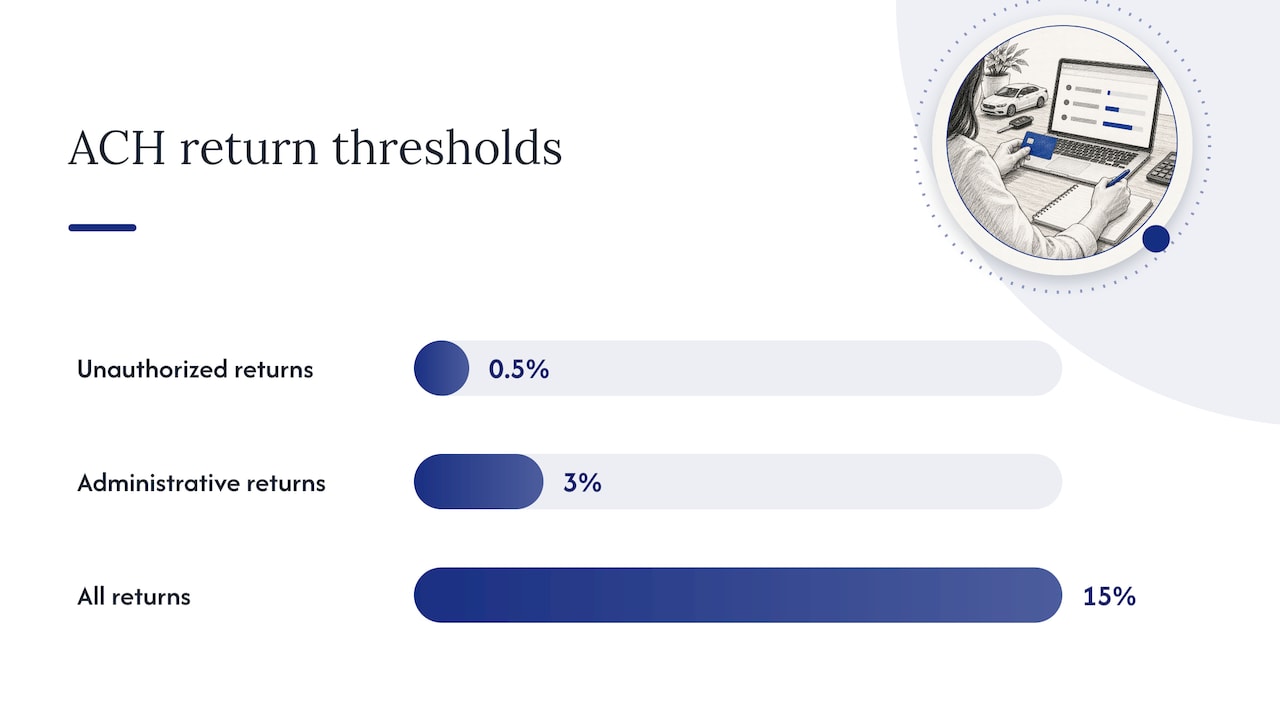
The guide also sets return-rate thresholds: 0.5% for unauthorized returns, 3% for administrative returns and 15% for all returns. A violation brings a 30-day remediation plan and 180 days below the threshold (Cornerstone Bank). Track your own rate monthly. For a business with 200 ACH debits a month, a single unauthorized return already amounts to 0.5%, which shows how small volumes can hit a ratio quickly.
Safeguards that protect a rental business
The FFIEC handbook notes that ACH brings credit, liquidity and operational risks, that fraud can be reduced through due diligence on originating customers and strict adherence to ACH and credit policies, and that Regulation E, which covers notices, authorization, error resolution and timing for consumer electronic transfers, applies to ACH (FFIEC).
The FDIC's examination policy gives a useful checklist of controls, even if you are not a bank: separate the people who set up access, create payment files and approve them; set limits and time-of-day restrictions; monitor for unusual activity; reconcile against independent information; cap customer exposure; and require multi-factor authentication for internet-based ACH products (FDIC).
Translated for a rental office:
- The person who creates a refund or a manual debit should not be the one who approves it.
- Require multi-factor sign-in for everyone with payment access, including remote staff.
- Reconcile every settlement against reservations weekly at minimum, daily for larger fleets.
- Set a cap on how much one customer can owe through ACH before a manager reviews it.
For more on transaction monitoring, account validation and approval controls in payment operations, see this overview of contact center payment security. If you take payment details online, this piece on cybersecurity for online payments covers the wider risks.
Nacha has also been phasing in rules that require fraud monitoring by parties in the ACH network, with a first phase taking effect on March 20, 2026 (Oscilar summary of the Nacha rules). Ask your bank or processor which phase applies to your volume, and what they will expect from you.
Reconciling ACH with reservations, contracts and the fleet
Collecting the money is half the job. The other half is knowing what each deposit on your bank statement pays for. A typical month-end problem looks like this: a $1,450 ACH credit appears, and nobody is sure whether it is a balance on a three-day SUV rental, two small deposits combined by a corporate customer, or a refund that bounced.
A clean routine has four parts:
- One reference per payment. Every debit carries the reservation or contract number in its description.
- One record per customer. Authorization, account details status and payment history live with the customer, not in someone's inbox.
- Returns posted the same day. A returned debit reopens the balance on the contract and flags the vehicle's status.
- Fleet-level view. Revenue and receivables by vehicle show which cars are paying for themselves.
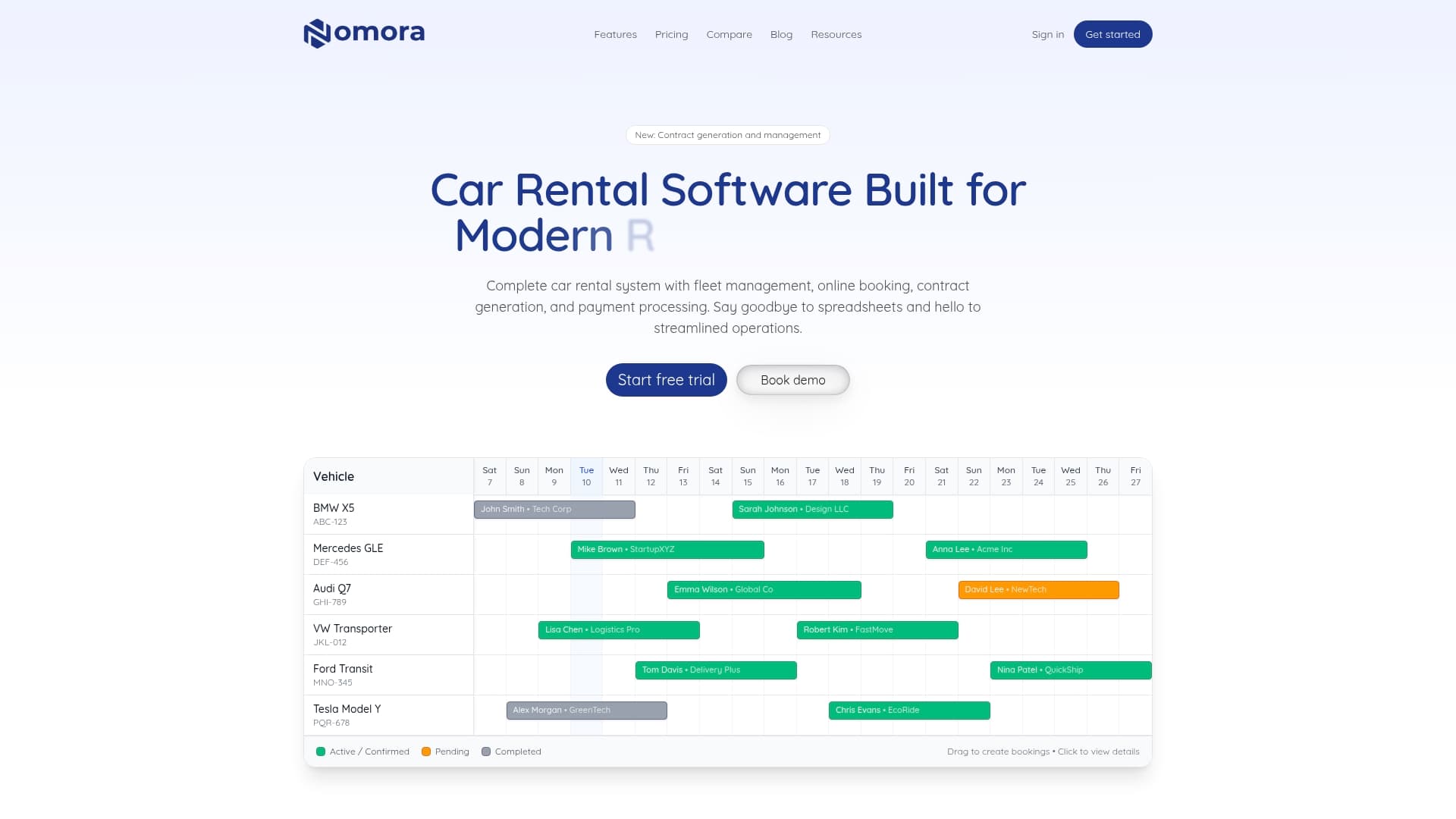
This is the part of the job that software does better than manual work. Nomora is a cloud-based platform that replaces spreadsheets with one system for reservations, fleet management, automatic contract generation, payments and customer data, with real-time visibility and conflict-free booking. Because the payment sits in the same record as the booking and the contract, the question "what is this deposit for?" has an answer on screen.
Where Nomora fits
If you are moving from spreadsheets and a bank portal to a connected system, the plan structure is simple. Prices below are as published on the pricing page.
| Plan | Published price |
|---|
| Starter | €45 per month |
| Business | €2.80 per vehicle per month |
| Fleet | €2.20 per vehicle per month |
| Enterprise | No published price |
Payment processing is a separate fee with no published price. Every plan includes all features, with no hidden fees, and onboarding is designed to get you operational within 24 to 48 hours. Nomora also integrates with GPS tracking and payment gateways, so the fleet, the booking and the payment stay connected. See the plans on the Nomora pricing page.
Our perspective
Most rental companies we talk about start with the payment method and only later realize the real question is where the payment lives. ACH is a good tool for deposits and corporate invoices, but it only helps you if every debit, return and refund is attached to a reservation, a contract and a vehicle.
We think of a rental management system as the central nervous system of the operation. The booking calendar, the contract, the customer record, the GPS data and the payment all report to the same place. When they do, a returned debit is a flag on a booking, not a mystery on a bank statement.
That is why Nomora is built as one platform with every feature in every plan: reservations without double bookings, automatic contracts, integrated payments and a live view of the fleet. Our aim is simple: less admin, fewer errors and higher fleet utilization for rental businesses of any size.
Dizzy
FAQ
How long does an ACH payment take to reach my rental business?
Debits are sent in batches one or two business days before settlement, and Reserve Bank debit settlement is final at 11:00 a.m. ET on the settlement day, assuming sufficient funds and no returns (FFIEC). Plan on one to two business days, and longer across weekends and holidays.
Do I need written authorization from every renter?
Yes. Consumer debit authorizations must be in writing or similarly authenticated, with clear terms, and for recurring debits you must explain how to revoke (Nacha). Build it into your contract or online booking flow and store it with the customer record.
Can a customer reverse an ACH payment after the rental?
A properly authorized debit can be returned only until the second banking day after settlement, but an unauthorized consumer debit can be contested for much longer, up to 60 days from the statement date in the FFIEC's description (FFIEC). Clear authorization wording and itemized charges are your best protection.
Is ACH a good fit for corporate fleet accounts?
It is often the best fit. Corporate accounts use corporate transaction types, which carry a 2-day return window for unauthorized debits instead of the 60 days that consumer codes give (Cornerstone Bank). Monthly invoicing also matches how fleet managers pay.
Sources