Key Takeaways
| Point | Details |
|---|
| Audit before automating | Map your highest-volume repetitive tasks first to identify where automation delivers the fastest return. |
| Prioritize payment automation | Automated rent reminders alone can cut late payments by 23%, improving cash flow immediately. |
| Integration determines success | Tools that sync with your existing systems eliminate data silos and manual reconciliation. |
| Start with one workflow | Piloting automation on a single critical task reduces risk and builds staff confidence before scaling. |
| Combine SOPs with technology | Standard operating procedures amplify automation benefits by ensuring consistent execution across your team. |
Ways to reduce rental admin tasks: where to start
Before reaching for any tool, you need to know exactly where your admin time is going. Not all tasks are equally worth automating. Prioritizing the right ones is what separates operations that see real efficiency gains from those that invest in software and still feel buried.
Here is a practical framework to evaluate where to focus:
- Task volume: How often does this task repeat daily or weekly? Rent collection, payment reminders, and maintenance intake are prime candidates because they happen constantly.
- Time cost per instance: Even a task that takes 10 minutes becomes significant at 50 repetitions per month. Measure actual time spent, not estimated time.
- Compliance sensitivity: Tasks tied to contracts, payments, and lease terms carry legal weight. Automating these requires tools with audit trails and documented accuracy.
- Integration compatibility: Any tool you adopt must connect with your existing reservation, payment, or fleet management systems. Disconnected tools create data silos that force manual reconciliation and defeat the purpose.
- Staff adoption likelihood: A tool nobody uses solves nothing. Consider your team's technical comfort level and choose platforms with clean interfaces and solid onboarding support.
- Return on investment: Calculate what each hour of admin time costs you in labor. If a $100/month tool saves 20 hours, the math is straightforward.
Pro Tip: Build a simple spreadsheet that logs each admin task, its weekly frequency, and the average time to complete it. Sort by total monthly minutes. The top five are your automation priorities.
1. Automate rent and payment collection
Manual payment chasing is one of the most draining, and most avoidable, admin tasks in rental management. Automated reminders reduce late payments by 23%, with further reductions when you layer in day-of reminders and post-due notices. That translates directly into more consistent cash flow without a single staff member picking up the phone.

Set up automated payment schedules, confirmation receipts, and escalating reminder sequences. Platforms like Nomora's automated payment processing handle this end-to-end, logging every transaction and generating receipts without manual input. For rental businesses processing dozens or hundreds of payments monthly, this single change frees a substantial block of staff time.
2. Digitize maintenance request intake and dispatch
Paper-based or email-only maintenance workflows create bottlenecks fast. Tenants or customers report issues through inconsistent channels, staff manually route requests to vendors, and follow-up falls through the gaps.
A digitized intake form, ideally embedded in a tenant portal, captures structured data immediately. Automated routing assigns the request to the appropriate vendor or internal team based on category and urgency. Staff receive exception alerts only when human judgment is needed. Modern automation platforms handle over 80% of routine operations without manual intervention, and maintenance dispatching is one of the clearest examples of that potential.
3. Implement online screening and lease processing
Tenant or customer screening done manually means chasing documents, cross-referencing data, and printing, signing, and scanning paperwork. Each step is a friction point. Moving this process online, with digital identity verification, automated background check requests, and e-signature lease execution, collapses a multi-day workflow into hours.
AI-powered tools can also support lease abstraction, saving up to 90% of the manual review time typically spent extracting key data from contracts. That accuracy improvement is not just a time saver. It reduces the risk of compliance gaps caused by missed clauses or incorrect data entry.
4. Automate inspection scheduling and digital reporting
Scheduling inspections manually and writing up reports by hand is a substantial time drain, particularly for operations managing multiple units or vehicles. Automated scheduling tools send calendar invites, reminders, and follow-up prompts without staff involvement. Digital inspection apps allow on-site staff to complete structured reports on mobile devices, with photos attached and data synced directly to the central system.
This is especially relevant for car rental businesses managing vehicle condition checks at every pickup and return. Standardizing this process digitally also creates a clean audit trail for damage disputes.
5. Use batch processing for communications and approvals
One of the more underappreciated efficiency tactics is batch processing. Rather than responding to individual emails and approvals throughout the day, designate specific windows for communication review and decision-making. Better yet, use a platform that queues routine approvals and surfaces only the exceptions.
Most tenant communications are repetitive and predictable, making them well-suited for template-based automation with personalization variables. Lease renewal notices, payment confirmations, contract expiration alerts, and check-in instructions all fall into this category. Automating their delivery and batching anything requiring a human response sharply reduces the back-and-forth interruption cycle.
6. Build standardized operating procedures for every recurring task
Technology does the heavy lifting, but people still execute parts of every workflow. Without clear, written procedures, even the best automation introduces inconsistency the moment a staff member makes a judgment call. Standard operating procedures complement automation by ensuring consistent task execution and reducing errors, particularly during staff turnover.
Document the exact steps for every recurring process: how a new booking gets entered, how a damage claim is filed, how a payment exception is escalated. These documents become the foundation for training and for expanding automation confidently.
7. Adopt a tenant or customer self-service portal
Self-service portals shift a significant portion of inbound admin volume directly to the customer. When tenants or rental customers can check their booking status, submit documentation, request support, or make payments without contacting staff, the volume of routine inbound inquiries drops substantially.
This is not just an efficiency tactic. It improves the customer experience. People increasingly prefer handling straightforward transactions without waiting for a callback. Portals that are mobile-friendly and clearly organized tend to see the highest adoption rates.
If your business manages assets on behalf of property owners or partners, regular reporting is a contractual obligation and a time-intensive one. Manually pulling data, formatting reports, and emailing them each month adds hours to your cycle.
Reporting automation pulls data from your management platform on a schedule, populates a standardized template, and delivers reports automatically. Some platforms include dashboards owners can access directly, eliminating the report generation step entirely. Tracking the right fleet performance metrics becomes far easier when data collection is automatic and continuously updated.
Not all platforms are equally capable, and choosing the wrong one creates new admin burdens instead of reducing them. The table below summarizes the key features to compare when selecting tools to reduce property management workload.
| Feature | What to look for |
|---|
| Integration depth | Native connectors to your existing systems; API access for custom builds |
| Automation scope | Coverage across payments, communications, scheduling, and reporting |
| Ease of setup | Deployment within days, not months; responsive onboarding support |
| Compliance tools | Audit trails, e-signature support, GDPR or relevant regulatory alignment |
| Scalability | Ability to handle portfolio growth without manual reconfiguration |
| Pricing model | Flat or usage-based plans that scale without penalizing growth |
Choosing tools that integrate with established platforms is particularly important for avoiding manual data reconciliation. When your reservation system, payment gateway, and fleet tracker share a single data layer, reporting and compliance checks become automatic rather than manual.
Key features that distinguish genuinely useful automation platforms from bloated ones:
- Real-time data sync across all connected modules
- Configurable workflows that do not require developer input
- Role-based access controls to protect sensitive data
- Mobile accessibility for on-the-go management
Pro Tip: Request a free trial or sandbox environment before committing. Run your three most time-consuming workflows through the system and measure actual time reduction against your baseline. Numbers from a live test outweigh any sales pitch.
10. Scale automation gradually, starting with one critical workflow
This is the insight most overlooked in the rush to modernize: automating all workflows simultaneously often results in failure. Staff become overwhelmed, errors multiply, and the business loses confidence in the technology. The better approach is to identify your single highest-friction workflow and automate that one first.
A successful automation strategy requires identifying bottlenecks, measuring performance, and expanding carefully. Once the first workflow runs reliably for 30 to 60 days, you have proof of concept, trained staff, and the data to justify the next phase. Core workflows can be operational within 2 to 4 weeks of implementation, so the ramp-up period is shorter than most managers expect.
Automation also enables current staff to manage significantly larger portfolios without added hiring. That is one of its most underappreciated benefits. The goal is not just to save time today. It is to create the operational capacity to grow tomorrow.
My honest take on rental admin automation
I've watched rental businesses invest in automation software and walk away frustrated. Not because the tools were bad, but because they tried to change everything at once.
In my experience, the operators who succeed treat automation the way a good mechanic treats an engine. They start with the part that is failing hardest, fix it, test it, and then move to the next. The businesses I've seen take this patient, workflow-by-workflow approach hit their efficiency targets within a quarter. The ones who deploy five tools simultaneously are still troubleshooting six months later.
What I've learned is that automation serves as a support layer for your team, not a replacement for judgment. The best AI property management tools are the ones that take pressure off your people so they can focus on relationships, exceptions, and decisions that actually require a human. Rent collection reminders do not need a human. A difficult tenant conversation does.
My honest advice: start with payment automation. It delivers measurable results fast, builds team confidence, and sets a clean data foundation for everything you automate next. The productivity gains are real, but only if you commit to the process rather than treating software as a shortcut.
— Dizzy
How Nomora helps you cut rental admin overhead
Managing a rental operation means fielding reservations, tracking vehicles, generating contracts, processing payments, and keeping customers informed. All at once. Nomora acts as the central nervous system of your operation, connecting every one of these functions in a single cloud-based platform so data flows automatically instead of being entered twice.
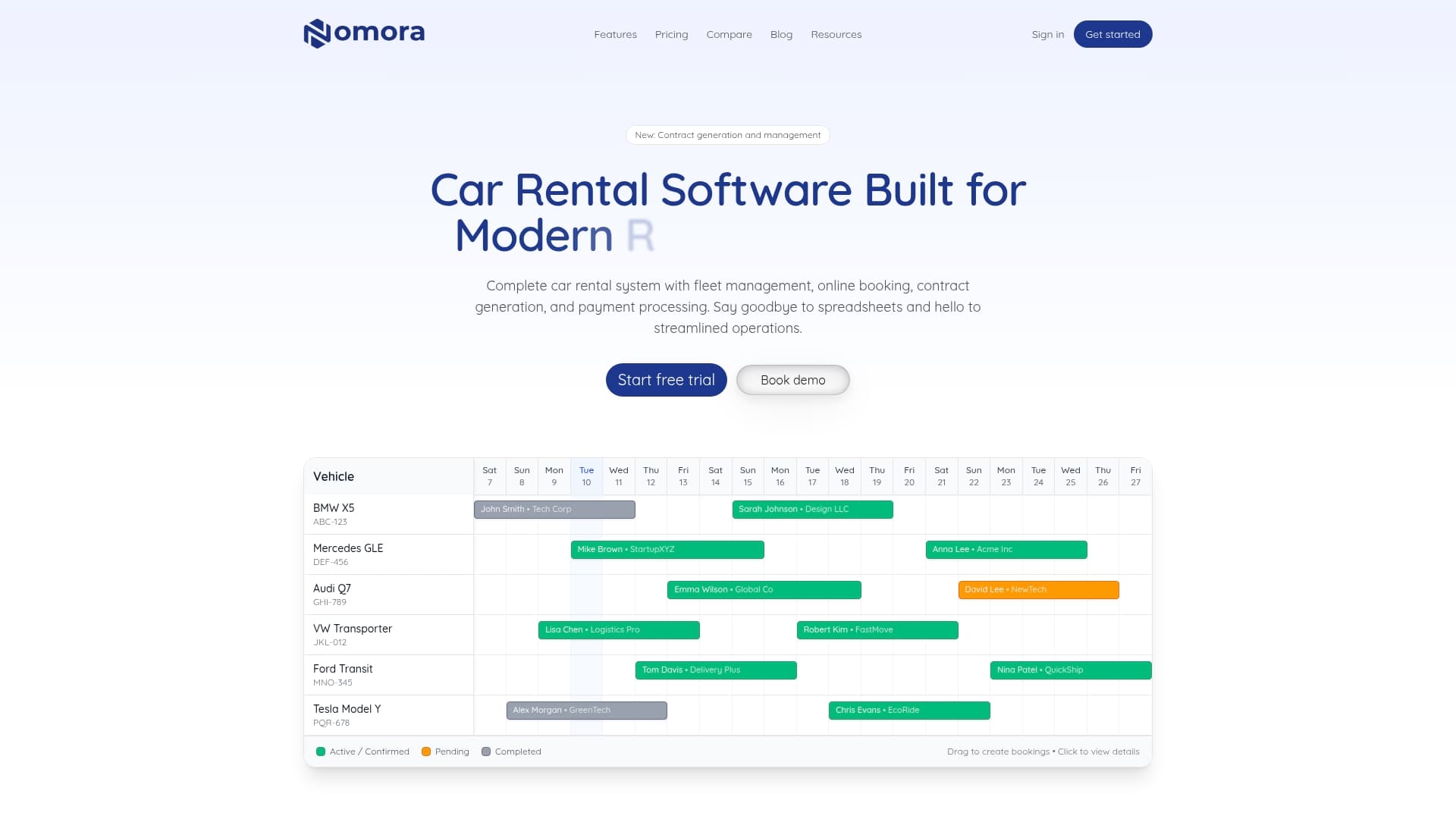
From automated car rental payments to real-time fleet visibility and contract generation, Nomora replaces the manual processes that slow your team down. Businesses across fleet sizes have used it to reduce admin overhead and scale without adding headcount. Explore the rental software use cases that match your business type and see which workflows you can automate starting this week.
FAQ
What are the best ways to reduce rental admin tasks quickly?
Start with payment automation and digital communication templates. These two changes require minimal setup and deliver measurable time savings within the first billing cycle.
How long does it take to implement rental management automation?
Core workflows like rent collection and maintenance intake are typically operational within two to four weeks after implementation begins, depending on the platform and data migration complexity.
Yes. Purpose-built platforms include audit trails, e-signature support, and configurable document templates designed to meet regulatory requirements and reduce the risk of compliance gaps.
How much of rental admin work can realistically be automated?
Over 80% of routine property management operations can be handled without manual intervention using modern automation platforms, with staff handling only exceptions and relationship-driven tasks.
Do I need technical expertise to adopt rental management software?
Most current platforms are designed for non-technical users, with guided onboarding, template libraries, and customer support. Setup typically takes days rather than weeks for standard configurations.
Recommended