Vehicle tracking technology combines GPS hardware, connectivity, and software to monitor fleet locations and operations in real time. It enhances safety, efficiency, and maintenance by integrating data into management workflows, thus reducing costs and asset loss. Most fleets underuse their existing systems by neglecting automated reports and driver engagement, missing opportunities for improved safety and productivity.
Vehicle tracking technology is defined as the integration of GPS hardware, cellular or satellite connectivity, and cloud-based software platforms to monitor vehicle location and operational status in real time. For rental and logistics businesses, this technology is the central nervous system of modern fleet management. It delivers the data you need to reduce costs, protect assets, and make faster operational decisions. Verizon Connect confirms that telematics goes beyond location tracking to improve safety, energy efficiency, productivity, and maintenance management across entire fleets.
Vehicle tracking technology explained: how the system works
Understanding how vehicle tracking works starts with the hardware installed in each vehicle. A GPS tracking system follows a defined chain: the vehicle's GPS device receives signals from satellites, calculates its position, then transmits that data over a cellular or satellite network to a backend server. The server processes and stores the data, which is then visualized on a dashboard and converted into reports and alerts. This chain runs continuously, giving fleet managers a live picture of every vehicle in their operation.
The hardware layer includes three core components:
GPS/telematics unit: Installed in the vehicle, this device receives satellite signals and records location, speed, and heading. Advanced units also connect to the vehicle's diagnostic systems.
Communications module: Transmits data over 4G/5G cellular networks in urban and suburban areas, or satellite networks in remote regions with no cellular coverage.
Sensors and peripherals: Temperature probes, door sensors, fuel monitors, and dashcams feed additional data into the telematics unit for a fuller operational picture.
The software layer is where raw data becomes business intelligence. Platforms process incoming data streams, trigger alerts for speeding or unauthorized use, generate compliance reports, and expose APIs for integration with other business systems. The reliability of the backend server is what separates a useful tracking system from an unreliable one. If the server buffers data poorly during connectivity gaps, you get incomplete records that undermine billing accuracy and compliance documentation.
Pro Tip:When evaluating GPS tracking platforms, ask vendors specifically how their system handles data buffering during cellular dead zones. A platform that stores and syncs data locally on the device before uploading will give you complete trip records, even in areas with poor network coverage.
What types of vehicle tracking devices are available?
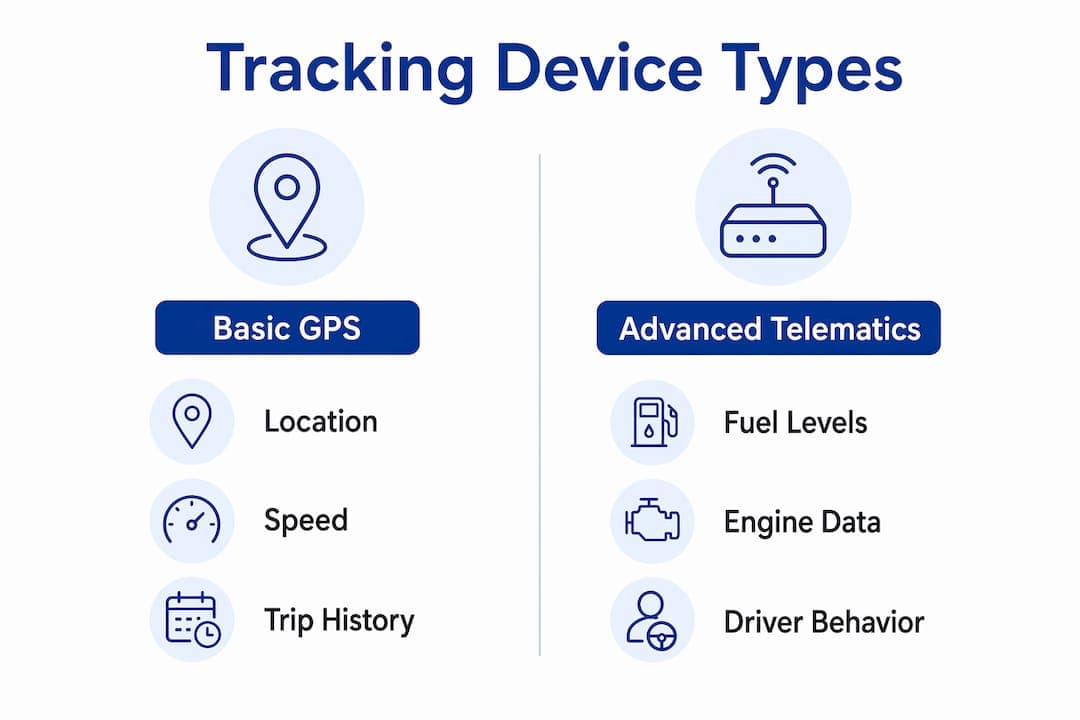
Vehicle tracking systems fall into two broad categories: basic GPS trackers and advanced telematics units. Choosing the right type depends on what operational data your business actually needs.
Basic GPS trackers report location, speed, and trip history. They are lower cost, easier to install, and sufficient for businesses that primarily need to know where vehicles are at any given time. They do not connect to vehicle diagnostics and provide no insight into engine health or driver behavior.
Advanced telematics units connect via the vehicle's OBD-II port or CAN bus to pull granular data including fuel levels, engine RPM, fault codes, harsh braking events, and acceleration patterns. This level of detail is what enables proactive maintenance scheduling and driver coaching programs.
Device type
Key data provided
Best suited for
Basic GPS tracker
Location, speed, trip history
Small rental fleets, asset monitoring
OBD-II telematics unit
Location + engine data, driver behavior
Logistics fleets, driver coaching programs
CAN bus telematics unit
Full vehicle diagnostics + all OBD-II data
Heavy transport, refrigerated fleets
Satellite tracker
Location in remote areas without cellular
Mining, agriculture, long-haul routes
Connectivity choice matters as much as device type. Most urban and suburban fleets run on 4G/5G cellular networks, which offer low latency and high data throughput. Satellite connectivity costs more per unit but is non-negotiable for fleets operating in areas without cellular infrastructure. Thermo King's TracKing Pro system, used in refrigerated trailer fleets, demonstrates how telematics hardware tailored to specific vehicle types delivers results that generic trackers cannot match.
Software platforms also vary significantly. Bundled solutions like Geotab pair proprietary hardware with their own platform, while device-agnostic platforms like Wialon work with hardware from multiple manufacturers. Bundled systems offer tighter integration; device-agnostic platforms give you more flexibility if you already have mixed hardware across your fleet.
Key benefits of vehicle tracking for rental and logistics fleets
The benefits of vehicle tracking extend well beyond knowing where your vehicles are. The operational and financial gains are measurable and documented across the industry.
Real-time location visibility: Dispatchers can assign the nearest available vehicle, reduce customer wait times, and respond immediately to unauthorized use or theft.
Route optimization: Live traffic data combined with historical route analysis reduces fuel consumption and improves delivery or return timelines.
Fuel and maintenance savings:Thermo King's telematics deployment across Dot Transportation's refrigerated fleet reduced engine runtime in continuous mode from 6% to 2%, generating an estimated $1.1 million in annual fuel and maintenance savings. That figure illustrates what systematic telematics use can achieve at scale.
Proactive maintenance scheduling: Engine fault codes and mileage data trigger service reminders before breakdowns occur, reducing unplanned downtime.
Compliance documentation: Hours of service records, temperature logs for cold chain, and mileage reports are generated automatically rather than manually compiled.
Idling reduction: Alerts for excessive idling cut fuel waste and reduce engine wear, with measurable impact on both operating costs and emissions.
"GPS tracking alone provides location. Adding telematics transforms that location data into operational decisions for safety and efficiency." — Verizon Connect
For rental businesses specifically, real-time location data also protects against asset loss and supports accurate billing. You can verify exactly when a vehicle left and returned, eliminating disputes over mileage and rental duration. The real-time data benefits for fleet management are most visible when tracking data feeds directly into your operational workflows rather than sitting in a separate dashboard.
Pro Tip:Do not treat your tracking platform as a monitoring tool alone. Schedule monthly reviews of idling reports, route efficiency scores, and maintenance alerts with your operations team. Fleets that use tracking data for continuous improvement consistently outperform those that only check it reactively after an incident.
How to integrate tracking data into fleet management workflows
Tracking data delivers its highest return when it connects to the systems your business already uses. Integrating telematics data via APIs into ERP, accounting, and maintenance platforms automates workflows that would otherwise require manual data entry, reducing errors and freeing up staff time.
The most impactful integration points for rental and logistics managers include:
Billing and invoicing: Mileage and usage data from the GPS system feeds directly into rental contracts or delivery billing, eliminating manual calculations and disputes.
Maintenance management: Engine hours and fault codes trigger work orders in your maintenance system automatically, so vehicles are serviced on schedule without relying on driver reports.
Compliance and reporting: Hours of service data, route records, and temperature logs populate compliance reports without manual compilation, reducing audit risk.
Dispatch and scheduling: Live vehicle location integrates with dispatch software to assign jobs based on actual vehicle position and availability rather than estimated locations.
Choosing between a SaaS GPS platform and a self-hosted solution affects how much control you have over your data. SaaS platforms like those offered by Geotab or Wialon handle infrastructure and updates for you, but your data lives on their servers. Self-hosted solutions give you full data ownership, which matters for businesses with strict data governance requirements or those operating in regulated industries. The car rental software integrations guide from Nomora covers the practical steps for connecting GPS tracking platforms with rental management workflows in detail.
The most common integration challenge is data format inconsistency. Different GPS hardware vendors output data in different formats, and not all platforms offer pre-built connectors for every combination. Before committing to a tracking platform, verify that it offers documented API access and check whether your fleet management or rental software has a native integration or a tested connector available.
How vehicle tracking improves fleet safety and risk management
Safety is one of the most quantifiable returns from telematics investment. AWP Safety reports that 32% of GPS tracking users decreased accidents, while 48% of video telematics users cut accident costs. Those figures reflect a shift from reactive incident management to proactive risk reduction.
Telematics systems monitor driver behavior in real time, flagging events that correlate with accident risk:
Harsh braking and rapid acceleration patterns
Speeding relative to posted limits or company policy
Mobile phone distraction detected via dashcam AI
Seatbelt non-compliance
Fatigue indicators from driving hours and break patterns
Video telematics adds context that data alone cannot provide. When a harsh braking event is flagged, a dashcam clip shows whether the driver reacted to a genuine hazard or was following too closely. This context is what makes coaching conversations specific and fair rather than based on numbers a driver cannot relate to. Video telematics shifts fleets from responding to accidents after they happen to identifying and correcting the behaviors that cause them before an incident occurs.
The organizational impact extends beyond individual drivers. When a fleet establishes clear safety benchmarks and shares performance data transparently with drivers, safety culture improves across the board. Drivers who understand how data is used and what it measures are more likely to engage with coaching programs than those who feel monitored without context. The driver management guide for rental fleets covers how to structure coaching programs that use telematics data constructively.
The 42-Point Car Rental Operations Checklist
The exact checks profitable rental operators run every week — free, straight to your inbox.
Fleet readiness & handover
Bookings & no-show prevention
Pricing & revenue reviews
Contracts & compliance
Payments & invoicing
Maintenance & fleet health
One email with the checklist. No spam, unsubscribe anytime.
Key takeaways
Vehicle tracking technology delivers maximum value when GPS location data is combined with telematics diagnostics and integrated directly into fleet management, billing, and safety workflows.
Point
Details
System architecture
Every tracking system combines GPS hardware, a communications module, and a software platform to deliver real-time data.
Device selection matters
Choose between basic GPS trackers and advanced telematics units based on the operational data your fleet actually requires.
Telematics drives savings
Thermo King's deployment cut engine runtime from 6% to 2%, saving an estimated $1.1 million annually in one fleet.
Integration multiplies ROI
Connecting tracking data to billing, maintenance, and dispatch systems via APIs automates workflows and reduces manual errors.
Safety gains are measurable
48% of video telematics users reported reduced accident costs, reflecting the shift to proactive driver coaching.
Why most fleets underuse the technology they already have
I have worked with enough fleet managers to know that the gap between what tracking technology can do and what most businesses actually use it for is significant. The majority of operators install GPS devices, check the live map occasionally, and call it done. They are leaving most of the value on the table.
The real opportunity is in the data that sits untouched in your platform's reporting section. Idling reports, route efficiency scores, maintenance alerts, and driver behavior summaries are generated automatically, but they only create value when someone acts on them. Fleets that schedule regular data reviews and tie findings to operational decisions consistently see better outcomes than those that treat tracking as a passive monitoring tool.
There is also an underappreciated dimension around driver trust. Introducing telematics without explaining to your team what data is collected, how it is used, and what the consequences of flagged events are will create resistance. Drivers who feel surveilled rather than supported disengage from coaching programs. The businesses I have seen get the most from telematics are the ones that frame it as a safety and support tool from day one, not a disciplinary mechanism.
Platform selection is another area where I see managers make avoidable mistakes. Choosing a tracking platform based on device cost alone, without evaluating the software's reporting depth, API capabilities, and user experience, leads to frustration within months. The device is the least important part of the decision. The software is where you will spend your time, and it needs to fit your actual workflows.
— Dizzy
How Nomora supports fleet tracking and rental operations
Nomora is a cloud-based car rental management platform built to connect the operational dots that tracking technology surfaces. When GPS data flows into a system that also handles reservations, contracts, payments, and fleet status, you get a complete operational picture rather than data scattered across disconnected tools. Nomora integrates with GPS tracking platforms to bring location and usage data into the same environment where your rental workflows live.
For rental operators looking to apply vehicle tracking technology across their fleet, Nomora's rental software use cases cover how the platform supports businesses from independent operators to franchise networks. Setup takes 24 to 48 hours, and the platform is built for the workflows rental and logistics managers actually use.
FAQ
What is vehicle tracking technology?
Vehicle tracking technology is the combination of GPS hardware, cellular or satellite connectivity, and software platforms that monitor vehicle location and operational data in real time. Advanced systems also capture engine diagnostics, driver behavior, and environmental conditions through telematics units.
How does GPS vehicle tracking work?
A GPS device installed in the vehicle receives signals from satellites to calculate its position, then transmits that data over a cellular or satellite network to a cloud-based server. The server processes the data and displays it on a dashboard with alerts and reports.
What is the difference between GPS tracking and telematics?
GPS tracking provides location, speed, and trip history. Telematics adds vehicle diagnostic data, driver behavior monitoring, and operational metrics like fuel consumption and engine fault codes, turning location data into broader fleet intelligence.
What are the main benefits of vehicle tracking for rental fleets?
The primary benefits include real-time asset visibility, accurate mileage-based billing, theft recovery, proactive maintenance scheduling, and compliance documentation. These reduce operating costs and protect revenue by eliminating manual record-keeping and billing disputes.
How do I integrate vehicle tracking data with my fleet management software?
Most GPS tracking platforms expose APIs that connect to fleet management, ERP, and accounting systems. The key is verifying that your tracking platform and fleet software have compatible data formats or a pre-built connector before committing to either system.