TL;DR:
- Structured revenue management maximizes profits by optimizing pricing, demand forecasting, and fleet utilization.
- Relying on intuition and manual rates often leads to profit loss; data-driven strategies outperform them.
- Implementing AI tools and real-time analysis can significantly boost rental revenue and operational efficiency.
Cutting prices to fill empty vehicles feels logical, but it's one of the most common traps in the car rental business. The companies consistently pulling ahead don't win on the lowest rate. They win by applying structured, data-driven rental revenue management, a method that treats every vehicle, every time slot, and every customer segment as a revenue opportunity to optimize. Most independent operators and even some mid-sized fleets still rely on instinct and manual rate sheets. That gap between intuition and structured management is exactly where profit gets left behind.
Table of Contents
Key Takeaways
| Point | Details |
|---|
| Revenue science matters | Structured revenue management strategies outperform guesswork and intuition in car rentals. |
| Dynamic pricing drives gains | Adjusting rates in real time based on demand significantly increases revenue and fleet utilization. |
| Data beats intuition | Embracing analytics, AI, and automation leads to smarter, more profitable management decisions. |
| Unique industry challenges | Car rentals face specialized challenges that make advanced revenue management even more essential. |
What is rental revenue management in car rentals?
Rental revenue management is not simply a pricing strategy. It is a systematic approach that combines pricing controls, demand forecasting, and fleet inventory management to extract the maximum possible revenue from a perishable asset, your fleet. A vehicle that sits idle overnight generates zero income. That's the core problem revenue management solves.
As described in industry analysis, rental revenue management is the application of pricing, inventory controls, and demand forecasting techniques to maximize revenue from a perishable fleet asset, similar to airlines and hotels but with unique challenges. The airline comparison is useful, but car rentals have a different dynamic. Airlines sell fixed seats on fixed routes. Car rental companies manage variable fleets across multiple locations, with customers who can pick up and drop off at different times, often with very little notice.
The four main components of rental revenue management are:
- Dynamic pricing: Adjusting rates in real time based on demand signals, competitor rates, and booking pace
- Fleet utilization: Ensuring the right vehicles are available at the right locations at the right times
- Demand forecasting: Using historical data and market signals to predict future rental volumes
- Ancillary revenue: Maximizing income from insurance add-ons, GPS rentals, fuel packages, and upgrades
Here's a quick comparison of how car rental revenue management stacks up against airlines and hotels:
| Factor | Airlines | Hotels | Car rentals |
|---|
| Asset type | Fixed seats | Fixed rooms | Variable fleet |
| Perishability | High | High | High |
| Inventory flexibility | Low | Low | Medium to high |
| Demand complexity | Moderate | Moderate | High |
| Ancillary revenue potential | High | High | High |
The key distinction from generic discounting is this: rental revenue optimization is about maximizing profit per unit, not just moving vehicles. Dropping rates across the board fills cars but destroys margins. A structured approach targets the right price for the right customer at the right moment.
Core methodologies: The science powering higher car rental profits
With the core definition clear, let's examine which proven strategies power best-in-class car rental revenue management systems.
The main tactics, ranked by typical impact, are:
- Dynamic pricing: Rates shift automatically based on demand, booking window, and competitor activity. Dynamic pricing yields a 5-10% revenue boost at baseline, rising to 15-30% with advanced forecasting in place.
- Demand forecasting: AI models and historical booking data predict when demand will spike or drop, allowing proactive rate and inventory adjustments.
- Inventory categorization: Grouping vehicles by class and managing availability separately for each class prevents over-discounting premium segments.
- Rate fences: Rules that restrict certain rates to specific customer segments, booking windows, or rental durations, protecting higher-yield bookings.
- Ancillary upsells: Structured offers for add-ons at booking and pickup, which can add 10-20% to per-rental revenue without touching the base rate.
The core methodologies also include surge pricing during peak periods, controlled overbooking to account for no-shows, and fleet repositioning to match supply with demand across locations.
Here's how each method translates to revenue impact:
| Method | Primary benefit | Avg. revenue gain |
|---|
| Dynamic pricing | Higher yield per booking | 5-30% |
| Fleet utilization | Fewer idle vehicles | 10-20% |
| Demand forecasting | Smarter inventory allocation | 8-15% |
| Ancillary upsells | Higher revenue per rental | 10-20% |
| Rate fences | Segment protection | 5-12% |
For vehicle rental pricing strategies to work, they need to be applied consistently across all booking channels, not just your website.
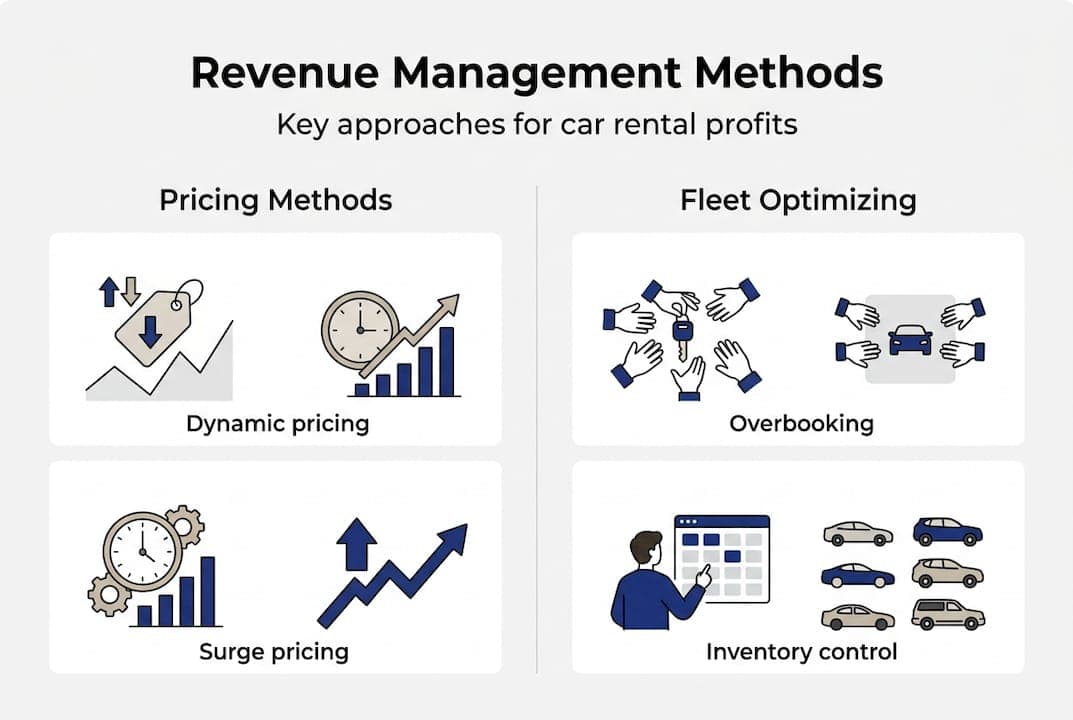
Pro Tip: Only implement overbooking when you have at least 6-12 months of reliable no-show and cancellation data. Without that baseline, overbooking creates customer service problems that cost more than the revenue gained. Pair it with a clear upgrade or alternative vehicle policy to protect satisfaction scores.
For fleet inventory management to support these strategies, your systems need real-time visibility into vehicle location, availability, and condition across every location.
Unique challenges in car rental revenue management
While the science of revenue management is powerful, real-world execution means tackling challenges unique to car rental businesses.

Car rental revenue management is genuinely harder than hotel or airline revenue management in several ways. The asset is mobile. It can be in the wrong location. It can come back damaged. And the demand patterns shift by hour, not just by day.
The key challenges include:
- Fleet capacity uncertainty: New vehicle deliveries, disposals, and mechanical issues constantly change available inventory
- Time-slot demand: Customers pick up and return at all hours, requiring 24/7 forecasting at a granular level
- Multiple car classes: Each segment, economy, SUV, luxury, has its own demand curve and optimal pricing
- Airport vs. off-airport dynamics: Airport locations see different demand patterns, customer types, and price sensitivity than neighborhood or suburban branches
- Repositioning costs: Moving vehicles between locations to balance supply adds real operational expense that must factor into pricing decisions
- No-show risk: Unlike hotels, car rental no-shows often mean a vehicle sits idle with no recourse unless overbooking is managed carefully
As industry analysis notes, fleet capacity uncertainty, 24/7 pickups, many car classes, airport vs. off-airport pricing, franchise vs. owned fleets, surcharges, repositioning, and weather or EV demand surges all add layers of complexity that generic revenue management tools simply can't handle.
"Relying on intuition or panic discounts during slow periods is one of the most expensive habits in the car rental business. Every reactive rate cut trains customers to wait for lower prices, eroding your baseline yield over time."
For a deeper look at how to handle vehicle fleet management challenges, including repositioning and multi-location inventory, structured frameworks matter more than experience alone.
Leveraging data and technology for smarter decision making
Given these unique obstacles, the path forward is increasingly shaped by technology and smart data usage. Let's see how top companies do it.
Hertz and Avis began adopting revenue management software in the 1990s. That early investment gave them a measurable edge over competitors still running on spreadsheets and gut feel. Today, modern forecasting tools achieve 80-92% accuracy in demand prediction, automating controls that would take a team of analysts hours to calculate manually.
The shift from static pricing to AI-powered dynamic systems is not just about speed. It's about consistency. A human pricing manager might update rates once a day. A software system can update rates dozens of times per hour based on live booking data, competitor feeds, and weather signals.
Here's a practical checklist to start leveraging data effectively in your rental operation:
- Audit your current data sources: Identify what booking, cancellation, and utilization data you already collect and where the gaps are
- Centralize your reporting: Move from scattered spreadsheets to a single dashboard that shows fleet status, revenue per vehicle, and booking pace in real time
- Set baseline metrics: Establish your current utilization rate, revenue per available vehicle, and ancillary attach rate before making changes
- Implement demand forecasting first: This single step delivers the highest ROI for most mid-sized operators before any other tool
- Test dynamic pricing in one segment: Start with your most in-demand vehicle class and measure the revenue impact over 60-90 days before rolling out broadly
Pro Tip: Invest in demand forecasting tools before anything else. Operators who forecast accurately can set prices confidently instead of reactively, which protects margins even during slow seasons.
The most common pitfalls are sticking to static pricing, ignoring competitor rate data, and underusing the rental data analytics already sitting inside your booking system. The data is often there. The problem is it's not being used. Pairing good data habits with the right rental software features turns raw numbers into decisions that directly improve your bottom line.
Many experienced operators genuinely believe their years in the business give them an edge over algorithms. That instinct is understandable. But the evidence tells a different story.
A single mispriced weekend during peak season can cost more in lost revenue than an entire year's subscription to a capable revenue management platform. That's not a hypothetical. It's a pattern we see repeatedly when operators finally move from manual pricing to structured systems and look back at their historical data.
The demand environment has also gotten more complex. Labor costs, EV fleet transitions, and shifting airport travel patterns have made the revenue curve steeper and less forgiving. The operators who rely on car rental profit strategies built on real data consistently outperform those adjusting rates based on how busy the lot looks on a Tuesday morning.
Real change requires confronting old habits. It means being willing to test a higher rate when instinct says to discount, and trusting the data when it contradicts your experience. That discomfort is temporary. The revenue gains are not.
Take your car rental revenue management to the next level
If you're ready to shift from guesswork to high-performance revenue management, the right tools make that transition faster and more reliable than building processes from scratch.
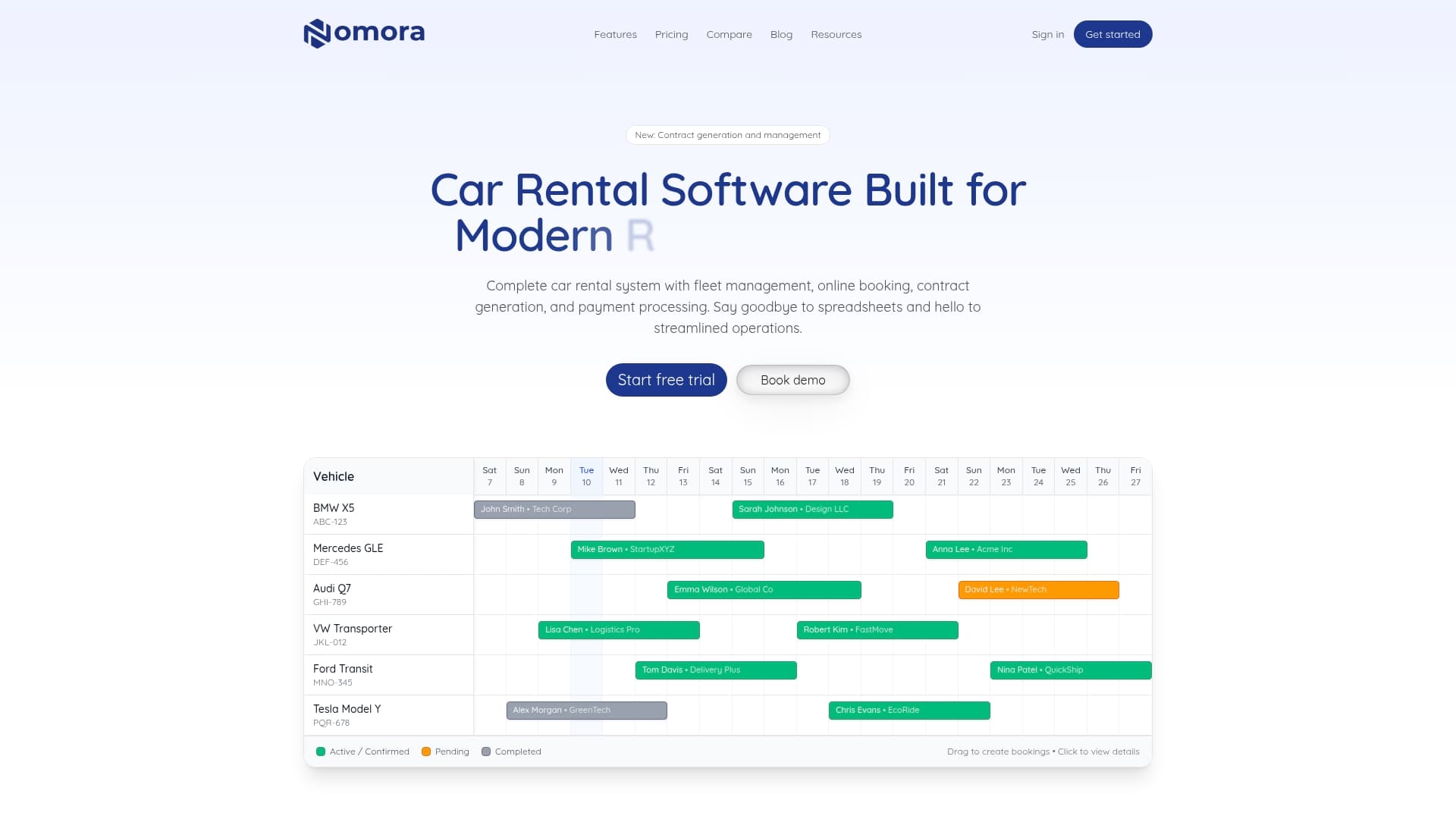
Nomora's platform is built specifically for car rental businesses, combining dynamic pricing, demand forecasting, fleet utilization tracking, and automation in one integrated system. Whether you run a single location or a multi-site operation, Nomora's use cases show how businesses like yours are applying these exact methodologies to increase revenue without adding headcount. Explore the Nomora car rental solution to see how quickly you can move from static pricing to a fully data-driven operation, with onboarding completed in as little as 24-48 hours.
Frequently asked questions
How does dynamic pricing improve car rental revenue?
Dynamic pricing adjusts rates based on real-time demand signals, and revenue boosts of 5-30% are typical depending on how advanced the forecasting model is. The more accurate the demand data, the higher the yield.
What role does demand forecasting play in revenue management?
Demand forecasting uses historical booking patterns and AI to predict future rental volumes, enabling smarter rate-setting and vehicle allocation. Forecasting is a core tactic that reduces reactive pricing and protects margins year-round.
Is revenue management only for large rental companies?
No. Core methodologies apply at every scale, from single-location independents to large franchise networks. Smaller operators often see proportionally larger gains because they start from a lower optimization baseline.
What's the biggest mistake in car rental revenue management?
Relying on intuition instead of structured data is consistently the most costly error. Data-driven pricing outperforms static or instinct-based approaches by measurable margins, particularly during high-demand periods when accurate pricing matters most.
Recommended
Ready to streamline your car rental business?
Book 30 minutes with the founder. We set up everything in this guide on your own vehicles, and migrate you out of Excel for free.