GDPR governs the collection, storage, and processing of personal data in fleet operations, emphasizing lawful basis and data minimization. Fleet managers must understand their role as data controllers or processors and implement clear policies, retention schedules, and role-based access controls. Proper architecture, regular vendor reviews, and organizational discipline are essential to maintain GDPR compliance and protect driver privacy.
The role of GDPR in fleet management is to regulate how personal data collected through telematics, GPS tracking, dashcams, and driver behavior monitoring is gathered, stored, and processed. For rental companies, this means every data point tied to an identifiable driver or customer falls under strict legal obligations. Fleet operators are defined as data controllers under GDPR, while telematics vendors and cloud platforms function as data processors. Getting this distinction right is the foundation of every compliant fleet operation.
What is the role of GDPR in fleet management?
GDPR governs the full lifecycle of personal data in fleet operations, from the moment a GPS device logs a driver's location to the day that record is deleted. The regulation applies to any data that can identify a natural person, directly or indirectly. For rental fleets, this includes customer names, driver license numbers, trip histories, and behavioral telemetry. The practical impact is that fleet managers cannot simply collect data because it is technically possible. Every data point requires a lawful basis, a defined purpose, and a documented retention limit.
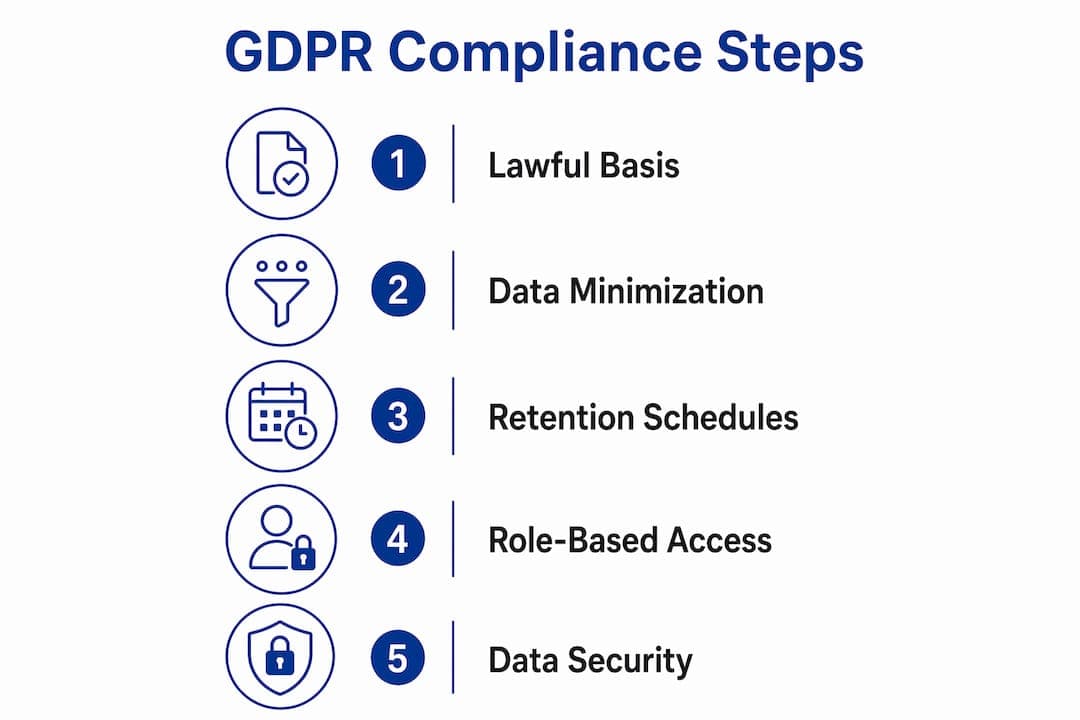
Three GDPR principles carry the most operational weight for fleet managers. Lawful basis requires you to justify each type of data collection, typically through legitimate interest or performance of a contract. Data minimization means collecting only what is necessary for a stated purpose. Purpose limitation prohibits using data collected for one reason (say, vehicle tracking for theft recovery) for a different purpose (say, monitoring driver productivity) without separate justification.
Telematics vendors, fleet management software providers, and GPS hardware manufacturers each play a defined role in this compliance structure. Understanding where your organization sits in the controller-processor relationship determines which contractual obligations you must fulfill before any data flows.
What types of fleet data count as personal data under GDPR?
Identifying which data categories fall under GDPR protection is the first practical step for any compliance officer. The scope is broader than most fleet managers initially expect.
The following data types are classified as personal data under GDPR when they relate to an identifiable individual:
GPS location data tied to a specific driver or vehicle assignment
Driving behavior records, including speed, braking patterns, and acceleration profiles
Dashcam footage that captures a driver's face or other identifiable features
Fatigue monitoring data from in-cab sensors or eye-tracking systems
Phone logs and navigation history stored in connected vehicle infotainment systems
Fuel card transaction records linked to individual drivers
Vehicle telematics timestamps that, when combined with route data, indirectly identify a person
The indirect identifier category deserves special attention. A vehicle's movement log does not contain a name, but if that vehicle is assigned to one driver during a shift, the data is personal. Fleet managers often overlook personal data like phone logs and navigation history stored in connected vehicles, yet these carry the same GDPR obligations as any other personal record.
Dashcam footage adds another layer of complexity. Footage capturing identifiable individuals, whether drivers, passengers, or pedestrians, is subject to GDPR. This means rental companies using dashcams must address both the footage of their own drivers and incidental footage of third parties captured during trips.
How do GDPR principles apply to fleet data processing?
Translating GDPR principles into day-to-day fleet operations requires a structured approach across four core obligations.
Establish a lawful basis for each data type. The two most applicable bases for fleet operations are legitimate interest and performance of a contract. Legitimate interest covers safety monitoring and theft prevention. Contract performance covers data collected to fulfill a rental agreement, such as mileage tracking for billing. A legitimate interests assessment (LIA) documents that the operational need outweighs privacy impacts and serves as your primary regulatory defense if challenged.
Apply data minimization at the collection stage. Configure telematics devices to capture only the data points your stated purpose requires. A rental company that needs mileage for billing does not need second-by-second speed logs. Reducing collection frequency and data granularity at the source is simpler than trying to filter or delete excess data after the fact.
Set and enforce retention schedules. Routine dashcam footage is typically retained 30 to 60 days under GDPR to balance incident investigation needs against privacy exposure. Safety-critical collision records may be retained 2 to 7 years depending on legal liabilities. These are not suggestions. They are the documented limits your retention policy must reflect.
Control access with role-based permissions.Fleet management platforms should implement role-based access control (RBAC) down to individual data fields. A billing administrator has no legitimate need to view a driver's real-time location. Restricting access by role prevents unnecessary exposure and satisfies the data minimization principle at the access layer.
Communicate clearly with drivers. Privacy notices must explain what data is collected, why, how long it is kept, and who can access it. Drivers have the right to access their own data and to object to certain types of processing. Building a structured workflow for data subject requests before you receive one is far less disruptive than scrambling to respond within GDPR's 30-day deadline.
Pro Tip:Draft your privacy notice in plain language, not legal boilerplate. Drivers who understand what is collected and why are more cooperative with monitoring programs, which directly improves the quality of your behavioral data.
How does data storage architecture affect GDPR compliance?
The way you store fleet data determines the complexity of your compliance obligations. Two architectures dominate the market, and each carries distinct trade-offs.
Architecture
GDPR complexity
Key obligation
Trade-off
Cloud-based telematics platform
Higher
Signed Data Processing Agreement (DPA) with vendor; cross-border transfer compliance
Fleet retains full control; no processor obligations to vendor
Manual retrieval; no remote access to footage
Hybrid (edge processing + cloud analytics)
Medium
DPA required for cloud component; local storage reduces transfer volume
Balances compliance and operational insight
Using subscription-based telematics platforms makes the vendor a data processor, requiring a DPA and cross-border transfer compliance under GDPR. If that vendor stores data on servers outside the European Economic Area, Standard Contractual Clauses (SCCs) or another approved transfer mechanism must be in place. This is a contractual requirement, not a best practice.
Local-only camera architectures that store footage exclusively on SD cards under fleet control drastically reduce processor-related compliance burdens. The trade-off is operational. You cannot remotely review footage after an incident. You must physically retrieve the device. For large rental fleets with vehicles distributed across multiple locations, this creates real operational friction.
The hybrid approach is gaining traction among mid-size rental operators. Edge processing handles real-time alerts locally, while only aggregated or flagged data is sent to the cloud. This reduces the volume of personal data transferred and stored externally, which directly reduces compliance exposure.
Pro Tip:Before signing any telematics vendor contract, request their DPA template and check whether their data centers are located within the EEA. If they are not, ask specifically which transfer mechanism they rely on. Vendors who cannot answer this question clearly are a compliance liability.
What are the most common GDPR compliance challenges in fleet management?
Most fleet GDPR failures are not technical. They are organizational. The data flows through IT systems, but the compliance decisions touch HR, legal, and operations simultaneously.
Siloed project ownership.Successful GDPR compliance projects require collaboration between IT, HR, legal, and operations because driver behavior data involves disciplinary processes. Starting a telematics rollout as an IT project without HR and legal input creates gaps that surface during audits or driver grievances.
Missing or outdated LIAs. Many fleet operators deploy monitoring tools without ever completing a legitimate interests assessment. Without a documented LIA, you have no legal defense if a driver objects to monitoring or a regulator investigates.
Data left in reassigned vehicles. Certified data wiping procedures are necessary when vehicles are reassigned to prevent residual personal data exposure. A formal deletion process with audit evidence, such as a Certificate of Deletion, reduces liability risks. This step is skipped more often than any other in rental fleet operations.
Unmanaged vendor relationships. DPAs with telematics vendors go stale. Vendors update their infrastructure, change subprocessors, or shift data center locations without proactively notifying clients. Reviewing DPAs annually and requiring vendors to notify you of subprocessor changes is a contractual right you should exercise.
Inadequate driver rights workflows.Data subjects have rights including access, deletion, and objection. Without a structured process for handling these requests, a single driver inquiry can consume days of staff time and still miss the 30-day response deadline.
Pro Tip:Assign a named compliance owner for fleet data, not just a general IT contact. When a driver submits a data access request, a clear owner with documented procedures responds faster and more accurately than a shared inbox.
How to implement GDPR-compliant fleet telematics in practice
Moving from principles to practice requires concrete steps applied at the platform, vendor, and operational levels.
Tune telematics devices to minimize data at the source. Reduce GPS reporting frequency to what your use case requires. Billing by mileage needs trip start and end points, not a location ping every 10 seconds. Configure devices before deployment, not after.
Automate retention and deletion schedules. Manual deletion is unreliable at scale. Fleet management platforms that support automated retention policies remove the human error risk and create an auditable deletion log. Set schedules to match your documented retention policy: 30 to 60 days for routine data, longer only for documented safety or legal holds.
Apply RBAC and audit logging across all data access.Enforcing data residency and immutable logging at the architectural level prevents accidental GDPR violations. Every access to personal data should generate a log entry that identifies who accessed what and when.
Select ISO 27001 certified vendors. ISO 27001 certification does not guarantee GDPR compliance, but it signals that a vendor has a structured information security management system. Pair certification verification with a current, signed DPA before onboarding any telematics or fleet software provider.
Train staff on data privacy policies and incident response. A data breach that is reported to the relevant supervisory authority within 72 hours carries significantly lower regulatory risk than one discovered weeks later. Staff who recognize a potential breach and know the escalation path are your first line of defense.
Rental companies that integrate real-time tracking with clear data governance frameworks gain operational insight without accumulating unnecessary compliance risk.
The 42-Point Car Rental Operations Checklist
The exact checks profitable rental operators run every week — free, straight to your inbox.
Fleet readiness & handover
Bookings & no-show prevention
Pricing & revenue reviews
Contracts & compliance
Payments & invoicing
Maintenance & fleet health
One email with the checklist. No spam, unsubscribe anytime.
Key takeaways
GDPR compliance in fleet management requires lawful basis, data minimization, defined retention schedules, RBAC, and current DPAs with every telematics vendor.
Point
Details
Personal data scope is wide
GPS logs, dashcam footage, behavior data, and infotainment records all qualify as personal data under GDPR.
Lawful basis must be documented
A legitimate interests assessment is the primary legal defense for monitoring tools like dashcams and telematics.
Retention limits are fixed
Routine footage should be deleted within 30 to 60 days; safety-critical records may be kept 2 to 7 years with justification.
Storage architecture shapes compliance burden
Local-only storage reduces processor obligations; cloud platforms require signed DPAs and transfer mechanism verification.
Vehicle reassignment creates hidden risk
Certified data deletion at vehicle handover is legally required and frequently overlooked by rental operators.
GDPR compliance is a team sport, not an IT checkbox
After working through fleet data compliance programs across multiple rental operations, the pattern that stands out most is this: the fleets that struggle are the ones that treat GDPR as a technology problem. They buy a compliant telematics platform, tick the box, and move on. Then a driver submits a data access request and nobody knows who handles it. Or a vehicle gets reassigned and the infotainment system still holds the previous renter's navigation history.
The fleets that get it right treat compliance as an operational discipline shared across HR, legal, IT, and fleet management. They write privacy notices that drivers actually read. They complete LIAs before deploying monitoring tools, not after a complaint arrives. They review vendor DPAs annually and ask hard questions about subprocessors.
There is also a trust dividend that gets underestimated. Operational insight and driver privacy can coexist when fleets minimize collected data and maintain transparency with drivers. Drivers who understand what is monitored and why tend to engage more constructively with safety programs. That is not a compliance outcome. It is an operational one.
The uncomfortable truth is that most rental fleets are one vehicle reassignment or one disgruntled driver away from a GDPR exposure they did not know existed. The fix is not expensive. It is disciplined. Build the deletion process. Document the LIA. Train the team. The architecture matters, but the habits matter more.
— Dizzy
How Nomora supports GDPR-compliant fleet operations
Nomora is built for rental companies that need operational efficiency and data protection to work together, not against each other. The platform integrates configurable data retention schedules, role-based access controls, and audit logging directly into the fleet management workflow. Driver data and customer records are handled within a GDPR-aware architecture, reducing the manual compliance overhead that slows down growing rental businesses.
For compliance officers managing vendor relationships and data subject requests, Nomora's car rental management tools provide the structured workflows and documentation trails that regulators expect. If you are ready to replace spreadsheets and manual processes with a platform designed for compliant, scalable rental operations, explore Nomora to see how it fits your fleet.
FAQ
What personal data does GDPR cover in fleet management?
GDPR covers any data that identifies or can identify a driver or customer, including GPS location logs, dashcam footage, driving behavior records, fuel card transactions, and navigation history stored in connected vehicles.
What lawful basis applies to fleet telematics under GDPR?
Fleet operators most commonly rely on legitimate interest or performance of a contract. A documented legitimate interests assessment is required to justify monitoring tools like dashcams and behavior telematics.
How long can rental fleets retain dashcam footage under GDPR?
Routine dashcam footage should be retained for 30 to 60 days. Safety-critical collision records may be kept for 2 to 7 years depending on legal liability requirements, provided the extended retention is documented and justified.
Do rental companies need a DPA with their telematics vendor?
Yes. Any subscription-based telematics or fleet software vendor that processes personal data on your behalf is a data processor under GDPR, and a signed Data Processing Agreement is legally required before data processing begins.
What happens to driver data when a rental vehicle is reassigned?
Certified data deletion is required when a vehicle changes hands to prevent residual personal data exposure. A formal deletion process with audit evidence, such as a Certificate of Deletion, reduces liability and satisfies GDPR obligations.