TL;DR:
- Fleet optimization strategies leverage data and technology to maximize vehicle utilization, reduce costs, and enhance fleet performance. They rely on proactive decision-making, real-time telematics data, route planning, right-sizing, and predictive maintenance to improve operational efficiency. Implementing disciplined routines and ensuring data accuracy are essential for cost savings and building customer trust in rental businesses.
Fleet optimization strategies are systematic approaches that maximize vehicle utilization, reduce operating costs, and improve overall fleet performance through data-driven decision-making and technology. For vehicle rental businesses, these strategies are the difference between a profitable operation and one bleeding money through idle assets, unplanned breakdowns, and inefficient dispatch. Data shows that fleet managers can cut costs by 30% through preventive maintenance alone, with 40% fewer unexpected breakdowns. Methods like telematics integration, route optimization, predictive maintenance, and driver coaching each address a specific cost driver, and the most effective rental operations combine all of them inside a single management system.
Fleet optimization strategies explained: the core framework
The fundamental difference between reactive fleet management and proactive, AI-driven optimization is not just technology. It is a shift in how decisions get made. Reactive managers fix problems after they occur. Proactive managers use real-time data to prevent them. For rental businesses, where every vehicle off the road is direct revenue loss, that distinction carries serious financial weight.
Effective fleet optimization operates as a continuous cycle rather than a one-time project. You track key performance metrics, set corrective thresholds, and automate workflow actions for rapid decisions. This cycle applies whether you manage 10 vehicles or 1,000. The strategies covered below, including telematics, routing, right-sizing, maintenance, and driver management, are the building blocks of that cycle.

How do telematics and data analytics drive fleet optimization?
Telematics systems capture vehicle location, speed, fuel consumption, idle time, and driver behavior in real time. That data feeds every other optimization decision you make, from scheduling maintenance to identifying which drivers need coaching. Without accurate telematics data, most fleet management techniques reduce to guesswork.

The practical value of telematics goes beyond tracking. When integrated with analytics platforms, telematics data reveals utilization patterns that are invisible in spreadsheets. You can see which vehicles sit unused for three days each week, which routes consistently generate excess idle time, and which drivers are burning 15% more fuel than the fleet average. These are the insights that translate directly into cost reductions.
Key metrics worth monitoring through telematics include:
- Vehicle utilization rate: The percentage of time each vehicle is actively generating revenue versus sitting idle
- Idle time per vehicle: Excessive idling is a direct fuel cost with no operational return
- Fuel consumption per kilometer: Identifies both mechanical issues and driver behavior problems
- Harsh braking and acceleration events: Predictors of accelerated wear and higher maintenance costs
- Preventive maintenance (PM) compliance rate: Tracks whether scheduled services are completed on time
Pro Tip: Avoid tracking every metric your telematics system can generate. Focusing on 3 to 5 key metrics such as idle time and PM compliance prevents analysis paralysis and keeps your team focused on what actually moves the needle.
AI-powered analytics tools can layer on top of telematics data to generate predictive alerts, flag anomalies, and recommend corrective actions automatically. For rental businesses using platforms like Nomora, GPS integration connects vehicle tracking directly to reservation management, giving you a real-time picture of fleet availability alongside utilization data.
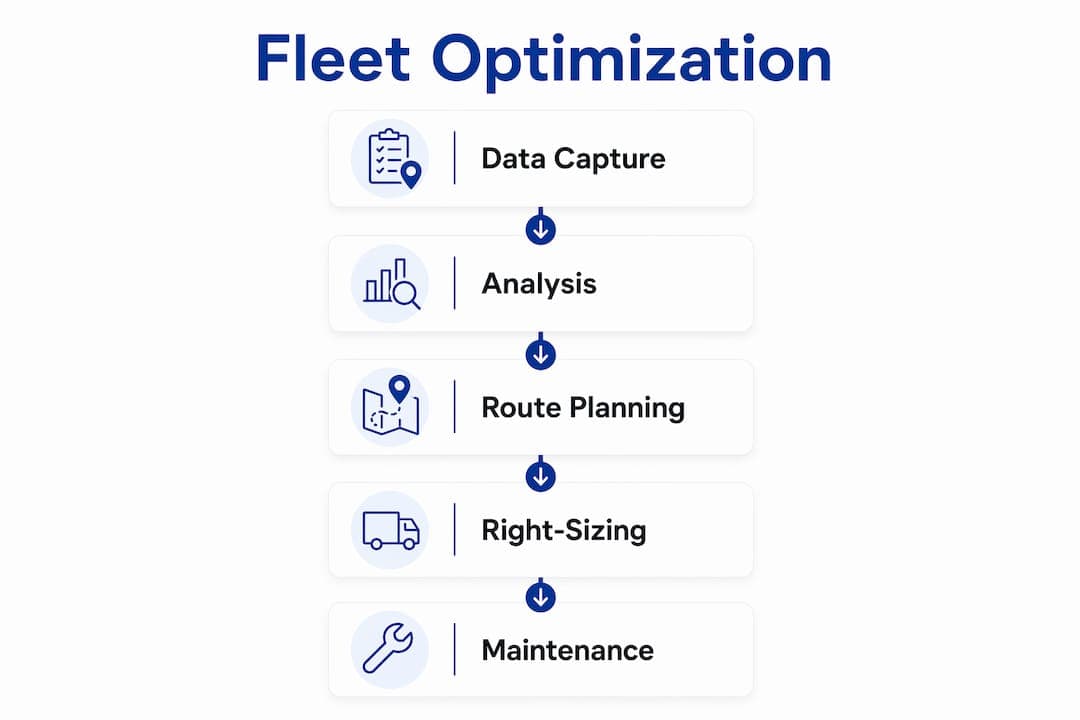
What are the best route planning and dispatch optimization strategies?
Route optimization is one of the highest-return investments in improving fleet operations. Advanced route optimization software reduces fuel consumption by 10 to 20% and increases vehicle capacity utilization by up to 25% by minimizing total miles and optimizing stop sequences. For rental fleets managing vehicle transfers, pickups, and drop-offs across multiple locations, those gains are significant.
Static vs. dynamic route optimization
Static route optimization assigns fixed routes based on historical patterns. It works well for predictable, repetitive operations. Dynamic route optimization recalculates routes in real time based on live traffic, new bookings, driver availability, and vehicle location. Rental businesses with variable demand patterns benefit most from dynamic approaches, since customer pickup and return schedules rarely follow a fixed pattern.
| Approach | Best for | Key benefit |
|---|
| Static optimization | Predictable, high-volume routes | Lower software complexity, easy to manage |
| Dynamic optimization | Variable demand, multi-location fleets | Real-time adaptability, higher fuel savings |
| AI-driven VRP (Vehicle Routing Problem) | Large fleets with complex constraints | Handles multiple variables simultaneously |
The algorithms behind modern route optimization include Vehicle Routing Problem (VRP) variants, genetic algorithms, and tabu search methods. However, the most important insight from fleet strategy research is that data quality drives efficiency gains more than algorithm sophistication. Precise vehicle availability data, accurate time windows, and correct capacity constraints produce 15 to 30% efficiency improvements. Feeding poor data into a sophisticated algorithm produces poor routes.
Pro Tip: Before investing in more complex routing software, audit your input data first. Accurate vehicle availability windows and realistic travel time estimates will outperform any algorithm running on incomplete information.
Dispatch automation complements routing by assigning the right vehicle to the right job based on proximity, vehicle type, driver availability, and customer requirements. Automated dispatch removes the manual coordination bottleneck that slows response times in growing rental operations.
How can fleet right-sizing improve operational efficiency and reduce costs?
Fleet right-sizing is the process of matching your fleet's size and composition to actual demand, eliminating vehicles that generate costs without generating revenue. Poorly optimized fleets carry 10 to 20% excess capacity, and eliminating that excess typically reduces operational costs by 15 to 25%.
The hidden cost of idle capacity is frequently underestimated. Vehicles not generating revenue still incur depreciation, insurance premiums, registration fees, and scheduled maintenance costs. A vehicle sitting at 50% utilization is not half as expensive to own. It is nearly as expensive as a fully utilized vehicle, with half the revenue return.
Practical right-sizing steps for rental businesses include:
- Establish a utilization benchmark: Vehicles consistently below 70% utilization are candidates for removal or redeployment
- Segment by vehicle type: Analyze utilization separately for sedans, SUVs, vans, and specialty vehicles to identify category-specific excess
- Apply seasonal analysis: Separate peak-season data from off-season data before making permanent fleet size decisions
- Model demand scenarios: Use historical booking data to project future demand before reducing fleet size
- Consider spot capacity alternatives: For peak demand periods, short-term rentals or fleet-sharing arrangements can cover demand spikes without permanent fleet additions
Right-sizing is not a one-time exercise. Rental demand patterns shift with seasons, market conditions, and customer mix. Building a quarterly utilization review into your fleet management best practices keeps your fleet composition aligned with actual revenue opportunity.
What maintenance strategies optimize fleet availability and lifespan?
Maintenance strategy directly determines vehicle availability, and availability is the core product of a rental business. The three approaches, reactive, preventive, and predictive, differ significantly in cost and operational impact.
-
Reactive maintenance addresses failures after they occur. It produces the highest per-incident repair costs, the longest vehicle downtime, and the greatest disruption to rental schedules. It is the default for fleets without a structured maintenance program.
-
Preventive maintenance schedules service at fixed intervals based on time or mileage. It reduces unexpected failures significantly and extends vehicle life by 20 to 30%, according to data-driven maintenance research. The limitation is that fixed intervals do not account for actual vehicle condition or usage intensity.
-
Predictive maintenance uses telematics sensor data and AI analysis to identify failure indicators before a breakdown occurs. It schedules service based on actual vehicle condition rather than calendar intervals. This approach produces the lowest total maintenance cost and the highest vehicle availability, making it the best practice for fleet optimization in rental operations.
Scheduling maintenance automatically based on telematics triggers, such as engine temperature anomalies, brake wear indicators, or oil degradation signals, removes the administrative burden of manual tracking. For rental businesses managing dozens or hundreds of vehicles, automated maintenance scheduling through a platform like Nomora prevents the service gaps that lead to costly breakdowns and customer disruptions. Detailed guidance on building this system is available in Nomora's fleet maintenance management resource.
How does driver management contribute to fleet optimization?
Driver behavior is one of the largest controllable variables in fleet operating costs. Fuel represents 30 to 40% of total fleet operating costs, and driver habits directly influence that figure through speeding, harsh acceleration, excessive idling, and inefficient route choices. Addressing driver behavior is not optional in a serious fleet optimization program.
Telematics-based driver monitoring captures the specific behaviors that drive up costs and accelerate vehicle wear:
- Speeding events: Each 10 mph over 60 mph increases fuel consumption measurably and raises accident risk
- Harsh braking frequency: A direct indicator of following distance habits and a predictor of brake wear costs
- Excessive idling: Idle time above 10% of total engine hours signals a coaching opportunity
- Seatbelt compliance: A safety metric that also affects insurance premiums in many markets
Effective coaching programs use this data to give drivers specific, objective feedback rather than general instructions. Drivers respond better to "your idling time last week was 18% of engine hours, the fleet average is 8%" than to "please reduce idling." Pairing data-driven feedback with recognition programs for top performers accelerates behavior change across the fleet.
Pro Tip: Build a monthly driver scorecard using 4 to 5 telematics metrics and share it with your team. Transparency about performance data, combined with positive recognition for improvement, produces faster results than enforcement alone.
Administrative process improvements compound the gains from driver coaching. Automation and continuous data-driven adjustments form the backbone of sustainable fleet optimization. Automating compliance reporting, dispatch assignments, and contract generation removes manual bottlenecks that slow operations and introduce errors. For rental businesses, this means faster vehicle turnaround, fewer booking conflicts, and more time for managers to focus on strategic decisions rather than paperwork.
Key takeaways
Effective fleet optimization requires combining telematics data, right-sized assets, predictive maintenance, and driver coaching inside a continuous improvement cycle rather than applying any single tactic in isolation.
| Point | Details |
|---|
| Telematics is the data foundation | Accurate real-time data on utilization, fuel, and driver behavior enables every other optimization decision. |
| Data quality beats algorithm complexity | Precise vehicle availability and constraint data produce 15 to 30% routing efficiency gains regardless of algorithm choice. |
| Right-sizing removes hidden costs | Vehicles below 70% utilization still carry near-full fixed costs; eliminating excess capacity cuts operational costs by 15 to 25%. |
| Predictive maintenance maximizes uptime | Condition-based service scheduling reduces breakdowns by 40% and extends vehicle life by 20 to 30%. |
| Driver behavior drives fuel costs | Fuel is 30 to 40% of fleet operating costs, and targeted coaching on specific telematics metrics produces measurable reductions. |
What I've learned about fleet optimization in rental businesses
The most common mistake I see rental businesses make is treating fleet optimization as a technology purchase rather than an operational discipline. They buy a telematics system, generate reports for two months, and then revert to managing by instinct when the data gets inconvenient or the team gets busy.
The businesses that actually achieve the 20 to 30% cost reductions the research describes are the ones that build optimization into their weekly routines. They review utilization reports every Monday. They act on maintenance alerts within 24 hours. They share driver scorecards monthly. The technology enables the discipline, but it does not replace it.
Data quality is the second underestimated challenge. I have seen fleets invest in sophisticated route optimization tools and get mediocre results because their vehicle availability data was inaccurate or their time window estimates were unrealistic. Fixing the input data produced bigger gains than upgrading the software. That lesson applies across every optimization strategy: garbage in, garbage out.
For rental businesses specifically, the right starting point depends on fleet size. Operators with fewer than 20 vehicles should prioritize utilization tracking and preventive maintenance scheduling before anything else. Those are the two areas where the return on effort is fastest and most direct. Larger fleets with 50 or more vehicles should layer in route optimization and driver coaching programs once the data foundation is solid. You can explore applied optimization examples from rental businesses at different stages to see what that progression looks like in practice.
The final point worth making is that customer satisfaction and fleet optimization are not separate goals. A well-maintained, right-sized fleet with reliable availability and fast dispatch is exactly what rental customers experience as good service. Optimization is not just a cost reduction exercise. It is how you build a rental business that customers trust and return to.
— Dizzy
How Nomora supports your fleet optimization program
Nomora functions as the central nervous system of a rental operation, connecting vehicle tracking, reservation management, maintenance scheduling, and driver data inside one cloud-based platform.
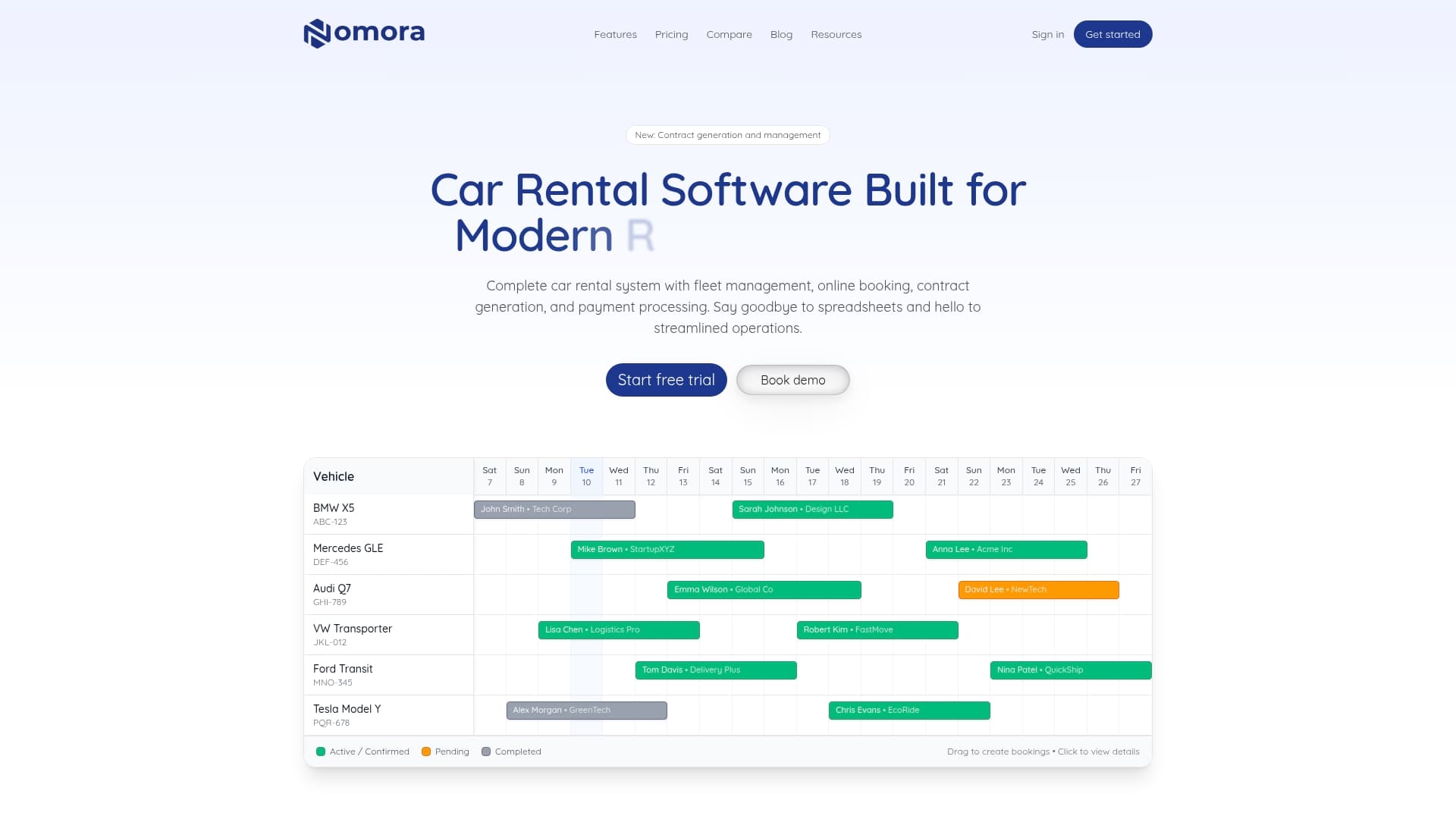
Fleet managers using Nomora gain real-time visibility into vehicle utilization, automated maintenance alerts triggered by actual usage data, and integrated GPS tracking that feeds directly into dispatch decisions. The platform eliminates the spreadsheets and manual coordination that slow down growing rental businesses. Reporting dashboards surface the 3 to 5 key metrics that matter most, without overwhelming your team with data. Whether you manage 10 vehicles or 500, Nomora's car rental software solutions are built to match your operational scale and help you apply fleet optimization strategies from day one. Setup takes 24 to 48 hours, and the platform handles reservations, contracts, payments, and fleet data in one place.
FAQ
What are fleet optimization strategies?
Fleet optimization strategies are systematic methods for maximizing vehicle utilization, reducing operating costs, and improving fleet performance through data analysis, technology, and process improvement. Core techniques include telematics monitoring, route optimization, predictive maintenance, right-sizing, and driver behavior coaching.
How much can fleet optimization reduce operating costs?
Data-driven preventive maintenance alone can cut operational costs by up to 30%, while right-sizing excess fleet capacity typically delivers an additional 15 to 25% cost reduction. Combined strategies produce the largest total savings.
What is fleet right-sizing?
Fleet right-sizing is the process of aligning your fleet's size and vehicle mix with actual demand, removing or redeploying assets that consistently fall below 70% utilization. Vehicles below that threshold still carry near-full fixed costs while generating reduced revenue.
How does telematics improve fleet efficiency?
Telematics captures real-time data on vehicle location, fuel consumption, idle time, and driver behavior, giving fleet managers the accurate utilization data needed to make informed decisions on routing, maintenance, and driver coaching. Without telematics, most optimizing fleet efficiency efforts rely on incomplete information.
What is the difference between preventive and predictive maintenance?
Preventive maintenance follows fixed time or mileage intervals, while predictive maintenance uses telematics sensor data and AI to schedule service based on actual vehicle condition. Predictive maintenance produces lower total costs and higher vehicle availability, making it the preferred approach for rental fleets where downtime directly reduces revenue.
Recommended