Customer data management (CDM) is the strategic process businesses use to collect, unify, govern, and activate customer data across channels and systems to improve engagement, personalization, and business outcomes. Think of it as the operational backbone that turns scattered customer information into a reliable, usable asset. At its core, CDM covers six interconnected activities:
- Data acquisition: Gathering information from web, mobile, in-store, and third-party sources
- Validation: Checking records for accuracy and completeness at the point of entry
- Storage: Centralizing data in a secure, accessible repository
- Integration: Connecting data across platforms so every team sees the same customer picture
- Governance: Establishing policies that control who accesses data, how it is used, and how long it is retained
- Activation: Putting clean, unified data to work in marketing campaigns, support workflows, and product decisions
Without a deliberate CDM process, customer records fragment across departments, personalization breaks down, and compliance risk grows. With it, organizations gain the foundation for every meaningful customer interaction.
Why customer data management matters for your business
The business case for CDM is concrete. Aberdeen Group reports that best-in-class companies achieve greater than 20% annual improvement in retention rates, revenues, data accuracy, and customer satisfaction when they excel at managing customer data. Those are not marginal gains; they reflect what happens when every team operates from the same accurate, current customer record.
Stat to know: Aberdeen Group found that best-in-class CDM practitioners achieve significant annual improvement across retention, revenue, data accuracy, and customer satisfaction.
The benefits compound across the organization:
- Higher retention: When support and marketing share a unified customer view, responses are faster and more relevant, reducing churn.
- Increased revenue: Accurate profiles enable precise segmentation, which lifts conversion rates on campaigns and customer retention strategies.
- Better personalization: Clean, unified data powers product recommendations, tailored offers, and timely outreach that customers actually respond to.
- Reduced waste: Duplicate records and outdated contact details cost money in wasted outreach; CDM eliminates both.
- Compliance confidence: Governed data with clear retention policies keeps organizations on the right side of regulations like the California Consumer Privacy Act (CCPA).
The importance of customer data only grows as customer journeys span more channels. A single purchase today might touch a website, a mobile app, an email, and a customer service call. CDM is what connects those touchpoints into a coherent record.
Best practices for building a customer data management process

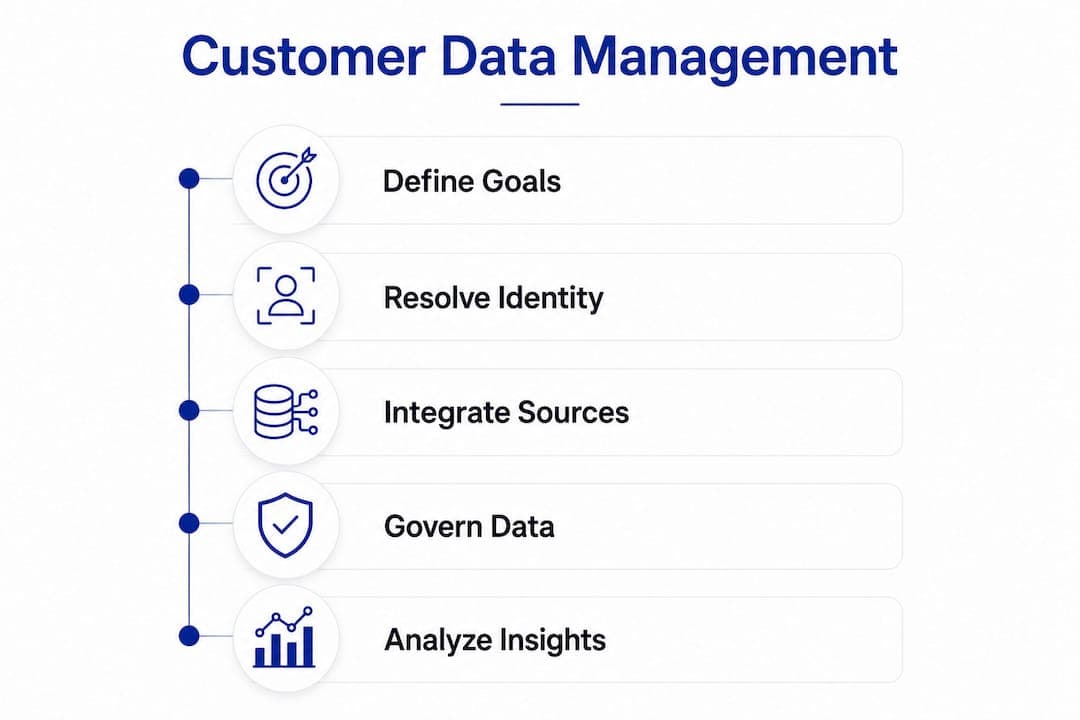
Most CDM initiatives fail for a predictable reason: organizations buy technology before defining what success looks like. Start with business goals, then map the data you need to achieve them, and only then select tools. That sequence prevents expensive mismatches between platform capability and actual need.
Pro Tip: Write down three specific business outcomes you want CDM to drive, such as reducing churn by a defined threshold or improving email open rates, before you evaluate a single vendor.
Follow these steps to build a process that holds up over time:
- Define measurable business goals. Anchor every data decision to an outcome: retention, conversion, support resolution time. Vague goals produce vague data strategies.
- Prioritize first-party and zero-party data. As third-party cookie tracking declines, collecting data directly from customer interactions and feedback becomes the most reliable path to accurate targeting.
- Establish data quality standards early. Define what a complete, valid customer record looks like, then enforce those standards at every collection point.
- Resolve identity across systems. Deterministic matching links a customer's app behavior, CRM contact record, and order history into one profile. Without this step, unified activation is impossible.
- Build governance alongside management. Management and governance are distinct: management covers the operational work of collecting and linking data; governance covers the policies that make that data trustworthy, secure, and compliant. Both are required.
- Adopt a federated governance model. A federated approach, where a central team sets standards and domain teams execute within those boundaries, balances control with the agility individual business units need.
- Schedule regular data cleansing. Customer data decays fast. Addresses change, emails bounce, and job titles shift. Quarterly audits catch decay before it corrupts campaigns or reporting.
- Audit privacy compliance continuously. Regulations like CCPA and GDPR require documented consent, clear retention limits, and the ability to fulfill data deletion requests. Build those capabilities into your process from day one, not as an afterthought.
The right tool depends on your specific pain point, not on what is most popular. Three categories cover most CDM needs:
- Customer Data Platforms (CDPs): CDPs ingest data from every source, resolve identities, and create persistent, unified customer profiles available to any downstream system. Segment (now part of Twilio) is one of the most widely deployed CDPs, used by organizations that need real-time profile unification across web, mobile, and server-side events. Adobe offers CDP capabilities within its Experience Platform, suited to enterprises already invested in the Adobe ecosystem.
- CRM software: CRM systems manage day-to-day customer interactions: sales pipelines, support tickets, email sequences. HubSpot is a strong example, combining contact management, marketing automation, and reporting in one platform. CRM is the right primary investment when your core challenge is managing sales or support workflows rather than unifying fragmented data profiles.
- Data warehouses: Platforms like cloud-based warehouses centralize large volumes of behavioral and transactional data for analytics and reporting. They excel at answering "what happened" questions but typically require engineering resources to activate data in marketing tools.
Choosing the right tool for your car rental software evaluation or any operational platform follows the same logic: match the tool to the problem, not to the vendor's marketing.
How does CDM differ from CRM, and why does the distinction matter?

Confusing CDM with CRM is one of the most common mistakes marketers make, and it leads to underinvestment in the wrong layer. CDM is a broad discipline covering data quality, unification, and governance across the entire organization. CRM is an operational application that uses that data to manage daily customer interactions.
A useful way to think about the relationship:
- CDM asks: Is our customer data accurate, complete, unified, and governed?
- CRM asks: How do we manage this customer's sales or support journey today?
Key distinctions at a glance:
- CDM spans all systems and teams; CRM is primarily a sales and support tool
- CDM produces clean, unified data; CRM consumes that data to drive workflows
- CDM includes governance and compliance frameworks; CRM focuses on interaction tracking and pipeline management
- CDM is a strategy and process; CRM is a software category
The two are complementary, not competing. A CRM fed by poor data produces inaccurate forecasts, missed follow-ups, and irrelevant outreach. CDM provides the clean foundation that makes CRM, marketing automation, and analytics tools perform as intended. Organizations that treat CDM as a prerequisite to CRM deployment consistently get more value from both.
Pro Tip: Before purchasing a CRM, audit your existing customer data for duplicates, missing fields, and inconsistent formats. A CRM built on bad data amplifies the problem rather than solving it.
Customer data governance deserves special attention here. Governance is not a feature inside a CRM; it is a set of organization-wide policies that define data ownership, access controls, retention schedules, and compliance obligations. Without governance, even the best CRM becomes a liability as data ages, duplicates accumulate, and consent records go untracked.
Key Takeaways
Customer data management works when organizations define clear business goals first, resolve customer identity across systems, and pair active data management with formal governance policies.
| Point | Details |
|---|
| Start with goals, not tools | Define measurable business outcomes before selecting any CDM platform or CRM. |
| Aberdeen Group benchmark | Best-in-class CDM companies achieve significant annual improvement in retention, revenue, data accuracy, and satisfaction. |
| Management vs. governance | Management handles data operations; governance sets the policies that keep data trustworthy and compliant. |
| First-party data is the priority | As third-party cookies decline, data collected directly from customers becomes the most reliable source for personalization. |
| CDM enables CRM, not the other way around | Clean, unified customer data from a CDM process is what makes CRM and marketing tools perform accurately. |
Recommended
Ready to streamline your car rental business?
Book 30 minutes with the founder. We set up everything in this guide on your own vehicles, and migrate you out of Excel for free.