Key takeaways
| Point | Details |
|---|
| Essential legal components ensure enforceability | Agreements need parties, duration, obligations, and payment terms to be legally binding. |
| Clear liability clauses reduce disputes | Specific provisions on damage, fees, and customer responsibilities prevent costly conflicts. |
| Contract violations trigger rental bans | Extending rentals without notice or breaking terms can land customers on do not rent lists. |
| Regular updates maintain compliance | Review contracts annually to reflect law changes, insurance updates, and new vehicle technology. |
| Controversial fees need documentation | Charges like diminished value require transparent explanation and proof to avoid customer pushback. |
Criteria for evaluating rental agreements
A strong rental agreement protects your business while remaining enforceable in court. Agreements must cover parties involved, contract term, obligations, and payment to meet basic legal requirements. Beyond these fundamentals, your contract needs specific clauses addressing damage liability, fees, and compliance to prevent disputes that drain your resources.
Your agreement should include these core elements:
- Parties: Full legal names and contact information for both your company and the renter
- Duration: Exact pickup and return dates with clear terms for extensions
- Vehicle details: Make, model, VIN, and condition documentation
- Payment structure: Daily rates, deposit requirements, and acceptable payment methods
- Insurance coverage: What your policy covers and what the customer must provide
- Prohibited uses: Off-road driving, racing, commercial use, or other restricted activities
Ensure your agreement complies with all local, state, and federal laws governing consumer contracts and vehicle rentals. Different states impose varying requirements for disclosures, fee caps, and liability limits. A clause that works perfectly in California might violate regulations in Florida.
Pro Tip: Give customers reasonable time to review your agreement before signing. Courts are more likely to enforce contracts when renters had a genuine opportunity to understand terms, not just a rushed signature at the counter.
Modern car rental software automates contract generation with templates that stay updated as regulations change. Rather than manually tracking legal requirements across jurisdictions, you can configure your system to insert the correct clauses based on rental location. This reduces compliance risks while speeding up your rental process.
Review and update contracts regularly to reflect changes in laws, insurance policies, and vehicle technology. What worked for your 2023 sedan fleet might not cover liability issues with your new electric vehicles. Set a calendar reminder to review agreements annually with legal counsel, or whenever you add new vehicle types or expand to new markets.
After establishing these criteria, you need concrete examples showing how these principles translate into actual contract language. The next section breaks down essential clauses with specific wording you can adapt for your business.
Examples of essential rental agreement clauses
Damage and liability provisions form the backbone of rental protection. Rental companies must consider various damage scenarios and include relevant provisions that address mechanical failure, collision damage, theft, and vandalism. Your clause should specify who pays for repairs, whether you charge for vehicle downtime, and what happens when damage exceeds insurance coverage.

A robust damage clause might read: "Renter accepts full responsibility for all vehicle damage occurring during the rental period, including but not limited to collision, vandalism, theft, and mechanical damage caused by misuse. Renter will pay all repair costs, diminished value fees, and loss of use charges until the vehicle returns to rental-ready condition."
That language is controversial. Hertz demanded an additional $842 for diminished value after insurance covered the initial repair bill, triggering customer complaints about unexpected fees. If you charge diminished value or loss of use fees, define them explicitly and justify the amounts with documentation.
Your fee disclosure clause should specify:
- Diminished value: Permanent reduction in vehicle resale value after accident repairs
- Loss of use: Daily rental income lost while the vehicle undergoes repairs
- Administrative fees: Costs for processing insurance claims, obtaining estimates, and managing repairs
- Late return penalties: Hourly or daily charges when customers exceed their contracted return time
Contract extension and late return clauses prevent violations that can spiral into theft accusations. State clearly: "Renter must contact the rental office before the scheduled return time to extend this agreement. Unauthorized extensions constitute breach of contract and may result in vehicle recovery and criminal charges."
Car rental contract software sends automated reminders to customers approaching their return deadline, reducing accidental violations. The system can also enable customers to request extensions through a mobile app, creating a documented approval trail that protects both parties.
Customer responsibility clauses outline prohibited behaviors and their consequences. "Renter agrees not to: operate the vehicle while intoxicated, allow unauthorized drivers, transport illegal substances, exceed posted speed limits by more than 10 mph, or use the vehicle for commercial purposes. Violation of these terms will result in immediate contract termination, forfeiture of all deposits, and placement on our do not rent list."
Pro Tip: Include a clause requiring customers to report accidents within 24 hours. Late reporting complicates insurance claims and makes it harder to verify damage circumstances. Your clause might state: "Renter must notify the rental company within 24 hours of any accident, theft, or damage exceeding $500. Failure to report promptly may result in denial of insurance coverage and full liability for all costs."
Software solutions track contract terms and flag potential violations in real time. When a vehicle's GPS shows operation outside permitted geographic zones or during prohibited hours, your system can alert staff to contact the customer immediately. Early intervention often prevents minor issues from escalating into major contract breaches.
Insurance cooperation clauses protect your ability to recover costs from customer policies. "Renter authorizes the rental company to file claims with Renter's personal auto insurance carrier and agrees to cooperate fully with all claim investigations. Renter will provide insurance information, respond to adjuster inquiries, and execute necessary documents to facilitate claim resolution."
With these clause examples in hand, you can see how different agreement types combine provisions to match specific business models and risk tolerances. The comparison ahead helps you choose the right approach for your fleet.
Comparison of common rental agreement types and clauses
Rental agreements vary significantly in their approach to liability, fees, and enforcement. Standard agreements from major chains tend toward strict terms that maximize company protection, while smaller operators often customize clauses to balance protection with customer relationships.
| Agreement Type | Damage Liability | Diminished Value | Loss of Use | Late Fees | Contract Extension |
|---|
| Major chain standard | Full customer liability | Often charged | Often charged | Strict hourly penalties | Must call before return time |
| Small operator flexible | Shared with insurance | Rarely charged | Case by case | Daily grace period | Text or app extension |
| Luxury/exotic specialist | High deductibles | Always charged | Always charged | Severe penalties | Pre-approval required |
| Peer-to-peer platform | Platform insurance covers | Not applicable | Owner discretion | Platform sets limits | In-app modifications |
The strictest agreements protect your assets but may alienate customers who feel nickel-and-dimed. Contract term violations are the primary cause for placement on do not rent lists maintained by major rental companies. When you ban customers for minor infractions, you lose potential repeat business and generate negative reviews.
Medium-sized fleets often find success with a middle approach. Charge clear, documented fees for actual costs like repairs and lost rental days, but waive questionable charges like administrative fees that feel punitive. Extending rentals without notification remains a legitimate reason to ban customers, as it disrupts your booking system and can constitute vehicle theft.
Rental software for medium fleets helps you implement nuanced policies that strict templates cannot accommodate. You can configure the system to automatically approve extensions when the vehicle has no immediate reservation, while requiring manager approval for popular vehicles during peak season. This flexibility maintains both asset protection and customer satisfaction.
Key trade-offs to consider when choosing clause strictness:
- Revenue protection vs. customer retention: Aggressive fee collection recovers costs but may drive customers to competitors
- Legal enforceability vs. practical collection: Technically valid clauses can still be difficult to enforce if amounts seem unreasonable
- Administrative burden vs. coverage: Detailed terms protect you better but take longer to explain and execute
- Flexibility vs. consistency: Custom approvals suit individual cases but create staff confusion and policy disputes
Luxury and exotic vehicle rentals justify stricter terms because the vehicles cost more to repair and lose significant value from even minor damage. Your $150,000 supercar needs ironclad protection that would feel excessive for a $25,000 sedan. Customers renting high-end vehicles generally understand and accept more stringent requirements.
Budget-focused operations competing on price may need looser terms to attract cost-conscious customers willing to switch providers over small fees. If your competitor waives the one-hour grace period on returns, you might need to match that policy or lose market share.
Different use cases require different agreements. Corporate accounts with negotiated contracts often include custom liability terms, insurance requirements, and billing procedures that override your standard agreement. Long-term rentals spanning weeks or months need provisions for routine maintenance, mileage limits, and periodic vehicle inspections that daily rentals do not require.
The right agreement for your business balances protection with practicality based on your fleet composition, customer base, and competitive environment. Your next step is implementing a process to select appropriate terms and keep them current as your business evolves.
Choosing and updating rental agreements for your rental business
Selecting the right agreement starts with understanding your specific risk exposure. Fleet size, vehicle value, customer demographics, and local regulations all influence which clauses you need. A five-vehicle operation serving local contractors faces different risks than a 50-vehicle tourist rental company near an airport.
Follow this process to choose and maintain effective agreements:
- Consult a lawyer before finalizing contracts to ensure legal enforceability in your jurisdiction
- Review your insurance policy exclusions and coordinate contract terms with actual coverage
- Document your decision rationale for including or excluding controversial clauses like diminished value
- Train all staff on agreement terms so they can explain provisions to customers accurately
- Implement technology to automate contract generation and monitor compliance
- Schedule annual legal reviews to catch regulatory changes and update templates
- Collect customer feedback about confusing or problematic terms and refine accordingly
Insurance coordination proves critical. The regular use exclusion in many personal auto policies means customer insurance may not cover rental vehicles they use frequently for business purposes. If you rent primarily to business customers, your agreement should require proof of commercial auto coverage or mandate your collision damage waiver.
Pro Tip: Create agreement variations for different rental scenarios rather than forcing one template to cover everything. Separate agreements for daily rentals, weekly rentals, corporate accounts, and specialty vehicles let you tailor provisions without cluttering each contract with irrelevant clauses.
Preventing double bookings requires your agreement and software to work together. Include a clause stating: "This agreement is contingent upon vehicle availability. Rental company reserves the right to substitute a comparable vehicle if the reserved vehicle becomes unavailable due to mechanical issues or prior rental extensions."
That clause protects you legally, but prevention works better than substitution. Fleet management software with real-time availability tracking eliminates the booking conflicts that force awkward conversations and customer disappointment.
Staff education determines whether your carefully crafted agreements actually protect you. Employees who cannot explain why you charge loss of use fees or what constitutes unauthorized use will skip over important sections during the rental process. Budget time for thorough training whenever you update contract terms.
Customer education reduces violations and disputes. Provide a one-page summary highlighting the most important terms in plain language: return deadlines, prohibited uses, damage liability, and extension procedures. Customers who understand expectations are less likely to violate them accidentally.
Technology enables consistent application of agreement terms across your entire operation. Manual processes create gaps where staff forget to collect insurance information, skip damage inspections, or fail to document pre-existing vehicle condition. These gaps invalidate your liability protections when you need them most.
Set calendar reminders to review agreements annually, or whenever these triggers occur:
- You add new vehicle types (electric, luxury, commercial) with different risk profiles
- Your state or municipality passes new rental regulations
- Your insurance carrier changes policy terms or exclusions
- You expand operations to new geographic markets
- Industry events (major lawsuits, regulatory enforcement) highlight new risks
With a solid process for selecting and updating agreements, you are positioned to leverage technology solutions that automate contract management while maintaining compliance. The following section explores how specialized software supports these objectives.
Explore Nomora software to streamline rental agreements in 2026
Managing rental agreements manually creates bottlenecks that slow your operation and increase compliance risks. Car rental contract software automates agreement generation with templates that populate customer information, vehicle details, and rate calculations instantly. You maintain compliance across jurisdictions because the system applies the correct clauses based on rental location and vehicle type.
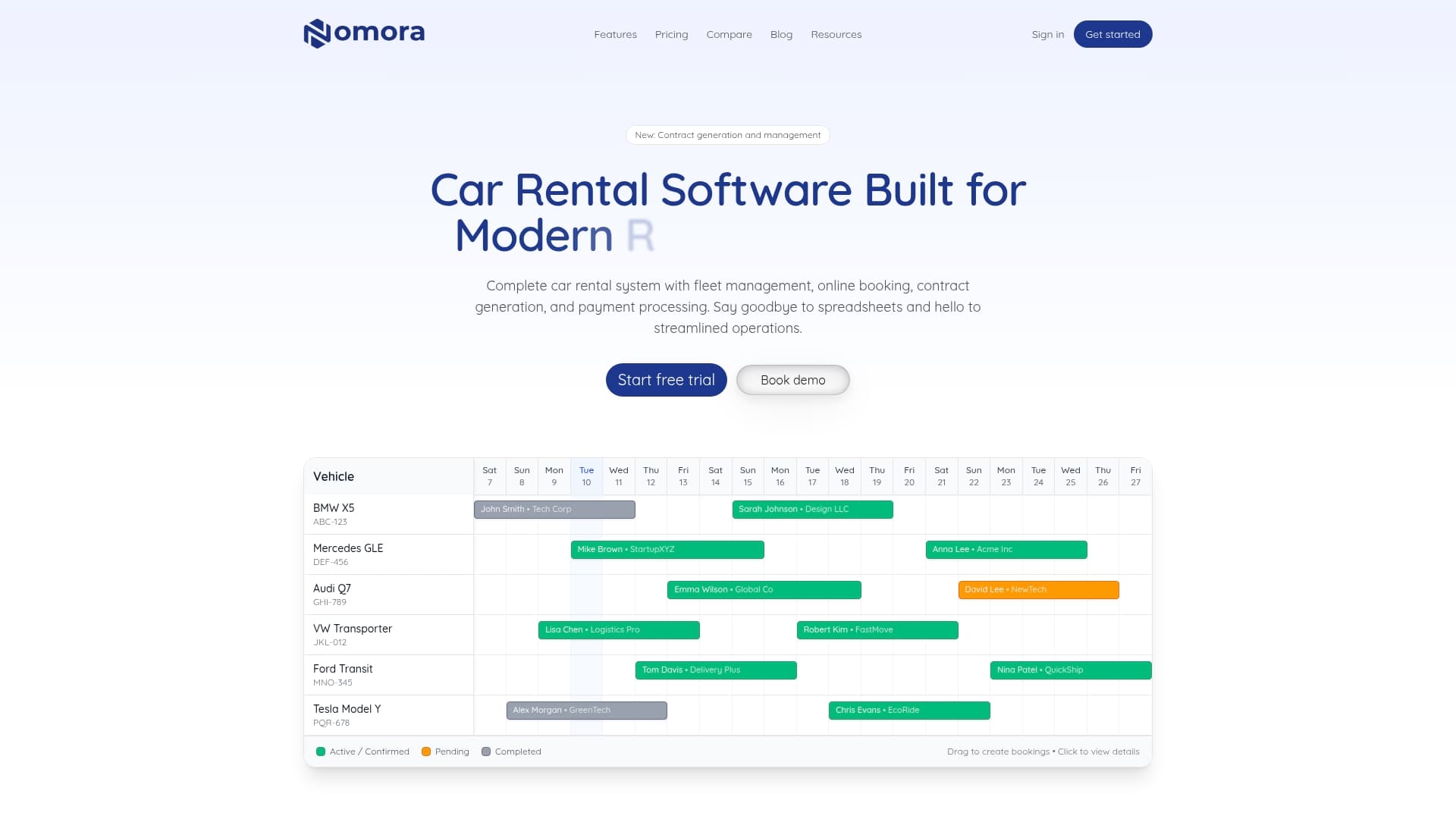
Fleet management software integrates contract terms with vehicle tracking, maintenance scheduling, and booking management. When a customer approaches their return deadline, the system sends automated reminders and offers one-click extensions through a mobile app. This prevents accidental violations while creating documented approval trails.
Various use cases demonstrate how rental businesses apply these tools. Corporate fleet managers use custom agreement templates with negotiated terms, while small independent operators benefit from standard agreements that update automatically when regulations change. The platform adapts to your specific business model rather than forcing you into a one-size-fits-all approach.
Frequently asked questions
What are the must-have components in a car rental agreement?
Your agreement must identify all parties, specify the rental period, describe the vehicle, outline payment terms, and define both parties' obligations. Include clauses covering insurance requirements, prohibited uses, damage liability, and return conditions. Missing any of these elements can render your contract unenforceable when you need legal protection.
How can rental companies handle fees like diminished value and loss of use?
Clearly define each fee type in your agreement with specific calculation methods. Hertz faced customer backlash demanding $842 for diminished value after insurance covered repairs. Provide documentation showing the vehicle's reduced resale value or actual lost rental income to justify charges. Transparency prevents disputes and improves collection rates.
What common mistakes lead to customers being banned from renting cars?
Violating rental contract terms is the primary cause for do not rent list placement. Extending contracts without notifying the agency ranks among the most common violations. Other triggers include failing to return vehicles on time, allowing unauthorized drivers, and aggressive behavior toward staff. Clear communication about expectations reduces accidental violations.
How often should rental agreements be reviewed and updated?
Review agreements at least annually to reflect changes in laws, insurance policies, and vehicle technology. Major operational changes like adding electric vehicles or expanding to new states require immediate review. Always consult legal experts before finalizing updates to ensure continued enforceability across all jurisdictions where you operate.
Recommended
Article generated by BabyLoveGrowth